USBE Data Analysis for K-3 Reading Assessment Program
Introduction
mCLASS Assessment: Acadience™ Reading
How it works: Quickly identify the needs of each student and inform next steps with instant analysis, reports, and instructional planning tools included in the only licensed mobile version of the research-based Acadience Reading assessment.
- Use short, 1-minute fluency measures for foundational reading skills.
- Replace manual calculations with instant results and recommended activities.
- Compare student progress with predictive, research-based benchmark goals.
- Track progress and target instruction to individual student needs.
- Support decision-making at every level using aggregate reports.
- Translate class- and student-level reports into individualized instruction using the Now What?Tools.
- Get a more complete view of early literacy skills with the new mCLASS:Early Literacy Measures (ELM).
Enrollment for mClass
Please review the Utah Enrollment for mCLASS document for important information about the rostering process for LEAs in Utah.
Benchmark Windows
The USBE has required that each Acadience Reading testing benchmark window occur within the below dates:
BOY — the first benchmark before October 14
MOY — the second benchmark between December 1 and February 5
EOY — the third benchmark between the middle of April and June 15
Benchmark windows for LEAs are set to the state benchmark window dates in mCLASS. Each LEA is to have 2-4 week benchmark period that is within the state benchmark window dates and LEA leaders are to share those dates with staff. The benchmark windows in mCLASS are set to the state benchmark window dates; not the LEA benchmark window dates and this can not be changed in mCLASS. If a student moves into your LEA and your benchmark window is closed, but the state benchmark period is still open, the student must be benchmarked. Should your LEA need an extension of a benchmark window beyond the close of the state benchmark windows, that must be approved by the USBE Assessment Department. Once the benchmark window closes, do not give the benchmark to a student, instead, educators can progress monitor the student on the measures they would have received a benchmark in order to get the students current instructional levels.
If you have questions regarding your current benchmark window dates, feel free to reach out to Amplify Customer Services at help@amplify.com.
Acadience Reading Benchmark Invalidations
Before you invalidate a benchmark probe, review the USBE’s list of acceptable reasons for invalidating on the Frequently Asked Questions: Acadience Reading Invalidations document. If a district/charter has a significant percentage of invalidations, contact and further action will be deployed. If you believe an invalidation is required, please contact your District/Charter Literacy Director. If they need support, they can contact Sara Wiebke, sara.wiebke@schools.utah.gov, to request an invalidation.
Progress Monitoring
The impact of progress monitoring
Progress monitoring is the most powerful tool we offer with regards to student achievement.
“Scores for Daze increase more slowly than they do for other Acadience Reading measures, so more frequent monitoring may not be as informative. For students who need to be monitored on Daze, we recommend monitoring once per month.”
Progress Monitoring with Acadience Reading
© Acadience Learning
October 2012
The Acadience Reading authors recommend progress monitoring students in the Well Below Benchmark category once every 7-10 days (and once every 10-12 days for students in the Below Benchmark category).
Progress monitoring is the practice of testing students briefly but frequently on the skill areas in which they are receiving instruction, to ensure that they are making adequate progress. When students are identified as at risk for reading difficulties, they can receive progress monitoring testing more frequently to ensure that the instruction they are receiving is helping them make progress. (Acadience Learning/October 2012, Progress Monitoring Guide)
The purposes of progress monitoring are:
- to provide ongoing feedback about the effectiveness of instruction,
- to determine students’ progress toward important and meaningful goals, and
- to make timely decisions about changes to instruction so that students will meet those goals.
How to progress monitor?
- Select students for progress monitoring
- Select Acadience Reading materials for progress monitoring
- Set progress monitoring goals
- Determine the frequency of progress monitoring
- Conduct progress monitoring assessment
- Access data through class and student reports
- Evaluate progress and modify instruction.
The key to progress monitoring: Instruction should link to progress monitoring and progress monitoring should link to instruction. They should run parallel and merge as one to confirm student growth in reading.
Check your progress monitoring fidelity report in mCLASS to ensure you are on track with these students. For more information regarding progress monitoring guidelines, visit the official progress monitoring guidelines.
Support Team
Amplify Customer Services
(800) 823-1969
Monday to Friday, 5 a.m. to 5 p.m. MT
help@amplify.com
Educational Support Team
Pedagogical Questions
(800) 823-1969
Monday to Friday, 5 a.m. to 5 p.m. MT
edsupport@amplify.com
For more information, please contact:
Sarah McCarty
Associate Director, Educational Partnership
(812) 593-5776
smccarty@amplify.com
Donna Bright
Educational Partnership Manager
(303) 960-3772
dbright@amplify.com
Robert McCarty
Regional Director of Educational Partnership
(435) 655-1731
rmccarty@amplify.com
Cydnee Carter
Assessment Development Coordinator
(801) 538-7654
cydnee.carter@schools.utah.gov
Liz Williams
Elementary ELA Assessment Specialist
(801) 538-7542
Liz.williams@schools.utah.gov
Sara Wiebke
Literacy Coordinator
(801) 538-7935
sara.wiebke@schools.utah.gov
Krista Hotelling
K-3 Literacy Specialist
(801) 538-7794
krista.hotelling@schools.utah.gov
Christine Elegante
K-3 Literacy Specialist
(801) 538-7551
christine.elegante@schools.utah.gov
Julie Clark
K-3 Literacy Specialist
801-499-2515
julie.clark@schools.utah.gov
Melissa Preziosi
Assessment Data Specialist
(801) 538-7949
melissa.preziosi@schools.utah.gov
Resources
Helpful tips and guides
- Implementation Roadmap Every school system has different objectives and needs, and this document is designed to help you define how the mCLASS system can best support you in achieving your goals.
- Checklist Use this checklist to ensure your staff is trained and your programmatic expectations are clearly communicated to all stakeholders. Completing each of these steps during the correlated benchmark window will help you realize the full value of your mCLASS assessment program.
- mCLASS: Online Help
- Acadience Reading Assessment Manual (Note: You will need to register as a user to get access to the materials; both registration and materials are available at no cost.)
- Acadience Reading Benchmark Goals and Composite Score
- Grouping Worksheets for Acadience Reading
- Acadience Reading Key Skills This document correlates the Acadience Reading measures to Basic Early Literacy Skills.
- The Big Ideas in Early Reading This document is a reference of the five Big Ideas in Early Reading.
- Acadience Reading Reminders A list of reminders the teacher can give to students while assessing Acadience Reading.
- USBE Literacy Framework
- Utah School Report Card: Early Literacy
- Utah State Board of Education Reading on Grade Level Targets for Acadience Reading K-6
- Five leadership practices that drive success in K-2 literacy
mCLASS:Acadience Reading tutorials
- mCLASS:Acadience Reading Next Scoring Practice
- mCLASS Now What? Tools Tutorial
- Pathways of Progress: Purpose
- ?Pathways of Progress: Setting Meaningful Goals
- Pathways of Progress: Highly Skilled Learners Criteria
- ?Goal Setting in mCLASS
- mCLASS How to calculate student pathways video
- Calculating Pathways from DYD Presentation
Technical resources
Amplify Enrollment This guide walks you through the necessary steps to complete enrollment using the manual enrollment tools on Amplify Home. It shows you how to manage staff, student, and class assignment information, and maintain the accuracy of your staff, student, and class assignments.
Devices & Requirements Ensure mCLASS is compatible with your devices and systems for optimal performance and support.
Remote Assessing
Videos:
Remote Assessment Guidance from the Acadience Team:
mCLASS®: Acadience® Reading (formerly known as DIBELS Next)
Key Points:
Before you assess:
1. Determine how you will show student materials and score in mCLASS at the same time.
| Description | |
|
Description Recommended set up |
|
| Modified set up |
Note: mCLASS app is optimized for touchscreen; scoring with a mouse may need more practice. |
2. Familiarize yourself with the digital copies of student materials.
3. Schedule virtual meetings with students. To communicate with English-speaking caregivers, consider sending this email or video. To communicate with Spanish-speaking caregivers, consider sending this email or video.
4. Determine how you will handle scenarios where there’s a lag:
| Description | |
| Record the meeting |
|
| Use a phone |
|
While you assess:
1. Take the opportunity to connect individually with your students as they experience so much change. Don’t make the session solely about testing, and remind caregivers and students that the assessment is a way to see how you can best tailor instruction.
2. Make student materials visible to your student.
For Maze, choose the model that works best for you:
Enter results into the mCLASS web reports
- Students complete online Maze during a video conference
- Put a link to the student assessment site (mclass.amplify.com/student) and the student’s credentials into the chat box (learn how to generate student credentials in this video)
- Ask your student to complete Maze.
- Students complete online Maze outside of a video conference (caregiver support is needed with log-in)
- Students complete Maze on paper
- Locate the benchmark Maze Acadience Learning’s site.
- Print a copy of the form you need (e.g. BOY) for each student in your class.
- Send the form home in a sealed envelope with students, mail the form to caregivers, or have caregivers get forms via school-based pick-up. Provide instructions not to open the envelope until the student is ready to take the assessment.
- Provide parents with instructions on how to proctor the assessment for their child. They need to:
- Give the form to their child
- Sit with their child and read the instructions and practice items
- Tell their child to stop when 3 minutes has elapsed
- Send screenshots of their child’s work via email or text, or return the completed form to the school in a sealed envelope provided by the school.
| Guidance | |
| Acadience:Reading |
Use the share screen feature to display student materials on your screen. Optional next step for measures that have student materials: Zoom users: grant your student control of your screen so you can see their cursor as they read:
Note: For Mac OSX, you will need to give Zoom access in the Accessibility tab in the Privacy and Security preferences of your Mac. For more information on giving Zoom access in Security and Privacy, click here. |
3. Score in mCLASS.
| Benchmark | Progress monitoring | |
| Acadience Reading (formerly known as DIBELS Next) | Available for free download on the Acadience Learning website | |
Utah – USBE Data Analysis for K-3 Reading Assessment Program – New
Collaborative learning strategies in math

Why is collaborative learning important?
Just ask this third grader: “It is important to work together, because when you work together you can get smarter by other people’s ideas.”
That just about sums it up!
Let’s take a closer look at what math looks like in a collaborative classroom, why collaboration matters, and how teachers can build a culture of collaboration for their K–8 math students.
What is collaborative learning in mathematics education?
Kristin Gray, executive director of Amplify’s math suite, is a veteran math teacher. (The answer above came from one of her very astute third graders.) And according to her, collaboration in math is so much more than just kids chatting. Gray paints a picture of collaborative math learning in elementary math and beyond as kids who are:
- Grouped around a table, not isolated at separate desks.
- Engaging in animated conversation.
- Explaining their thinking and justifying their answers.
- Comparing their various approaches.
- Connecting math to their own lived experiences.
- Connecting their ideas to the ideas of others.
Taken together, collaboration supports connections—among experiences, math concepts, and others’ ideas and experiences.
Collaboration means making the time and space to take these widely varied things that each student brings uniquely to our math classroom and bring them out in a really safe and collaborative culture.
– Kristin Gray, executive director of Amplify’s math suite
Why is collaborative learning important in math?
Substantial research shows that collaborative learning promotes active learning, critical thinking, communication skills, social development, a positive learning environment, deeper understanding of concepts, and preparation for real-life situations.
Gray cites a few findings in particular:
- A 2014 NCTM study found that mathematical conversations and discourse among students—at all grade and ability levels—helps build a shared understanding of mathematical ideas.
- Hope A. Walter’s article “Beyond Turn and Talk: Creating discourse” (Teaching Children Mathematics, 2018) asserted that meaningful math discourse supports metacognition and teaches students how to discuss, debate, and reevaluate mathematical situations in a respectful manner .
- A 2018 NCTM study found that when students have the chance to analyze and compare each other’s approaches, any sense of hierarchy in the classroom is reduced and replaced with a classroom culture that values input from all students.
Hands-on math activities and more: Components of a collaborative classroom
What conditions best set up a math class for collaboration?
Above all, students need hands-on activities that truly engage—or, in Gray’s words, “tasks worth talking about.” Teachers should emphasize the importance of the process of getting to the answer, encouraging the sharing of “rough draft ideas” that students can develop together. Gray also recommends stopping the groups’ conversations before they’re done, so that they can reflect on what they’re doing rather than just report what they did.
Other resources:
Problem-based learning offers a powerful approach to collaborative learning in math. Our guide around making the shift to problem-based learning through Learning Labs will walk teachers through what problem-based learning is, why it’s critical to math instruction, and how to support the shift to this approach through Learning Labs. A tried-and-true STEM strategy that Gray has often used with teachers, Learning Labs break the typical mold of siloed professional development days by encouraging collaborative professional learning within the classroom!
Desmos Classroom activities let students share their thinking with each other. The teacher dashboard provides educators a window into this thinking in real time, as well as a powerful toolkit to turn those ideas into still more productive conversations and effective learning. Check out all the Featured Collections Desmos Classroom has to offer.
More to explore
Problem-based learning in Amplify Desmos Math
This program brings problem-based learning into the math classroom, with an approach proven to help students develop math reasoning and problem-solving skills—not to mention deep understanding, fluency, and comfort with all things math.
Let’s take a closer look at problem-based learning in math, and at the contours of this exciting curriculum.
How problem-based learning helps math students—and math teachers
When you learned math, you likely started out learning arithmetic then moved on to solving word problems. You might have learned formulas, then practiced using them to determine the volume of a prism or which train will arrive at what time.
But life works differently. Sometimes we tackle the problem first, not the formula. When you get a new piece of technology—a phone, a TV, a computer—you might read the user guide, or you might just turn it on and try some things.
If that second style sounds like you, that’s common—and it’s an example of learning through problem-solving.
“It’s something we naturally do,” says Kristin Gray, executive director of Amplify’s math suite. “We’ve had a phone before, so we would pick up this new phone and try doing things that we know worked before, and then we would experiment. Does it work the same on this phone? This bouncing between experience and explanation is the foundation of how we learn through problem-solving.”
What does that look like in the math classroom?
Students tackling interesting problems, raising questions about the math required, receiving an explanation, and applying it back to the problem—just as in the example of new technology.
“When we show students how to get the answer, we send the message that math is solely about answer-getting and learning processes. Answers are important, but we want to use problems to teach the math, not just teach students to get the answer,” says Gray.
Learning through problem-solving can also engage more learners in math, says Gray. By influencing the way students (and teachers) think about what it means to know and do math, problem-based learning has the potential to shift the way they think of themselves as mathematicians.
“Students are naturally curious and like solving challenges and trying things in new ways, so that’s a great start,” says Gray.
And understanding is motivating. It inspires perseverance and confidence. It supports making connections, not learning concepts in isolation.
When students are given a new problem and are able to use prior knowledge to help solve it, that “promotes the development of autonomous learners,” says Gray.
Supporting the brilliance of student thinking
Our program combines interactive problem-based lessons with explicit instruction, reinforcement, and practice. Lessons build a strong foundation in procedural and fact fluency, deepen understanding of concepts, and enable students to apply learning to real-world tasks.
To learn more about how and why it all came together, watch the following video featuring Amplify Director of Project Management Christina Lee, Amplify Math advisor and Desmos user Fawn Nguyen, and Desmos Director of Research Dan Meyer.
Christina: Hi, I’m Christina, the product manager at Amplify working on our K–12 math program. As you may have heard by now, Desmos Classroom is joining Amplify. This includes all of teacher.desmos.com, including all of the free activities, the free activity builder, and the Desmos math curriculum. I have Fawn Nguyen and Dan Meyer here to answer a few questions about what’s going on. Thank you both for joining!
The first question is to you, Dan. One thing every Desmos user is going to want to know is, will the Desmos calculators and activities on teacher.desmos.com stay free to use forever?
Dan: Yes, period. It’s an important question and an easy one to answer. Our commitment to users, from day one, has been [to] whatever you can use for free. Now we’re not going to make you pay for that. We know how hard it is as a teacher to build your practice on top of software that could disappear, and Amplify shares that commitment in a rock-solid way.
Christina: That’s great to hear! Fawn, can you tell us a little bit about what you love about teacher.desmos.com? Why should a teacher who’s never used [it] check it out?
Fawn: How do I love teacher teacher.desmos.com? Let me count the ways! There’s nothing like it out there that allows teachers to build lessons from scratch. What makes it unique? Well, there are lots of things that are unique about Desmos, but the screen-by-screen build is a standout for me. It allows me to interact with students prior to moving to the next screen. More importantly, the interaction among the students and the teacher dashboard is just brilliant. It lets me see the students’ responses, especially the graphical ones, in real time. I feel like it’s a built-in formative assessment [in] the lesson. And not surprisingly, the structures from the five math practices by Peg Smith are built-in there with the selecting, sequencing, and connecting.
Christina: Dan, why does it make sense for Amplify and Desmos to build one core math program for grades 6–12?
Dan: We’ve been traveling on separate parallel paths for a really long time and it makes a lot of sense for us to go farther together. For instance, we’ve both been building a core curriculum based on the Illustrative Mathematics curriculum. We have both been doing that using core Desmos technology. We both share an understanding of the complexity of teaching, the brilliance of student thinking, and so it makes sense for us to merge together. Desmos brings to the table a deep understanding of how technology can support student learning, and Amplify brings to the table an understanding of how systems support students at scale. So we bring a lot of commonalities and a lot of elements that both of us need from the other.

Christina: Fawn, you’ve been an advisor on the Amplify Math curriculum focused on problem-solving. In what ways do you think this knitting together of the two programs will help make teaching through problem-solving easier for teachers?
Fawn: I actually knit, Christina! So I really like your description of the partnership as knitting together the two programs. It’s like taking two luxurious fibers, if I may say––ironically, luxurious but free, which describes literally nothing except Desmos––and weaving them together to create a gorgeous and functional design. I’m thinking about a sweater vest for Dan, he would look great in it! Amplify truly understands what problem-solving is, that it’s non-routine. And Amplify’s math curriculum has many great activities. However, when this task can only live on a printed page it’s hard for it to stay as a problem-solving task. What I mean is that it’s hard for students to unsee things. So when it’s on paper, you have to show all the cards and that ruins everything to me, frankly. But with Desmos again, with that screen-by-screen build and the pause and pace functions, they are designed so that the timing of teacher moves can happen. I think the timing is really important. And then problem-solving is about tinkering with ideas and testing conjectures, and Desmos is built for such. It invites you to play, it invites you to take risks, and it doesn’t shame you when you make a mistake. So ultimately, Desmos brings school mathematics, which Amplify writes, closer to what doing mathematics looks like.
Christina: Dan, one final question for you. What’s going to happen to the Desmos calculators now?
Dan: The Desmos calculators, like all the other technology as part of this deal, will remain free into perpetuity. They’ll get spun over into a new corporation, a public benefit corporation called Desmos Studio, where they’ll have a lot more focus from the people who work on it and a lot more resources to expand and develop and do that work.
Christina: Thank you, Dan. Thank you, Fawn. Thank you both. I’m really excited about this opportunity we have to build something special for teachers and students! For more information about Amplify Math and Desmos Classroom, and everything else we’ve got going on, please visit amplify.com/futureofmath.
From math lesson planning to long-term success
Amplify Desmos Math makes it easy for both teachers and students to make the shift to a problem-based approach by providing captivating activities, powerful teacher-facilitation tools, and lots of support for differentiation and practice.
Lessons start with warm-ups that tap into prior knowledge and move into problems that require collaboration to solve. Teachers monitor, engage, and ultimately synthesize student work into the main idea. There are also ample opportunities for practice and reflection.
Amplify Desmos Math will be available for 2025–26 school year implementation. Interested districts can pilot the beta release starting fall 2024.
Learn more about Amplify Desmos Math.
S1-09: Supporting K–8 science students in the digital world: Ricky Mason

In this episode, Eric sits down with Ricky Mason, chief executive officer of BrainSTEM. Ricky shares his passion for inspiring students into science careers, and his path from an engineering career with organizations like the Department of Defense, National Aeronautics and Space Administration, and the Central Intelligence Agency to starting BrainSTEM, an education program that develops creative digital tools to enable all teachers and students to dive deeper into STEM content. Ricky and Eric talk about representation in science classrooms and the importance of embedding fun within K–8 science content! Explore more from Science Connections by visiting our main page.
Ricky Mason (00:00):
I feel like comfort is where dreams go to die. And I’m still dreaming every night. So I’ll wake up, chasing them.
Eric Cross (00:08):
Welcome to Science Connections. I’m your host, Eric Cross. My guest today is Ricky Mason. Ricky is an engineer whose career included lead roles at the Department of Defense, NASA, and the CIA. Ricky transitioned to education as an adjunct faculty at the University of Kentucky. And while there, he founded BrainSTEM, an edtech company that developed a 3D virtual reality metaverse for STEM education. Today, BrainSTEM serves public school districts, private schools, and nonprofits. And in this episode, we discuss what led Ricky to creating BrainSTEM Metaversity, and how he’s using the metaverse to transform STEM learning for students. And now please enjoy my conversation with Ricky Mason. How did you, so like maybe going back doing your origin story, maybe you can talk about it, but brother, you don’t sleep. Talk about keep making moves, your hashtag, I mean, I was looking at your LinkedIn profiles, looking at your details. You get after it. I was getting tired just reading it. I was like John Hopkins, electrical engineering, real estate, starting companies. You must have that gene where it’s like four hours of sleep and then you’re like, ready to go.
Ricky Mason (01:19):
Yeah, man. My mom told me if I didn’t stay busy, then I’m in trouble. So when I was about 14, she told me that. I said, well, Mama, I guess I’m gonna stay busy then. And yeah, man, that’s just been my life. I feel like if I don’t keep making moves, then I’m in trouble. So, feel like comfort is where dreams go to die and I’m still dreaming every night. So I’ll wake up chasing them.
Eric Cross (01:44):
I feel like a kindred spirit with you. So, were you always interested in STEM like, was there something like a moment or a year where you remember you were like, this is my jam. This is what I’m gonna get into.
Ricky Mason (01:57):
Yeah, man. When it really clicked for me was in the fifth grade. I was at a school assembly and an IBM engineer came in and he brought a robot and he programmed it with punch cards right on the stage. And I got the opportunity to come up andyou know, put one of the punch cards in the robot to program it. And I asked him, I’m like, what is your job? He said, I’m a robotics engineer. And I went home right after that assembly and I said, Mom, that’s what I wanna do, become a robotics engineer. And my mom would take me to the libraries. Well, I felt like I was getting outta bible study on Wednesdays by going to the library. So I went there and I started researching robots.
Ricky Mason (02:39):
And at the time the robots that were popular were all being sent to space. And it was the spiritless. It was being sent to Mars. And I said, Mom, well, I guess I gotta become an astronaut if I’m gonna be a robotics engineer. And that’s kind of what set me out on that dream. And my mom started trying to find outlets for me to get involved in STEM, but it was really tough to find those outlets, you know, especially in that fifth to eighth grade range here in Kentucky. So that was kind of where it started for me man, when I knew that yeah, engineering is what I wanna do.
Eric Cross (03:14):
What does an electrical engineer do? I imagine there’s different types of specialties, but like, was there something that you specialize in that you focused on or was it, is it just kind of like a generalist field?
Ricky Mason (03:23):
Yeah, so I would say, yeah, man, it’s a huge field. So you could be doing anything from, you know, power, like power coming into your house. So those large power systems all the way down to nanotechnology and microchips. I like to tell people I’m a real full stack engineer, so my wheelhouse is kind of from the PCD, the little green computer chips, all the way to the cloud. Over my career, I’ve had some pretty cool jobs. One of those things was I was a test engineer for the army. So I got to test weapons up at Aberdeen Proving Ground for the Army. So I got to drive those weapons and test them before they went to theater there. After that,I worked at United Launch Alliance down at Cape Canaveral where I launched five rockets.
Ricky Mason (04:07):
So I was a part of the electrical ground systems team there where we were responsible for all of the electrical systems on the rocket while it was on the pad. Somonitoring the temperature of the rocket, the fuel, the entire system for safety while it was on that pad. And then finally I worked at the CIA as a computer engineer building data centers and as a data center architect for some of our remote systems and virtualizing our systems. So kind of had a broad spectrum of things there. And then finally coming back to the University of Kentucky as a research engineer and faculty. I developed drone technology for monitoring crops. So flying drones over crops with LIDAR, just like self-driving cars with high-definition cameras to pull in data about those crops, to help farmers determine about pesticides fertilizers, and the overall health of their crops from a remote location.
Eric Cross (05:10):
It’s so neat to hear you talk about it and to see how this is all built up to what you do now with BrainSTEM. How would you explain what BrainSTEM is? I know that’s your, that’s kind of your baby right now and what you’ve been working on a few years.
Ricky Mason (05:23):
Yeah, man, we started BrainSTEM in 2019 officially, but I would say BrainSTEM has been almost 10 years in coming. While I was in undergrad, I played football at the University of Kentucky. But I got hurt going into my sophomore year and that kind of shattered my dreams of football. And that’s when I really got back into engineering. One of my professors asked me to come to a robotics competition and I saw these third graders and sixth graders programming robots. And I’m like, oh my God, they’re programming robots! And I had no idea how to code or what to do with these things. And where was this a when I was a kid? And so I immediately bought one of those robots and taught myself how to program it <laugh> and then we started a robotics team in Lexington,there at a church.
Ricky Mason (06:10):
And we got a sponsorship from Lexmark to start that team. And that was kind of my first leap into STEM and teaching STEM and creating programs for students in STEM. I did that in undergrad and like I said, fast forward 10 years later, I’m teaching at the University of Kentucky and we’re struggling to recruit STEM students. Why aren’t students going into STEM? I hear too many adults tell me, oh man, I wish I would’ve done engineering, or I started out in engineering, but I left engineering or I wish I could go back to school for engineering or learn to code. And I’m like, I asked them like, why didn’t you do this? What happened? And often it’s like, it was the math. It was, oh, I didn’t get into it until I was in college. And I’m like, well, that’s the key.
Ricky Mason (06:52):
I knew I wanted to do this in the fifth grade. And I started with a plan in the fifth grade to achieve these goals and dreams. And I started doing that research and realizing that the same problem existed that I had. There was no outlet for kids to get involved in STEM, and so many kids have an affinity for STEM an early age. So we started BrainSTEM to provide access to STEM education and exposure STEM careers, STEM professionals, and just to STEM fields as a whole, because too often kids may know about the term, engineer, or the term, scientists, but they don’t really know what those people do or have a strong connection with the field or have any hands-on projects that they kind of done around those things or met anyone like me.
Ricky Mason (07:42):
I didn’t meet an engineer until I was in college. So that has really been impactful for some of the students that we’ve been able to touch. I had a family reach out to me. They moved to Lexington from California and they were like, man, I really want my ninth-grade son to get involved in engineering. So we started a weekend program with that one student and it went amazing. Like we competed in science fairs, we applied for different college programs and things like that. So it became an entire like mentorship program. And I’m proud to say that a year ago, he actually graduated with his bachelor’s in electrical engineering from your side of town, UCSB. It was just awesome to actually see this come full circle. And that’s kind of one of the first things that we did before we actually formalized as BrainSTEM University.
Eric Cross (08:34):
What will be like your elevator pitch for a teacher? If you were gonna say, this is what BrainSTEM does. I have the luxury of going through it on the site, but since we’re on a podcast, how would you kind of pitch it to people letting them know, like what, what does it do? Who does it serve?
Ricky Mason (08:47):
Yeah. So BrainSTEM provides STEM curriculum and STEM magnets for schools and nonprofits looking to increase access to STEM for K through 12 students. We also have launched our BrainSTEM Metaversity, a metaverse product for teachers to take their 2D Google classroom and convert it into a 3D metaverse classroom where students can collaborate during a 3D class. So all of your students show up as their avatars that they can select from our inventory of 150 avatars, and enjoy class in a 3D gameified Minecraft like World.
Eric Cross (09:26):
So I made my avatar by the way. It’s kind of tight, I have to say, it’s kind of tight. Hey, I’m gonna share. So those of you in the podcasts I’ll share it so you can see it. You’re not gonna be able to see it right now, but since I have the man himself I gotta share it with him just so I can get a reaction. So can you see that?
Ricky Mason (09:43):
Yeah. <laugh> That’s so good.
Eric Cross (09:44):
I feel like I wanna look like him though. I want him in real life. Like I want be able to switch to looking like my avatar
Ricky Mason (09:52):
<Laugh>
Eric Cross (09:54):
That was the first thing that I jumped on, when I went on your site, was making the avatar and I had so much fun doing it. I actually took longer than I probably wanna admit cause I was like customizing everything
Ricky Mason (10:03):
Yeah, man. It’s so fun. And that’s exactly what, you know, when you can show up as the person you want, it changes your whole being. I’ve seen kids that are quiet in class. They show up as their avatar and they’re talkative, they’re asking questions, they’re moving around the room, interacting with other kids. I feel like it’s almost like a superpower just to put your avatar on.
Eric Cross (10:25):
So what is something that a teacher could have their students go and learn or do if they, if they signed up,
Ricky Mason (10:31):
Let’s kick it off. So how we started with the metaverses, was teaching coding. So our first class was Minecraft and Python coding in the metaverse. So students showed up in the metaverse with our virtual instructor, that instructor led a lecture in the metaverse and then those students could collaborate on their Python games. So, they created and built the game in Python. We shared those games in the metaverse and we have our leaderboards that are in the metaverse, as they’re completing these challenges, including these games, then sharing them back in the metaverse with other students and getting that feedback on their game. So we’ve seen huge excitement from students when I can come back in and see my friend’s work. Like too often, students don’t get to see their work and that’s motivation to do better when I’m like, Jim’s gonna see my work. It’s amazing to see that motivation when students are sharing their work with other kids and not just their parent or just them and the teacher or seeing their grades. It’s been really cool to see.
Eric Cross (11:33):
You have that genuine audience too. Like that real-time feedback. And then like an authentic audience for students that makes everything seem, it takes it up a notch.
Ricky Mason (11:42):
Yeah, man. And then as we have built on this platform, so like you said with that avatar, so think if you created a really cool looking avatar and other students wanted to be that avatar, we have a way of sharing that avatar back into the world and in the inventory so that other students could then be your avatar. Or, if you create a world, we could then share that world back into the inventory, so the teacher could have class in a world that you created.
Eric Cross (12:07):
They’re creating content, not just consuming it. They’re actually creating content that could be shared across like grade levels or students.
Ricky Mason (12:14):
Well, we’re gonna say right now it’s just within your classroom. Eventually yes, we want students to be able to share that across school districts. At least we think that data will be probably limited to those kinds of realms as far as schools go. But you’ll be able to share this across sixth grade. We’ll be able to see what everyone in the sixth grade is doing in their STEM class or their game development class or their history class, per se, even if they’re giving back a presentation or what we have here in JCPS is backpack skills of success, where students are presenting on things that they’re learning that relate back to core competencies that the district is focused on. And I think that sharing those in the metaverse and doing those in the 3D world will be an awesome experience for students.
Eric Cross (12:56):
Are you seeing anything else as far as those skills that we see that are needed in coding? Is there something that the VR adds that was distinct from maybe just a kid with a Chromebook in his class that it’s just him in isolation doing the coding? Was there any like aha moments or surprises when they’re in the VR world doing this?
Ricky Mason (13:13):
I think the biggest thing is we could actually show them real examples of code working in other ways. Sofor example, if we’re working through loops, we can show them something looping. We can relate these functions to real-world things happening in the VR world so that they can see and better relate the actual concept with visuals, if that makes sense. So, you’re in loop Allen the whole time you’re learning about loops. You’re immersed in that kind of world. What we’ve seen is students really start to, you know, they it pick up and it clicks a lot faster because some of these concepts are so abstract for students to understand, when we can relate them to things in that world that they see that are in front of them, that they can grasp before we go to okay, type in “while” “”parentheses” <laugh> they can thenrelate that and pick up on those clues a lot better after they’ve seen those things in the world.
Eric Cross (14:09):
So they can actually visualize it in the metaverse. Whereas outside of it, it’s more just, just text-based coding and they’re not isolated. Like the first thing I’m thinking about is how like, with my own students, when they’re learning Sratch or Python, it’s not easy to share back and forth because they all are on individual accounts and they’d have to go on a different computer, or we’d have to find some way to publish it. And then all the kids would have to access it. But it sounds like in the metaversity classrooms, it’s easy for students in that same class to see each other’s work. Am I getting that right?
Ricky Mason (14:37):
Yeah. So most of our classrooms are limited to 24 students and in some of our breakout classrooms, we limit them to about eight students. Everybody can share their screen, so students can share their screen in the metaverse. They can share their video in the metaverse. They can share documents in the metaverse. They can share their, like I said, their code or anything that they want to share with other students. They can kind of do that. So it’s been a really cool product, I think, for students to almost find independence to work within a group, in an online setting. As they’ve been working through these problems online and remote it’s been really cool to see how they use the metaverse and break out. Even in a class, they can go off into a section because it’s all spacial. If you walk away, I can’t hear your conversation. So they can go into a little section within a metaverse class and have their own breakout. And a teacher can walk over to them. Okay. You guys are working over here. Let me walk to my next group. Just like in class. So it’s been really cool to see those students use the metaverse like that.
Eric Cross (15:41):
Just listening to you talk about this. One of the exciting things about emerging technologies or taking what the private sector does, and someone with a mind like yourself, and go, how do I use this for education? Like, that’s something that like excites me and you’ve run with it. But I just thought about, you’re doing an hour of code, you’ve created this metaverse, and you can bring in somebody, a professional into the metaverse, but they’re in, you know, the Bay area, but they could be a software engineer for Tesla or Google or anybody. Could they move around the metaverse and take a look at different students’ work and interact in that way.
Ricky Mason (16:17):
Yeah, man, we get in there. We make metaverse selfies. I drop Lambos in the metaverse, we take picture with Lambos. We have scavenger hunts in the metaverse. It’s a really awesome experience. And that’s one of the big things I think that is so powerful, is like you said, we could have that engineer, that celebrity, we could have Travis Scott, you know, in the world meeting thousands of kids motivating them because they met their STEM goals. They met their, you know, their testing school goals or whatever. These are things that kids really care about. If I get the Travis Scott avatar or the Elon Musk avatar, because I completed the Elon Musk rocket challenge, like that’s huge for me to show up in class as that avatar, like it’s just like Fortnite and it’s bringing all of those mechanics into the classroom.
Eric Cross (17:07):
When I hear you talk about the metaverse and I hear you talk about the potential of where you want to go with it, I think about my own students, and I think about, how they would really have a genuine interest and desire to want to do this and probably be doing it when they don’t have to, like at home at night wanting to go back into it and interact. And, you’re also building this virtual community. I mean, are you seeing that like, cause I’m hearing that?
Ricky Mason (17:28):
Yeah, man, building that community is huge. And I often tell people all the time, I want the STEM community to be just like the basketball community, the football community. I want students to have that camaraderie built around them for learning STEM and participating in STEM activities and competitions. Because when you see students out there at a robotics, they have the same zeal, the same, you know, everything that you find at a football competition. So we just have to get behind them and back those events with the same enthusiasm that we back sports. And that’s the environment that I want to create for STEM students and for that STEM community, because I longed for that community when I was in school. And like I said, I had it in football, but I wanted both. I wanted the best of both worlds. I wanted my robotics guys and my football guys to show up together here at the competition and have a good time.
Eric Cross (18:23):
You’re absolutely right. Like robotics STEM, these things, community helps fuel like people’s interest and working together. And it brings people from the outside who are seeking that community. Like, hey, my friends are doing this, I wanna kind of check it out. That’s how we recruit a wider swath of our population into it. So it’s not this kind of very narrow channel of folks who are going into STEM.
Ricky Mason (18:45):
If you can’t find that community. I mean for me, I felt like I was the only one playing football who was interested in robotics. So I never told anybody because I didn’t feel like that related to anybody within my vicinity. So I kept that to myself and that’s the biggest thing. I think if we get these kids just talking more about their interests, because a lot of them are interested in robotics and space and these STEM topics, but they don’t have anyone that’s really nudging them or asking them or piquing their interest in those spaces and saying, hey man, it’s okay to, you know, learn about robots. It’s okay to geek out on space. <Laugh> So that’s been my goal and that’s kind of why I felt like this was the time in my career for me to kind of do this, be a face for STEM education and inspire kids to chase their goals and dreams. Over my career, I’ve had some really cool jobs, but I felt like I could keep doing cool jobs, but I’m like at the right age to still connect with those students and inspire them to chase their dreams. And that’s why I feel like right now, man, it’s just an opportune time to get these students involved in STEM.
Eric Cross (20:01):
We don’t get that. Oftentimes, when we’re solely doing the cool job or simply in the private sector, we don’t get those experiences as much as we do when we’re able to actually serve our community or students or take our passion, our skill set, and use it to serve another person. I hear that like, as you describe what you’re doing now is like, there’s something beyond just, you know, the using your skills and doing cool stuff, but there’s something I hear. That’s helping people and actually doing something you believe in that resonates deeply in you. And I can hear it as you talk about it.
Ricky Mason (20:30):
It’s been just amazing to actually chart out that journey. Like I said, and like tell kids, like, no man, I’m from right up the block from you, cause I mean, I’m building this back at home in my hometown. And that’s the reason why I kind of came back to kind of do that in my hometown, because I really want to, you know, relate to those students and inspire, you know, students here. Nobody thinks about technology coming out of Kentucky and that’s been a gift and a curse, I guess, with launching BrainSTEM in Kentucky. When I first started, I said, we’re a STEM education company, people are asking me what is STEM? So, that was where we started out with this in 2019, all the way to, you know, hey, in 2020, we’re gonna launch a metaverse. A metaverse! What is that? It’s been amazing to try to change the minds of not only Kentuckians about STEM and the importance of STEM, but the world that a metaverse company is coming outta Kentucky. <Laugh>
Eric Cross (21:31):
The work that you’re doing and, it exists beyond you and you probably know this, but as a Black science educator out here in San Diego … We don’t see people who look like all of us in this work often, and I saw that you had created something, a network group, network and chill. And that was one of the things, we had touched on community, but I thought that that was so huge because we need each other.
Ricky Mason (21:55):
I feel like that was the biggest thing for us in engineering. Like I showed up to my first internship and I’m like, I mean, my boss was cool. Everything else was cool, but I just didn’t feel like, hey, this is a community for me. And I almost changed my major because of that. But I’m glad that I didn’t, it’s huge to have more of us represented in, in these spaces.
Eric Cross (22:16):
And you know, in engineering, especially when we look at the disproportionate, you know, men versus women. Like it’s not, you know, it’s not just culture, but it’s, you know, gender, all of these different things. And if we’re gonna change it, I think a program like yours that gets exposure to all kids and then giving them choice. What advice would you give to students? Or what advice I should say, do you give to students now? When you see like your younger self in the different kind of K12 grades who are thinking about their futures or they’re thinking about STEM, what do you say to them?
Ricky Mason (22:46):
So my biggest advice, man is start now. Whatever that big thing is, that big dream is that you have, what is that now? You’re thinking about planes. You’re thinking about robots. You’re thinking about RC cars, whatever that is. Let’s start now. Let’s get your hands on an RC car. Let’s take it apart. Let’s start coding. Let’s start thinking about those problems now. But the biggest thing is, is getting kids used to solving tough problems. Typically, most students that have an affinity for, you know, STEM — and you just know that that kid’s gonna go into, STEM — they’re problem solvers. They’re typically looking and seeking those tough problems and seeking opportunities to learn. That’s where I feel like it’s parents’ jobs to provide that environment to foster, that zeal. A five-year-old kid, we started our STEM program with them at the beginning of this month.
Ricky Mason (23:39):
The first day I came in after I told him I was a rocket scientist. And now he’s like, well, I wanna be a pilot. I said, if you pay attention to this class, we’re gonna get you started on your way to being a pilot. And he knows all the parts of a rocket and he knows a rocket needs an oxidizer. And he knows the fuselage, the wings, the wing flaps. He knows all the different parts of the plane and how the forces, the drag, the lift, the weight, he knows how those are working cause we talked about those in class and he has so much more confidence and it came all to fruition when a kid said, wow, I thought it was gonna be really hard to be a robotics engineer. And I’m like, no, that’s not gonna be that hard. That is exactly what we set out to do when we started BrainSTEM, was to break down those barriers and those walls and build that confidence and say, look man, you can do this. It’s easy.
Eric Cross (24:26):
Society doesn’t help much either because one of our terms, right, if something’s really hard, or if something’s not hard, we say it’s not rocket science. That implies that rocket science is really hard and inaccessible. If kids would hear that it kind of instills in their brain, okay. It’s really hard, it’s probably too hard for me. To that point to parents, it sounds like a lot of just exposure, like giving students the opportunity to be able to be exposed to these things and letting them create wonder from it.
Ricky Mason (24:51):
Yeah, man. I often tell parents we’re gonna set kids up to go pro no matter what,
Eric Cross (24:56):
And those skill sets transfer, whether they decide to go into coding or they decide to manage a bank, you’re still gonna be dealing with people. You’re still gonna be problem-solving. You’re still gonna have to come up with creative solutions to things. It sounds like through a program like this, they learn those skills early.
Ricky Mason (25:12):
Yes. And I think that one thing that parents don’t think about … We talk about all the STEM and we want smart kids, but we need those soft skills also within STEM. So those competitions, getting them involved in those communities with STEM students is really huge in presenting their ideas because oftentimes, you know, our STEM guys, we’re in a lab working and that’s where we love and that’s where we wanna be because we haven’t, you know, been prepared to talk and present our ideas. So I think that’s a huge part of what we have to teach our STEM students. And we do that by providing that community and those opportunities for them to, you know, do that.
Eric Cross (25:47):
Thinking about where you are now, looking back on your K-12 education, were there any teachers that stood out to you or that inspired you as I even just say that, can you think of a particular teacher or one or two?
Ricky Mason (26:00):
When I think about my teachers, my teachers really taught me to solve those tough problems and those subjects that you don’t kinda like <laugh>, cause I was always a great student, but my teachers helped me to focus on those subjects that I didn’t so much, you know, enjoy. So I enjoyed math and science, but English social studies, like why do I have to be here? I had two teachers during my high school career that really supported me in that regard, and helping me to be the best student all aroundfrom like I said, STEM to English and social studies, and making me realize that I have to be a well-rounded student if I’m gonna be truly successful. As far as engineering, man, I would say one guy, my teacher, Nick Bazar up at John Hopkins. During my master’s there, I had a really cool project. I got to do data forensics on a real live murder case. <Laugh> That was really inspiring because I’m like, wow, this is real life where my coding skills are being used in a jury trial <laugh>. And so that was a really cool experience to partner with my professor to kind of do that. I mean, that was just mind blowing that I got to help with that and that, I mean, he was using his programming skills to help solve a murder case.
Eric Cross (27:22):
What’s the best way for people to connect with you and follow your journey? And if a teacher’s interested and they’re listening to this and they’re hearing, okay, this metaverse coding thing sounds awesome, I want to get involved, I wanna know more, where can people go? What steps should they take to be able to get connected to you and what you’re doing?
Ricky Mason (27:40):
Yeah. So you can check us out at brainSTEMu.com, that’s brainSTEM, the letter “u” dot com and on all social medias, we’re BrainSTEMu or BrainSTEM University. Teachers, right now, we are doing our free course for teachers. So sign up at brainstemu.com. You can sign up for your class to get into a free metaverse experience, just so you can kind of check it out and get your class into the metaverse and see how your students like the metaverse, how you like teaching in the metaverse and convert one of your 2D lessons from Google classroom into a metaverse classroom. For me, I’m Ricky Mason, 5 0 2 on all social media platforms. So you can just type that in Ricky Mason502 and get with me there.
Eric Cross (28:28):
Nice. Well Ricky, I wanna thank you for sharing your story and creating BrainSTEM. And then for, I know you’re a man of tremendous talents and skills and accomplishments, and you’re focusing all that on not only being back in your community, but also creating something for younger versions of you and opening up opportunities that they might not otherwise have, as you said, folks are like, what is STEM? And that is exactly where we need those seeds planted. So thank you for doing that.
Ricky Mason (28:55):
Oh man, this is awesome. I appreciate you, man for hosting this podcast and providing this platform and sharing the message of, you know, educators and people in the space.
Eric Cross (29:07):
Thanks so much for joining me and Ricky today. Make sure to support Science Connections by subscribing wherever you listen to podcasts. And you could hear more from Ricky in our Facebook group, Science Connections the community, where you can check out all the exclusive content. Until next time.
Stay connected!
Join our community and get new episodes every other Tuesday!
We’ll also share new and exciting free resources for your classroom every month.


Meet the guest
Ricky Mason is the dynamic CEO and founder of BrainSTEM, an ed-tech company that developed a metaverse for education. His corporate career included lead engineer roles at the DoD, NASA, and CIA. Ricky transitioned to education as adjunct faculty at the University of Kentucky. While there, he started BrainSTEM to bring innovative technology and an inspirational curriculum to STEM education. Today, BrainSTEM serves public school districts, private schools, and nonprofits.
Follow Ricky on all social media @rickymason502

About Science Connections
Welcome to Science Connections! Science is changing before our eyes, now more than ever. So…how do we help kids figure that out? We will bring on educators, scientists, and more to discuss the importance of high-quality science instruction. In this episode, hear from our host Eric Cross about his work engaging students as a K-8 science teacher. Listen here!


School by Design (SxD) becomes an independent company dedicated to helping education leaders design the schools their kids and teachers need
SxD will be led by Andrew Joseph, a senior executive at Amazon Education and the co-founder of TenMarks Education, Inc., a personalized online math program. Vicki Phillips, the previous K-12 Director of Education – College Ready at the Bill and Melinda Gates Foundation, will join the SxD Board of Directors, along with David Stevenson, Executive Vice President of Amplify.
SxD brings a design thinking approach to education’s annual resource planning cycle—from district budgeting to master scheduling—so that it shifts from an administrative process to a strategy for instruction. Delivered through an online platform, analytic tools, and technical assistance, SxD services include:
- Specialized resource audits that give districts and schools a quick way to see how resource allocation and utilization are currently impacting instructional decisions related to teacher time, student time, equity, class size, and more.
- Scenario planning to uncover the different ways budgets and time could be used based on the school experience leaders and teachers want to provide students and the supports staff need. Examples include: looking at ways to manage class size within current budget while also finding more time for teacher professional development; and exploring school designs developed around student learning opportunities such as STEAM, problem-based learning, and community-based learning.
- Decision-making supports for districts and schools to make informed decisions about budgeting, scheduling, and school model options so that they support, not block, high quality teaching and learning experiences.
“School by Design is tackling one of the biggest challenges for districts and schools: making sure resources and policies support teachers and students,” explains Vicki Phillips. “The SxD services and supports are invaluable to schools because they help solve, within budget, the age-old ‘pain points’ that undermine good teaching—issues such as class size, time for teacher collaboration and professional learning, and scheduling for interdisciplinary learning and student field experiences.”
School by Design is built around the leading work of Marilyn Crawford on resource alignment, master scheduling, and professional development in service of innovative teaching and learning. Over the past few years, School by Design has worked with dozens of districts and CMOs across the country to find thousands of hours for teacher professional development and planning, while helping schools address the unique learning needs of their students within budget.
“School by Design helps you solve problems. Most people know what their issues are, but School by Design helps them know what to do about it,” states Steve Broome, director of state development for high school and middle grades at the Southern Regional Education Board (SREB). Working with education leaders, Steve and the team at SREB use the SxD audit and scenario planning to help schools turn their High Schools that Work principles—such as multiple pathways to college and careers—into reality.
The SxD spinoff enables Amplify to focus on its core offerings of digitally-enabled instruction, assessment, and professional development for K-5 reading and language arts and middle school ELA, math, and science. As Amplify’s and SxD’s services and products are distinct but complementary, the organizations expect to collaborate to serve districts and schools.
“I’m honored to be leading School by Design to the next level,” says Andrew Joseph. “We are uniquely positioned in this too-often ignored space where resources meet instruction. Our platform and services have helped a number of districts and schools solve their resource allocation and scheduling challenges and uncover the possibilities for their schools. We’re excited to now help other educators create the conditions in which teaching and learning can thrive.”
As an independent company, School by Design will be better able to respond to the evolving needs of educators and expand its suite of products and services. Through actionable analytics, virtual experiences, and new school models, SxD will further its position as the leader of education design thinking—helping school leaders leverage data, see all of the opportunities for engaging, high quality schooling within their resources, and make informed decisions for the types of schools their teachers, parents, and students want and deserve.
Contact: media@amplify.com
Amplify CKLA
S5-04. Coaching tips for managing math anxiety in teachers
So far this season, we’ve investigated math anxiety in students and its causes with passionate researchers and curriculum experts, including one from Sesame Workshop! Now we hear from Dr. Heidi Sabnani, consultant, coach, and co-host of Math 4 All, as she gives us research-based tips for teachers who are facing math anxiety themselves! Listen as we discuss Heidi’s own math anxiety and journey through math, the effects teacher math anxiety can have on instruction, and practices educators can implement right away for overcoming math anxiety.
Listen today and don’t forget to grab your MTL study guide to track your learning and make the most of this episode!
Dr. Heidi Sabnani (00:00):
Coaching is the opportunity to provide that just-in-time kind of professional development for teachers, if we go at it in a slightly different way.
Dan Meyer (00:10):
Hey folks, welcome back to Math Teacher Lounge. I’m your host, Dan Meyer.
Bethany Lockhart Johnson (00:14):
And I’m Bethany Lockhart Johnson.
Dan Meyer (00:16):
Bethany, how are you doing, and how are you feeling about our current trajectory through this exploration of math anxiety?
Bethany Lockhart Johnson (00:24):
Dan, I gotta tell you — let me make it about me for a second. <laugh>.
Dan Meyer (00:29):
Go. Do it.
Bethany Lockhart Johnson (00:30):
If only I had known that so many other people experienced math anxiety, and I wasn’t the only one. I mean, I’ve said it before, but you know, I hope that this series so far is helping to reframe math anxiety for folks who maybe have a narrow definition of it … and I guess expand, reframe. And also, for those folks who are working with students who have math anxiety, or who they themselves have experienced math anxiety, I hope they’ve found some tools, some resources. Right? Like, “Yes!”
Dan Meyer (01:04):
Yes! Same.
New Speaker (01:06):
And what about you? How are you feeling?
Dan Meyer (01:08):
Yeah, I hope this has been cathartic for all of our listeners who have experienced math anxiety, and not re-traumatizing, that there are lots of people who feel this way about math in particular. And that it’s so well-experienced, so broadly experienced, that people have decided to study it a whole bunch. Which is great. And now we’re moving into our kind of solutioning. You know, in my relationships, I’m sometimes told that I rush too quickly to solutions before trying to understand what’s going on. So I’ve loved our episodes that have been about what is going on. And now, with Dr. Truglio last episode and our guest today, we’re moving more into some solutions, which I’m excited about.
Bethany Lockhart Johnson (01:49):
I don’t know, Dan, I think next time I see you I’m gonna bring a list of some concerns or worries I have, and I would love if you just get right to the solution. I’m actually OK with that.
Dan Meyer (02:01):
All right. Good to know. Good to know. I’ll say I am coming off of a day where I was feeling some teacher anxiety today, because I taught really real students. So just to let you know where I’m coming from here. I taught some seventh grade students at Montera Middle, here in Oakland Unified School District. Taught ’em a lesson outta the Desmos curriculum. And it was one of those lessons where some thorny stuff comes up. I’m talking students who are wrong for smart reasons, who are right for the wrong reasons, and their minds are working so hard trying to figure out inequalities. And I’m like trying to just step into that process as an educator with some curriculum and help shape those ideas. But it’s just … I don’t know, you want it to be as easy as like, “let me just show you how it’s done a few times, and now you got it.” But whew, some of these ideas, they take a long time to form up and they’re really easily reshaped by lots of stuff going on. So that’s where I’m at, anxiety-wise, right now. The teacher anxiety stuff.
Bethany Lockhart Johnson (03:04):
I think there’s probably plenty of teachers who do kind of just say, this is how you do it. And so, from what I have seen of your teaching and what I know of the Desmos curriculum, it is such an opportunity to think hard about the things that we are assuming about our students, assuming about what we know about the math itself. And yeah, that requires some thought.
Dan Meyer (03:30):
Yeah, for sure. I came in ready, like, “When you multiply both sides of an inequality by a negative, this sign flips around.” And I could just say that to kids and say, “Hey, remember that! Write that down!” And a lot of them would do it really well, you know, provided the assessment problems looked like ones we’ve gone over in class. And they’re also learning — in addition to that math, they’re learning that math is a giant sack of tricks they gotta memorize, right? So there’s just these pros and cons. And at the end of the one period I’m gonna teach this week, I was like, “Well, your teacher’s gonna go over that tomorrow, when they’re with you instead of me.” So it felt a bit like I copped out on that one. And I’m just in in my feelings about that right now. And I’m gonna try to come on down here and be present in the math-anxiety world.
Bethany Lockhart Johnson (04:25):
I appreciate you sharing that, Dan. And I think … I have a feeling that you could write a pretty catchy rhyme to allow the students to flip and <starting to rap> “multiply by negative. and dit-dit-dit-dit.” Can you feel it? You picking up that beat?
Dan Meyer (04:40):
Ooh, yeah. A nice little beat. Uh-huh. Yup.
Bethany Lockhart Johnson (04:41):
Yeah. You know, you could come up with something pretty clever, and yet you did not lean on your wordsmithing skills. You said, “No, let us dive in.” So what are you gonna do with this lesson, by the way? What happens now? You popped in for one period, and then what happens?
Dan Meyer (05:03):
Yeah. So this is gonna be a blast. I hope you folks tune in. We’re gonna actually release the footage of me teaching this lesson live. You know, it’ll be replayed live. And on top of that, a couple of my favorite teacher coaches and just smart people about teaching are going to be giving commentary. They are gonna be giving the director’s commentary, the sports announcers’ commentary on what they’re seeing. I beg for their generosity in their commentary. But I think it’ll be a lot of fun. I’ve never seen anything like this before, a commentary track on top of a teaching lesson, in this way. So I’m just gonna gonna be excited to see what they noticed that I didn’t, what they might have done, the thoughts they might have. Maybe I’ll do a post-game interview, you know.
Bethany Lockhart Johnson (05:50):
Ooh, yes!
Dan Meyer (05:50):
With my towel around my neck, <laugh> looking all sweaty.
Bethany Lockhart Johnson (05:54):
Ready, set, grow!
Dan Meyer (05:55):
Like, “Yup, we gave it all out there, you know, just a real team effort.” You know, that kind of thing. We’ll see how that goes.
Bethany Lockhart Johnson (06:02):
I actually love that idea. I love that it’s not just this one random lesson that just kind of floats out there, and it’s about, you walk away with whatever feelings you have, and the students obviously walk away, but that this is gonna help other educators.
Dan Meyer (06:17):
Yeah. Yeah. We’ll multiply my anxiety and make it more people’s anxiety. We’ll see how that goes. So stay tuned on the Math Teacher Lounge feed for that. All right?
Bethany Lockhart Johnson (06:25):
All right! And speaking of anxiety, Dan Meyer, we gotta get to today’s show. You know, last time we had some amazing strategies for helping students from Dr. Truglio from Sesame Workshop. I gotta tell you, I sent that episode to so many of my friends, like, “Listen to these ideas!” and have had some interesting follow-up conversations. And we would love to hear what you think about this season so far, at MTLShow on Twitter or in our Facebook group, Math Teacher Lounge. So today, we’re gonna focus on strategies for supporting teachers.
Dan Meyer (07:00):
Yes. Which is why we’re so excited to bring to you folks Heidi Sabnani, who — we’ve had researchers. We’ve had Sesame Workshoppers. And Heidi Sabnani has been a classroom teacher; she’s teacher-consultant; newly minted doctoral degree holder. We’re so pumped to bring to you folks: Heidi Sabnani.
Bethany Lockhart Johnson (07:25):
Dr. Sabnani, thank you for being here. Can we call you Dr. Heidi? What would you. …
Dr. Heidi Sabnani (07:31):
You can just call me Heidi. Yeah. Heidi is good.
Dan Meyer (07:36):
Right on.
Bethany Lockhart Johnson (07:36):
- Heidi, thank you for joining us in the Lounge. We’re so excited to talk with you.
Dr. Heidi Sabnani (07:41):
I am super-honored to be here. It’s really exciting and I just really appreciate the opportunity.
Bethany Lockhart Johnson (07:47):
I will say I don’t have a PhD, although the two people I’m talking with right now, both do, and you’re both like holding up your degrees as we speak and saying, “Wah-wah.” But I imagine that if I did, I’d wanna throw that doctor in more frequently, so.
Dr. Heidi Sabnani (08:02):
Well—
Bethany Lockhart Johnson (08:03):
If I sneak in a “Doctor,” Heidi, it’s only out of respect.
Dr. Heidi Sabnani (08:05):
- I appreciate it.
Bethany Lockhart Johnson (08:07):
Dan makes me call him Dr. Meyer all the time.
Dan Meyer (08:10):
You don’t call me Dr. Dan or Dr. Meyer, ever. So—
Bethany Lockhart Johnson (08:13):
I will now!
Dan Meyer (08:14):
—this respect only goes towards Dr. Heidi, it seems. But yeah, we’ll take that off the air.
Bethany Lockhart Johnson (08:19):
Well, we are going to delve into your research on math anxiety soon, because I actually — speaking of becoming a doctor, a new doctor, I have some questions. We have questions about your research, but on a personal level, I really appreciated the way that you share that you yourself experienced math anxiety as a student. So I’m wondering if you could tell us a bit about your own math anxiety, your <laugh> journey through math.
Dr. Heidi Sabnani (08:50):
Yeah, so much like the people in the research that I did, and with the research that I read by others, many of us can tie the beginnings — or like the evil villain origin story of math anxiety — to a particular event, or series of events. And my series of events started, the big blow-up, I guess, in fourth grade. And I had had some struggles in school — I have mild dyslexia and dyscalculia. And so I had always been in the special group of kids who got some extra attention <laugh> from the teacher, or from an aide, or whoever happened to be in the room. But in fourth grade — at that time, they taught multiplication and division facts in fourth grade. Many, many moons ago. And I struggled greatly with just understanding what was happening and why we were moving so quickly. And, my teacher was probably not the best person to be entrusted with my learning at the time. Like, her style may have been OK for others, but it was obvious that she felt like kind of wasting her time with some people in the classroom. And I happened to be one of those people.
Bethany Lockhart Johnson (10:26):
Mmm. You said that really diplomatically, though. <Laugh>
Dr. Heidi Sabnani (10:30):
Well, you know, you look back at things from the perspective of many years. And having made lots of mistakes myself in the classroom as a teacher, I try to give some grace to things that happened, and how you remember them. Yeah, that’s my story, but maybe she had a different one, right?
Bethany Lockhart Johnson (10:55):
Yeah. But fourth grade Heidi was still, you know, still experiencing that. Yeah.
Dr. Heidi Sabnani (11:01):
Yeah. Fourth-grade Heidi didn’t like being in the “dumb group” and didn’t like being told that she would probably not graduate from high school. So that was kind of the general environment. And I got further and further behind in math. The dyslexia was less and less of an issue the older I got, because I had great comprehension. And so I could figure out the fluency thing just by the pattern of language, because mine is mild in comparison to so many who struggle with that. But math was not working in that same way. And I got more and more behind and to the point where I was having to stay in every day at recess. And I had had it after like a month. Like, I’m not staying in at recess anymore to do this math that I don’t understand, by myself. Like, not doing it. So I—
Bethany Lockhart Johnson (11:53):
Which, by the way, if there’s one way to make you hate it, <laugh> like, to engender, to endear you to a subject, could it be, “Let’s have you stay in at recess”?
Dr. Heidi Sabnani (12:07):
Right. And so one day I just stormed out of the classroom, I was like, “I’m not coming. I’m not staying, I’m not doing this anymore. I’m done.” And I can remember her standing up at the top of the hill screaming at me to come back, and I was like, “No way. Not doing it. Done with this.” I went to a parochial school, though, and my dad is a pastor. So that whole little incident blew up in the greater community in a way that I didn’t really anticipate as a fourth grader. And my parents had no idea that this was going on. And so they were shocked and dismayed that their — up until that point — oldest child, rule-follower, had done this. But then even more upset when they found out what was happening with my math understanding, or lack thereof. And they did what they knew best at the time. So my mom was a great memorizer. She has a brain like an elephant. And my dad grew up in the British system in India and Singapore, and it was at that time very much based on memorization. And so they were like, “We are gonna just work really hard. We’re gonna buckle down and do this thing <laugh>.” And so that’s what we did, and that’s where all of it began. It was not — it was just about “We’re gonna learn the facts. We’re not gonna ask questions; we’re not gonna think about it, because it’s just the rules. And if you can figure out the rules or the system or what the teacher wants, and mimic what the teacher is doing, then you’ll be successful.” And it was really successful for me, once I figured that out all the way through. My whole goal in high school when I took high school math was to take enough math courses with a high-enough GPA that when I got my BA in college, that I would never have to take math again. And I succeeded in that and got an English degree and a Master’s in world lit. And I was in no way doing math ever again.
Bethany Lockhart Johnson (14:31):
But little did you know that Future You was going to be researching math anxiety. How did you wind up researching it then? How did you wind up researching math anxiety?
Dr. Heidi Sabnani (14:43):
So I took a job in school improvement when I was working in Ohio, after a number of years teaching high school English in Southern California and Guatemala and Michigan, all over the place. And I took a job in school improvement with a co-consultant who was gonna be doing the math end, and I was gonna be doing the literacy end, and we were just gonna go in, and I was gonna make kids love reading, and she was gonna make kids love math, and it was gonna be so fun. And then she decided she didn’t like working with adults and they couldn’t find anyone else. And my boss said, “So you’re just gonna do both for the rest of the year.” After that year, I got requested to go back and, and do this again. I said, “Well, if I’m gonna do this, I’m going to go back and reteach myself the math in ways that I wish that fourth-grade Heidi had learned it, and fourth-grade-and-up Heidi had learned it.” And so that was like the, the beginning of the switch. And so now equal amounts of time in my career have been spent in both. But when I started, when I continued working, when I left the classroom to continue working with teachers, and when I transitioned more into an elementary setting, I began to notice the same behaviors that I had in high school of avoiding math, and avoiding teaching math, were happening in the classrooms that I was supporting. And so I would have teachers come and say, “Oh, can we talk about this literacy thing?” And even if it was like a math meeting, or we were supposed to split the time evenly, and ohhh, for some reason the literacy time talk would just like move over <laugh>. And then there was no time to talk about math at the end. And “Oh, that’s just too bad.” Like, we’re just gonna move on to this next thing. Funny how that happens, right?
Bethany Lockhart Johnson (16:32):
Yeah. <laugh>.
Dr. Heidi Sabnani (16:34):
And noticing teachers’ behaviors around going to and or avoiding math professional development that I was giving. Or getting sick. Or like having to leave the room for a long period of time. And so I began to notice these behaviors. And initially I thought I wanted to look at math anxiety in children, which is one branch of the research that I started with. But as I got into things more, the people that I have the most influence in are adults right now.
Dan Meyer (17:09):
Right.
Dr. Heidi Sabnani (17:09):
And so as I started looking at the research that had already been done, I feel like we do a really nice job of admiring the problem of math anxiety, and we do less in the “what to do about” phase. And so I was like, “Well, if I’m going to continue to be in this career and in this profession, then I need to be doing something in the space of ‘what are we gonna do about it?’” And so that’s how I switched to looking at “what do we do to help teachers?” Particularly elementary school teachers, because that’s the area of greatest need, based on previous research that we could at least do something to help.
Dan Meyer (17:51):
Yeah. A previous guest mentioned that a lot of research is better understood as me-search, especially in this kind of arena, where we’re going back in to try to understand what it was that happened for us and how to prevent it for future generations. And I have nothing but respect for that motivation right there. And your point is well-put, that it is very possible to spend a ton of time examining math anxiety from every angle, every facet, you know, put it up there on a mounted board and admire it … and there’s a lot of value there, but I appreciate that you’re moving into, “So, now what?”
Dr. Heidi Sabnani (18:27):
Yep.
Dan Meyer (18:28):
And so I’d love if you’d share with us and our listeners the broad details of your study, and what you ultimately found. Like, if there are any large takeaways here, what were they?
Dr. Heidi Sabnani (18:40):
Yeah. So a couple of things to kind of just lay a little bit of the groundwork. One out of four teachers say that they have math anxiety. Those numbers increase rapidly, the younger of the grades that the teachers teach. So if we think about preK to two, it’s about 88%, based on other people’s research. So I was like, “Well that’s a lot of people <laugh>!” And so, that’s the scope of the problem. And so I was thinking, “OK, what do we do in these moments?” Because other researchers had said they’re spending — when they don’t like it, they’re spending less time teaching math and avoiding it, or relying on methods that were done to us. Just out of fear of trying something different, at many times. And so one thing that has become more prominent in math education since I transitioned 16 years ago into this has been the role of coaches in school systems. And so one of the questions I wanted to think about was, “What can coaches or math specialists who work with adults as well do to help the teachers that they work with?” So that was kind of the lens that I was looking at. Like, let’s think about the systems that we currently have in place. Is there something that we could be doing that would help teachers, that wouldn’t be so huge or so monumental that with little shifts in our own behavior as coaches or professional development providers that we could make that would make a difference? So that being said, this was a qualitative study, so a small group of people in very intense settings. So I kind of always wanna preface that, because in academic world, you know, there’s <laugh> all sorts of thoughts about that. So I had asked teachers from districts that I work with who self-identified as having math anxiety if they would be interested in the study. So, this is what we’re thinking of, this is what it would look like, and the scope of the support they would have.
Bethany Lockhart Johnson (20:50):
So basically you’re tracking these four teachers who self-identified as math anxious. And were you serving as their coach and kind of seeing what was working?
Dr. Heidi Sabnani (21:00):
I was serving as their coach. Yeah. I was serving as their coach during that time period. And some fairly recent research that had been done was in the idea of “Can we do some reflective conversations or reflective writing around where your math anxiety started, and how that makes you feel both as a teacher of mathematics now, because you are teaching math, and how that affects your identity as a mathematician?” And so that was the first starting point. And that was a really critical moment that I’m glad that I had stumbled across the research on, because it turned out that having someone hear and acknowledge that what happened to them was both wrong and inappropriate, in many cases, and in a couple instances, was traumatic and also abusive — that that mattered. That it was OK to feel anger and hurt and frustration based on what happened to you in the past. And then have that moment to reflect on, “OK, so what do you want the classroom environment that you’re building as a teacher to feel like for your students?” So it was turning that moment of how they felt to thinking about, then, what kind of environment do we wanna make within the math classroom? And what steps can we take to ensure that happens? So that was like, Step One is just thinking about what that looks like. What kind of math identities then do you want to create for your students? Because all of the teachers were very concerned with not continuing the cyclical nature that often happens with math anxiety, from teacher to student and back again.
Bethany Lockhart Johnson (22:54):
Well, and even that validation, right? Like, how many of them hadn’t even had, like you said, had that? We had another, when in our first episode, Dr. Gerardo Ramirez talked about that validation and how key.
Dr. Heidi Sabnani (23:09):
Yeah. That was the first thing. The next step of it, which very different from what I often do — I don’t generally go in and model for teachers — just me, taking over your classroom. I really like to co-plan with teachers and co-teach with teachers and have it not feel like they’re losing control over what’s happening in that moment. And that’s generally the way that I go in when I’m doing professional development in a classroom, right? Like, I’m working with the teacher and we’re a team; we’re doing this together. But in these four cases, these teachers were very, very resistant <laughs> to co-teaching. And so I said, “OK, well, let’s throw everything out. Let’s try whatever it happens to be.” So the modeling aspect turned out to be really important, in part when three out of the four cases, because they were like, “Oh, I can do that.” <laugh> like, Well, yeah, I know you can! Like, it was that having a moment to sit back and see someone else doing it — which is harder to do when you’re co-teaching, right? It’s harder to be reflective in the moment when you’re still thinking about the teaching choices you’re making, because you’re both co-teaching.
Bethany Lockhart Johnson (24:24):
Right. Or sometimes you see, like in co-teaching, it falls into “one teach, one manage,” you know, or something like that.
Dr. Heidi Sabnani (24:31):
Yes.
Bethany Lockhart Johnson (24:31):
I have definitely fallen into that. But you, by modeling … it was almost, I don’t know, it feels like you’re kind of holding their hand. Like, “I’ll show you!” And not that it has to exactly look like that, right? But you found if a coach is coming in and the teacher gets to sit back and basically watch their students learn, they’re probably gettinga ton of information about their students, and they’re really learning some teaching strategies for mathematics that they can then like dip their toe in. I think? <Laugh> Am I kind of thinking of this? I’m trying to picture this and it feels rich and rife with possibilities <laugh>.
Dr. Heidi Sabnani (25:16):
Well, and it, it turned it from … I think sometimes, when I go into a classroom, I learn so much from watching teachers and being able to sit and listen to students, that you don’t always have the luxury of when you’re the teacher. <Laugh> Right? It’s so much harder to be like, “OK, I’m gonna be watching what a kid does, because I’m hoping someone uses this strategy, so I can connect it to this other person’s strategy, so that we can take that apart and look at it and really have immediate discussion around it.” Those are all so many things that are happening in the moment as a teacher. You don’t get to sit back and look at it from a researcher kind of lens. Or look, you know, from the up-above lens. And when I had these conversations with teachers, I was like, “That’s what I want you to do. I want you to be able to sit back and look at all the things that are happening.” Because then you begin to notice not only the moves that the teacher — in this case, me — who was modeling for them was doing, but also the student conversations. And it was almost like having a case study within that moment, where they got to sit back and just experience, versus thinking about all the decisions that they would make at the moment. So that was something that was really surprising to me.
Dan Meyer (26:33):
Yeah. And I love the idea that they’re seeing the pedagogical moves, but they’re also experiencing perhaps a sense of math that’s de-stressed. You know, they are allowing themselves to sit next to students and feel as though they are a student, in ways that if you’re co-teaching, you are still like enmeshed in the gears of the whole lesson. I wonder if that’s a part of this too. So I’m hearing from you that we’re taking these teachers who have all admitted to some math anxiety, and that one of the interventions, or one of the findings, was that modeling worked really well for, again, this set of teachers. But you modeling lessons that highlighted mathematics, that was less anxious, that helped the teachers see that students were engaging in really productive un-anxious ways, brave ways. Were there other kinds of takeaways that you experienced there?
Dr. Heidi Sabnani (27:24):
Yeah. So in addition to that, we had to think about and start at Step One. One of the teachers that I worked with had done her student teaching with a teacher who had math anxiety, and who never taught math. And so she entered her teaching career, never having taught math before or seen it taught. And so in her situation, she had had one course in her teacher preparation program, that was on fractions.
Bethany Lockhart Johnson (27:54):
That’s often the case, right? One math methods course! Help, we have to get it all in in this semester! <Laugh>
Dr. Heidi Sabnani (28:01):
<Laugh> Yes. And so she came in and said, “I feel like I have to start at the beginning.” And so there was no question that was inappropriate, or that we weren’t going to explore or think about. And so that was, I think, the starting place with that particular teacher. And then one other, who was kind of in her same age range, where we had to start thinking about, “OK, how did you learn as a learner? What ways are you seeing your students learn as learners? And then let’s focus on those first as the areas that you wanna explore in your teaching.” And so a lot of that ended up being much more visual and hands-on ways of exploring. And so those were some of the changes in, I think, pedagogy that were the most significant. In a couple of cases, these are early elementary teachers who had had one experience with manipulatives in their whole teaching career up until that point. And so one teacher brought me a bucket of Cuisenaire rods and said, “These are in my room. I don’t know what they are. <Laugh> Are we building things with them? Are they blocks that are just small? <Laugh> Like what are they for?”
Bethany Lockhart Johnson (29:20):
Yes!
Dr. Heidi Sabnani (29:21):
And so, <laugh> it was that idea of, “OK, let’s, let’s explore all the different ways that we can use these, and that we can think about how your students might learn best with this particular tool that you have in your room.”
Bethany Lockhart Johnson (29:34):
So hearing you talk about this research — which by the way, I know, you’re like, for our listeners, it’s all, “Quick, boil down your years and hours of research and synthesize it for us.”
Dan Meyer (29:50):
Your life’s work.
Bethany Lockhart Johnson (29:50):
In a little tiny neat package. But really though, even though I know there’s so many layers to your research, and your work with these teachers, I wanna flag for our listeners that even the things that you’ve identified for us, you were giving teachers space — as coach, giving teachers space, and validating their experience as a mathematician, as you know, as a young student, right? Making space for that experience and validating “Yeah, that was really lousy and your math anxiety is real.” Like, Step One is already powerful. And then you’re creating space where they get to be in their classroom as a learner, right? And have a lesson modeled. And then you’re creating more <laugh> space for them to learn and ask questions. And I have absolutely seen teachers like, “I don’t know what to do with these,” and kind of shove aside the district-provided tools or the curriculum-provided tools. And so even those things, Heidi — Dr. Heidi <laugh> — you know, even if … I don’t know, for me, I am listening to you and just holding those points in mind and feeling like that, alone, if a coach did even just that … I know there’s so much more to it, but what a powerful opportunity for reclaiming math as an educator, right? That’s what I’m feeling.
Dr. Heidi Sabnani (31:25):
Well, and I was hoping that there wouldn’t be … I mean, OK, it’s a double-sided hope. If there was something like so novel and so fantastic that was so different from the things that we have already at our disposal, that would’ve made a much better book or dissertation. <Laugh> But the reality is, there are things that we already know work. And we don’t often take the time or, or are given the time to be able to explore those things. Right? So even as coaches, you have district initiatives or things like, “this is what we’re working on this year,” and that’s fantastic, right? We keep those things moving forward. But if we’re thinking about coaching teachers with math anxiety, no teacher with math anxiety is going to be coming to NCTM.
Dan Meyer (32:16):
Right. Right. Or the training.
Dr. Heidi Sabnani (32:19):
Or the training. They’re like, “Oh, PD day? Literacy! Yes, please! Bye!” You know, it’s that piece of it. So when we have these moments, the coaching is the opportunity to provide that just-in-time kind of professional development for teachers, if we go at it in a slightly different way. It does not have to be huge. It can be things like, they feel that they’re stronger in literacy. Well, then, let’s explore some of the ideas around math, anxiety and math identity and examples of people who’ve overcome either those things or other barriers in their life. And how can those things help form not only your students’ math identity, but your math identity. And it gives entry points in ways that you have access to if you’re a person’s coach.
Dan Meyer (33:18):
So in that sense, I’d love to know from you, if someone came to you at a coach’s meeting at NCSM and asked you, “What is something I can do right now to support the teachers at my site and my district, who are commonly experiencing math anxiety?” What is something that you would offer them in that brief moment you had with that coach?
Dr. Heidi Sabnani (33:40):
So it is hearing their story first. That’s the big one. And then, can you, in your coaching, provide opportunities to slow down? We all have these pacing guides in some form or another, that drive the things that are coming. Is there a way that you can set up meetings a month or more in advance of the content that those teachers are going to teach? Can we explore a month in advance, that content? And ways to teach it and understand it? There’s the ways to teach it, but there’s also like, “What is this math and how do kids experience this math?” What kind of experiences do we want to have ourselves as learners and then have as kids? If we can create cycles like that, that then don’t feel so rushed. It’s so hard when we’re like, “Oh, we have a planning meeting and we’re meeting with our coach!” And you’re teaching this lesson tomorrow. “Learn all this stuff about adding and subtracting on a number line. Go!” It’s so fast. And so if we had those opportunities to build in cycles, where we could slow down that process, it would make a huge difference in the lives of so many teachers. And it’s finding that time and the willingness. If you listen to teachers, they will work with you. If you validate what happens to them, and acknowledge that sometimes that still happens to us. I mean, I still have experiences like that. Sometimes I’ll walk into a classroom and I’m like, “Oh, I forgot how to do that!” You know, like, “I’ve not reached that far in my remaking of my own education!”
Bethany Lockhart Johnson (35:24):
Yehhhh, heh heh heh.
Dr. Heidi Sabnani (35:25):
<laugh>. And you think, “I don’t wanna look like an idiot. I’m the math consultant who’s here to duh duh duh.” All of those things still come up. Yeah. And stopping and saying like, “OK, everybody, this is what’s happening to me right now.” <laugh> The vulnerability you have, you have to think about that. Even if you don’t have experiences of math anxiety in your own life. Let’s say you always rocked out in math, and you’re now a math specialist and you love it. You think it’s the most spectacular thing. There’s some other element in your life where you face some anxiety. All of us do. So it’s about thinking about, “OK, this is where I experience anxiety. Can I find that in the teachers that I work with? And then, can my teachers find that in the students they work with?” You know, the teachers, as they begin to reflect on their own experiences, began noticing which students always went to the nurse during math time, always asked to go to the bathroom during math time, always couldn’t find a pencil, or whatever it happened to be. And they began to be more aware of their students’ behaviors as well, and could then say, “Hey, let’s sit and talk about how you feel in math class. Like, I’ve been noticing that when it’s time for math, like your stomach hurts. Can we talk about like why that might be?” Because those teachers with math are more attuned, often, to those students. And so it just … the time factor, I guess is, is the bottom line.
Bethany Lockhart Johnson (36:59):
I just wanna say, it’s so great to have you in the Lounge. Because I think you’re really bringing this perspective that we haven’t talked about, which … we are not expecting coaches to walk in and know it all. That’s actually the exact opposite. You are allowed to be vulnerable. We are not saying, “Come,” quote-unquote, “Fix this.” It’s like, “Hey, how can you facilitate and make space?” And I feel like you have given us just a taste of like how that might be possible. And you know, I think even if it’s just a chance for teachers to reflect on their own experience in math, even that would probably be kind of revolutionary for — and I don’t say that word lightly — for some PD spaces, especially if they have another peer in their team that is like quote-unquote, “a whiz,” or like, “Oh, I don’t feel like I can be vulnerable in my math anxiety because this teacher seems to know it all.” But you’re creating space where it’s like, “Hey, we all have strengths. We all have areas where we could support each other.” And I love that invitation for coaches. I love that invitation for teachers. And … yeah. I’m just, I’m so glad we get a snapshot of your research. Again, I know, I respect that this is not the whole thing!
Dan Meyer (38:22):
Can we find … is there a link to your dissertation in the show notes, for those of us who peruse dissertations? Can we add something here? Think about —
Dr. Heidi Sabnani (38:29):
Oh, I have no idea!
Dan Meyer (38:30):
Just think about it. Just think about it. But —
Dr. Heidi Sabnani (38:34):
It’s somewhere on ProQuest. It did get some. …
Dan Meyer (38:36):
Right on.
Bethany Lockhart Johnson (38:36):
Is that a thing, Dan? Could I go, like, Google your dissertation?
Dan Meyer (38:39):
You definitely could. Yeah, for sure. It’s around. Yeah, same way. Well, that’s awesome. And I think it’s so helpful for those who write those enormous unwieldy essays to, you know, distill it in different ways. I hope it’s been … we’ve enjoyed so much, hearing you carve up a huge project into pieces that were really helpful for us to think about here in the Lounge. Thank you so much for coming on and hanging out with us. Dr. Sabnani, it’s been a pleasure.
Dr. Heidi Sabnani (39:06):
Hey, I’m happy to do it any time. Always the biggest joy in the work that I do is little changes in a positive direction.
Dan Meyer (39:18):
Right on.
Dr. Heidi Sabnani (39:19):
That’s all that this is about. Right? Whether it’s kids, whether it’s teachers, whether it’s administration. The work that we all do is so valuable, and it is more and more difficult over time. And just giving ourselves a little bit of space to think about and acknowledge that, I think, is really important. So I appreciate you all making space as well. And thinking about this idea. Because <laugh> we’re math people! And we don’t have math anxiety! Right?
Bethany Lockhart Johnson (39:51):
<laugh>
Dan Meyer (39:51):
So people would assume
Dr. Heidi Sabnani (39:54):
<laugh>. Yeah.
Bethany Lockhart Johnson (39:54):
Thank you so much. You’re welcome back in the Lounge anytime. <laugh> Thanks so much for listening to our conversation with Dr. Heidi Sabnani, consultant and co-host of the show “Math for All.” I can’t get enough about talking about math anxiety!
Dan Meyer (40:13):
Especially from people who are working with teachers so closely.
Bethany Lockhart Johnson (40:18):
Yes, totally. I loved that lens of, “Hey, look at what happens if we actually focus on the teacher’s experience and help them kind of reclaim this comfort, this sense of identity, relationship with math that’s positive. How does that impact their teaching?” I loved talking about it, and I’m really interested in how that work continues to evolve. So thank you so much Dr. Sabnani, for your time. And you know, listeners, please keep in touch with us on our Facebook, in our discussion group, Math Teacher Lounge Community, or you can find us on Twitter at MTL show.
Dan Meyer (40:58):
If you haven’t already, please subscribe to Math Teacher Lounge, wherever you get podcasts. Also, if you like what you’re hearing, please rate us and leave us a review. It will help more listeners find the show. And it just makes me and Bethany feel good about ourselves, too. You can find more information on all of Amplify’s shows at our new podcast hub. Go to Amplify.com/hub.
Bethany Lockhart Johnson (41:20):
You know, Dan, I also always like to say, I find most of my podcasts through recommendations from other listeners, friends, folks. So if you like what you’re hearing, share it in your teacher lounge. Just, like, on break, turn it up and start vibing and having the conversation right there.
Dan Meyer (41:40):
Yep. Yep. I got a better idea. Take the link to this podcast and then copy it and find the longest — the thread in your inbox with the most people on it. One of those ones that’s like, someone accidentally cc’d like 500 people, everyone at your school. Press “reply.” This is crucial. Not “reply,” but “reply all.” Paste that link in. Press “send.” Watch what happens.
Bethany Lockhart Johnson (42:04):
Nothing but good —
Dan Meyer (42:04):
Good fortune will be yours.
Bethany Lockhart Johnson (42:06):
Nothing but good things can happen when you send this to 500 people in the next 10 minutes. Next time on Math Teacher Lounge, we’re gonna be joined by Dr. Marjorie Schaeffer of St. Mary’s College for a conversation about math anxiety, and specifically Dan, how parents and caregivers, how their disposition influences the way their kiddos feel about math.
Dr. Marjorie Schaeffer (42:29):
I think the most important thing we know from literature right now is that high-math-anxious parents, when they interact with their children, their children learn less math over the course of the school year.
Bethany Lockhart Johnson (42:40):
And get this, she’s gonna talk to us about an app that just might be something worth, you know, heading over to the app store for.
Dan Meyer (42:49):
I’ve used some apps, I have opinions, and I can’t wait. We just share recommendations on apps with Dr. Schaeffer.
Bethany Lockhart Johnson (42:56):
That’s next time on Math Teacher Lounge. Thanks so much for listening.
Stay connected!
Join our community and get new episodes every other Tuesday!
We’ll also share new and exciting free resources for your classroom every month.
Meet the guest
Heidi Sabnani is always surprised that she works in math education. She developed math anxiety as a young student and spent much of her school life and early career avoiding math. After teaching English in the United States and Guatemala, and earning her MA in World Literature, she found herself in the uncomfortable position of working in math classrooms as a school improvement consultant. Once she realized that her life was going to involve math, Heidi decided to relearn math in the ways she wished she had learned the first time around. 18 years later she is still learning with and from the students and teachers she has the privilege to serve.
Heidi’s doctoral research at Northeastern University focused on interventions for math anxiety in elementary teachers. She currently works as a consultant, speaker, and author.
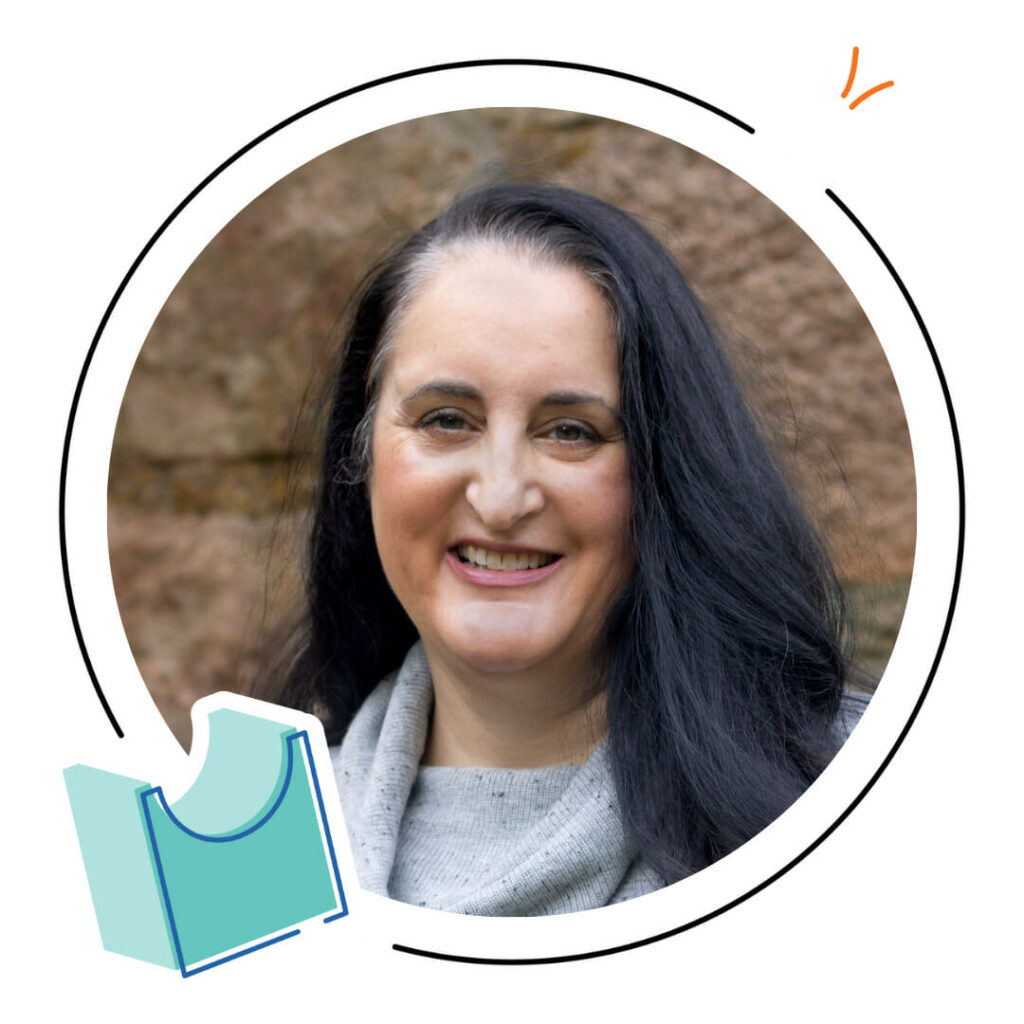
About Math Teacher Lounge
Math Teacher Lounge is a biweekly podcast created specifically for K–12 math educators. In each episode co-hosts Bethany Lockhart Johnson (@lockhartedu) and Dan Meyer (@ddmeyer) chat with guests, taking a deep dive into the math and educational topics you care about.
Join the Math Teacher Lounge Facebook group to continue the conversation, view exclusive content, interact with fellow educators, participate in giveaways, and more!
You might also like:
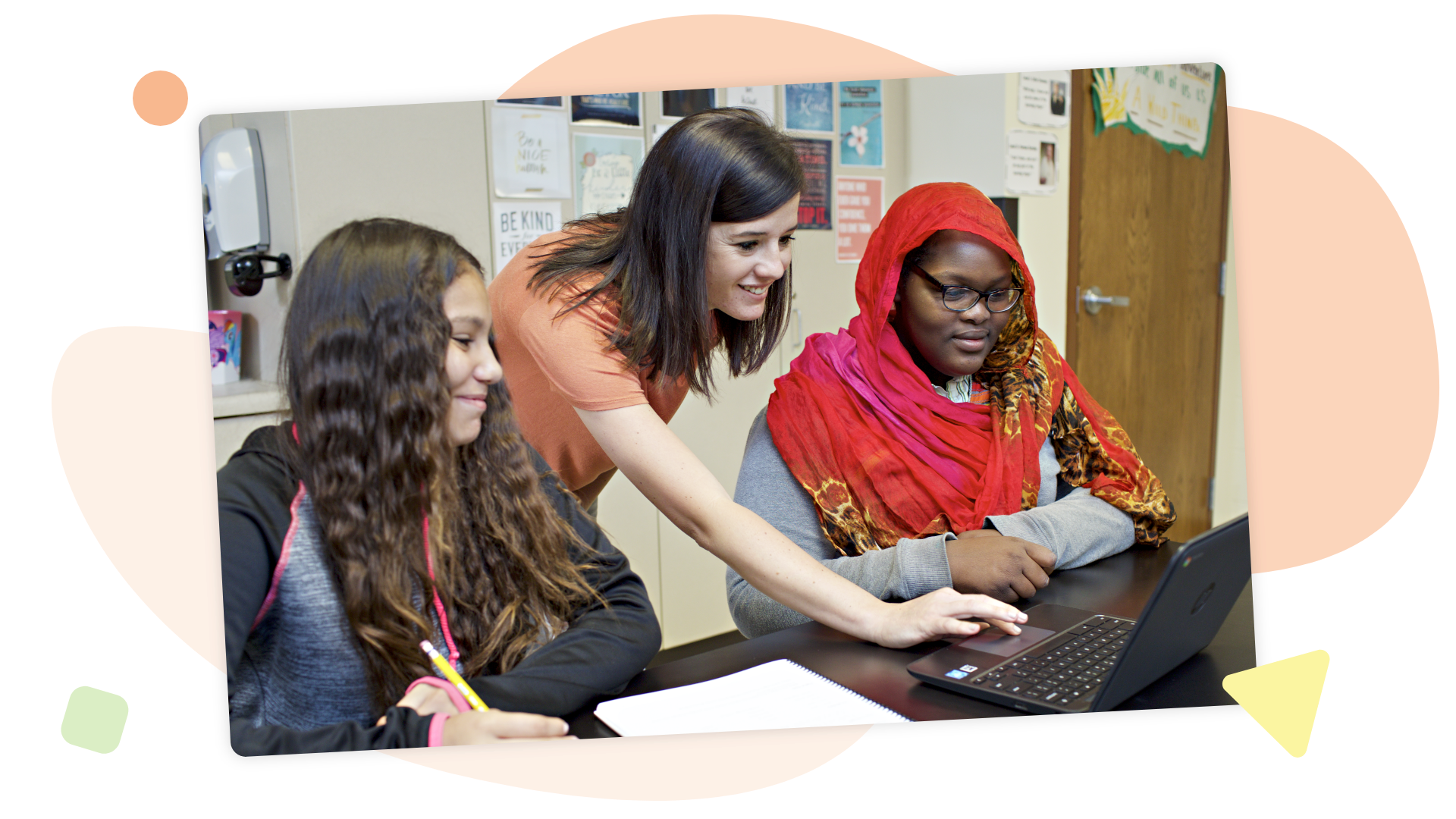

What’s included
Along with compelling print materials, powerful digital resources, and more hands-on materials than any other program, Amplify Science California also includes engaging and realistic experiences, access to diverse role models, countless a-ha moments, and the inspiration and confidence to consider a future as a scientist or engineer.
Choose level
Year at a glance
Amplify Science California is organized around units where students explore compelling phenomena and real-world problems, develop and strengthen claims by collecting evidence and testing assumptions, and apply their learning in new contexts.

Units at a glance
In each Amplify Science California unit, students are asked to inhabit the role of a scientist or engineer in order to investigate a real-world problem. These problems provide relevant, 21st-century contexts through which students investigate different scientific phenomena.

1
Needs of Plants and Animals
Students take on the role of scientists in order to figure out why there have been no monarch caterpillars in the community garden since vegetables were planted. They investigate how plants and animals get what they need to live and grow, and make a new plan for the community garden that provides for the needs of the monarch caterpillars in addition to producing vegetables for humans.

2
Pushes and Pulls
Students take on the role of pinball machine engineers as they investigate the effects of forces on the motion of an object. They conduct tests in their own prototypes (models) of a pinball machine and use what they learn to contribute to the design of a class pinball machine. Over the course of the unit, students construct a foundational understanding of why things move in different ways.

3
Sunlight and Weather
The principals of Woodland Elementary and Carver Elementary need student weather scientists to help them explain why Woodland’s playground is warmer than Carver’s at recess. Students gather data from models of the sun and Earth’s surface and observe their own playgrounds to figure out how sunlight causes changes in the temperatures of different surfaces. Students then use models to figure out why Woodland’s playground sometimes floods.

1
Animal and Plant Defenses
Students play the role of marine scientists. In their role, students apply their understanding of plant and animal defense structures to explain to aquarium visitors how a sea turtle and her offspring can defend themselves from ocean predators when they are released into the wild.

2
Light and Sound
Students take on the role of light and sound engineers for a puppet show company as they investigate cause and effect relationships to learn about the nature of light and sound. They apply what they learn to design shadow scenery and sound effects for a puppet show.

3
Spinning Earth
As sky scientists, students explain why a boy living in a place near them sees different things in the sky than his grandma does when he talks to her on the phone. Students record, organize, and analyze observations of the sun and other sky objects as they look for patterns and make sense of the cycle of daytime and nighttime.

1
Plant and Animal Relationships
In their role as plant scientists, students work to figure out why there are no new chalta trees growing in the Bengal Tiger Reserve, which is part of a broadleaf forest. Students investigate what the chalta tree needs to survive, then collect and analyze qualitative and quantitative data to solve the mystery.

2
Properties of Materials
As glue engineers, students are challenged to create a glue for use at their school that meets a set of design goals. Students present an evidence-based argument for why their glue mixture will be good for their school to use.

3
Changing Landforms
The director of the Oceanside Recreation Center gets a scare when a nearby cliff collapses overnight. Research reveals that the distance between the Recreation Center’s flagpole and the edge of the cliff have changed over time. Students play the role of geologists and work to figure out why the cliff has changed over time. Based on what they learn about erosion, they advise on whether it is safe to keep the center open even though the cliff is changing.

1
Balancing Forces
People in Faraday are excited to hear that a new train service will be built for their city, but concerned when they hear that it will be a floating train. Students are challenged to figure out how a floating train works in order to explain it to the citizens of Faraday. They develop models of how the train rises, floats, and then falls back to the track, and then write an explanation of how the train works.

2
Inheritance and Traits
Students play the role of wildlife biologists working in Greystone National Park. They study two wolf packs and are challenged to figure out why an adopted wolf (“Wolf 44”) in one of the packs has certain traits. Students observe variation between and within different species, investigate inherited traits and those that result from the environment, and explain the origin of several of the adopted wolf’s traits.

3
Environments and Survival
In their role as biomimicry engineers, students work to figure out how the traits of grove snails affect their survival in different environments. They then explore how the traits of different organisms make them more likely or less likely to survive, collecting and interpreting data to understand how organisms’ traits affect their survival in different environments. Students then apply their understanding to a new challenge: designing effective solutions for the removal of invasive plants.

4
Weather and Climate
In their role as meteorologists, students gather evidence to decide where to build an orangutan reserve by analyzing patterns in weather data. After choosing the strongest evidence, students use data to make arguments about which of three fictional islands has weather most like that of orangutans’ existing habitats, Borneo and Sumatra. They then discern patterns in the locations of natural hazards in order to figure out which ones the Wildlife Protection Organization must prepare for.

1
Energy Conversions
Students take on the role of systems engineers for Ergstown, a fictional town that experiences frequent blackouts, and explore reasons why an electrical system can fail. Students apply what they learned as they choose new energy sources and energy converters for the town, then write arguments for why their design choices will make the town’s electrical system more reliable.

2
Inheritance and Traits
As conservation biologists, students work to figure out why a population of Tokay geckos has decreased since the installation of new highway lights in the rainforest. Students use their understanding of vision, light, and information processing to figure out why an increase in light in the geckos’ habitat is affecting the population.

3
Environments and Survival
Playing the role of geologists, students help the director of Desert Rocks National Park explain how and when a particular fossil formed and how it came to be in its current location. Students figure out what the environment of the park was like in the past and why it has so many visible rock layers.

4
Weather and Climate
In their role as marine scientists, students work to figure out how mother dolphins communicate with their calves. They write a series of scientific explanations with diagrams to demonstrate their growing understanding of how sound waves travel. Then they apply what they’ve learned about waves, energy, and patterns in communication to figure out how to create patterns that can communicate information over distances.

1
Patterns of Earth and Sky
Playing the role of astronomers, students help a team of archaeologists figure out what the missing piece of a recently discovered artifact might have depicted. As they learn about the sun and other stars and the movement of Earth, students can explain what is shown on the artifact and what might be on the missing piece.

2
Modeling Matter
In their role as food scientists at a fictional company, students are introduced to the idea that all matter is made of particles too small to see, and that each different substance is made of particles (molecules) that are unique. They are then challenged to solve two problems: one requires them to separate a mixture, and the other requires them to make unmixable substances mix. Students are challenged to use the particulate model of matter to explain their work to the CEO of the company.

3
The Earth System
The cities of East Ferris and West Ferris are located on different sides of a mountain on the fictional Ferris Island. East Ferris is having a water shortage while West Ferris is not. As water resource engineers, students learn about the Earth system to help figure out what is causing the water shortage problem and design possible solutions, including freshwater collection systems and proposals for using chemical reactions to treat wastewater.

4
Ecosystem Restoration
As ecologists, students work to figure out why the organisms in a part of a Costa Rican rainforest ecosystem aren’t growing and thriving. As they solve this problem, students learn more generally how organisms in an ecosystem get the matter and energy they need to survive, and then write a series of restoration plans that include arguments about why the rainforest ecosystem is not thriving and recommend actions to restore its health.
Print & digital components
Amplify Science California includes instructional guidance and student materials in English and Spanish for a year of instruction, with lessons and activities that keep students engaged every day.
Component
FORMAT
NEW! Classroom Slides
Meet your new hands-free TG! These lesson-specific PowerPoints make delivering daily instruction a snap with embedded links to related resources and suggested teacher talk in the Notes section of each slide.
Digital

Teacher’s Reference Guide
Available digitally and in print, this unit-specific reference guide includes scientific background knowledge, planning information and resources, color-coded 3-D Statements, detailed lesson plans, and tips for delivering instruction and differentiating learning.
Print and digital

Hands-on materials kits
Each unit-specific kit contains consumable and nonconsumable materials for use during hands-on investigations. In each kit you will find:
- Hands-on materials
- 18 copies of each of the Student Books
- Big books (grades K–1)
- Classroom display materials
- One Student Investigation Notebook
Kit
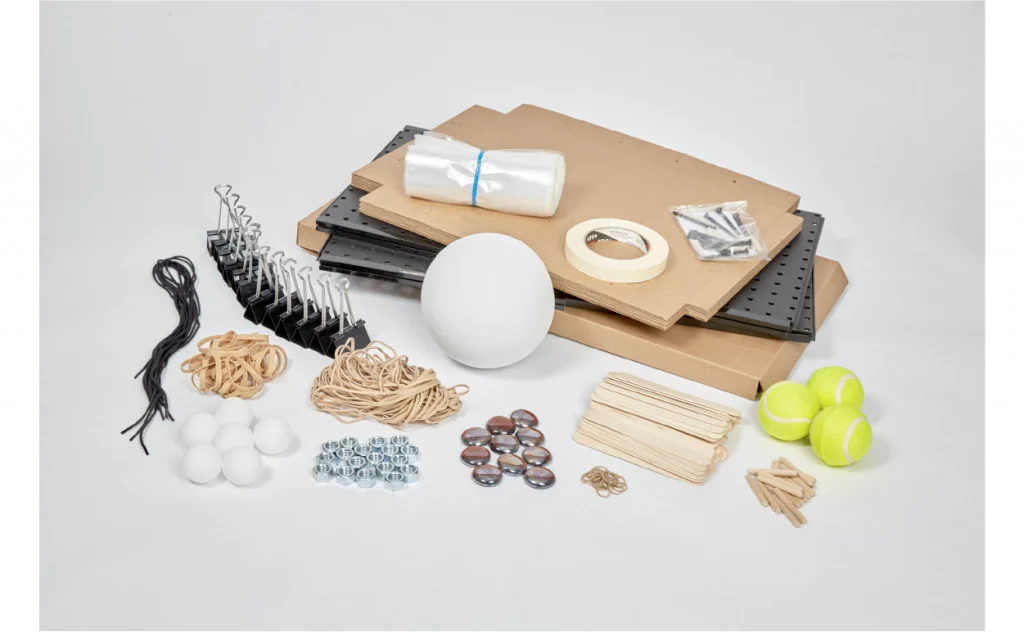
NGSS Benchmark Assessments
Delivered four times per year in grades 3–5 and three times per year in grades 6–8, our benchmark assessments report on students’ facility with each of the grade-level appropriate DCIs, SEPs, CCCs, and performance expectations of the California NGSS.
And now, Amplify Science California users can choose to administer the NGSS Benchmark Assessments (grades 3–8) through their Illuminate assessment platform.
*Also available in Spanish
Digital

Component
FORMAT
Student Investigation Notebooks
Available for every unit, the Student Investigation Notebooks contain instructions for activities and space for students to record data, reflect on ideas from texts and investigations, and construct explanations and arguments.
*Also available in Spanish
Print and digital

Big books (grades K–1)
Amplify Science California never asks our youngest readers to read alone. Rather, we provide scaffolded literacy experiences every step of the way. With our large-format big books, introducing and revisiting concepts though read-aloud and shared reading experiences is a breeze.
*Also available in Spanish

Simulations and practice tools (grades 2+)
Developed exclusively for the Amplify Science California program, these serve as venues for exploration and data collection, allowing students to explore scientific concepts that might otherwise be invisible or impossible to see with the naked eye.
*Spanish versions coming soon
Digital

Explore more programs
Our programs are designed to support and complement one another. Learn more about our related programs.
Screen and intervene faster with mCLASS DIBELS 8th Edition: California SB 114 Approved
California educators, Amplify’s mCLASS Assessment Suite is one of three approved screeners in California for Reading Difficulties at K–2.
mCLASS® DIBELS® 8th Edition is an all-in-one system for Science of Reading-based reading difficulties screening, progress monitoring, and instruction for grades K-6. Amplify’s Spanish language assessment, mCLASS Lectura, works in tandem with DIBELS 8th Edition’s English assessments to help teachers understand where their Spanish-speaking students are in their English and Spanish literacy paths.

About the program
mCLASS offers teacher-administered assessment, intervention, and personalized instruction for grades K–6. Know exactly how to monitor and support every student in your classroom, with features like:
- Precise one-minute measures based on over three decades of predictive data.
- Reading difficulties screening in one tool.
- Instruction that highlights observed patterns and recommends activities.
- Robust reports for teachers, specialists, administrators, and parents.

The right measures at the right time
With mCLASS DIBELS 8th Edition, you’ll assess students based on grade-specific curriculum and instructional standards, in accordance with SB 114 guidelines.
mCLASS DIBELS 8th Edition offers one-minute, easy-to-administer measures of processing speed, phonological awareness, alphabetic principle, and word reading.
| DIBELS® 8th Edition subtest alignment with SB 114 | ||||||
|---|---|---|---|---|---|---|
| Screening Area | mCLASS DIBELS 8th Edition Measure | Grade K | Grade 1 | Grade 2 | Grade 3 | Grade 4–6 |
| Rapid naming ability | Letter Naming Fluency (LNF) |  | | |||
| Phonological awareness | Phoneme Segmentation Fluency (PSF) | | | |||
| Alphabetic principle | Nonsense Word Fluency (NWF) | | | | | |
| Word reading | Word Reading Fluency (WRF) | | | | | |
| Word reading | Oral Reading Fluency (ORF) | | | | | |
| Comprehension | Maze | | | | ||
Validated as a universal screener
Strong reliability and validity evidence shows that DIBELS 8th Edition can effectively assess students in key skills linked reading difficulty. The research supporting DIBELS 8th Edition, conducted by the University of Oregon, is rigorous, meets high technical standards, and empowers educators to make well-informed decisions.
Read the DIBELS 8th Edition Dyslexia White Paper.

A complete system for data-based decision making

mCLASS DIBELS 8th Edition provides rich data that helps you make informed instructional decisions and seek out further dyslexia screening evaluation if needed:
- Assess skills: mCLASS DIBELS 8th Edition and additional measures in Rapid Automatized Naming (RAN), Spelling, Vocabulary, and Oral Language accurately assess students’ abilities.
- Identify risk: The DIBELS 8 composite score shows each student’s risk level, with ‘Well Below Benchmark’ indicating a need for intensive support. Students who are also ‘Well Below Benchmark’ in RAN and/or Spelling have an additional Risk Indicator icon next to their name.
- Provide instruction: The mCLASS Instruction feature analyzes student error patterns to key dyslexia-related subtests, then recommends small groups and explicit, multi-sensory activities for reinforcing skills.
- Progress monitor: mCLASS includes progress-monitoring measures to track student growth in letter sounds, alphabetic principle, word reading, oral reading fluency, and comprehension, so that informed instructional decisions can be made.
- Adapt instruction: mCLASS displays indicators based on progress monitoring performance that indicate when a change in instruction may be needed. It also updates instruction recommendations using the latest data.
Differentiated literacy instruction
mCLASS DIBELS 8th Edition lays the groundwork for a strong Multi-Tiered System of Supports (MTSS).
In addition to identifying students with symptoms of dyslexia, mCLASS DIBELS 8th Edition data recommends early intervention, personalized instruction, and core instruction within Amplify’s early literacy suite. Based on the Science of Reading, Amplify’s early literacy suite programs follow an explicit and systematic structure, build knowledge, and instruct on all of the foundational skills essential to literacy development.
- Intervene with mCLASS Intervention and Amplify Tutoring: Staff-led Tier 2 and 3 intervention for intensive support.
- Practice with Boost Reading: Personalized learning program to extend and reinforce core instruction.
- Instruct with Amplify Core Knowledge Language Arts (CKLA): Core curriculum to build foundational skills and knowledge.

Bilingual dyslexia screening
By assessing with mCLASS DIBELS 8th Edition and its Spanish counterpart, mCLASS Lectura, you’ll know with confidence whether a student truly shows signs of reading difficulties or is experiencing difficulties learning a new language.
When used together, mCLASS DIBELS 8th Edition and mCLASS Lectura feature a Dual Language Report that analyzes screening results in both languages. The report also details how each student can leverage their strengths from one language to support growth in the other.

Equal skill coverage in English and Spanish
| Screening areas | English measure | Spanish measure | Description* |
| Letter Naming and RAN | Letter Naming Fluency (LNF) | Fluidez en nombrar letras (FNL) | Grades K–1: Naming letters in print. 1 minute, 1:1 administration. |
| Phonological Awareness (Segmentation) |
Phonemic Segmentation Fluency (PSF) | Fluidez en la segmentación de sílabas (FSF) & Fluidez en la segmentación de fonemas (FSF) | Grades K–1: Hearing and using sounds or syllables in spoken words. 1 minute, 1:1 administration. |
| Phonological awareness (Elision) | ¿Qué queda? (QQ) | Grades K–2: Produce the part of a word that remains after deleting a syllable or phoneme. 1 minute, 1:1 administration. | |
| Letter-Sound Knowledge | Nonsense Word Fluency Correct Letter Sounds (NWF-CLS) | Fluidez en los sonidos de letras (FSL) | English: Grades K–3: Identify letter-sound correspondences in the context of pseudo-words. Spanish: Grades K-1: Identify letter-sounds in isolation. 1 minute, 1:1 administration. |
| Letter-Sound Knowledge (Receptive) | Fluidez en los sonidos de las letras K-Inicio (FSL K-Inicio) | Grade K: Identify (point to) which letter makes a certain sound. Untimed, 1:1 administration | |
| Decoding | Nonsense Word Fluency Words Recoded Correctly (NWF-WRC) | Fluidez en los sonidos de las sílabas (LSS) | English: Grades K–3: Decode orthographically regular pseudo-words Spanish: Grades K-1: Decode orthographically regular syllables 1 minute, 1:1 administration |
| Word Reading | Word-Reading Fluency (WRF) | Fluidez en la lectura de palabras (FEP) | Grades K–3: Reading common words easily, quickly and correctly.1 minute, 1:1 administration. |
| Fluency | Oral Reading Fluency (ORF) | Fluidez en la lectura oral (FLO) | Grades 1–6: Reading connected text with accuracy and automaticity. 1 minute, 1:1 administration. |
| Reading Comprehension | Maze | ¿Cuál palabra? (CP) | Grades 2–6: Understanding meaning from texts. 3 minutes, group administration. |
| Vocabulary | Vocabulary | Vocabulario | Grades K–3: Knowledge of grade-specific words. 15 minutes, group administration. |
| Encoding | Spelling | Ortografía | Grades K–3: Arranging letters correctly to spell words with grade appropriate features 15 minutes, group administration. |
| RAN (Numbers) | Rapid Automatized Naming | – | Grades K–3: Correctly and quickly naming visual symbols, such as numbers. 3-4 minutes, 1:1 administration. |
| Language Comprehension | Oral Language | Lenguaje oral | Grades K–2: Demonstrate the ability to use words and phrases acquired through conversations, reading and being read to, and responding to texts. 5 minutes, 1:1 administration. |
*Students can be assessed using off-grade measures when information on specific skills is needed.
Dyslexia resources for families
Families play a crucial role in helping children overcome reading challenges. mCLASS DIBELS 8th Edition and mCLASS Lectura provide a Home Connect letter after each screening to explain the results in family-friendly language, recommend activities, and direct families to a free website for additional at-home support.

Developmentally appropriate
Computer-based assessments that require students to complete tasks silently or independently may over-identify students for intervention services, especially young learners who are still developing focus and attention abilities.
mCLASS requires students to actively demonstrate their proficiency in producing letter sounds, forming words, and reading texts. This approach to assessment aligns with the California Reading Difficulties Risk Screener Selection Panel (RDRSSP) guidelines for effective screening of reading challenges. By choosing mCLASS for reading difficulties screening, you’ll gain accurate information about a student’s risk for dyslexia, and gain the capability to monitor every student’s path to reading proficiency.
Additional resources
- 4 tools to help teachers better understand dyslexia
- Science of Reading: The Podcast, Season 7, Episode 7: Debunking the “gift” of dyslexia in children, with Dr. Tim Odegard
- Science of Reading: The Podcast, Season 1, Episode 6: The facts and myths of dyslexia, with Emily Lutrick
- Dyslexia Fact vs. Fiction
- mCLASS Dyslexia Toolkit
- mCLASS Research Hub
- mCLASS Program Guide
- mCLASS Digital Access Guide
- mCLASS Reporting Guide
- mCLASS Help Site
- Supporting multilingual and English learners in literacy
Demo access
Please watch the navigation video for a short overview of the mClass platform, and reach out to your Amplify Account Executive (contact information below) for demo access credentials.
Questions?
Looking to speak directly with your local representative?
Get in touch with a California team member to learn more about our early literacy suite or request a demo account.
Erin King
Sales Director, CA
(512) 736-3162
eking@amplify.com
NORTHERN CA
Wendy Garcia
Senior Account Executive
(510) 368-7666
wgarcia@amplify.com
BAY AREA
Lisa Marinovich
Senior Account Executive
(831) 461-4187
lmarinovich@amplify.com
CENTRAL VALLEY and CENTRAL COAST
Demitri Gonos
Senior Account Executive
(559) 355-3244
dgonos@amplify.com
VENTURA and L.A. COUNTY
Jeff Sorenson
Associate Account Executive
(310) 902-1407
jsorenson@amplify.com
ORANGE and L.A. COUNTY
Lauren Sherman
Senior Account Executive
(949) 397-5766
lsherman@amplify.com
SAN BERNARDINO and L.A. COUNTY
Michael Gruber
Senior Account Executive
(951) 520-6542
migruber@amplify.com
RIVERSIDE and L.A. COUNTY
Erin King
Sales Director, CA
(512) 673-8526
eking@amplify.com
SAN DIEGO COUNTY
Kirk Van Wagoner
Senior Account Executive
(760) 696-0709
kvanwagoner@amplify.com
BUTTE, DEL NORTE, HUMBOLDT, and SHASTA COUNTY
DISTRICTS UNDER 2250 ENROLLMENT
Kevin Mauser
Lead Account Executive
(815) 534-0148
kmauser@amplify.com
What to expect
Researchers and practitioners have defined effective pathways to reading success and still, combining the science of early reading with the art of implementing change remains a challenge. Chandler Unified School District is partnering with current thought leaders, academics, and Amplify facilitators to immerse participants in reading research and improvement science, supporting your district in developing practical, actionable solutions focused on helping young learners become successful readers. Your school team will have the opportunity to work hands-on with our experts and leave the experience with two specific, targeted commitments to a behavior or system change (a “change idea”), which they can implement to improve reading performance.
Speaker bios
Dr. Elfrieda “Freddy” Hiebert (Ph.D., University of Wisconsin, 1979) is the President and CEO of TextProject, a non-profit aimed at providing open-access resources for instruction of beginning and struggling readers. Freddy has had a long career as a literacy educator and is also a research associate at the University of California. Her research, which addresses how fluency, vocabulary, and knowledge can be fostered through appropriate texts, has been published in numerous scholarly journals and books. Hiebert’s contributions to research and practice have been recognized through awards such as the Oscar Causey Award for Outstanding Contributions to Reading Research (Literacy Research Association, 2015), Research to Practice award (American Educational Research Association, 2013), William S. Gray Citation of Merit Award for Outstanding Contributions to Reading Research (International Reading Association, 2008), and membership in the Reading Hall of Fame (2008).
Dillon Hauptfuhrer is the Associate Director of Curriculum Development for the Teach Like a Champion Team. Dillon brings eight years of leading and teaching to her role creating curriculum for the Teach Like A Champion team. Prior to joining the team, Dillon served as a Principal in Residence and Academic Dean at Achievement First in Brooklyn and she worked with YES Prep in Houston for six years as both a teacher, Content Specialist, and Dean of Students. Dillon is a graduate of the University of Virginia and received her M. Ed from Harvard’s Graduate School of Education.
Jen Rugani is the Associate Director of Curriculum and School Support for the Teach Like a Champion Team. As a former principal of Uncommon Schools’ Leadership Prep Canarsie Elementary Academy, member of the inaugural cohort of Teach Like a Champion Fellows, and elementary school teacher, Jen Rugani brings 9 years of leading and teaching to her work creating curriculum and supporting schools. Jen is a graduate of Harvard University and has a Master’s degree from Relay Graduate School of Education, where she also completed the National Principal’s Academy Fellowship.
Pre-reads
Reading Reconsidered
Hard Words
Agenda
Presentations
Introducing our 2023 Science of Reading Star Award finalists!

Roll out the red carpet and shine those spotlights—it’s time to meet the 25 finalists for our 2023 Science of Reading Star Awards!
These educators and leaders help light the way for the next generation. They’ve implemented Science of Reading principles and guided their students toward lifelong literacy. They’ve demonstrated expert change management and professional development. Get ready to meet some of the brightest minds in education as we celebrate their achievements and see what makes them truly stellar!
Join our virtual event and awards program on May 23.
But first…meet our 2023 finalists! Below, you’ll hear from the nominees themselves, as well as the colleagues who nominated them, about what makes them stars.
The Changemaker Award
For exemplary leadership in guiding a district through a shift to the Science of Reading.
And the finalists are…
Heather Campbell
Learning Coach, Sunset Elementary, Washington County District, UT
Why she’s a star: “Heather’s philosophy that all students can learn to read if given proper instruction has changed the data. Our school made the change and the data is showing our students are thriving.” —Shelli Campbell, Learning Coach
Javonna Mack
Lead Content Teacher, Caddo Parish School, LA
Why she’s a star: “Whether working with students or teachers, Mrs. Mack keeps best practices grounded in the Science of Reading at the forefront. She constantly strives to build teachers’ expertise in teaching students to read through content-rich professional learning communities, often on Saturdays or after the workday has ended.” —Shannon Southwell, Lead Content Teacher
Aaron Jura
Reading Interventionist, Bloomingdale, IL School District
Why he’s a star: “Aaron has been the catalyst for our entire district embracing this shift to the Science of Reading, and we are just at the beginning of this amazing journey.” —Nicole Gabany, Reading Interventionist
Nicole Peterson
Director of PreK–8 Education, Sampson County Schools, NC
Why she’s a star: “She has created, initiated, implemented, monitored, evaluated, and adjusted processes and systems to ensure that teachers have access to resources, training, materials, and professional development to ensure that all students gain equitable access to high-quality, evidence-based instruction.” —Matthew McLean, Director, PreK–8th Grade Education
Virginia Quinn-Mooney
Teacher, Northville Elementary School, CT
Why she’s a star: “Virginia has gone from one person with a personal commitment to advancing her literacy knowledge. She has now impacted countless educators, parents, etc., with her tenacity and learning journey.” —Nicole Gregory, Teacher
The Data Dynamo Award
For commendable use of data to align a literacy system and maximize student achievement
Shennoy Barnett
Kindergarten Teacher, South Smithfield Elementary, NC
Why she’s a star: “My objective is to help as many children as I can become fluent readers and critical thinkers. As a literacy specialist here for just four months, I made great strides with literacy with my students.” —Shennoy Barnett, Kindergarten Teacher
Anne Elizabeth Carter
Kindergarten Teacher, Wake County District, NC
Why she’s a star: “Through systematic and explicit phonics instruction as well as targeted language comprehension instruction—using texts that incorporate science and social studies content as well as build knowledge systematically—my kiddos were TRULY learning how to read accurately and fluently.” —David Gaudet, Principal
Bethani Ploegstra
Kindergarten Teacher, Union Colony Elementary, CO
Why she’s a star: “She takes data from mCLASS® DIBELS®, Lexia, and SchoolPace (part of our reading curriculum), as well as formative feedback from what she hears and sees students doing daily in the classroom, to immediately adjust what she presents next to students, whether individually, in small groups, or whole class.” —Mandy Bailey, Assistant Principal
The Knowledge Builder Award
For showing the world that the Science of Reading is more than just phonics, and empowers students with knowledge from elementary to middle school
Corey Beil
Instructional Interventionist, Quakertown Community School District, PA
Why he’s a star: “He incorporated literacy into his daily math instruction by providing our students with opportunities to understand and connect with the content more deeply. Our students were exposed to practicing literacy concepts while expanding their mathematical knowledge and foundational understanding.” —Julianne Pennabaker, Teacher
Kim Smaw
Principal, Rosalyn Yalow Charter School, NY
Why she’s a star: “She was able to persuade the learning community to adopt the Science of Reading, firmly convincing them that this curriculum could empower students to gain rich learning experiences.” —Deirdre Frost, Reading Intervention Specialist
Angie Dutton
Instructional Coach, Onslow County Schools, NC
Why she’s a star: “Her positive attitude about the Science of Reading is contagious and is most likely why other educators feel comfortable reaching out to her for questions and guidance.” —Stacey Horne, Instructional Coach
Nicole Brodie
ELA Grade 7 Teacher, Long Middle School, GA
Why she’s a star: “She encourages her students to use their [voices] for change and impact and supports them in their learning process academically, [socially, and emotionally].”
—Renee Dawson, Grade 7 English Language Arts Teacher
The Intervention Innovator Award
For admirable use of intervention strategies to get at-risk readers back on track
Suzanne Maddox
RTI Teacher, Robertson County Schools, TN
Why she’s a star: “Mrs. Maddox reviewed individual student data, worked with teachers, and began using CKLA Skills and the intervention materials provided with this curriculum to continue a sounds-first approach to meeting the individual needs of students.” —Brooke Callis, RTI Teacher
Sara Thornton
Reading Interventionist, Senior Team Lead, Schmitt Elementary, CO
Why she’s a star: “Sara’s enthusiasm for and dedication to her work has been an inspiration to all involved and has resulted in a successful transition to the Science of Reading—as evidenced by our students’ amazing academic growth!” —Hayley Gunter, Reading Interventionist, Senior Team Lead
Markaya Aga
Reading Interventionist, Merit Academy, CO
Why she’s a star: “Since she has come on board at our school, the mindset around literacy and the growth of our programming [has improved] ten-fold. We need more educators like Markaya!” —Allison Hanson, Reading Interventionist
The Language Luminary Award
For outstanding success in developing the skills and strengths of emergent bilingual students
Wanda Ramirez
Grade 2 Teacher, El Sol Science and Arts Academy, CA
Why she’s a star: “We used to emphasize to students that what they know in one language cannot be used in the other language. Now, as a dual-immersion educator, I have the opportunity to change that mindset, teach my students to embrace their native [language], and empower them to use their entire linguistic ability. It’s a very powerful thing to be able to do.” —Wanda Ramirez, Grade 2 Teacher
Esmeralda Martinez
Kindergarten Teacher, Compass Community Schools, TN
Why she’s a star: “She has consistently worked on improving her teaching methods, tried new ways to engage the class, and worked diligently to support all of our students.” —Rachel, Marinari, Teacher
Christine Black
ESL Teacher, North Dover Elementary School, NJ
Why she’s a star: “We have a rapidly expanding ESL population, and Mrs. Black works tirelessly to ensure that her students are expanding their ELA skills in accordance with the major tenets of the Science of Reading.” —Dawn Gawalis, ESL Teacher
Rookie of the Year Award
For showing the world that the Science of Reading is more than just phonics, and empowers students with knowledge from elementary to middle school
Caitlyn Cockram
Teacher, Patrick County Schools, VA
Why she’s a star: “We have offered professional development in vocabulary and implementing SOR strategies, and Caitlyn is always one of the first teachers to sign up. She is dedicated to improving student achievement through research and evidence-based practices.” —Callie Wheeler, Teacher
Andrea Mason
Academic Interventionist, County Line Elementary School, GA
Why she’s a star: “Making the shift from balanced literacy to the Science of Reading hasn’t always been easy. But I continue to research and implement these best practices with my students because I can see that they are now on a path to becoming strong readers.” —Jennifer Ezell, Academic Interventionist
Mallory Pendergast
Phonics Teacher, Literacy Interventionist, Circle City Prep, IN
Why she’s a star: “As a kindergarten teacher, she led 100% of her scholars to be reading on grade level in the first quarter and maintained that momentum through the first semester.” —Sami Hyde, Senior Instructional Coach
ESSER Ace Award
For notable and innovative use of stimulus funds to help kids rediscover the joy of reading
Stephanie Hurst
District Literacy Specialist, Maple Avenue Elementary, NH
Why she’s a star: “She is also a voice on the utilization of [the] ESSER Fund—using the distribution of funds per federal protocol to ensure that the district’s lowest-performing schools have access to quality instructional materials and professional development all grounded in the Science of Reading.” —Mark Blount, K–12 Literacy Specialist
Callie Wheeler and Sara Vernon
Instructional Coaches, Patrick County Schools, VA
Why Callie’s a star: “Mrs. Wheeler played a key role in creating a culture of literacy within our schools, where the Science of Reading is central to the education of our students.” —Sara Vernon, Instructional Coach
Why Sara’s a star: “Sara has worked tirelessly to make the shift from the vision that was grounded in balanced literacy to one that is now making waves in Southwest Virginia with its Know Better, Do Better, Be Better approach to reading instruction.” —Callie Wheeler, Instructional Coach
Edie Bostic
Literacy Coach, Gallia Local, OH
“As a teacher, district Title I coordinator, elementary principal, and now district literacy coach, she continually champions the students under her care and is passionate about those students receiving the highest levels of instruction.” —Leslie Henry, Principal
Inspired? We are! Register to join our May 23 Science of Reading Star Awards virtual ceremony!
More to explore
Learn with and from other top-notch educators like you through our family of podcasts.
The importance of decoding in effective phonics instruction

Early readers are like CIA analysts, using what they know about symbols and patterns to decipher unfamiliar texts and messages. And one of their most important code-cracking tools? Phonics.
In reading, phonics and decoding are closely intertwined. And the Science of Reading confirms that strong decoding skills help students sound out and decipher unfamiliar words, opening up new levels of reading and learning.
What’s the definition of “phonics”?
Phonics is a method for understanding the relationship between letters (graphemes) and the sounds (phonemes) they represent in words. It’s a crucial skill that helps students decode and read words accurately. The Science of Reading recognizes phonics as one of the five foundational reading skills—along with phonological awareness, fluency, vocabulary, and comprehension—that contribute to reading proficiency.
Phonics instruction focuses on teaching students the systematic and explicit rules and patterns of letter-sound correspondences. It typically begins with teaching the basic letter-sound correspondences, such as the sounds associated with individual letters or letter combinations (e.g., “a” as in apple, “sh” as in shell).
As students progress, they learn more complex patterns and rules, such as vowel digraphs (two vowels together producing a single sound, like “ea” in beach) and consonant blends (two or more consonants together, like “bl” in black).
Decoding in reading
Decoding is a key part of phonics instruction—and a vital skill that helps students unlock meaning. It’s what students are doing when they use phonics skills to sound out words, breaking them down into individual phonemes or letter sounds.
By understanding the relationship between letters and sounds, students can apply their knowledge to decode new words. For example, knowing that the letter “s” represents the /s/ sound allows students to decode words like sit or sun based on their knowledge of phonics.
(A note on encoding vs. decoding: While decoding focuses on translating written words into spoken language, encoding refers to the ability to convert spoken language into written words.)
Why is decoding important—especially when combined with phonics?
Decoding skills are fundamental because they bridge the gap between recognizing individual letters and understanding the meaning of words. Phonics instruction is most important when it teaches and reinforces decoding skills.
Together, the two accomplish a lot:
- Building word recognition: Decoding skills enable students to recognize words accurately and independently. By applying phonics knowledge, students can decode unfamiliar words, expanding their word-recognition abilities.
- Enhancing reading comprehension: Decoding is an essential component of reading comprehension. When students can decode words effectively, they can focus on understanding the text, making connections, and engaging in critical thinking.
- Boosting independence: Decoding skills help students tackle unfamiliar words on their own without having to rely as much on context or memorization.
Phonics and decoding activities
To reinforce decoding skills, educators can incorporate various phonics and decoding activities. These might include word blending exercises, word family practice, phonics games, or guided reading sessions.
Phonics instruction gives students the tools to recognize and understand the relationship between letters and sounds. Decoding skills allow them to apply this knowledge to reading words accurately and independently. When educators explicitly teach phonics and reinforce decoding skills, they set students up to engage with the unfamiliar, expand their vocabularies, and become confident and curious readers.
More Amplify and Science of Reading resources
Science of Reading, A Primer: Part One
Science of Reading: Your guide to making the shift
Science of Reading: The Podcast “Deconstructing the Rope: Decoding with Louisa Moats”
Foundational skills instruction in Boost Reading
The power of data-driven instruction for reading success

Words tell stories—and so do numbers. Even though reading can take us to magical places and spark immeasurable wonder, it’s data that can best guide literacy instruction (and instructors) toward delivering reading success.
Amplify’s Executive Director of Learning Science Danielle Damico, Ph.D., notes in this webinar that educators and districts can, understandably, get stuck in out-of-date beliefs. One common one is that reading is a natural process, the product of variables we can’t change in schools. But data shows the opposite—and provides immense opportunity.
Data is at the heart of what we now call the Science of Reading—a term for the decades of data now available on how kids learn to read and write, and how to best teach them. In making the shift to instruction grounded in the Science of Reading, educators can make effective use of this data to change not only literacy practices, but lives.
If you’ve been following the Science of Reading movement, you likely know the power of making that shift. But whether you’ve been following it for years or are just learning about it, there are some questions you’ll need to explore. What data do you need to make your case to your school or district? And what data will help you monitor implementation—and future success?
Using data to make your case for the Science of Reading
When making the shift to instruction grounded in the Science of Reading, you need to build buy-in among key stakeholders. Your most powerful tool in this endeavor? Data.
If your screening data shows that 20% or more of your students require intervention, it’s time to make the shift. That key performance metric is sometimes all you need, but other indicators can include high error rates among students reading decodable words, fluency below grade-level, words-per-minute scores, or struggles in identifying base words with a prefix or suffix.
Your teaching materials are also a source of data. When you conduct an audit of their content and approach, do you notice—for example—a lack of direct connection between phonics lessons and texts? Emphasis on visual strategies for decoding? Few decodable texts in the first place? These clues (or even red flags) could point to materials that are not grounded in the explicit, systematic instruction recommended by the Science of Reading.
The same may be true of your shared or inherited instructional practices. Is reading typically taught through isolated topics or generic skills (like “find the main idea”) that are disconnected from knowledge domains? Those approaches to reading could contribute to low performance data—and could help you make your case as you champion a shift to data-driven instruction.
What does data-driven instruction look like—in implementation and beyond?
Science-based reading instruction reduces the need for intervention and allows students to move forward as capable, confident readers. Once you’ve begun to implement data-driven instruction, you’ll need to collect key information to make sure you get—and stay—on the right track for all of your students.
Among the eight core principles of the Science of Reading, universal screening and progress monitoring are two that are absolutely necessary to ensure that all students receive the right instruction. It’s also important that your universal screener measures phonemic awareness, phonics, fluency, vocabulary, and comprehension.
It’s important to monitor improvement in foundational literacy skills and decline in the number of students requiring literacy intervention as well. Collecting qualitative insights regarding classroom practices and tracking their alignment with Science of Reading principles forms a crucial part of the data landscape during this instructional shift.
And finally, as Danielle Damico notes, implementation data can help you:
- Confirm that your program has indeed been implemented.
- Ensure that student learning is meeting key goals.
- Distinguish between an ineffective program and an effective program not being implemented as designed.
- Determine opportunities for professional development and coaching.
To take a deeper dive into all the data that can help you champion, navigate, and succeed in this shift, download our ebook The Story That Data Tells: Using Data to Chart Your Course With the Science of Reading and explore our webinar What Does Data Tell Us? Building Buy-In and Determining Areas of Need With Data.
5 strategies to transform your math classroom

Want to shift your math teaching practices this year, but not sure where to start? That’s a good problem to have!
You can boost your instruction this fall with problem-based learning, technology in the math classroom, and more—all in ways that put students at the center.
“All students need the opportunity to feel like they can figure out mathematics,” says Jennifer Bay-Williams, Ph.D., an author and professor of mathematics education at University of Louisville. “That’s where they develop a math identity, [the idea] that they can do math. And they start feeling like, ‘I can figure this out.’”
Bay-Williams spoke at our 2024 Math Symposium, along with other thought leaders and expert educators. Keep reading to see how their key takeaways can help you shift your math instruction this school year!
Center student ideas in a collaborative math classroom
Amplify Math Suite Executive Director Kristin Gray had great tips for teachers looking to center student ideas in the classroom. Simply put, it’s all about helping them make several types of connections. These can include any of the following:
- Connecting students’ classroom math experiences to real life
- Connecting math ideas to one another
- Connecting their ideas to the ideas of their classmates
How do teachers foster these important connections? That’s where problem-based lessons come in. Rather than teaching a concept or formula in isolation, then having students practice it, try inviting students to collaborate on a real-life problem that will lead them to that math idea. (For example, you might ask them to work on designing a small traffic or subway system that requires developing ideas about distance, rate, and time.)
As a result, students build problem-solving skills collaboratively, feel their ideas are valued, develop their own ways to make math make sense, and learn from and with each other. Teachers also get to know and appreciate the different backgrounds and styles students bring to the classroom, opening up new opportunities for engagement—and connection.
Reimagine student engagement
No matter how engaging you are as a teacher, it’s typically students who drive engagement—and that’s actually good news. You don’t have to reinvent the wheel or do somersaults to get their attention. In fact, a lot of engagement comes from creating routine and familiar opportunities for connection. And it can also come from allowing students to make mistakes.
“We want all students to have an entry point into [math] tasks,” notes Amplify STEM Product Specialist James Oliver. “Those students that seem to always feel like they don’t fit or don’t have the identity in that math classroom, we want them to immediately have successes and have their curiosities tested.” Successes—and productive failures. “What we’ve learned is, you are not firing any synapses, nothing’s happening if you’re just getting it immediately correct.”
Nurture student curiosity
Which is better: letting students dive into a box of LEGO pieces to see what happens, or providing a step-by-step guide to building the airplane?
It’s actually a tie. In both structured and loose approaches, the key is to spark curiosity and communication. “If we want them to be mathematicians, we should let them talk about math,” says Amplify Director of 6–12 Core Math Curriculum Kurt Salisbury, Ph.D. Here’s his 3D approach:
DISCOVER
Discovering the relationships among mathematical ideas is a key part of mathematical thinking.
DESCRIBE
Students communicate their mathematical thinking by describing the processes, procedures, or relationships needed to work with a concept or pattern.
DEVELOP
When students develop a strategy they can apply to a variety of contexts, their math thinking gets validation and purpose.
So whether you lean into a more structured approach or prefer to let kids figure the LEGOS out themselves, small mindset changes like these can create more space for your students to discover, describe, and develop as mathematicians.
Make math fluency fun
As with someone fluent in a language, someone fluent in math is able to think and calculate mathematically without struggle or effort—that is, with fluidity.
In order to think and calculate fluently, students need to build a toolbox of strategies—and games are a great way to do that.
While you’re making the learning fun, students are absorbing tools they’ll use throughout their lives. “When we ensure that every student has access to a range of strategies, and has regular opportunities to choose among those strategies, that’s what games do for us.” says Bay-Williams.
Elevate student voices
When student thinking isn’t explicitly invited into the classroom, students may begin to narrow their focus, providing merely what they think their teacher wants to hear. But given genuine invitations to share, students are more likely to follow their thought process wherever it leads them, taking a more organic approach to problem-solving.
“Taking a step back as a teacher, and inviting students to take a step forward, [activates] students getting started with finding the answer,” says Stephanie Blair, vice president of Desmos Coaching. “And all of them might take a different step forward, which is okay.”
It’s time for math that does more for students
“All students need the opportunity to feel like they can figure out mathematics,” says Bay-Williams. We need to connect with our students, nurture their curiosity and comfort with math, and welcome their unique ways of thinking.
We hope the thought leaders and speakers from our Math Symposium have inspired you to do just that!
Welcome, San Diego Unified School District!
At Amplify, we partner with you to engage all students deeply with high quality content while also providing teachers with powerful tools that support remote and hybrid learning. We’ll be by your side with new resources and product enhancements to ensure continuity of learning in Amplify Science, Amplify ELA, and Amplify Desmos Math.
Choose a program below for implementation resources, including onboarding videos, program overviews, information about professional learning sessions, and more.
Amplify Desmos Math caregivers: K – 5th Grade

Questions?
Amplify Support
Monday through Friday, 4 a.m.–4 p.m. PT
Saturday through Sunday, 8 a.m.–4 p.m. PT
(800) 823-1969
help@amplify.com


Expect more from your assessments with mCLASS Math.
Understanding student thinking is the key to accelerating student performance.
Welcome to mCLASS® Math, the benchmarking and progress monitoring system for grades K–8 that measures proficiency, reveals underlying mathematical thinking, and informs instructional support for every learner. Analyzing student responses to reveal valid underlying mathematical thinking—even in wrong answers—helps better target individualized instructional recommendations that build grade-level proficiency.
Meet mCLASS Math.
mCLASS Math’s research-based benchmark and progress monitoring assessment system tracks performance against grade-level expectations to help predict later growth outcomes.
With screening and diagnostic capabilities and empirically established cut scores to assess risk, mCLASS Math reporting helps educators pinpoint strengths and areas of growth for individualized instructional support for every student. Together, these establish a strong Multi-Tiered System of Supports (MTSS).
This powerful assessment is digitally assigned to the whole class three times annually: beginning-of-year (BOY), middle-of-year (MOY), and end-of-year (EOY). The open responses of the assessment give more robust data-points gathered from each item, and it only takes 30 to 40 minutes to complete.
Designed to target critical grade-level skills that predict success, the rich data can be used as a diagnostic tool for Tier 2 and Tier 3 intervention and flags for the potential risk of dyscalculia.
mCLASS Progress Monitoring assessments help teachers chart students’ progression between benchmark assessment windows. For students receiving targeted support, mCLASS Progress Monitoring determines if intervention is effective or adjustments are needed to enhance student learning.
These short yet effective assessments enable teachers to monitor a student’s math performance between mCLASS Benchmark assessments. mCLASS Progress Monitoring assessments can be assigned to a select group of students needing targeted support in a specific skill or Tier 2 or Tier 3 intervention, and are aligned around crucial math domains for each grade level.
Assess in less time.
With the groundbreaking digital analysis of student thinking, mCLASS Math teachers can rely on the predictive validity of assessments in less time.
The powerful Student Response Analysis of open-ended questions provides deep insight into what and how students think—faster and with fewer questions.

Access deeper insights.
mCLASS Math’s dynamic data reports offer a window into student thinking, reliably guiding intervention across Tiers 1–3.
The more teachers understand how their students think, the better they can support their growth. The assessment system recognizes students’ individual strengths, experiences, understandings, and strategies—or assets, as we collectively refer to them—to inform the robust data that powers mCLASS Math.
Educator and caregiver reports
Empirically established cut scores and domain-specific measures help teachers plan for tiered intervention with classroom, school, and district-level performance reports set to predict end-of-year outcomes.
To reinforce learning at home, Home Connect letters provide caregivers with easy-to-use reports on their child’s math development.
Student Thinking Report
The Student Thinking Report gives teachers actionable recommendations tailored to how individual students or groups of students approach problems. By understanding the different ways of thinking in skimmable, yet robust, reports, teachers have the tools they need to efficiently plan differentiation to achieve instructional targets.
Actionable recommendations enable teachers to quickly differentiate with intervention resources aligned to common misconceptions.
Research behind mCLASS Math
Based on decades of research for best practices in math, mCLASS Math efficiently assesses students’ skills and thinking to give teachers instant recommendations for small group and individualized instruction.
Following research from leading math experts and an in-depth validation analysis through WestEd, a technical report will be released summer 2025.

A dedicated team at Amplify with over 500 combined years of classroom teaching, school leadership, and assessment experience thoughtfully created mCLASS Math with teachers and students in mind.
Following research from leading math experts and an in-depth validation analysis through WestEd, data will be continuously released starting in spring 2025.

Sandra Pappas
Associate Director of Research

Patrick Callahan, Ph.D.
Educator and Founder of Math ANEX

Jason Zimba, Ph.D.
Chief Academic Officer of STEM
at Amplify
The mCLASS Math K–5 assessment system is designed to provide educators with reliable and valid measures to identify students needing additional support in mathematics and to inform instructional decisions. Preliminary data presents evidence supporting the psychometric quality of the assessment using the technical standards outlined by the National Center on Intensive Intervention (NCII) and state requirements for screening measures.
Data informs
instruction
mCLASS Math works alongside your core instruction, differentiation, and intervention. The data model behind mCLASS Math provides comprehensive data for each student across grades K–8, easily connecting teachers to the immediate next steps that will support, strengthen, and stretch all learners.
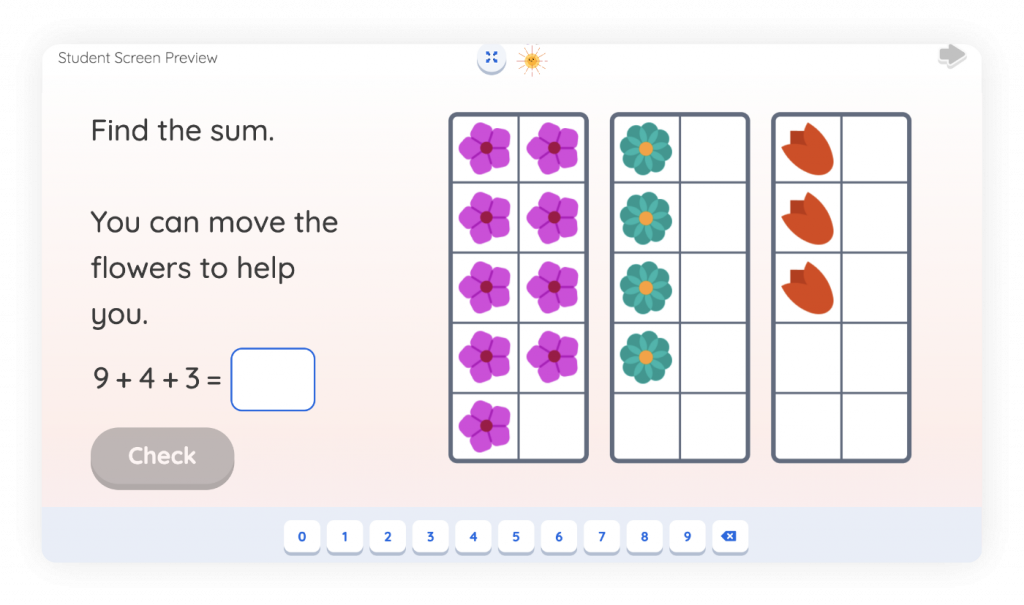
Personalized Learning accelerates student growth with daily, targeted 15-minute digital activities. Supported by a virtual tutor, students tackle individualized tasks linked to daily lessons, receiving just-in-time support to foster grade-level success.

Teacher-led, 15-minute Mini-Lessons can build grade-level proficiency by providing research-based, targeted intervention to small groups of students who need additional support.

Reinforce students’ understanding of concepts through collaborative, hands-on Centers (grades K–5). These student-led routines provide additional practice with vertical alignment across grade levels.
Fluency Practice uses spaced repetition, an evidence-based approach to promoting memory retention, to teach basic facts. The adaptive nature of the practice allows students to focus less and less on the facts they already know. We’ve partnered with Math for Love to iterate on the popular Multiplication by Heart to create Division by Heart and Addition and Subtraction by Heart I & II. These proven fluency decks—plus Skills Fluency for supporting procedural fluency practice—help students practice crucial skills independently.
Item Banks provide space for teachers to create custom practice and assessments by using filters and searching for standards, summative-style items, and more.

All students should have access to fun and challenging problems. Extensions are 10- to 15-minute activities aligned to the most critical topics for the grade, providing flexible, low-lift activities for the whole class or targeted intervention to small groups of students ready for an extra challenge.
One cohesive math experience
As part of Amplify Desmos Math, Amplify’s comprehensive math suite, mCLASS Math provides a strong foundation of actionable data to help teachers diagnose and capitalize on student strengths. Amplify Desmos Math ensures that you have all the core, intervention, and personalized instruction you need to support each stage of a student’s math journey.
S3-05: Thinking is power
Join us as we sit down with Melanie Trecek-King, college professor and creator of Thinking is Power, to explore how much of an asset science can truly be in developing the skills students need to navigate the real world. You’ll learn about “fooling” students and the importance of developing critical thinking, information literacy, and science literacy in the classroom. We’ll also share real strategies and lesson examples that help build these essential skills and engage students in learning.
And don’t forget to grab your Science Connections study guide to track your learning and find additional resources!
We hope you enjoy this episode and explore more from Science Connections by visiting our main page!
Melanie Trecek-King (00:00):
We say knowledge is power, but it’s not enough to know things. And there’s too much to know. So being able to think and not fall for someone’s bunk is my goal for my students.
Eric Cross (00:12):
Welcome to Science Connections. I’m your host, Eric Cross. On this third season, we’ve been talking about science’s underdog status. And just this past March at the NSTA conference in Atlanta, I had the chance to speak with science educators from around the country about this very topic.
Hermia Simanu (00:28):
Right now, there’s only two teachers in our high school teaching science.
Shane Dongilli (00:32):
I have 45 minutes once a week with each class. The focus is reading and math.
Alexis Tharpe (00:38):
Oftentimes science gets put by the wayside. And you know, I love math and I love my language arts, but I also think science needs to place be placed on that high pedestal as well.
Askia Little (00:46):
In fifth grade, oh, they teach science, because that’s the only grade that it’s tested.
Eric Cross (00:50):
That was Hermia Simanu from American Samoa. Her team flew for three days to make it to the conference. You also heard from Shane Dongilli from North Carolina, Alexis Tharpe from Virginia, and Askia Little from Texas. All of these teachers were excited to be at the conference and had a lot to say about the state of science education in their local schools. Throughout this season, we’ve been trying to make the case for science, showing how science can be utilized more effectively in the classroom. We’ve explored the evidence showing that science supports literacy instruction. We’ve talked about science and the responsible use of technology like AI. My hope is that all of you listeners out there can use some of this evidence to feel empowered to make the case for science in your own communities. And on this episode, we’re going to examine how science can help develop what might be the most important skill that we try to develop in our students: Good thinking. On this episode, I’m joined by a biologist who actually advocated for eliminating the Intro to Bio course at her college. Instead, Professor Trecek-King created a new course focused on critical thinking, information literacy, and science literacy skills. In this conversation, we discuss why the science classroom is such a good environment for helping students become better thinkers. Now, I don’t think that you can make a much stronger argument for science than using it to develop the skills that Melanie describes in this conversation. So, without further ado, I’m thrilled to bring you this conversation with Melanie Trecek-King, Associate Professor of Biology at Massasoit Community College, and creator of Thinking Is Power. Here’s Melanie.
Eric Cross (02:29):
Well, Melanie, thank you for joining us on the show. It’s so good to have you.
Melanie Trecek-King (02:34):
I am so happy to be here.
Eric Cross (02:35):
Now, I went to your session at NSTA in Chicago … I think it was two years ago. A couple years ago. And I was listening to your session, and as I was listening to you, I started Reverse Engineering in my mind what you were doing with your college students. I started reverse engineering the K–8. I was like, “This is amazing.” Where has what you’ve been doing been hiding? We need this not just in the college, higher ed. We need this all the way up and down. Because I hadn’t seen it before. So I think a good place for us to start is gonna be like the story of how and why you as a biologist wound up making the case to actually eliminate the Intro to Biology course at your college. So can you start off and tell us a little bit about that story?
Melanie Trecek-King (03:20):
Sure. So I started teaching at a community college in Massachusetts. And I absolutely love teaching at a community college. And I was teaching the courses that people who don’t wanna be scientists when they grow up have to take to fulfill their science requirement. And that course was Intro Bio. And I tried every way I could figure out to make that class be useful,] relevant to students. I mean, the thing is, our world is based on science and you have to understand science to be a good consumer of information, to make good decisions. And I’m a biologist, so it pains me to say this, but you know, somewhere in the middle of teaching students about the stages of mitosis and protein synthesis, I thought, “Is this really — like, if I have one semester that’s gonna be the last chance that someone’s gonna get a science education, is this really what they need?” And I just decided, “No.” So, to my college’s credit, they were very supportive. I went to them and said, “You know, I think we should assess the non-majors courses. Like, why do we teach non-majors science?” And we all agreed, well, it was for science literacy. OK, great. Do our existing non-majors courses do that? And so we evaluated each of the courses. I made a case that Intro Bio was not doing it. And so we actually replaced it with a course that I call Science for Life. And the whole course is designed to teach science literacy, critical thinking, and information literacy skills.
Eric Cross (04:48):
And so you did this while you were looking at mitosis. And you’re looking at students who may or may not be science majors. And then kind of asking that question. I know every educator asks this, and whether or not it’s welcomed or supported is a different question: “Is what I’m teaching actually gonna be relevant and useful later on down the road for this group of students?” And you actually got to run with it and then create this course, this new course. So, what were the skills that you were hoping to achieve with the new course you developed, and and why were those skills so important?
Melanie Trecek-King (05:21):
Well, if I just go back for a second to what you said, ’cause it, really hit me: I remember the actual moment — it had been building up to that point, but the actual moment that it hit me — I was teaching students the stages of mitosis. And I was applying it to cancer, because the thought is that if we use issues that are relevant to students to teach concepts, that it will be more meaningful to them. They’ll learn it better; they’ll be able to apply it. And they just looked absolutely deflated. They didn’t wanna be there. And I had this moment where I thought, “You know, if, if these students ever have cancer somewhere in their lives, is what I taught them going to be something that they remember? Is it going to be useful to them?” And quite frankly, like, no. <Laugh> They’re not gonna remember proto-oncogenes. And quite frankly, is that really what they need to know at that moment? What they need to know is, “What does this mean? Who is a reliable source of information here? If these treatments are recommended, what is the evidence for them? What are the cost-benefit analyses? Where do I go to find reliable information?” And in that space, cancer in particular, we have this whole field of — I wanna say charlatans, ’cause they may not actually be lying, but they’re pedaling false cures, false hopes. And people need that kind of hope, and so in their time of need, they’re more likely to fall for that kind of thing. Which leads me to the skills that I teach students. I call them this tree of skills. And the order is important. I start — and there’s a lot of overlap to be fair — but critical thinking, and then information literacy, and science literacy. The idea is that students carry in their pockets access to basically all of human’s knowledge at this moment in time. And if they needed to access it, they could. The question is, do they know what they’re looking for? Are they aware of their own biases that are leading them to certain sources, or certain false hopes? Are there certain things that are making them more vulnerable to the people that might prey on them? Are they able to use that information to make good decisions? There’s a great Carl Sagan quote, and it’s something like, “If we teach people only the findings of science, no matter how useful or even inspiring they may be, without communicating the method, then how is anyone to be able to tell the difference between science and pseudoscience?” So yes, the process of science is a process of critical thinking. However, we do tend to present science most of the time. Like, here’s what science has learned. And to be fair, those things that we’ve learned from science are really useful and inspiring. But if we don’t teach the process, so you’ve got somebody now who let’s say has been diagnosed with cancer and is on their phone and they’re scrolling through social media and everything looks the same. And of course the algorithms learn who you are. Next thing you know, there’s all of these like pseudo-treatments popping up. It all looks the same. Somebody who says that acupuncture can be used to cure cancer can feel the same, from someone who doesn’t understand the process of science, as a medical fact. And so the process is the process of critical thinking. My class everything is open note. The quizzes are open note. The exams — and I say open note, they’re also open online, because I know for the rest of their life they’re gonna have resources available to them; I want them to be good consumers with that information, which to me requires metacognition and critical thinking and information literacy and all those skills that I’m trying to teach them.
Eric Cross (08:58):
You’re basically taking what … we’ve taught science for so long. And more recently, it’s changed to more focusing on skills. At least in K through 12. But a lot of it was just memorization of a ton of different things that now we can pull up our phone, go on the internet. You can pull up a lot of those facts. But those facts don’t necessarily translate to actual real-world skills. When I listen to… I kind of make this analogy sometimes: students say … it’s funny, I have 12-year-olds that say this. They go, “How come they don’t teach us how to do our taxes?” And you know they’re regurgitating what they hear from adults, right? “Teach us real-world skills!” And I was like, really, if we taught you right now how to do your taxes, how many of you would really be like, “Oh, this is an awesome lesson! We’re really engaged!” But their point is that “I wanna learn something that I could actually use later on, that’s that I’m gonna carry on.” And in your course, you’re talking about these skills that actually can apply. Like you said, if I had cancer and I’m looking at different types of medical procedures, do I have the skills to really be able to evaluate and make informed decisions on that? And that’s, that’s not something that I’ve seen explicitly taught really anywhere. And I hadn’t heard anybody talk about it, really, until I heard your session, where you’ve kind of unpacked this, and over the last couple of years, have created some programs or resources for educators, where they can take this into their classroom. So what were some of those skills, again? What were were some of the skills that you thought, “I wanna make sure that my students can walk out and they know how to do this and apply it to maybe several different fields”?
Melanie Trecek-King (10:35):
Oh, that’s a really good question. Because the whole thing was a process for me. Like, when I finally let go of Intro Bio, I was so glad to see that class go, by the way. ‘Cause I just felt like I was beating a dead horse. So when I let go of it, I thought, “What do they need instead?” And for me, what I realized was I was trying to make the class I would’ve wanted to take. I realized the things that I personally didn’t know, that my own education maybe let me down a bit. But things that I thought were important. So then I took all of those, synthesized them, tried to figure out the best order. The class is currently in its third iteration. And I hope every iteration is an improvement. But I’m thinking about the students that I taught before the pandemic. It was Intro Bio. Up to just maybe the couple years before the pandemic, and during the pandemic, we had a new virus and we had a new vaccine and we had new treatments. There was hydroxychloroquine and there was ivermectin and then there’s masks. Are masks effective? Well, you know, in what circumstances? What kind of mask? There are all of these questions. And that whole thing was we saw science playing out in real time.
Eric Cross (11:50):
Absolutely.
Melanie Trecek-King (11:51):
And so were my students able to follow that? And then what happened in that process is that science became politicized. And in a time where things are uncertain and we need answers, ’cause it’s scary, people want certainty and science doesn’t tend to provide that. Especially when it’s just starting out. And then when it becomes politicized, people decide that they’re going to — it’s not necessarily a conscious decision — but they retreat into what people in their camps are saying or their groups are saying. Which actually leads me to one of the more important parts of information literacy skills in there, which is most of our knowledge is shared. We tend to have overinflated senses of what we individually know. And studies actually show that with Google, if you have access to Google, you think you’re smarter than if you don’t have access to Google. But we all have access to knowledge in our communities, and that’s one of the reasons humans are so successful, is that we can each specialize in different things and share our expertise and become greater than the sum of our parts. The problem with that, of course, is that we forget what we don’t know, and we assume that we know what the community knows. And so recognizing the limits of your own knowledge and how different communities produce knowledge, like the different epistemic processes that communities use to come to knowledge. When it comes down to it, an important part of knowing is knowing who to trust, right? Knowing where the source of knowledge lives. And in order to do that, you have to understand the processes that they’re using to come to that knowledge and the limits of your own knowledge. And then how to find who has that knowledge so that you can use that to make better decisions.
Eric Cross (13:38):
So, when I hear what you’re doing with your college students, and I think about what I’m doing in the classroom, in the middle school, we are really focusing on literacy as skills. Reading, writing, speaking, listening. And then when I think of the next step of the journey, your information literacy and the literacy you’re teaching is really the application of those things in the real world. And the examples that you gave are very critical examples. Evaluating claims about Covid. Making informed decisions about a medical procedure that you might need. And we all get that applied to us. We’re scrolling through social media and somehow social media is listening. It’s figuring out exactly what I’m doing, because all of a sudden the ads are telling me … how did you know I was alking about KitchenAid mixers now? I just said KitchenAid mixers and it’s gonna show up in my feed! But <laugh> I take that in the same way from the same place that I take in maybe an oncologist. So it’s it’s coming through the same channels. So now I kind of wanna pivot. So we’ve talked about what you’re doing, why you’re doing it, the connection between “am I really teaching the skills that my students need in the science class? Is it really critical thinking explicitly or is it just kind of implied?” Now I wanna ask you how you do it. What’s the annotated, abbreviated kind of syllabus of your course?
Melanie Trecek-King (15:03):
So the course is called Science for Life. And the premise behind it is the kinds of skills and understanding of the process of science that they would need to make good decisions to be empowered in a world based on science. And so the very first lecture, I say, “OK, I’m gonna tell you a story and I just want you to listen to the story. And at the end I’m gonna ask you why I told the story.” And the story that I tell them is some of the history of the witchcraft trials in Europe. And I start with the Malleus Maleficarum, or the Hammer of Witches, from the Pope, and about how people would accuse witches of causing birth defects or storms or crops dying. And, the best evidence that they had to absolutely know somebody was a witch was if somebody accused them, and then if they were accused, if they confessed. OK? But the problem is, to get them to confess, they would torture them. Roasting over coals, or splitting until somebody broke. And so I tell my students, “OK, this was absolute proof that someone was guilty of witchcraft. I don’t know about you; I would confess to anything, right? Make it stop!” So this is where I get to ask students, “Why would I ask you this? Why would I tell you this story? And traumatize you on the very first day of lecture?” And they see the reasoning, right? They thought they had evidence. The question was, is that good evidence? And so, you know, I’m getting students to have a basic understanding of epistemology, right? Without calling it that, or without going into all of the philosophical background of epistemology. Apply this to your own reasoning. What are you wrong about? Well, you probably wouldn’t know. OK, how would you know if you were wrong? Like what kinds of things do you feel that you’re so right about? How good is your evidence for that? So what I want them to do is internalize the thinking about thinking, and analyzing how they come to conclusions, and proportioning how strongly they believe. Their confidence in how right they are. So I think starting with that kind of misinformation, and getting students to internalize that process is important. But I think the example is really useful, because most of my students don’t believe in witchcraft. Right? So it’s not an issue that would immediately threaten them in some way. So when, when a belief is tied to identity or how we see ourselves or is really important to us, then it’s very difficult to be objective about that belief. And so by starting with witchcraft, it’s not triggering. I get them to think about thinking and practice that muscle so that when we get to those more important issues, they have the skills they need to evaluate them.
Eric Cross (17:55):
So would it be fair to say that your Science for Life class is really applied scientific thinking for the real world?
Melanie Trecek-King (18:01):
Absolutely. That’s the idea. I mean, science is too good to keep to ourselves, right? And it’s everywhere. So how can you understand the world through a scientific lens?
Eric Cross (18:10):
What are the nuts and bolts of how you teach your students these strategies? What do you do? What are some strategies and techniques that we can maybe share with listeners? And then where I want to go after that is I wanna ask you, how early do you think this can be started? So lemme start off first with, what do you do?
Melanie Trecek-King (18:28):
So I use three different strategies. One is, I provide students with a toolkit. And the toolkit is one that I created and it is like my one toolkit to rule them all. It is trying to apply critical thinking and science reasoning all together in one place. So that if students are met with a claim, they’ve got the toolkit with an acronym. They can now start and have somewhere to go. In that if I gave you a claim and said, “Just critically think through this claim,” I mean, that’s a mighty task. But if you have a structured toolkit, then it’s hopefully a systemic way that’s helpful. The toolkit is summarized by FLOATER. I have published it on Skeptical Inquirer. It’s free. So it’s Falsifiability, Logical, Objectivity, Alternative Explanations, Tentative Conclusions, Evidence, and Reproducibility. So I provide students with a toolkit. The next thing I do is I use a lot of misinformation in class. Back to what Carl Sagan says: What I heard was we should use pseudoscience to teach students the difference between a pseudo-scientific process and a scientific process. So, I use science denial, conspiracy theories, and give my students a lot of opportunities to practice evaluating claims with the toolkit. And the other thing I do is, I use inoculation activities. So inoculation theory is based on William McGuire’s original research in the ’60s, which is basically like a vaccine analogy. Where you can inject a small amount of a virus or bacterium into the body, so that it creates an immune response, so that it can learn the real thing. And so in the real world, it can fight it off. Inoculation theory does the same thing, but with misinformation. So, what we can do is, in controlled environments, expose students to little bits of misinformation so that they can recognize it in the real world. There’s different kinds of inoculation, but I’m a big fan of what’s called active and technique-based inoculation. So technique-based means that students are learning not the facts of misinformation, not factually why this thing is wrong, but about the technique used to deceive. So maybe the use of fake experts. Or maybe the use of anecdotes. Or the use of logical fallacies. The other part of that is active, which is where students create the misinformation. So for example, my students, just now, we finished covering pseudoscience. And I teach students the characteristics of pseudoscience. And basically we have fun with it. Where they pretend to be grifters and they sell a pseudoscience product. And so they have to make an ad like they’d see on social media, using the different techniques. And the point there is that it’s supposed to be funny, right? And lighthearted. But in a real way, by using the techniques used to sell something like pseudoscience, it’s opening their eyes. You can’t unsee how every alternative product has, “it’s an all-natural and used for centuries and millions use it and look at this person who says, ‘Wow, it worked for me!’ And it’s certified by some society that doesn’t exist, but this doctor behind it says that it’s really great!” I mean, it’s all the same stuff. So they create the misinformation using their own techniques.
Eric Cross (22:02):
That’s one of my favorite things that you’ve talked about, and I want to dive in that a little bit more. But when you’re teaching the toolkit, FLOATER, what does that look like in the classroom, when you’re actually breaking all of those things down? What does it look like as you’re walking your students through this, and you’re kind of coaching them on all of those different things? ‘Cause I feel like some things might be like, “Oh yeah, I got that.” And then some of them might be, “Oh, what is that?”
Melanie Trecek-King (22:24):
Yeah, it takes me probably a good solid lecture to get through the basis of the toolkit. But then over the rest of the semester, I’ll spend more time going into different parts, different rules, a bit more in-depth. So, for example, logical fallacies and objectivity. So the rule of objectivity basically states that you need to be honest with yourself. I’m gonna quote Feynman here, so: “The first principle is that you must not fool yourself — and you are the easiest person to fool.” We don’t tend to think that we can be fooled. But of course we can. So actually, if you wanna talk about it, I start class by fooling my students.
Eric Cross (23:03):
Wait, what do you do? What do you do for that?
Melanie Trecek-King (23:05):
Oh, so this is really fun. Day 1 of class, after the syllabus, I tell my … so you’re in my class now, Eric. “So I have a friend, and she’s a psychic. She’s an astrologer and she’s pretty good at what she does. I mean, she’s got books and she’s been on TV and stuff. She knows I teach this course about skepticism. And so she’s agreed to test how effective she is by providing personality assessments to students in class. So if you wanna participate, what I need from you is your birthday, your full name, answer a few questions. Like, if your house was on fire and you could take one thing, what would it be? Or if you could get paid for anything to do anything for a living, what would it be? Um, there’s a third one. Oh! If you could have any superpower, what would it be?” So the next class, it’s usually over a weekend. The next class I say, “OK, I’ve got your personality assessments back, but remember, we wanna test how effective she is. So in order to do that, I need you to read your profile as quietly as possible. And then I’m gonna have you rate her accuracy on a scale of 1 to 5. OK? So close your eyes; rate her.” Over the years doing this, it’s about a 4.3 to 4.5 out of 5. They think she’s pretty accurate. OK? “So now, if you feel comfortable, get with a person next to you. And I want you to talk about what parts of the personality assessment really spoke to you and, and why, and why you thought she was accurate or not.” And it takes them 5, 10 minutes before they realize they all got the same one. So, this is not my original experiment. It was first done by Bertram Forer in … I think it was the ’50s. And it’s done in psychology classrooms. James Randi made it famous. But the personality assessment itself is full of what are called Barnum statements. So, named after P.T. Barnum. These are statements that are very generic. So, “You have a need to be liked and admired by people. You are often quiet and reserved, but there are times where you can be the life of the party.”
Eric Cross (25:13):
How do you know this about me, by the way? This is a — I feel like you know me right now.
Melanie Trecek-King (25:17):
“There are times where you’ve wondered whether you’ve done the right thing.”
Eric Cross (25:19):
This is getting weird.
Melanie Trecek-King (25:21):
I’m just on fire, right? So these are Barnum statements. They’re the basis of personality assessment.
Eric Cross (25:29):
Mel, can I pause you right there? You said Barnum. Is that the same Barnum, like Barnum & Bailey Circus?
Melanie Trecek-King (25:34):
Yeah. P.T. Barnum, who didn’t actually say “There’s a sucker born every minute,” but we attribute him with that kind of ethos. These statements though, if you read a horoscope or even like personality indicators, like the MBTI, it is basically pseudo-scientific. And it ends up with lots of these Barnum statements. They produce what’s called the Barnum Effect, which is, “Wow, that’s so me! How did you know me?” I could even do more. Like, you have a box of photos in your house that need to be sorted. Or unused prescriptions. And these can apply to nearly everyone, but they produce this effect where we go, “Wow, that is so me!” Right? So by fooling them this way, I get to … well, so the next thing is, “Yes, I lied to you. And I’d like to tell you I won’t do that again. But I’m not going to, ’cause I might. So be on your guard.” But I did it for free. And why did I do it? “I did it because I could tell you ‘I could fool you,’ but you wouldn’t necessarily believe me. So I fooled you, so that you would learn what it feels like to be fooled.” It’s not fun. But we’re gonna make a joke outta this. And students are almost never upset about this ’cause it’s a fun process and they’re all fooled. And again, the point is, I didn’t disprove psychic powers. I didn’t just disprove psychics with this exercise. But I did show you how easy it was to fake. So if somebody is gonna tell you that they can know these things about you through some way, hopefully the evidence they provide should be stronger than something that’s easily faked. Right? Extraordinary claims require extraordinary evidence. If you claim to be able to read my personality based on my birthdate, then I need more than something that you can be taught to do in 15 minutes. So, I fool them to convince them that they could be fooled.
Eric Cross (27:27):
You’re giving them a practice scenario for thinking. And I was thinking about basketball. I grew up playing basketball. And my coach would have our own team be the defenders of the next team we were gonna play, so that we can be prepared for the defense. We were gonna see. Now, when I’m thinking about education, and what you just said reminded me of this, it’s like we’re often just teaching offense. We’re always teaching the plays. We’re always teaching what to do. But we rarely teach defense. What happens when someone comes towards you and, and they challenge you or they come at you with claims? How do we evaluate this? And I think in pockets we do it. We do claim-evidence-reasoning. We present claims and evidence and reasoning. But we don’t always have practice defending them. And I think there’s great resources. There’s Argumentation Toolkit and there’s all these awesome resources that do this. But does that fit? You’re kind of having them practice defense?
Melanie Trecek-King (28:26):
Yeah. You know, that’s brilliant. I never considered that analogy. But, yeah, in the real world, you don’t just get to always try to score all the time. Someone’s gonna challenge you and give you a claim that maybe you haven’t heard before. So how do you think through it?
Eric Cross (28:41):
Yeah. And you become better. So now I’m thinking about how early could we start doing this? For one, I love the idea of lying to your students, because I do that. And it’s just such a fun scenario. How early could we start implementing these strategies or these ideas or these toolkits? In your mind, what do you imagine? How early could we start this with young people?
Melanie Trecek-King (29:07):
Yeah. I’m so glad you asked that question, ’cause honestly, by the time they get to me, it’s almost too late. And I don’t wanna say it’s too late, ’cause it’s never too late. But, oh, we need to start so much earlier! That example that I gave about the selling pseudoscience argument? I have a wonderful colleague, Bertha Vasquez, who’s a middle school teacher in Miami and the director of TIES at CFI. She did this with her middle school students. And quite frankly, their examples were just as good, or in some cases better, than my college students. And they had so much fun with it, too. And she just said that, you know, <laugh>, they actually are more savvy with the kinds of things that they see online than we — I don’t wanna say give them credit for. But almost that we want to believe. My students give me examples of things that are from corners of the internet that I didn’t know existed. And quite frankly, that’s probably a good thing for my own mental health. But students are on there too, like middle school students, and we need to prepare them for the kinds of things that they see in the wild.
Eric Cross (30:13):
So in middle school, definitely. Now, you’ve also done some work in high school as well, right? In Oklahoma? Did you do some. …?
Melanie Trecek-King (30:17):
Yeah.
Eric Cross (30:18):
…some work with high schoolers? What was that like? Did you see any impact there?
Melanie Trecek-King (30:21):
So I didn’t actually do it in Oklahoma. I have taught the course … actually, you were talking about younger kids. I’ve taught the course to high schoolers in my area that are parts of dual enrollment. And they absolutely ate up the curriculum. And they were wonderful, wonderful students. And it was completely appropriate for … they were juniors, actually. But the course has also been taught in Oklahoma, through a dual enrollment program as well. And it was a small sample size. But we have pre-post testing that showed that it improved their critical thinking, their acceptance of science. But anecdotally the head of the program there said that in his years doing this, he’d never seen a course that helped them improve in their other courses so well. So, I felt very rewarded by hearing this. But apparently their critical thinking skills and information literacy skills helped them succeed in their other courses that they were taking. And I love that the students were transferring those skills to other classes. That’s the whole point.
Eric Cross (31:23):
And that’s a big … I think that what you just said is really the core, especially of what we’ve been talking about this season: What you’re talking about and what you’re teaching can transfer and supports literacy. And this is an example of science doing that across all other content areas. So I think that that’s huge, that that was said. What do people say about this course? I know I went on your website, and I looked at some of the comments that some folks were saying, and I know it’s just a snippet, but what do you hear from the education world about this? Because I don’t see it in many places. I see it kind of embedded, sprinkled into different content areas. But you’re actually teaching it explicitly. Do you tend to find positive feedback, overwhelmingly? Or do you get pushback on on some of this? What’s it been like for you?
Melanie Trecek-King (32:16):
I think the biggest pushback — and it’s good pushback, and I would agree entirely — is with inoculation activities, you do need to be careful to, when you debrief students, you wanna tell them why you did what you did and to use their powers for good and not for fooling other people. And I think importantly, for not putting misinformation out into the wild without having context around it. So if you do these kinds of inoculation activities, like if you have your students create pseudoscience ads, don’t just let them put them on social media. Obviously, you can’t control everything that they’re doing. But explain to them why you wouldn’t wanna do that. As far as everything else, I’ve heard really great feedback. You’re referencing my website. So, when I put together the course, I was trying to find resources for students to read. Textbooks are ridiculously expensive and I couldn’t find anything that I really wanted students to buy. So I just started writing, and I put it on my site. I have a site that’s basically the core of the curriculum. More in progress. And then I’ve got some of the topics that we explore and those are all assigned readings. My students are captive, in that I know they want a grade, and for four months they have to sit with me for the entire semester, in that I’ve specifically ordered the content in a way that would be most conducive to them learning these things. On the internet, though, and on social media, ’cause I post on there as well, people come in from all kinds of entry points, and so the goal would be to have them start at the beginning and go to the end. But people … I’m pleasantly surprised that there is an audience for critical thinking and science literacy content out there. And so that really warms my heart. But I am doing more and more for educators. And so I have a section for educators. I put content on there. I put assignments, the assignments that we’ve talked about and more, are on there. And the educators that I’ve had use it have just been really wonderful. Like, I hear great things. If I might, the biggest issue that I’m having is actually reaching educators. I’ve gone to — I met you at NSCA, actually, that was only last summer.
Eric Cross (34:30):
Oh, wow. Wow.
Melanie Trecek-King (34:32):
Right?
Eric Cross (34:32):
Yeah, you’re right. It wasn’t even a year.
Melanie Trecek-King (34:35):
Yeah, I think it was like July last year. So, um, you’ve been to the conferences. And I just went to the last one as well. But I have yet to figure out a way to really get in front of enough educators to share the content. So if anybody’s listening and is interested in learning more, please let me know! <Laugh>
Eric Cross (34:52):
Yes. And we talked about your website, but I didn’t say what the website was. So it’s ThinkingIsPower.com.
Melanie Trecek-King (34:57):
Yes.
Eric Cross (34:58):
And on there, there’s tons of resources. There is the toolkit. And it’s all free.
Melanie Trecek-King (35:06):
Yes.
Eric Cross (35:07):
And there’s a dope t-shirt on there that I just bought today, that Melanie’s actually wearing right now. It says, “Be curious, be skeptical, and be humble.” And I love that. Because I think one of the things that we can’t forget about teaching people how to think and critically evaluating information, sometimes those conversations can become very dehumanizing. And what I mean by that is it sometimes can become, like, intellectual sport, where we forget that there’s a human being on the other other side. And we lose that empathy and compassion. We can kind of see that. It just becomes this intellectual jousting and arguing. And one of the things I know about you, and when you talk about this or you talk about the work that you do, and even the shirt that you’re wearing, there’s this, “be humble.” There’s this human that is never lost in this. And you said it, too: When you’re teaching your students and you’re equipping them with all of these intellectual skills and all of these tools, to use it for good. So to maintain your humanity, to maintain your character, and then to use it to edify and lift people up, not to go out and do harm. That balance, I think, is so, so important. So it’s something that I really appreciate about you and how you teach.
Melanie Trecek-King (36:19):
I appreciate those kind words. Actually—
Eric Cross (36:21):
Oh, of course!
Melanie Trecek-King (36:22):
—and if I might, I sometimes see people using critical thinking like a weapon. It’s like, “I have learned fallacies and I’m just gonna use the tools of critical thinking to tell you why you’re stupid, or why you’re wrong, and why my position is right!” But real critical thinking involves applying those same standards to your own thought processes. And even something like argumentation: the goal of our argumentation is not to BE right; it’s to GET it right. And so we’re on the same team. If we’re arguing about something, if the idea is in scientific argumentation we’re trying to find the truth, which one of us is making a better argument based on the evidence? Can your perspective help me see my own blind spots and vice versa? And the more different perspectives that we have, the more able we are to find whatever reality is. But we are in this together. And so, yeah, I think … I’m glad to hear that that’s coming through. But if you don’t have the kind of humility that says, “You know, I could be wrong,” then you’re never gonna change your mind anyway. So having the humility to say, I’m wrong. <Laugh>
Eric Cross (37:33):
Yeah. You end up just seeing people just defend turf, as opposed to support “look for truth.” And I know for me, my own education journey, I end up with more questions than answers anyways. So I go in trying to find an answer for something and I end up with 10 more questions. And I go, “OK, this is kind of how it is.” You go down this rabbit hole and you just end up with all these different questions. And it forces the humility, because you’re like, “I don’t know! I think this is what it could be, but it could also be these other answers or explanations. So this is just where I’m at, based on what we know right now, at this present time, which might shift.”
Melanie Trecek-King (38:07):
And that sounds reasonable. Yes. Which might shift. Yes.
Eric Cross (38:11):
And especially for us as life-science biology teachers, our content is something that definitely shifts. I know some of the things I teach now are not things that I learned when I was even in middle school. Just because things evolve. They change. We learn, we get new data. That’s just the way it is.
Melanie Trecek-King (38:24):
<Sighs> And Pluto is no longer a planet.
Eric Cross (38:26):
I know. Rest in — well, no, Pluto’s still there. Yeah. It’s no longer a planet. But that was one part of my kindergarten memorizations <laugh> is Pluto being in there.
Melanie Trecek-King (38:36):
Gotta change your mind.
Eric Cross (38:38):
I know. Any words of advice for science educators out there who want to focus more on honing these critical thinking skills and strategies with their own students, but they don’t know where to start? Where would you point them? Or what advice would you give them?
Melanie Trecek-King (38:52):
I think start with what you want the students to know. And not necessarily the FACTS that you want students to know, but start with the skills that you want them to know. And then really be honest with your process. When I designed Science for Life, I started with, “these are the skills that I want students to know.” And everything was in service of that. So this sort of backwards design, I think, helped me follow a path that was more likely to be useful, if that makes any sense. But it really required doing it all over again. So don’t be afraid to question the things that you’re currently doing, even if that’s all you’ve been taught or all you know.
Eric Cross (39:41):
What I’m hearing is, don’t be afraid to question your own assumptions about what you’re doing. And don’t be afraid to adapt or change or modify. Kinda, pivot. Be flexible.
Melanie Trecek-King (39:51):
Yes, be flexible and pivot. And this is where I’m in a different position than middle school and high school educators. Because I have complete freedom over what I teach in my class.
Eric Cross (40:01):
Sure.
Melanie Trecek-King (40:01):
At the end of the semester, I always joke with non-majors that there’s nothing they have to know, which actually gives me a lot of flexibility, because I could teach ’em a lot of different things. So if there are things that you have to teach students, obviously that’s one thing. But I personally think that the way that we’ve been teaching science needs a refresher. A rethinking. And so I would say, “If you want your students to learn science literacy, honestly ask, what does that mean to you? And what would that look like to get to that point?” For me, though, it was also keeping in mind that maybe I didn’t already know the best way to do that.
Eric Cross (40:43):
One of the things you mentioned earlier is trying to reach out to educators. And I know that when we work together, it’s a force multiplier. And what you’re doing is developing skills. And there’s these skills that are happening right now in academia that you’re doing. And then how do we transfer that into middle and high school. Or, I’m sorry, middle and elementary school, high school. We need to get more people into this conversation to kind of brainstorm and figure that out. We have a Facebook group, Science Connections: The Community, where we have educators that gather. That can be one place we start the conversation. And again, I know on your website you’ve been super active on social media; you’ve grown your presence on Twitter and all these different places, engaging with folks. Which is awesome. ‘Cause I know I see your posts and I’m saving the things that you’re posting and I’m thinking of ways that I can do it in my classroom. I’m gonna take that product. By the way, is that on your website, the lesson that you do with the product?
Melanie Trecek-King (41:43):
No, actually. So the article, “How to Sell Pseudoscience” is … I know Bertha Vasquez wrote up a version of it.
Eric Cross (41:50):
Maybe we can grab that. ‘Cause we might be able to put that into the show notes for folks, because she’s a middle school educator. If there’s already something that’s been done for teachers like us, we’re like, “Yeah, let me get that and let me remix it and make it my own!” if there’s already a exemplar out there.
Melanie Trecek-King (42:04):
Yeah, she’s done it. And so I will absolutely share that with you.
Eric Cross (42:08):
So, all season long, we’ve been talking about science as the underdog. We kind of framed it, you know, science oftentimes takes a back seat to math and English. It’s kinda the first thing to go. Or the first area where time can get cut. Because of what gets tested gets focused on, oftentimes. And then in addition to that, when you’re a multi-subject teacher, elementary science isn’t just one thing — it’s every field. You know, you’re a biologist, which is different than a geologist. And when you’re teaching every subject, that’s a lot. And you might not have had a science class for years. And the realities that we’re seeing over and over with different researchers and practitioners is that science could actually enhance literacy, and building those skills. And I think you really talked about it with the critical thinking skills. Those can transfer. Or the administrator that said, “This is one of the only courses I’ve seen where it transfers to other areas.” Could you share maybe with our listeners, just any advice for advocating for science in their own world?
Melanie Trecek-King (43:13):
Wow, I’m not sure I’m qualified to answer that question! One of the things that comes to mind though — because I was listening to your last episode and educators … I honestly didn’t realize how little time they had for science. And how often science was then the first to go, to allow room for other subjects. But science overlaps with a lot of other issues. And so I feel like there could be a way to bring in science when teaching these other subjects. So, for example, argumentation and logical fallacies are easy to apply to reading and writing. Information literacy, and being able to find good information online, teaching students how to laterally read, to be able to check a source, or how to use Google effectively, to put in neutral search terms to find sources, or teaching students how to recognize the characteristics of conspiratorial thinking: All of these things can overlap with so many other subjects. So the scientist in me is a little biased towards science being important enough to do this. But try to bring it into the other subjects. It doesn’t have to be completely separate.
Eric Cross (44:43):
So integrating science into other things. And I … big believer. And a hundred percent agree with you. Now I’m gonna ask a question that kinda like takes us backwards. You shared an app with me when we first met that I thought was really cool. And I know it’s a friend or colleague of yours. But as a middle school teacher, I thought it was great, because it was something that my students could download and practice some of the skills that you’re talking about. Would you talk a little bit about the cranky uncle? Is it the Cranky Uncle app?
Melanie Trecek-King (45:17):
Cranky Uncle.
Eric Cross (45:18):
Could you share a little bit about that?
Melanie Trecek-King (45:20):
Yeah. Cranky Uncle is awesome. So, Cranky Uncle is the brainchild of John Cook, who is the founder of Skeptical Science and the author of the 97% Consensus study on climate change. Cranky Uncle … so he’s also a cartoonist. And Cranky Uncle is a cartoon game where … I don’t even have to explain who Cranky Uncle is to my students. Everybody inherently gets the, the character, right? So he’s like the guy at Thanksgiving that you don’t wanna talk to because he denies climate change and he’s just really cranky. But Cranky Uncle uses the techniques of science denial, which are summarized by the acronym FLICC: So it’s Fake experts, Logical fallacies, Impossible expectations, Cherry-picking, and Conspiratorial thinking. So he uses those techniques. Again, this is technique-based inoculation. So they recognize the techniques in the game, and you earn cranky points. And as you make Cranky crankier and crankier because you’re recognizing his techniques, you learn the techniques of science denial, and level up and open up other techniques. This is another one of those examples where climate change has a lot of science behind it, right? And if you wanted to get to the science behind climate change for any particular issue … so let’s say it’s cold today, so I’m gonna say there’s no climate change. OK? If I’m gonna unpack that at a factual level, and with science, we could be here for a while. But if I told you, “That’s like saying, ‘I just ate a sandwich so there’s no global hunger.’” OK? So that’s a parallel argument. Humorous. Love to use this kind of argumentation, ’cause it makes for some … I mean, it’s funny, but you get the point. It’s an anecdote. And anecdotes aren’t good evidence. So just like that, you could teach the technique of using an anecdotal fallacy for climate-change denial. So, I have my students play this game. You could do it when you’re studying argumentation. You could do it for science denial. I use an inoculation extension with that, where I have my students pretend that … um, actually, back up for a second. So I teach a class on critical thinking. And at the end of semesters I would get emails from students on, well, they’re failing the class, but they really shouldn’t, for all of these reasons. And reading these emails, I’m like, “If you think that’s a good argument, you clearly didn’t learn what I was hoping you would learn.” So I now have my students, early in the semester, after they play Cranky, pretend that it is the end of the semester and you’re failing the class and you’re failing because you didn’t do the work. Use at least four of the fallacies from class to argue for why you should pass. So they have to put it on a discussion forum, and they’ll say things like, “Well, if you fail me, then I won’t get into graduate school and then people will die and it will all be your fault.” Or, “My dog died, and so I was really sad.” Or, um, “You’re just a terrible teacher. And you’re short. So I don’t like you.” Or that kind of thing. So, oh, they love to attack my character. It’s really funny. But it’s supposed to be funny. And the point is, the students are using those arguments, they’re using the fallacies, to argue for something. And so by creating that misinformation themselves, they learn how those fallacies work. But taken together, I mean, everything that we just talked about there, Cranky Uncle, and the fallacy assignment, or whatever iteration you want that to be in, that doesn’t have to be in a purely science unit. Right? That could be sociology. It could be argumentation. It could be English.
Eric Cross (49:01):
Absolutely. That could be totally a prompt in an English class. And practiced in there. And then this could be an interdisciplinary thing, going back and forth between English and and science. Just having these discussions and looking at it from different angles. And you’re practicing the skills in two different contexts. So you get into argumentation. And then that app, I know I had fun with it. And the questions on there definitely resonate with people in my own family. I’m like, “I feel like I’m talking to exactly somebody that I’m related to right now.” <Laugh> Melanie, anything else that you wanna share, or discuss or highlight, before we wrap up?
Melanie Trecek-King (49:39):
So we could talk about lateral reading, if you like. ‘Cause I know a lot of educators use the crap test.
Eric Cross (49:45):
Please, please, please talk about that.
Melanie Trecek-King (49:47):
So, when evaluating sources, a lot of educators teach what’s called the CRAP test. And I wish I remembered what it stood for. But basically what you do, a lot of us have been taught when you go to a website, to figure out if it’s reliable, you wanna go to the about page. Read the mission; see who they are; maybe read some of the content; evaluate the language. So is it inflammatory? Are they making logical arguments? Are the links to reputable sources as well? And the problem is that if a site wants to mislead you, they’re not going to tell you that it’s a bunk site, right? They’re just gonna do a good job of misleading you. And so, what you wanna do instead … the CRAP test basically is an evaluation of a site. And that’s what’s called vertical reading. So you’re looking through a site to determine if it’s reliable. Uh, I think his name’s Sam Wineberg at Stanford, proposed something called lateral reading. Where, instead of on the site, what you wanna do is literally open a new tab and into the search engine type the source. You could do the claim, too. And then something like Reliability or FactCheck or whatever it’s that you’re checking, and then see what other reputable sites have to say about it. So, in their study, actually, they did a really interesting study where they compared professional fact checkers to PhD historians to Stanford undergrads. And they evaluated — I wish you could … um, there’s two pediatrician organizations. One’s like the American Association of Pediatrics and the American Academy of Pediatricians, something like that. They’re very similar sounding. So you give them to students. I do this with my students as well, the same study. So I give my students those two websites. And I say, “Which one of these is more reliable?” And they do exactly what most of us do, which is spend time on the site looking around. And most of the time, if not nearly all the time, they come to the wrong conclusion. And so then I tell them what lateral reading is: “OK, instead of looking through the site, open a new tab, search the organization and reliability.” Something like that. And it takes probably 30 seconds before they realize one of them has been dubbed by the Southern Poverty Law Center as a hate group. As opposed to the other one, which is like a hundred year old huge pediatrician organization that produces their own journals and so on. But nearly all my students are fooled. And in the study, none of the fact checkers were fooled. I’m gonna get the number right. It’s something like 50% of the historians and 20% of the Stanford undergraduates got the correct answer. And they spent a lot more time on it. So it’s a great way to teach students how to use the power of the internet to evaluate sources much more quickly and, effectively. And yes, use Wikipedia, right? Wikipedia is not a final answer, but Wikipedia is actually pretty accurate. So if Wikipedia is the first place you stop, then yes, go there, see what Wikipedia says, and then follow some of their sources.
Eric Cross (52:47):
What popped in my head was like, Yelp reviews for websites. That almost sounds like what it was. It’s like when I search for a product, I don’t go and read the product description marketing. ‘Cause that’s all designed to sell me on something. But I’ll go and look in Reliability, if it’s like a car, or just other sites to cross-reference. And that sounds like what you were talking about is like cross-referencing. Seeing what FactChecker [sic] said about this site, versus seeing what a site says about itself.
Melanie Trecek-King (53:14):
Well, that’s a great analogy. Because if I wanted to know if a product was effective, what the manufacturer says about the product, clearly there’s a strong chance of bias. Right? They’re going to be on their best, um, put their best foot forward. Versus, what do independent reviewers say about this product?
Eric Cross (53:35):
Yep. And I am known to research something to death. And I get something called “paralysis by analysis.”
Melanie Trecek-King (53:42):
Ohhhh, yeah.
Eric Cross (53:44):
And it’s so bad that even if I’m trying to buy, like, towels, I need to find the best-bang-for-the-buck towel. I have to defer some of these decisions out, because I’m on the internet for three hours now. I’ll be a pseudo-expert in towels, and thread count, and all of that stuff. But yeah, that maybe that’s just the science person.
Melanie Trecek-King (54:03):
I mean, I feel your pain. I do the same thing. <Laugh> It’s annoying. Like, it’s just towels. What does it really matter? But yeah.
Eric Cross (54:10):
Coffee! It doesn’t matter what it is. I just need to go, “OK, I have to use these powers for good. Otherwise I’m gonna be researching forever.”
Melanie Trecek-King (54:16):
I wanna say one other thing. So, again, this is a college class and I have a lot of freedom. But one of the driving philosophies behind the class is a wonderful quote in a book, Schick and Vaughn, How to Think about Weird Things. And they said, “The quality of your life is determined by the quality of your decisions, and the quality of your decisions is determined by the quality of your thinking.” And I know my students want a grade. But I’m really trying to teach them how to be empowered through better thinking. That’s where the name “Thinking is Power” came from. I mean, we say “Knowledge is Power,” but it’s not enough to know things. And there’s too much to know. So being able to think and be empowered to have your own agency and not fall for someone’s bunk is my goal for my students.
Eric Cross (55:07):
And doing that is gonna help them through the rest of their lives. Not be swindled, not be taken advantage of, be able to make better decisions. There’s so many benefits to building that skill. And I know your students have definitely grown and benefited. I’m sure you’ve heard, long after you’ve taught them, heard back from them and how they’ve applied that course to their lives. Melanie, thank you so much for being here. For a few things. One, for providing and filling this space where there’s such a need. Again, the critical thinking resources, the tools that you used, are so, so important. If we ever lived in a time where they were critical, it was really what we experienced during the pandemic in the last few years. We watched people’s information literacy and science literacy play out in real time. And we literally saw life-and-death decisions being made based off those skills. That highlighted, I think how important this is. And then, taking the time to generate resources for educators like myself, that we can take and adapt and put into our classroom and start teaching our students. ‘Cause like you said, by the time they get to you, they’re, they’re so far downstream or so far in a system that, depending on the teachers that they’ve had and the education system they’ve been in, may or may not have even touched on these things. They might have learned a lot of facts, but they may not have built their muscle to be able to critically analyze and interpret the world around them. And you’ve just — even the last year, it hasn’t even been a year since we talked the first time — I’ve watched your resources continue to grow, and you share them. And so I, on behalf of those of us in K–12, thank you. And thank you for being here.
Melanie Trecek-King (56:49):
Oh, well, thank you so much for this opportunity. Thank you for everything that you do, reaching out to other educators and for giving me a platform to hopefully reach other educators.
Eric Cross (57:00):
Thanks so much for listening to my conversation with Melanie Trecek-King, Associate Professor of Biology at Massasoit Community College and creator of Thinking Is Power. Make sure you don’t miss any new episodes of Science Connections by subscribing to the show, wherever you get podcasts. And while you’re there, we’d really appreciate it if you can leave us a review. It’ll help more listeners to find the show. You can find more information on all of Amplify shows at our podcast hub, Amplify.com/Hub. Thanks again for listening.
Stay connected!
Join our community and get new episodes every other Wednesday!
We’ll also share new and exciting free resources for your classroom every month!
Meet the guest
Melanie Trecek-King is the creator of Thinking is Power, an online resource that provides critical thinking education to the general public. She is currently an associate professor of biology at Massasoit Community College, where she teaches a general-education science course designed to equip students with empowering critical thinking, information literacy, and science literacy skills. An active speaker and consultant, Trecek-King loves to share her “teach skills, not facts” approach with other science educators, and help schools and organizations meet their goals through better thinking. Trecek-King is also the education director for the Mental Immunity Project and CIRCE (Cognitive Immunology Research Collaborative), which aim to advance and apply the science of mental immunity to inoculate minds against misinformation.
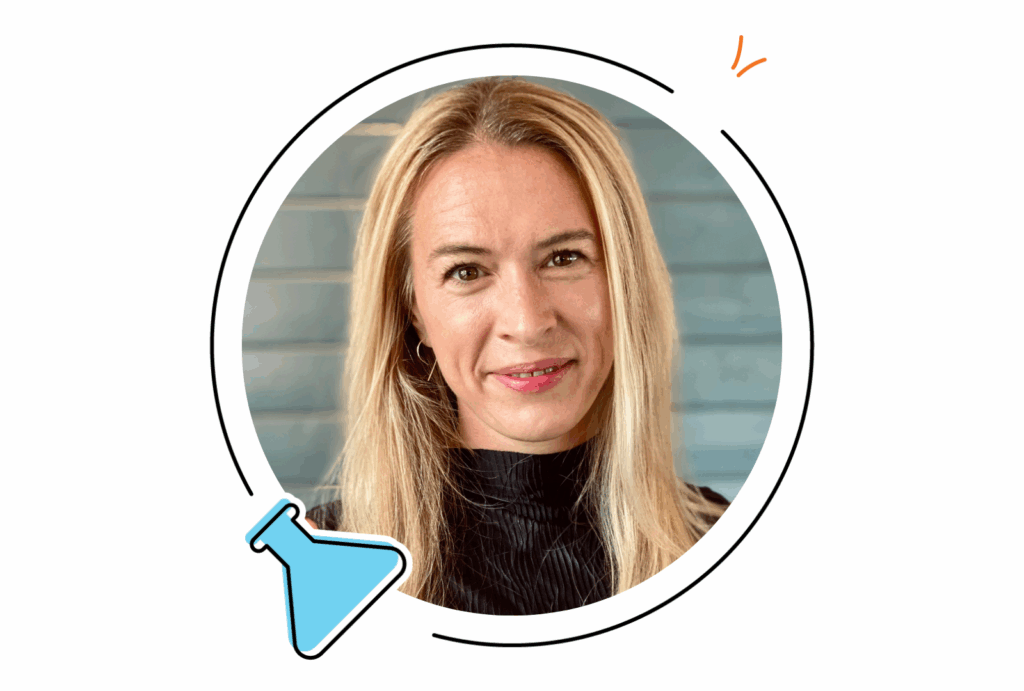
About Science Connections
Welcome to Science Connections! Science is changing before our eyes, now more than ever. So…how do we help kids figure that out? We will bring on educators, scientists, and more to discuss the importance of high-quality science instruction. In this episode, hear from our host Eric Cross about his work engaging students as a K-8 science teacher.
You might also like:

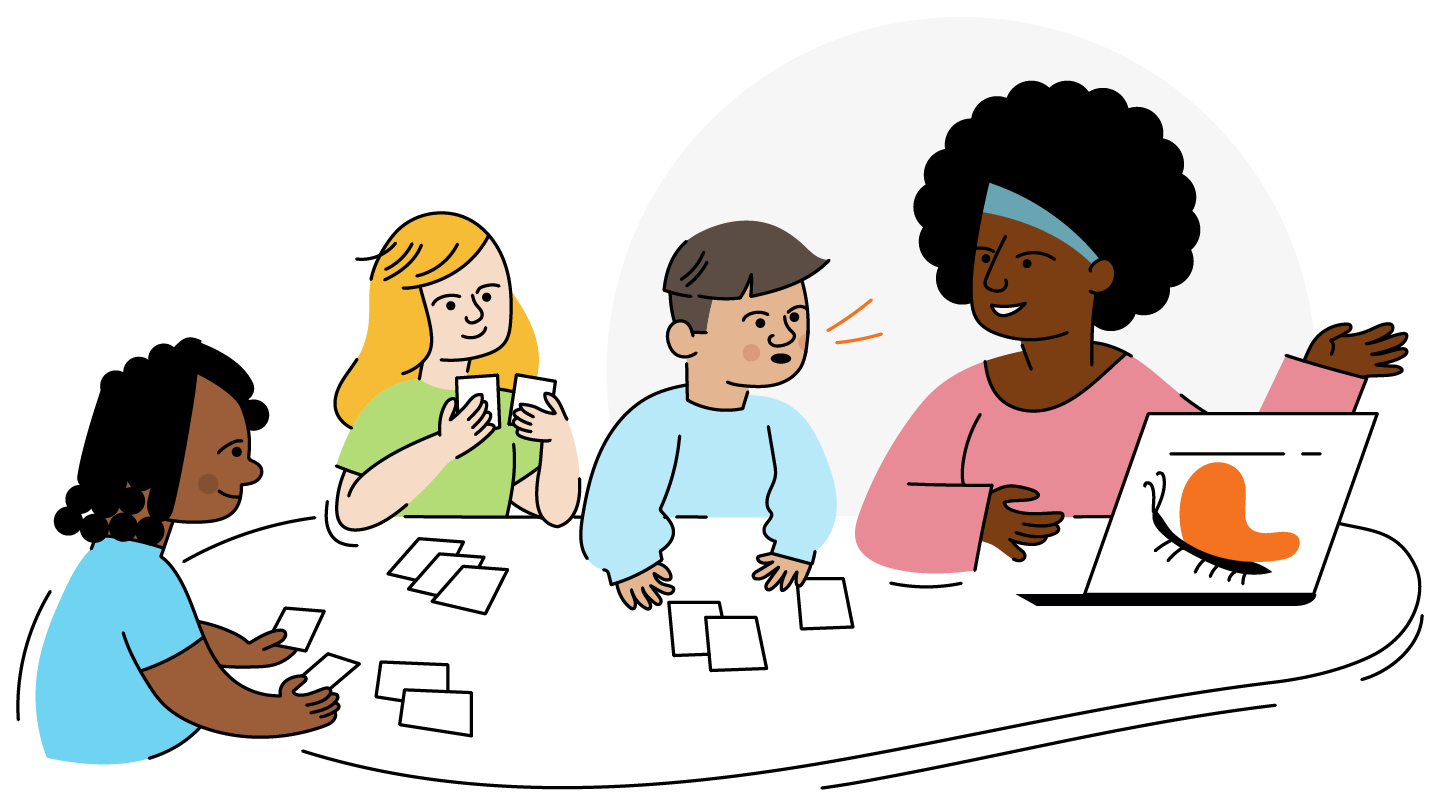
S1-10: Empowering the science educator: Jessica Kesler

In the final episode of the season, Eric sits down with his friend and professional development facilitator, Jessica Kesler. Jessica describes her passion for sharing free, high-quality, empathy-centered professional development for K12 educators. Jessica also shares her experience jumping into leadership positions while teaching in Philadelphia. Eric also chats with Jessica about how students often lean on teachers for more than delivering content. Explore more from Science Connections by visiting our main page.
Jessica Kesler (00:01):
One student at a time, isn’t gonna bring a million students through the door. But if we focus on their teachers, then they can implement it in their classroom and have this multiplicative effect that can continue on and help us to reach those millions of kids and helping them be prepared for future careers.
Eric Cross (00:19):
Welcome to science connections. I’m your host. Eric Cross. My guest today is Jessica Kessler. Jessica’s director of professional learning at TGR foundation, which is a tiger woods charity. There she creates and leads free stem, professional learning opportunities for educators across the country. Prior to working at TGR, Jessica worked as an elementary, middle and high school science teacher while fulfilling several leadership roles, including science department, chair and principal intern. In this episode, Jessica shares some of her classroom experiences while working in Philadelphia, where she was in classrooms, where her students needed her to be more than just her content. She also addresses how designing professional learning with empathy for teachers in mind creates better experiences for teachers. And now please enjoy my discussion with Jessica Kessler. So let’s, let’s start off with St. Joseph’s chemistry college to the classroom, like your origin story. What led you to ultimately get into the classroom and being successful, even just looking at, at your kinda like your resume or your CV of all of the things that you’ve done. You definitely weren’t idle, but start off with chem. Yeah. Like where did that passion come from?
Jessica Kesler (01:27):
Yeah. So when I was younger, I just had this burning passion to help people. Right. And when you’re young and you think about helping people, you think about doctors, doctors help people. Right. So I had this idea that I wanna be a surgeon. I wanna be a black surgeon. I wanna be a young girl, female Charles drew, and I just wanna go out there and do it. And so my mom is actually an alum of St Joe’s. So I spent a lot of time on campus cuz as she was getting her mini master’s degrees I will visit campus with her often. And so when I applied, I had the scholarships, had everything and I went in ready to be bio ready to be a surgeon. I took my first bio class and I was like, yes, let’s talk about the human body. And let’s get into dissections and sections. And they were like, okay, so a plant so has this. And I was like, Ooh <laugh> I was like, this is not what I was expecting at all. It just felt so detached from the trajectory that I wanted to take. And it just did not feed that passion of helping people in the immediate moment.
Eric Cross (02:31):
Did it, did it feel too abstract?
Jessica Kesler (02:33):
It felt abstract. It felt boring. Okay. And one thing I didn’t want was to be like stuck, bored. Like if I’m not being stimulated in a good way, mm-hmm <affirmative> then it’s not gonna last, but I love science. So I switched over to chemistry cuz I’m like this chemistry is exciting. I’m mixing things together. I’m producing new things. I’m doing extractions. I’m being introduced to machinery that I haven’t seen before. I’m loving it. I’m doing a math. The math is awesome. And so I switched over to chem and I started doing research in the summers and things like that. My research was around water quality in Philadelphia and looking at different natural water sources and comparing them and all those great things. But I was in a lab and the lab had no windows and I was stuck talking to this atomic absorption specter every day.
Jessica Kesler (03:24):
And I hit that, that wall again, where it was like, is this the rest of my life? Like talking to these machines and not having windows and not being able to interact with people. What is this? This can’t be life. And so I was seeking out some new opportunities that said, Hey, I need more money. First of all. So I’m like, I call the financial aid office like every week, like, Hey, what’s out today. What new scholarships do you have? I’m applying for everything. Like it was my goal to not have to pay for much of my education. And so I was talking to them and they’re like, Hey, you’re in science. There’s this awesome opportunity called a noise scholarship where they’ll pay for your last year and your master’s degree. If you go into education mm-hmm <affirmative> and I sat on it and I was like, this makes so much sense to me.
Jessica Kesler (04:12):
I was like, I’ve been literally tutoring my peers and teaching in churches and all this other kind of stuff. My whole life. It makes so much sense. How come nobody ever said this before? <Laugh> and so I applied for the noise scholarship, got in and started, you know, mm-hmm, <affirmative> doing practicums in the classroom as I went through my last year as a chemistry major and my first year for my masters and it just felt so right. And I was like, I can do this. And of course there were a lot of people who told me, no, Josh, you can’t do that. Like these kids will eat you alive. And I’m like I don’t think so. <Laugh> but, but that’s give it a go. And I stepped into the classroom and it, it just felt like, felt like it was always meant to be there.
Eric Cross (04:57):
So you were able to, you were able to make that connection between, I mean, if you’re, if you’re studying chemistry and bio and going into stem, I mean, there’s, there’s an aptitude there, but then you realize that this there’s a road that you could take that leads you into a room with no windows. And you’re just hanging out with machines all day
Jessica Kesler (05:14):
And I’m not helping people. Right. Right. And that was, my passion was like, I’m not helping people sitting in this room. I need to be a person that’s outside telling people about what happens in the room. Right. And how they can get involved and like what’s going on in here. Like that’s, that’s where I can be useful.
Eric Cross (05:28):
When you were, you were in Philly when you were teaching, what were you teaching when you were there?
Jessica Kesler (05:33):
So I started off teaching eighth grade science first job in north Philadelphia, teaching eighth grade science and just a, a funding tangent that first day a student called me a B
Eric Cross (05:44):
Trial by fire
Jessica Kesler (05:45):
Trial by fire called me out in front of like the whole floor. We were outside doing line drills and just was like, I hate you miss Kusa your B. And I was like, oh, this is it. This is it. This is where you stand your ground and you take it or you, you bail out <laugh> and you go back into the lab mm-hmm <affirmative>. And of course at the end of that, that traumatic experience between all the kids, like two months later, she wanted me to adopt her. So like everything comes full circles. Right.
Eric Cross (06:10):
That’s how it is. Right.
Jessica Kesler (06:11):
But I started teaching eighth grade science. There’s not a lot of science teachers at that level who actually have a science background. Most of them have elementary school background. So I’m the only scientist walking into the science classroom and saying, this is how science actually works. And so I ended up taking a lot of onus of science while I was there. Ended up building out the K through eight curriculum for science. I ended up doing like a science strategic plan to submit to the district. I ended up leading out our first couple stem nights and like really leading the stem department and kind of our science department. And this was as like a second, third year teacher <laugh> know, but nobody else had the science mm-hmm, <affirmative> the way that I had the science and the education. So it really opened up a door for me to be able to, to run full steam with all those things.
Eric Cross (07:04):
So MI was it primarily middle school during those, those years that you were there?
Jessica Kesler (07:07):
So there, I started with middle school and I did that purposefully because I was still young and I wanted there to be a good age gap between me and the students. And then I moved up to high school and taught high school chemistry, also taught a couple other different subjects while I was at that school. But primarily high school chemistry. Then I actually took a big leap down and I said, okay. I was going for my second master’s degree in educational leadership. And I was going for my principal cert. And I said, if I’m gonna be a principal of a school, then I need to understand all the levels of education and how they operate, cuz they operate really differently. So I said, I started in middle school, went to high school. I don’t have elementary school experience. In fact, I’d spent a day in a kindergarten classroom and I was like this never again, but I was like, I need to go back down there and I need to figure out how this system works because you know, I never know where I’m gonna land as far as principalship.
Jessica Kesler (08:01):
So I went and taught fourth grade.
Eric Cross (08:03):
How was that experience?
Jessica Kesler (08:05):
So imagine me going from teaching high school, seniors and juniors Uhhuh and like they’re self-sufficient and you know, they’re independent, they’re driving to school and all these things. And then I immediately drop down and go into fourth grade where these kids are crying every five seconds. They still have like a lot of bodily fluids, like there’s noses running and things. And like <laugh>, I was like a fish outta water. I was like, what is this? What’s going on down here. But those kids pour out so much love. And they, you, you become another parent to them. Mm-Hmm <affirmative> your high schoolers know who their parents are. They kind of are finding their place in society, but the little ones, they only know big people as parents, small people as equal. So they see you as another parent. So it taught me a lot about, you know, patience and breaking information down, even smaller. I had to figure out new and inventive ways to teach science and bring it down so far that they would be able to grab onto it and achieve it. And it was a challenge, but at the end it paid off, we were running, we were hitting like great markers for all of our PSSA goals that year. I mean, we were really knocking it out the park
Eric Cross (09:17):
And this backstory leads into how we met and adds to the picture as to why I really want to have you on, because your involvement with TGR, which is where I want to go next for the folks listening. I bet a lot of them have no idea what it’s about, just like I did. And now me learning about TGR foundation and meeting you I would love to make sure that everyone knows about it and what they offer.
Jessica Kesler (09:39):
Absolutely. So TGR foundation, a tiger woods charity was founded by tiger woods and his father with a mission to really introduced them education to students in low income minority populations and prepare them for success in their world and their future careers moving forward. And so was founded in 1996 and went through several changes in iterations since 1996. But eventually opened up its first learning lab, which is in Anaheim, California. And through the learning lab, they opened up these satellite sites. So they basically partner with schools to provide after school education and robotics and wearable electronics and things like that. And they would partner with schools to teach these courses after school, they would pay the teacher, pay for the materials and stuff like that to provide more opportunity for students in different areas. And so that’s how I was introduced to the foundation because while I was teaching high school my good friend and previous manager, Jason Porter shout out to JP Jason Porter used to lead the tiger woods foundation when it was the tiger woods foundation.
Jessica Kesler (10:52):
He used to lead the afterschool program. And when I joined that high school, he said, Jess, you got all this great content, knowledge, all this great enthusiasm, and we wanna get more women into this robotics. We wanna get them engaged in this process of, of stuff. And you will be a great role model to start bringing in more of our female students. And I was like, great, sign me up. And that’s where I started working with the TGR foundation, right after school programs, getting my students into robotics, competitions and clubs, doing different challenges and design challenges. And then after some time, a few years, they actually needed someone to come to the DC area and support the development of professional learning and partnerships here in DC, as they were continuing to expand. And really it came out of the idea that tiger gave this big mission to the organization that he wanted to reach millions of kids.
Jessica Kesler (11:48):
He said millions and everybody said, what millions, what M <laugh>. So the foundation was like, okay, well we can’t reach millions by just tackling one student at a time, right? Not one student at a time, isn’t gonna bring a million people or students through the door. But if we focus on their teachers, mm-hmm <affirmative>, then those teachers not only spend most of their day with these students and learn the basics of their skills with these students. But each one of those teachers has 30 to 150 200 students that they see every day. And that’s how we multiply this effect. So we train the teachers on all the stem competencies and the pedagogical tools and strategies to implement the stem that we’re doing in our learning labs. And then they can implement it in our classroom and have this multiplicative effect that can continue on and help us to reach those millions of kids and helping them be prepared for future careers.
Eric Cross (12:44):
And so D divide the effort, multiply the effects. Exactly. And then when I was exposed to it, this was over zoom. Now, how long has it been going on? Has it always been virtualized or did you do the, were you all doing this before? We all went online
Jessica Kesler (12:57):
Before the pandemic man, the glory days, right before pandemic, it feels like I’m talking about prehistoric times, right? Like back in the dinosaur, like era, like, I don’t know, pre we actually did these workshops in a person. So we would invite people to come to DC, invite teachers in Philadelphia to do a Philly one. We were in New Mexico. We were in Florida. We were, I mean, we were everywhere and this would be a extremely hands on engaging workshops. So not only do we focus on this is the theory and the philosophy behind the pedagogy, but we would also focus on like creating a student experience for the teacher, having the teacher flip into student mode and put on that student hat and actually go through sample lessons, model lessons and activities as the student so that they can feel it. So you can feel if, if you feel confused, your students are gonna feel confused.
Jessica Kesler (13:52):
If you feel like this is challenging, you, your students are gonna feel the challenge. If you are, don’t understand the instructions, your students will understand the instructions. So it gives us a different perspective and it puts us in their shoes. So we can better empathize with them and create more responsive lesson planning. So we flipped them into that student role for that purpose. When COVID hit, we went virtual, but virtual allowed us to reach teachers that we probably would’ve never hit. So it was kind of that blessing and disguise, right? It was like we didn’t keep people as long cuz obviously virtually you’re not, you don’t wanna stare at a screen for eight hours. So we cut it down. We revised it a little bit, but we kept the hands on philosophy and feel of it going by, you know, using materials that they could find at home really modeling what education could look like.
Jessica Kesler (14:41):
Mm-Hmm <affirmative> if you used your Z zoom room to capacity, or if you had these materials and resources or rethought your lesson plans and structures. So we went virtual and not only were we able to hit so many more thirst that first year thirsty educators ready to get, dive into it, ready for some comradery with fellow educators. But we were also able to expand our international network. We were able to get so many international educators through our global work that it was, it was beyond what we had when we were in person. So it really had this skyrocketing effect.
Eric Cross (15:20):
There’s professional learning pathways and then virtual stem studio. Is that right for professional development for like teachers who are listening, are those the two kind of main prongs?
Jessica Kesler (15:30):
Yeah. So a stem studio is basically just one, right? And a pathway is a collection. So we now offer four stem studios, four separate stem studios. The first one is on inquiry mindset. You attended that one area. And it’s really about for teachers who are changing their perspective on what the classroom should look and feel like, especially administrators too. It’s about developing that inquiry mindset. So you understand and you feel, and you practice and you learn the tools that are necessary for inquiry to happen in your classroom. We never promote overhauling your classroom. We’re just saying, add a little bit here and there and see how it impacts your students. The second one is on making inquiry, visible, making inquiry visible is all about making students thinking visible in the moment. What are tools and strategies that you use so that students can illuminate their thinking for themselves, but for you and their peers as well and how we benefit from that.
Jessica Kesler (16:28):
So not only do the students get to see their own thinking as they progress and you get to tell the story of how their minds have evolved, but you, as the teacher get to see, oh, this is where everyone is making the mistake, or this is how this misconception came about. Or this is where I need to target for my next lesson. So it makes you more responsive in the moment. And then the third and fourth one where we’re actually launching for a small group this summer, it won’t be available to the masses until maybe a year or two down the line. We have one small group that we’re just going to test it out with. The third one is about developing your inquiry environment. So thinking not just about your physical space, but thinking about your intellectual space too. So what are the things that you can embed into your physical space and develop in a student’s intellectual space that will help you create a holistic inquiry environment?
Eric Cross (17:22):
So this is this inquiry space, not just physical, but then also the intellectual environment
Jessica Kesler (17:26):
Intellectual. Exactly. And it focuses in on the design process and how we design spaces. Because as a teacher, we take a lot of background in the background onus of de creating these spaces. If you take someone out of an old habit or space and tell them, oh, we are gonna change in your minds and teach inquiry, but put them back in the same environment, they’re gonna be conflicted, right? Their bodies wanna do one thing, their minds wanna do another thing. And they don’t know how to bridge the gap between the two. So this is a really illuminating, like how do you change all the spaces? How do you design a flow in space in your classroom and in your students thinking that allows them to be productive in that inquiry environment. It’s really good stuff
Eric Cross (18:11):
Who creates these experiences for teachers.
Jessica Kesler (18:14):
We do. So me and my teammate, Holly, Dard shout out HD. Holly Dard, we really put our brains together and developed these. So it’s a really a team effort because like Jason Porter, Eric even David Tong when he was with us, really collectively thought about what it is that we wanted educators to experience. And then Holly and I do a lot of the grunt work, but then we really collectively put it all together and make it what it is. So I have a heavy hand and a lot of that. And in fact, inquiry four is all about the entrepreneurial mindset. So oftentimes educators don’t consider themselves entrepreneurs, but if you take a look at what an entrepreneur is and what they do on a regular basis, educators are entrepreneurs, but we are missing an opportunity to use our entrepreneurialship in the classroom to drive for stem competencies in inquiry based practices. And so in, in stem studio, four, we really focus in on how the educator is the entrepreneur of their classroom, but also uses entrepreneurial techniques to tackle issues in their schools, districts, and spheres of influence. So it’s really taking the educator to the next level of their teaching practice through entrepreneurship. This is some deep stuff.
Eric Cross (19:37):
It is, well, this entrepreneurial mindset is, is something that I’ve heard before. And I definitely see the link between even the term teacherpreneur beyond just selling lessons on teachers, pay teachers. <Laugh> it’s way bigger than that,
Jessica Kesler (19:52):
Where entrepreneurs actually in the classroom, not just because we do things on the side to make money. Exactly.
Eric Cross (19:57):
A lot of teachers hear that. They’re like, yeah, I got, you know, I got, got a few jobs going on. Exactly. Yeah. And, and I think one thing we, I should have said this earlier, and I’ll, I’ll say the intro, but these are all free.
Jessica Kesler (20:07):
This is largely sponsored by do OD stem as well. So we have a partnership with D O D stem and they have been driving forth the department of defenses, strategic stem plan for years. And as a part of that, they give us funding in order to provide these opportunities for educators for free. So literally educators don’t have to come with anything. And we are giving you not only the content of our, our lessons and our instruction, but we’re also going give you a chance to earn a free micro credential. So people are spending 12 plus hours with us in a workshop which sounds like a lot of time, but it’s over a series of time and days. But we wanna give you something that means something after that, we wanna give you a micro credential to add to your resume, to show your administrator, to show that you have achieved the next level in your professional learning career.
Jessica Kesler (20:59):
Right? And if you finish the pathway, which is all for, then we give you our TGR foundation certificate that says that you’ve completed so much professional learning in these areas that you are basically a warrior of inquiry that you are ready to go out and really lay inquiry out in new creative ways, not in your CLA just in your classroom, but everywhere you go in your district, in your school. And on top of that, we just offer so many other great free partnership incentives like discovery, education, experience licenses. We’re doing raffles this summer. We’re giving out free a free meal voucher so that you can get some lunch. One of these days we’re offering $50 gift cards so that people can get school supplies. So anything you do with us, and you’re like, man, I really wish I could have this so that I can do that in my classroom. We wanna break down all the barriers that prevent teachers from doing this stuff in their classroom, actively engaging in this stuff. And we give you a free copy of the books that we reference. Again, trying to break down the barriers,
Eric Cross (22:00):
What are some of the things that you’ve noticed kind of being on both sides of science teaching in the classroom, and then in training trends with teachers, things like moments that have been great or, or challenges that you’re noticing teachers experiencing, especially maybe changes in differences from a, from, you know, an outsider’s perspective. Seeing what teachers are experiencing are like, since you’ve been doing PDs for folks.
Jessica Kesler (22:22):
Yeah. So it’s actually really interesting being on both sides of the fence. You know, what I always noticed is that teachers are eager, but they’re tired. They’re wanting to learn, but they can’t take advantage of every opportunity to learn. And especially during COVID time, if you take a look at even all the professional learning that’s happening across the world right now, attendance is going down because teachers are so burnt out this hybrid space, this either we’re in person, but we’re still wearing masks and still social distancing and all this other stuff, or I’m still virtual or I’m virtual some days and I’m in person other days, it’s just wearing our teachers out. And I think we notice that as we see a large numbers of friends and family just start to retire, right? Like people are just like, I don’t know if I can adapt to another change in education.
Jessica Kesler (23:14):
Like education goes through these waves of big changes and it’s hard for everybody to adapt to, but for those who are willing to stick it out and those who are able to stick it out and, and still have that energy and enthusiasm to learn, they come in so hungry for more resources, so hungry to learn more and they still have their why at the top of their minds, as they think about why they do this it’s for the kids it’s to drive this mission is to get more kids excited about this. And they just come in so passionate. So once they come in, once we can get them to come in they stick with us for a really long time. They’re like, what else do you have? What else do you have? What else do you have? But we hear, still hear the common threads of like, do I have time for this?
Jessica Kesler (23:58):
Do I have the funding for this? Do I have the energy for this? Do, will my students understand this? And we are constantly facing that challenge of trying to address those things by, but keeping the excitement going, like we know you don’t have enough time. We’re gonna call it out from the start. I know you don’t have enough time to try to do 29 extra things. Mm-Hmm <affirmative>. But my advice is always, but do one thing at a time, start with something small, asking your students a few questions rather than lecturing to them. Doesn’t take a whole lot of extra time, but it gives you so much extra insight. So let’s not work, you know, harder, let’s work smarter. Let’s embed this into our, our work together. And I always say that we’re not asking you to add to your plate. You know, it’s not Thanksgiving where you just pile, keep piling on a plate.
Jessica Kesler (24:47):
It’s it’s a time where you organize the plate. It’s allowing inquiry to restructure your plate so that everything has its place and its time mm-hmm <affirmative> do you wanna leave room so that the educator feels comfortable trying some new initiative? That’s why we encourage admin. We have librarians attend elementary school teachers, administrators, we, and we encourage it because everyone can support the classroom. And if administrators are more in touch with these new practices and tools and strategies, then they can help facilitate the learning. As the teachers are trying new things and coaching them in specific areas. So we really opened the door for some studios, for any and all who are gonna participate in that child’s education, because us all rallying around them as that three-legged stool helps to create that environment and helps support the teacher. The teachers need support, and we’re trying to do our part by providing the resources and the tools, but they need everyone else to.
Eric Cross (25:42):
We don’t always think about it as a way to support, to get support in our classrooms for ourselves. But I agree with you by, by educating vertically up the chain, you know, vice principal, principal, whoever it is, mm-hmm <affirmative> superintendent getting them on boarding and, and educating them to see what’s ex expected. We’ll open up doors and more freedoms for you because now you just have this vertical alignment of folks kind of on the same wave length. Exactly.
Jessica Kesler (26:07):
Yep. And that’s why we love districts. Anaheim union school district is actually one of our partners this year, where they have invited their teachers to participate in the whole pathway because they know how important it is that we practice these tools and strategies. And they want as many educators in the same space going through this at the same time as possible so that we can support each other through it. And so that we don’t feel like islands, oftentimes as educators, we feel like islands we’re in our classroom day in and day out. And we don’t feel like there’s anybody else who’s doing the same things we’re doing and supporting the work that we’re doing. So when we get administrators who support it, it’s magical. It can be magical.
Eric Cross (26:47):
What are some opportunities that are coming up if somebody’s listening and they, they wanna sign up for something, are there things coming up this month or next month or in the summer that they can participate in?
Jessica Kesler (26:55):
Yeah, for sure. So we’ve been doing our monthly workshops. And if you go to our website, so if you actually go to TGR foundation.org and slash stem studio you’ll actually see our summer events already posted, already live for everybody to start engaging in. And again, everything is free. So registration is open and available for everybody to participate. We are offering that first inquiry stem studio inquiry mindset twice the week of June 21st and the week of June 28th, two opportunities for educators to join us for inquiry mindset for the first one. And then also in July, we’re offering the second one making inquiry visible, and that’s the week of July 12th. So again, all free stuff, raffle prizes are available for those who register early and get in there and reserve their seat. It is limited seating. And so, yeah, a bunch of opportunities coming up this summer and guess what all you have to do is sign up and then you get all these free things coming your way. You get to look forward to all this exciting stuff. So TGR foundation.org/studio.
Eric Cross (28:01):
And if folks wanna follow you in your career, your journey.
Jessica Kesler (28:05):
Yeah. I’m on Twitter and LinkedIn, for sure. And it’s Jessica Kessler, K E S L E R one S
Eric Cross (28:12):
I wanna honor your time. And as we close, you’ve been an educator of impact in, in your own classroom. And I know you’re still teaching actively now, and you’ve also made an impact on me and other educators through your professional development. And, and the last question I’d like to end with is who’s the most memorable teacher or learning experience that you had during K eight. When you think about you, your time in school, who was a memorable teacher or a moment that kind of stands out to you and what was it that they did that made them memorable?
Jessica Kesler (28:44):
It was that one teacher who brought me my first T I, 84. You remember when a new calculators came out, I had a teacher give me one amazing, but I think in high school, there was really a turn about where I had miss Caroline and Mr. Canello math and Spanish teacher. So two opposite wings of the, the education spectrum there. But most of all, they listened. They listened to me. I felt seen with those teachers, they supported me. They listened to me, they saw my potential. And they just rallied around me and continued to support me thereafter. Even afterwards, I continued to reach out to those educators. And I think that’s what drives me to be that force for, for my students. And I remember my most memorable heart touching education experience was probably, I had a high school student get interviewed by the newspaper.
Jessica Kesler (29:38):
And they were like, oh, what’s your favorite classes? And what’s your favorite this, and what’s your favorite of that? And he was like, well, I love chemistry, which is what I was teaching. It was like, and I love my after school robotics team. I was leading and I love this and this and this. And he basically listed all the stuff that I was doing that I was teaching and that I was leading in the school. And I was like this one student, literally out of all the classes and experiences he’s experiencing is really just calling out everything that I’m doing. And I feel like it’s because he felt seen, he felt heard. He was like, this person is listening to me. And no matter what space we’re in this teacher is, is there for me. And so I try to be that wherever I go, <laugh>,
Eric Cross (30:16):
It’s amazing how making someone feel seen and, and making them feel important and heard, and, and being present for them. All of a sudden opens up their interests into the subjects that you’re teaching. Thank you for, for making time for serving our kids for serving teachers during a hard time, and for making PD one, being part of an organization that made it free and serve teachers, but also making PD fun and enthusiastic. I think that was one of the things in addition to the empathy that you led with, but also your enthusiasm and passion was something that really resonated with me. And it made our time together. Feel like something that was, was making me a better teacher for my kids. And so, thanks for making time for us tonight. Oh,
Jessica Kesler (30:53):
Bless face.
Eric Cross (30:57):
Thanks so much for joining me and Jessica today. If you have any great lessons or ways that you connect with students, please email us@stemamplifycom.wpengine.com. That’s S TM amplifycom.wpengine.com. And please remember to support the podcast by clicking subscribe, wherever you listen to podcasts, you can also hear more about the podcast in our Facebook group, science connections, the community until next time.
Stay connected!
Join our community and get new episodes every other Tuesday!
We’ll also share new and exciting free resources for your classroom every month.
Meet the guest
In the final episode of the season, Eric sits down with his friend and professional development facilitator, Jessica Kesler. Jessica describes her passion for sharing free, high-quality, empathy-centered professional development for K12 educators. Jessica also shares her experience jumping into leadership positions while teaching in Philadelphia. Eric also chats with Jessica about how students often lean on teachers for more than delivering content.
About Science Connections
Welcome to Science Connections! Science is changing before our eyes, now more than ever. So…how do we help kids figure that out? We will bring on educators, scientists, and more to discuss the importance of high-quality science instruction. In this episode, hear from our host Eric Cross about his work engaging students as a K-8 science teacher. Listen here!

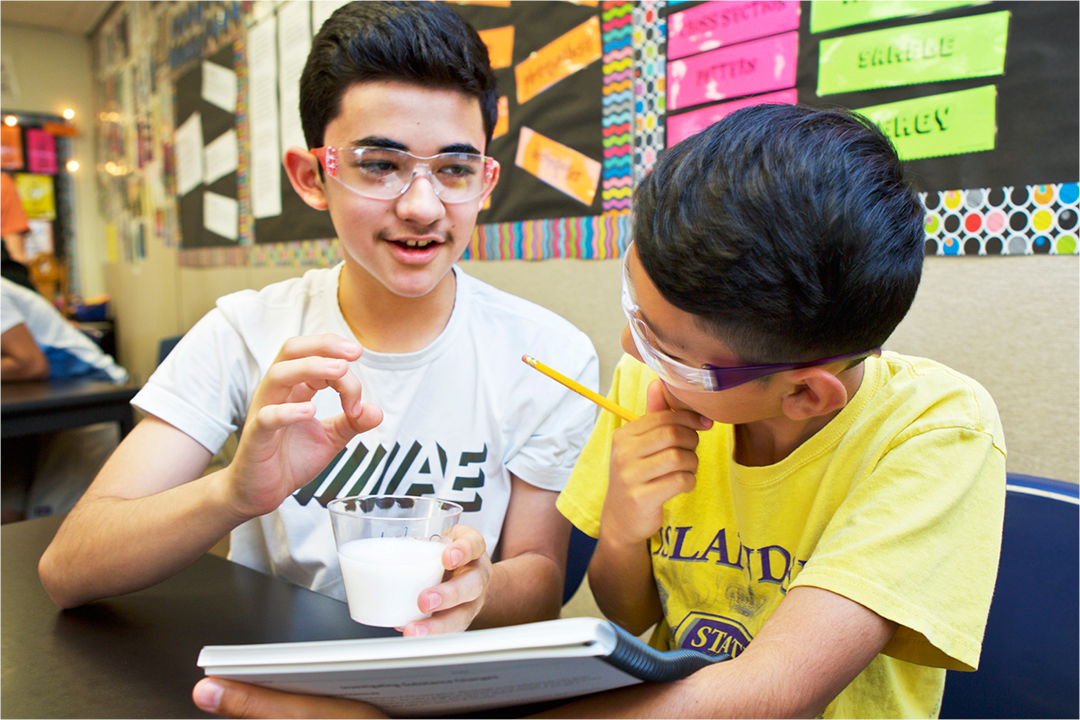

What’s included in our phenomena-based science curriculum
Amplify Science is a phenomena-based science curriculum for grades K-8. This program is designed to give students engaging, realistic experiences that mirror how scientists and engineers actually work. To do this, the Lawrence Hall of Science and Amplify created compelling print and digital resources that work seamlessly together to enable students’ investigations and explorations.
Year at a glance
Amplify Science is organized around units where students are introduced to compelling phenomena and real-world problems, develop and strengthen claims by collecting evidence and testing assumptions, and apply their learning in new contexts.
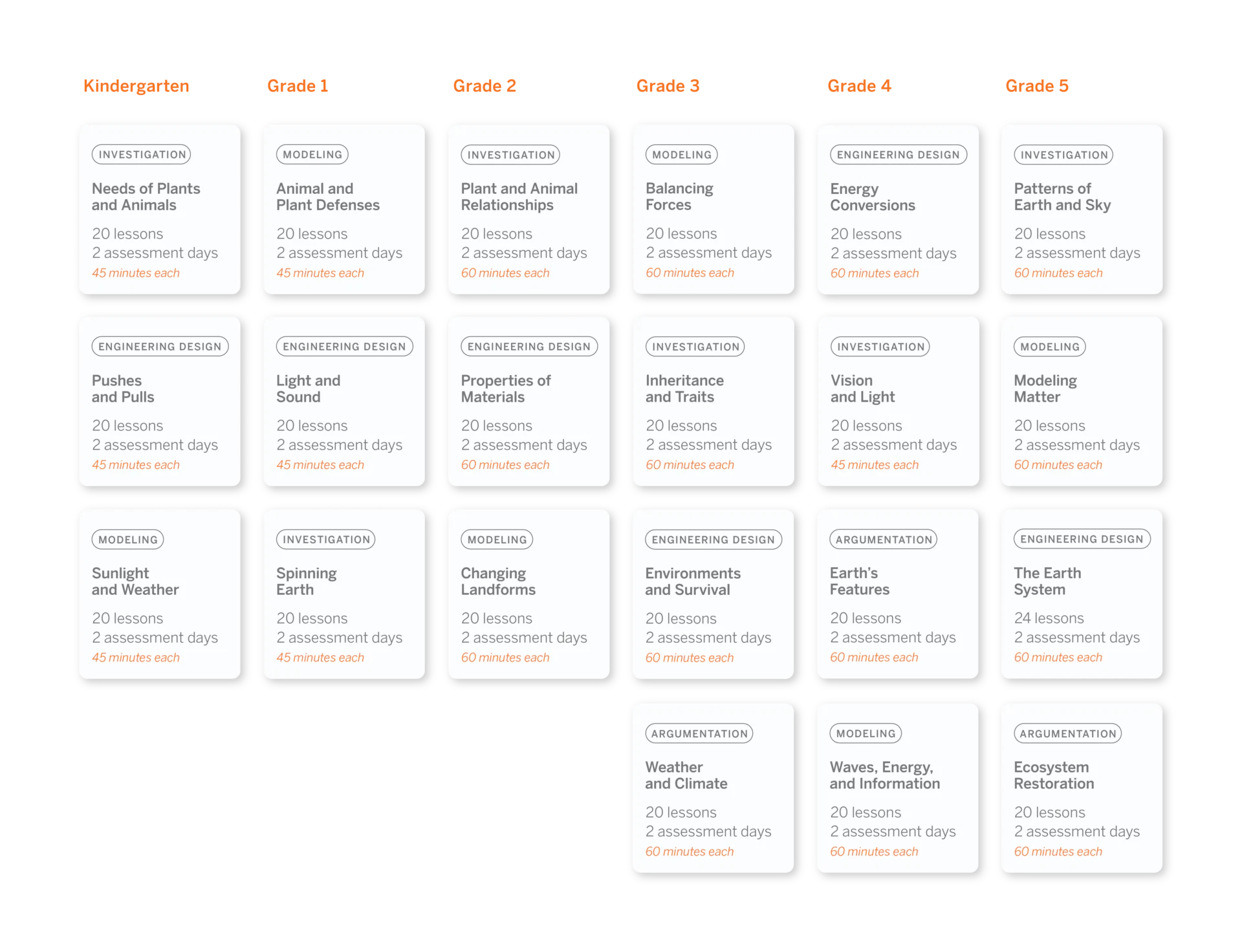
Units at a glance
In each Amplify Science unit, students are asked to inhabit the role of a scientist or engineer in order to investigate a real-world problem. These problems provide relevant, 21st-century contexts through which students investigate different scientific phenomena.
1
Needs of Plants and Animals
Students take on the role of scientists in order to figure out why there have been no monarch caterpillars in the community garden since vegetables were planted. They investigate how plants and animals get what they need to live and grow, and make a new plan for the community garden that provides for the needs of the monarch caterpillars in addition to producing vegetables for humans.
2
Pushes and Pulls
Students take on the role of pinball machine engineers as they investigate the effects of forces on the motion of an object. They conduct tests in their own prototypes (models) of a pinball machine and use what they learn to contribute to the design of a class pinball machine. Over the course of the unit, students construct a foundational understanding of why things move in different ways
3
Sunlight and Weather
The principals of Woodland Elementary and Carver Elementary need student weather scientists to help them explain why Woodland’s playground is warmer than Carver’s at recess. Students gather data from models of the sun and Earth’s surface and observe their own playgrounds to figure out how sunlight causes changes in the temperatures of different surfaces. Students then use models to figure out why Woodland’s playground sometimes floods.
1
Animal and Plant Defenses
Students play the role of marine scientists. In their role, students apply their understanding of plant and animal defense structures to explain to aquarium visitors how a sea turtle and her offspring can defend themselves from ocean predators when they are released into the wild.
2
Light and Sound
Students take on the role of light and sound engineers for a puppet show company as they investigate cause and effect relationships to learn about the nature of light and sound. They apply what they learn to design shadow scenery and sound effects for a puppet show.
3
Spinning Earth
As sky scientists, students explain why a boy living in a place near them sees different things in the sky than his grandma does when he talks to her on the phone. Students record, organize, and analyze observations of the sun and other sky objects as they look for patterns and make sense of the cycle of daytime and nighttime.
1
Plant and Animal Relationships
In their role as plant scientists, students work to figure out why there are no new chalta trees growing in the Bengal Tiger Reserve, which is part of a broadleaf forest. Students investigate what the chalta tree needs to survive, then collect and analyze qualitative and quantitative data to solve the mystery.
2
Properties of Materials
As glue engineers, students are challenged to create a glue for use at their school that meets a set of design goals. Students present an evidence-based argument for why their glue mixture will be good for their school to use.
3
Changing Landforms
The director of the Oceanside Recreation Center gets a scare when a nearby cliff collapses overnight. Research reveals that the distance between the Recreation Center’s flagpole and the edge of the cliff have changed over time. Students play the role of geologists and work to figure out why the cliff has changed over time. Based on what they learn about erosion, they advise on whether it is safe to keep the center open even though the cliff is changing.
1
Balancing Forces
People in Faraday are excited to hear that a new train service will be built for their city, but concerned when they hear that it will be a floating train. Students are challenged to figure out how a floating train works in order to explain it to the citizens of Faraday. They develop models of how the train rises, floats, and then falls back to the track, and then write an explanation of how the train works.
2
Inheritance and Traits
Students play the role of wildlife biologists working in Greystone National Park. They study two wolf packs and are challenged to figure out why an adopted wolf (“Wolf 44”) in one of the packs has certain traits. Students observe variation between and within different species, investigate inherited traits and those that result from the environment, and explain the origin of several of the adopted wolf’s traits.
3
Environments and Survival
In their role as biomimicry engineers, students work to figure out how the traits of grove snails affect their survival in different environments. They then explore how the traits of different organisms make them more likely or less likely to survive, collecting and interpreting data to understand how organisms’ traits affect their survival in different environments. Students then apply their understanding to a new challenge: designing effective solutions for the removal of invasive plants.
4
Weather and Climate
In their role as meteorologists, students gather evidence to decide where to build an orangutan reserve by analyzing patterns in weather data. After choosing the strongest evidence, students use data to make arguments about which of three fictional islands has weather most like that of orangutans’ existing habitats, Borneo and Sumatra. They then discern patterns in the locations of natural hazards in order to figure out which ones the Wildlife Protection Organization must prepare for.
1
Energy Conversions
Students take on the role of systems engineers for Ergstown, a fictional town that experiences frequent blackouts, and explore reasons why an electrical system can fail. Students apply what they learned as they choose new energy sources and energy converters for the town, then write arguments for why their design choices will make the town’s electrical system more reliable.
2
Vision and Light
As conservation biologists, students work to figure out why a population of Tokay geckos has decreased since the installation of new highway lights in the rainforest. Students use their understanding of vision, light, and information processing to figure out why an increase in light in the geckos’ habitat is affecting the population.
3
Earth’s Features
Playing the role of geologists, students help the director of Desert Rocks National Park explain how and when a particular fossil formed and how it came to be in its current location. Students figure out what the environment of the park was like in the past and why it has so many visible rock layers.
4
Waves, Energy, and Information
In their role as marine scientists, students work to figure out how mother dolphins communicate with their calves. They write a series of scientific explanations with diagrams to demonstrate their growing understanding of how sound waves travel. Then they apply what they’ve learned about waves, energy, and patterns in communication to figure out how to create patterns that can communicate information over distances.
1
Patterns of Earth and Sky
Playing the role of astronomers, students help a team of archaeologists figure out what the missing piece of a recently discovered artifact might have depicted. As they learn about the sun and other stars and the movement of Earth, students can explain what is shown on the artifact and what might be on the missing piece.
2
Modeling Matter
In their role as food scientists at a fictional company, students are introduced to the idea that all matter is made of particles too small to see, and that each different substance is made of particles (molecules) that are unique. They are then challenged to solve two problems: one requires them to separate a mixture, and the other requires them to make unmixable substances mix. Students are challenged to use the particulate model of matter to explain their work to the CEO of the company.
3
The Earth System
The cities of East Ferris and West Ferris are located on different sides of a mountain on the fictional Ferris Island. East Ferris is having a water shortage while West Ferris is not. As water resource engineers, students learn about the Earth system to help figure out what is causing the water shortage problem and design possible solutions, including freshwater collection systems and proposals for using chemical reactions to treat wastewater.
4
Ecosystem Restoration
As ecologists, students work to figure out why the organisms in a part of a Costa Rican rainforest ecosystem aren’t growing and thriving. As they solve this problem, students learn more generally how organisms in an ecosystem get the matter and energy they need to survive, and then write a series of restoration plans that include arguments about why the rainforest ecosystem is not thriving and recommend actions to restore its health.
Print & digital components
The program includes instructional guidance and student materials for a year of instruction, with lessons and activities that keep students engaged every day.
Component
Format
Teacher’s Guides
Available digitally and in print, the Teacher’s Guides contain all of the information teachers need to facilitate classroom instruction, including detailed lesson plans, high-level overview documentation, differentiation strategies, standards alignments, materials and preparation steps, teacher support strategies and in-context professional development, possible student responses, and more.
Print and digital

Hands-on materials kits
Hands-on learning is integrated into every unit of Amplify Science. Each hands-on activity is supported through clear instructions for the teacher, as well as easily accessible materials in unit-specific kits. Each kit contains hands-on materials, both consumable and nonconsumable, and various print materials (e.g., Vocabulary and Key Concept cards). With Amplify Science, students can actively participate in science: gathering evidence, thinking critically, making observations, and communicating their claims.
Kit

Component
Format
Student Investigation Notebooks
Available for every unit, the Student Investigation Notebooks contain instructions for activities and space for students to record data, reflect on ideas from texts and investigations, and construct explanations and arguments.
Print and digital
Student books
The age-appropriate Student Books in Amplify Science allow students to engage with content-rich text, obtain evidence, develop research and close reading skills, and construct arguments and explanations about the ideas they are learning in class.
Print and digital

Simulations and practice tools (grades 2+)
Developed exclusively for the Amplify Science program, these serve as venues for exploration and data collection, allowing students to explore scientific concepts that might otherwise be invisible or impossible to see with the naked eye.
Digital

Explore more programs
Our programs are designed to support and complement one another. Learn more about our related programs.



Featured blog post
What my wedding taught me about choosing curriculum
The right curriculum choice isn’t only about the product—it’s about who’s by your side from start to finish. Here’s how one district found that with Amplify CKLA.
By Kelly Pruitt, Instructional Facilitator, Peninsula School District | May 28, 2026

Explore more posts.


Amplify raises $215 million in a growth funding round from Learn Capital, A-Street Ventures, and current investor Emerson Collective
(Brooklyn, NY – October 26, 2021) Amplify, a publisher of next-generation curriculum and assessment programs, announced today it has raised $215 million in a growth funding round with Learn Capital and A-Street Ventures, joining current investor Emerson Collective in this round. The funding will accelerate Amplify’s remarkable growth in providing students and teachers with high-quality, digital-forward instructional programs and helping districts address unfinished learning from the pandemic. Rob Hutter from Learn Capital and Marc Sternberg from A-Street Ventures have joined the company’s board, currently made up of Emerson Collective Managing Director and XQ Institute CEO Russlynn Ali, Amplify CEO Larry Berger, Monarch Global Strategies President and CEO Michael Camuñez, Emerson Collective Managing Director Brad Powell, and former Secretary of Education Margaret Spellings.
Amplify currently reaches more than 10 million students in 4,000 districts across all 50 states, with a growing international presence. All three of Amplify’s existing core programs have garnered top ratings on third-party curriculum evaluation site EdReports.org, resulting in strong demand across the country, including in California, where Amplify Science was the lead publisher and won approximately 35 percent of the market in the most recent adoption. Digital supplemental program Amplify Reading also continues to gain traction, as does Amplify’s gold-standard early reading assessment, mCLASS®, which was recently selected as the K–3 formative and diagnostic assessment for North Carolina’s Read to Achieve program. By meeting the demand for research-based, technology-enabled programs, Amplify’s bookings have grown by 50 percent year-over-year for the last four years (2017-2020).
“Our educators and our students have been hit hard by the events of the last two years, which have only exacerbated existing gaps in reading and math skills. Amplify is working to provide the best resources possible to schools and districts while they work to recover and support all students in achieving at high levels,” said board member and former secretary of education Margaret Spellings. “We are deeply grateful for our new partners, their K–12 expertise, and their ongoing commitment to investing in the high-quality, digital-forward learning our students need now and in the future.”
Amplify plans to use the funds to make strategic acquisitions in best-of-breed education companies and to accelerate product development across its portfolio, with a focus on its digital supplemental programs.
“Amplify has experienced remarkable growth for six years in a row, is profitable, and is earning the trust of teachers and students. This moment is urgent for accelerating our ability to serve the needs of schools and districts. The magnitude of learning loss and the range of hybrid models for delivering instruction call for the kinds of products that Amplify builds,” said Larry Berger, chief executive officer of Amplify. “As impact-oriented investors, Emerson, Learn Capital, and A-Street Ventures raised a significant round in order to help us address these urgent needs by being a rapid reaction partner for districts across the country.”
Learn Capital, based in Silicon Valley, is one of the world’s leading venture capital funds with a dedicated focus on education technology and companies that leverage technology for better and smarter learning worldwide.
“We focus on finding the most extraordinary teams working in education, and Amplify is a natural fit,” said Rob Hutter, head of Learn Capital. “Amplify stands at the center of a profound shift in K–12 curriculum delivery that pairs an acceleration of digital learning with an unprecedented emphasis on quality in core instructional materials design. Amplify is uniquely positioned to benefit from both of these trends, and we’re thrilled to have this opportunity to participate in the company’s journey. ”
A-Street Ventures is a privately sponsored investment fund with a strategic focus on seeding and scaling innovative K–12 student learning and achievement solutions for students, families, and schools with a current focus on digital-first instructional materials in curriculum and new paradigms for student assessment.
“At A-Street, we believe education can serve as a powerful engine of mobility, and now is the time for big leaps forward in transforming how students learn and how teachers teach,” said Marc Sternberg, Founder and Managing Director of A-Street Ventures. “That’s why we are excited to partner with Amplify, a company that is lifting up the quality of daily instruction and leaning into digital-forward tools to accelerate learning.”
“We could not be happier to have Rob Hutter and Marc Sternberg join the team,” said Brad Powell, board member and managing director of Emerson Collective. “Rob and Marc each bring deep knowledge about K–12 education and share a long-term, impact-oriented vision to investment in this industry. They, along with their firms, will bring important new expertise to our governance, our network, and our brain trust. We are grateful to have such strong partners supporting Amplify’s future growth.”
About Amplify
A pioneer in K–12 education since 2000, Amplify is leading the way in next-generation curriculum and assessment. Our captivating core and supplemental programs in ELA, math, and science engage all students in rigorous learning and inspire them to think deeply, creatively, and for themselves. Our formative assessment products turn data into practical instructional support to help all students build a strong foundation in early reading and math. All of our programs provide teachers with powerful tools that help them understand and respond to the needs of every student. Today, Amplify reaches more than ten million students in all 50 states. To learn more, visit https://amplify.com.
About Emerson Collective
Emerson Collective deploys a wide range of tools—from impact investing to philanthropy to advocacy—in pursuit of a more equal and just America. Emerson focuses on creating systemic change in education, immigration, climate, and cancer research and treatment. To learn more, visit https://www.emersoncollective.com.
About Learn Capital
Learn Capital, based in Silicon Valley, is one of the world’s leading venture capital funds with a dedicated focus on education technology and companies that leverage technology for better and smarter learning worldwide. Since 2009, Learn Capital has backed extraordinary teams building market transforming services for every age and stage of learning, on nearly every continent. The company’s practice spans seed, early stage and emerging growth companies that are committed to the improvement of individual and societal capacities at scale, propelling the generation of inclusive prosperity worldwide. For more information and to view the fund’s portfolio, please visit http://www.learncapital.com.
About A-Street Ventures
A-Street Ventures is a privately sponsored investment fund with a strategic focus on seeding and scaling innovative K- 12 student learning and achievement solutions for students, families, and schools. A-Street intends to invest in a mix of early-, growth- and late-stage ventures, with a current focus on digital-first instructional materials in curriculum and new paradigms for student assessment. A-Street was founded because the time is now for big leaps forward in how students learn, and for what teaching and learning can look like; for lifting up the teaching profession by reorienting the teacher to his or her most sacred task: the human-centered work of facilitating learning; for leveraging digital-forward tools to accelerate learning; and for leaning into the surging digital access, breakthrough, and platforms that can transform at long last the Industrial Age classroom and into the modern hub of learning. For additional information about A-Street Ventures, please visit https://www.astreet.ventures and on Twitter @astreetventures.
Contact:
Kay Moffett
Chief Marketing Officer
kmoffett@amplify.com
Amplify announces new board member Michael Camuñez
Brooklyn, NY (October 21, 2020) – Amplify, a publisher of next-generation curriculum and assessment programs, announced today that it appointed a new board member, Michael Camuñez to its board of directors.
Camuñez serves as president and chief executive officer of Monarch Global Strategies LLC, a bi-national consulting firm providing strategic advice and advocacy to companies doing business in emerging economies, with a particular emphasis on Mexico and Latin America. Previously, Camuñez served as one of the nation’s leading commercial diplomats as the assistant secretary of commerce at the International Trade Administration, where he managed a global portfolio to help lead the U.S. government’s efforts to open new markets for U.S. goods and services. Prior to that, he also served as special counsel to the president at the White House.
“We are honored and excited to have Michael Camuñez join the board of Amplify,” said Amplify CEO Larry Berger. “His unique experience in political, legal, economic, and international worlds means he brings critical insight to our company as we continue growing and serving educators and students across the country and, in time, the globe.”
“Amplify’s mission to revolutionize education and expand access to learning through technology is not only exciting, it’s essential to help bridge the equity gap and accelerate learning for millions of children in the U.S. and around the world,” stated Camuñez. “I’m thrilled to be joining such an important endeavor with such a talented team.”
Camuñez joins Amplify’s existing board members: Russlynn Ali, CEO and co-founder, XQ Institute; Brad Powell, managing director, investments at the Emerson Collective; Margaret Spellings, president and CEO of Texas 2036; and Larry Berger, CEO at Amplify.
About Amplify
A pioneer in K–12 education since 2000, Amplify is leading the way in next-generation curriculum and assessment. Our core and supplemental programs in ELA, math, and science engage all students in rigorous learning and inspire them to think deeply, creatively, and for themselves. Our formative assessment products turn data into practical instructional support to help all students build a strong foundation in early reading and math. All of our programs provide teachers with powerful tools that help them understand and respond to the needs of every student. Today, Amplify serves seven million students in all 50 states. For more information, visit amplify.com.
Contact: media@amplify.com
Bridging the Divide: Elevating Student Literacy
Thursday, 4:30am UTC
What does it take to build confident, capable readers? In this session, discover how real-time data and targeted resources can help teachers meet the wide range of literacy needs of students in grades K–8. Hear directly from school leaders who’ve successfully implemented a structured literacy system and learn how they supported teachers, families, and students every step of the way.
Joining our webinar will be Lisa Matthes, director of curriculum at Christian Community Ministries, and Lisa Fenning, literacy project lead advisor at Catholic Education Tasmania. They’ll share their experiences guiding large-scale literacy initiatives, offering insights into how they supported teachers through the transition and built stronger outcomes for students across their schools.
Amplify Education welcomes executive Paul Griffin
Brooklyn, NY (February 24, 2020) — Amplify, a publisher of next-generation curriculum and assessment programs, announced today the appointment of Paul Griffin as vice president of strategic urban initiatives. In Griffin’s new role, he will partner with sales managers across Amplify and work with large urban accounts and superintendents. Griffin previously served as head of national partnerships at Lexia Learning and director of urban initiatives at Houghton Mifflin, where he built relationships with key urban school districts and decision-makers across the nation.
“Amplify is thrilled to welcome Paul Griffin to the company,” said Rita Schaefer, senior vice president and national sales manager at Amplify. “Paul’s extensive K–12 experience, strong record of success, and long-standing ties within the industry will allow us to deliver the dynamic opportunities that educators and students across the country deserve.”
At Lexia Learning, Griffin worked with sales teams and district administrators to bring learning solutions to schools nationwide; at Houghton Mifflin he was the organization’s trusted liaison to member districts of the Council of Great City Schools. He has a long history of participation with nationally recognized organizations such as the Council of Urban Boards of Education (CUBE), The School Superintendents Association (AASA), the National Alliance of Black School Educators (NABSE), and the Association of Latino Administrators and Superintendents (ALAS).
Griffin is a former advisory board member of the National League of Cities, Youth, Education and Families Institute. He holds The President’s Award from the National Alliance of Black School Educators, the organization’s highest honor, as well as the California Alliance of African American Educators’ Corporate Leadership Award. He has been listed in Ebony Magazine’s 100 most influential Black Americans. Griffin continues to have a strong interest in increasing educational excellence across the country.
About Amplify
A pioneer in K–12 education since 2000, Amplify is leading the way in next-generation curriculum and assessment. Our captivating core and supplemental programs in ELA, math, and science engage all students in rigorous learning and inspire them to think deeply, creatively, and for themselves. Our formative assessment products turn data into practical instructional support to help all students build a strong foundation in early reading and math. All of our programs provide teachers with powerful tools that help them understand and respond to the needs of every student. Today, Amplify serves five million students in all 50 states. For more information, visit amplify.com.
Contact: media@amplify.com
Join our User Research Community!
Help shape Amplify products.
Educators and students are at the center of what we do. That’s why we test our products with real users, visit classrooms across the country, and gather ideas and feedback from educators like you! This is how we ensure that we’re developing new products that meet your needs, as well as continuously improving our existing products to better support your classrooms.
That’s where our User Research Community comes in. This is a group of valued educators we look to for their expertise! They regularly participate in research and feedback opportunities and share their insights with our Product teams.
We hope you’ll consider joining Amplify’s User Research Community. When we have a study that’s a good fit for you, our team will reach out with details and next steps.

Why participate in user research?

Make an impact
Help influence and improve Amplify products by sharing your feedback and ideas

Get sneak peeks
Learn about new products and features that Amplify teams are working on

Connect with us
Share your thoughts and feedback directly with Amplify product development teams

Enjoy thank-you gifts
Receive incentives as a thank you for your time
What to expect
When you sign up to join the Amplify User Research Community, we’ll ask you some questions that will help us match you with research studies. When an opportunity sounds like a good fit, we’ll send you an email and share the details up front, such as study topic, research format, time commitment, and compensation. Then, you can decide if you’d like to participate.


Frequently asked questions
We’re looking for all types of educators to join our User Research Community: new Amplify users, power users, and everyone in between. We’re also looking for people who don’t use our products. If you work in a school setting or support schools, we want to hear from you. Here are some of the people we’d love to connect with:
- Classroom teachers (PreK–12)
- Biliteracy teachers
- Special education teachers
- Interventionists
- Coaches
- Curriculum directors
- School administrators
- District administrations
- Parents and caregivers
We have a separate research program for K–12 students. Learn more about our Playtesting program below.
Amplify runs a variety of research studies, and we’ll include the details of the study in our email. When you participate in one of our studies, you might be invited to:
- Talk to a researcher in a video call: Share your experiences with a specific product.
- Share your screen: Show us how you use Amplify’s products, try out a prototype, or test new features.
- Complete a survey: Answer questions about your current practices and/or preferences.
- Host a school visit: Have a few Amplify employees visit your classroom to observe our programs in action.
- Participate in a long-form study: These studies may involve a small commitment for several days or over a few weeks. You may be asked to review new materials or designs or to try something out in your classroom. Our researchers may ask you to respond to questions or take notes based on your experience using a product.
The information you provide will only be used to match you with suitable research studies and won’t be shared or sold to external parties. All data is stored on a secure server. See our Privacy Policy for more detail.
Amplify’s goal is to design welcoming product experiences. To do this well, it’s important for us to get feedback from everyone. We collect demographic information to help ensure that study participants represent the educators, students, and school environments we serve. All questions are optional and your information is kept confidential in accordance with our Privacy Policy.
You can opt out at any time by clicking unsubscribe in any of our research emails.
We typically offer e-gift cards as a way of saying thank you to those who participate in our research studies. We’ll include the exact details of the thank-you gift in the email invitation for the session. If your session is eligible for a thank-you gift card, you should receive it within five business days after completing your session. Please note that not all study participants will receive a thank-you gift.
Amplify Playtesting Program
A fun and empowering experience for kids
Students in our Playtesting Program provide feedback on new Amplify games and features as they’re being developed. Our researchers work one-on-one with students for 30 minutes at a time, inviting them to interact with new games and designs and gathering their feedback. We then integrate that feedback directly into our product development. It’s a chance for students to share their thoughts and ideas and have a real impact on the programs we’re building.

Who can participate?
Any students in kindergarten through grade 12 this school year can be part of our playtesting program, with parental permission.
What are the perks?
Aside from a fun time and a sneak peek at what’s in development, all students receive a $20 Amazon gift card for participating in a playtesting session.
When, where, and how do kids participate?
When playtesting needs arise, our User Research team will reach out to parents/caregivers to schedule a Google Meet session at a time that’s convenient for you and your child.
How can I sign my child up?
To enroll your student, please fill out this consent form. Your child will then be added to our playtesting program database. When a playtesting opportunity arises that we think would be a good fit, we’ll reach out!
Create transformation that lasts.
Embarking on educational change takes heart, intention, and determination. It also requires proven strategies and practical tools. With data, resources, and countless stories of successful implementations to guide us, we can take the first step toward true transformation together.


Principles for Educational Change Management
Whether you’re looking for transformative change in math, literacy, or science instruction, some essential principles apply across the board. As a teacher, administrator, or community leader, you’ll find these guiding principles can help you manage your new curriculum implementation and help each student reach their potential.

Leading instructional shifts across all disciplines

Make the shift to the Science of Reading.
Learn the key steps that will drive the success you need.

Change in math is different.
Managing change in math doesn’t have to mean starting over. It starts with a few simple shifts.

Be a science inspiration.
Intentional shifts help transform students into concerned global citizens ready to take on the world. Find out how.
Let data guide your transformation.
The right data at the right time is crucial in planning lasting instructional change. With specific metrics to guide your implementation, you’ll know exactly how to monitor your progress. Download our literacy assessment infographic as a model for the key data questions to ask at critical points in the school year.

Achieve implementation success.
Ready to navigate educational implementation with confidence? The following resources will help you discover practical strategies for decision-making, managing change, and engaging stakeholders.

Discover five steps to successful implementation.
Balancing decision-making, data collection, and transparent communication doesn’t have to be overwhelming. Discover the five essential steps to making implementation manageable.

Think like a leader.
Strategic leadership requires more than sharp management skills. Find out how the leadership brain model can help you, as a district leader, connect initiatives with your broader vision.

Turn plans into results.
Educational change requires intentional effort. Key leadership imperatives can provide the framework you need for effective implementation.

What district leaders are saying

What district leaders are saying

What district leaders are saying
Educational leaders share their success.
Find out how educational leaders have transformed their districts through successful implementation, revealing the commitment and strategic approach that led to real academic improvements.

Change needs commitment.
Change is achievable when everyone commits to the process. See how one district turned collaboration into a successful implementation of Amplify CKLA.

Existing strengths need focused direction.
Strong district foundations require intentional focus. Learn how systematic analysis helped one district turn comprehensive resources into meaningful impact for teachers.

Shared responsibility transforms implementation.
Managing implementation alone limits success. Discover how one district leader used stakeholder mapping to create shared leadership and building-level ownership.

See implementation in action.
Learn how one district achieved positive test results across grades 1–5 within their first year of adopting Amplify CKLA.

Strategic change delivers results.
Results happen when change is managed strategically. Check out how one district turned thoughtful planning into successful Amplify CKLA adoption.

Curriculum evaluation leads to confident decisions.
Explore how one district implemented Amplify CKLA (after piloting seven different programs!) and achieved powerful kindergarten reading gains.

Regular communication fosters growth.
Structured coaching support transforms implementation outcomes. Find out how regular communication helped one district achieve consistency and sustained student growth with Amplify CKLA.

Preparation creates lasting results.
Comprehensive training creates the foundation for sustained success. Read about how strategic summer preparation and ongoing professional learning helped one county achieve significant academic improvements.
Welcome, California Review Committees!

Leadership and literacy brunch with Natalie Wexler
with Amplify and Riverside USD
Thursday, February 27, 2020
9:30–11:30 a.m. PST
Location:
Benjamin Franklin Elementary School – Library
19661 Orange Terrace Parkway
Riverside, CA 92508
Registration deadline: Space is limited at this free event! RSVP by February 20 to secure your spot.
Who should attend: Supervisors, ELA and reading directors, curriculum coordinators, and principals.
About the event
Join us for a free brunch, author talk, and book signing with education writer and author Natalie Wexler on February 27 from 9:30–12 a.m.
During our time together, Natalie will discuss the latest research around reading, writing, and engagement in elementary school, along with the key findings of her book The Knowledge Gap: The Hidden Cause of America’s Broken Education System—and How to Fix It (2019).
As our guest, you’ll:
- Meet and hear from education writer and author Natalie Wexler.
- Mingle with other district leaders from Riverside USD and surrounding areas.
- Enjoy a delicious brunch with colleagues.
- Leave with a signed copy of Natalie Wexler’s book The Knowledge Gap: The Hidden Cause of America’s Broken Education System—and How to Fix It (2019).
Agenda:
9:30 a.m.: Arrive, check in, and visit our brunch buffet.
10–11 a.m.: Hear from Natalie Wexler
11–11:15 a.m.: Q&A with Natlie Wexler
11:15–11:30 a.m.: Book signing

Meet our featured presenter

Natalie Wexler
Natalie Wexler is an education writer and the author of The Knowledge Gap: The Hidden Cause of America’s Broken Education System—and How to Fix It (2019). She is also the co-author, with Judith C. Hochman, of The Writing Revolution: A Guide to Advancing Thinking Through Writing in All Subjects and Grades (2017) and a senior contributor to Forbes. Her articles and essays have appeared in The New York Times, The Washington Post, The Atlantic, and other publications. Before turning to education, Wexler worked as a freelance writer and essayist on a variety of topics, and as a lawyer and legal historian. She lives in Washington, D.C.
Submit this form to register for the event!
Leadership and literacy brunch with Natalie Wexler
with Amplify and Riverside USD
Thursday, February 27, 2020
9:30–11:30 a.m. PST
Location:
Benjamin Franklin Elementary School – Library
19661 Orange Terrace Parkway
Riverside, CA 92508
Registration deadline: Space is limited at this free event! RSVP by February 20 to secure your spot.
Who should attend: Supervisors, ELA and reading directors, curriculum coordinators, and principals.
About the event
Join us for a free brunch, author talk, and book signing with education writer and author Natalie Wexler on February 27 from 9:30–12 a.m.
During our time together, Natalie will discuss the latest research around reading, writing, and engagement in elementary school, along with the key findings of her book The Knowledge Gap: The Hidden Cause of America’s Broken Education System—and How to Fix It (2019).
As our guest, you’ll:
- Meet and hear from education writer and author Natalie Wexler.
- Mingle with other district leaders from Riverside USD and surrounding areas.
- Enjoy a delicious brunch with colleagues.
- Leave with a signed copy of Natalie Wexler’s book The Knowledge Gap: The Hidden Cause of America’s Broken Education System—and How to Fix It (2019).
Agenda:
9:30 a.m.: Arrive, check in, and visit our brunch buffet.
10–11 a.m.: Hear from Natalie Wexler
11–11:15 a.m.: Q&A with Natlie Wexler
11:15–11:30 a.m.: Book signing
Meet our featured presenter

Natalie Wexler
Natalie Wexler is an education writer and the author of The Knowledge Gap: The Hidden Cause of America’s Broken Education System—and How to Fix It (2019). She is also the co-author, with Judith C. Hochman, of The Writing Revolution: A Guide to Advancing Thinking Through Writing in All Subjects and Grades (2017) and a senior contributor to Forbes. Her articles and essays have appeared in The New York Times, The Washington Post, The Atlantic, and other publications. Before turning to education, Wexler worked as a freelance writer and essayist on a variety of topics, and as a lawyer and legal historian. She lives in Washington, D.C.
Submit this form to register for the event!
S5-03. Cultivating a joy of learning with Sesame Workshop
Listen as we chat with Dr. Rosemarie Truglio, senior vice president of curriculum and content for Sesame Workshop! Continuing our theme of math anxiety this season, we sat down with Dr. Truglio to chat about Sesame Street and her thoughts on how to spread a growth mindset to young children and put them on course to academic achievement and long-term success.
Listen today and don’t forget to grab your MTL study guide to track your learning and make the most of this episode!
Dr. Rosemarie Truglio (00:00):
Children don’t come with this math anxiety. Math anxiety is learned.
Bethany Lockhart Johnson (00:07):
Welcome back to Math Teacher Lounge. I’m Bethany Lockhart Johnson.
Dan Meyer (00:11):
And I’m Dan Meyer.
Bethany Lockhart Johnson (00:12):
Hello, Dan Meyer.
Dan Meyer (00:14):
Great to see you, Bethany. We are on episode three. Can you believe it?
Bethany Lockhart Johnson (00:18):
So, I feel like we’ve just started scratching the surface about math anxiety. We’ve talked to two amazing researchers. We’ve talked about what math anxiety is, how it’s often screened for some of the causes, some of the consequences … I mean, we’ve had some good conversations. Dan, what do you think?
Dan Meyer (00:38):
Definitely, I think that the consequences have only grown more dire in my head. I’m not sure how you feel about the consequences. But, you know, it is enough for me that we ask students to take mathematics for much of their childhoods, to worry about their anxiety, taking that. But to hear about from these researchers about all the different things that correlate with math achievement and math anxiety—talking about future careers, certainly, but even some other, more serious lifelong concerns? That gives me a lot of motivation to continue this study of math anxiety here with you on the show.
Bethany Lockhart Johnson (01:14):
It is really widespread. It has a big impact, not only on students, but on parents, on educators. You know, it’s—
Dan Meyer (01:23):
Multi-generational.
Bethany Lockhart Johnson (01:25):
Yes. And you know, so often when folks think of math anxiety, what I hear them say is, “Oh, yeah, in high school is when math really ramps up. That’s when anxiety starts.” But we know that it starts in our youngest learners. And our research has already backed that up. We know it. I’ve seen it in my classroom. You may have seen it with some students you work with. And let me tell you, it starts young.
Dan Meyer (01:52):
It does start early. Right now, I have a son that’s just started kindergarten, and he seems relatively math-positive, but we’ve known from our interviews on this show and other kinds of experiences that oftentimes, that feeling —that math is for me, and I am for math, and we are all friends — can turn on a single moment. It seems like one teacher says a thing that changes a student’s perception of themselves as a mathematician or of math itself. So I keep waiting with bated breath, hoping not to find that one moment that changes our current open posture towards mathematics. So now it’s time to really dive into some strategies for combating math anxiety.
Bethany Lockhart Johnson (02:34):
To help us out, we’ve called on a pretty exciting guest. I am so excited, Dan Meyer! We are being joined by Dr. Rosemarie Truglio. She is Senior Vice President of Curriculum and Content at Sesame Workshop. Sesame Workshop! As in, “Tell me how to get to Sesame Street.” Dan, I have to tell you, I spent many, many hours of my childhood watching Sesame Street. I have to ask, do you have happy Sesame Street memories? Is this part of your formation, Dan Meyer?
Dan Meyer (03:08):
At this point? In my advancing years, and the brain cells that I have left, Sesame Street is really kind of just a vibe in my head. But that vibe is such a pleasant one. One in which like nothing bad could happen. One in which learning is common and normalized and fun. And you just kind of feel at home, constantly.
Bethany Lockhart Johnson (03:33):
I don’t know about the “just the vibe” part, because for me, it is visceral. I’m there. I am actually … I mean, I might still be there.
Dan Meyer (03:42):
You could reenact some of the skits?
Bethany Lockhart Johnson (03:44):
. You didn’t watch Sesame Street with your kiddos when they were younger?
Dan Meyer (03:49):
We watched a lot of Elmo. A lot of Elmo. Yeah.
Bethany Lockhart Johnson (03:52):
Next-generation Sesame Street. Well, I think it’s so perfect that we’re gonna be talking about what Sesame Workshop does to help combat math anxiety and create a positive connection and relationship with mathematics. So I’m really excited to hear what Dr. Truglio and her team have been working on. And here’s our conversation with Dr. Truglio.
Dan Meyer (04:15):
Welcome to the show, Dr. Truglio. It is an honor.
Dr. Rosemarie Truglio (04:18):
Great to be here. Thank you for inviting me.
Dan Meyer (04:20):
You are Senior Vice President of Curriculum and Content at Sesame Workshop, which definitely sounds like the coolest job in the world to both four-year-old me and also Now me. Would you just help us help us with some backstory of how you ended up here, and what you do at Sesame Workshop?
Dr. Rosemarie Truglio (04:38):
Sure. It is a pretty cool job. And I am very fortunate that I’ve been in this position for the past 26 years. So, I am a developmental psychologist, and my job is to help Sesame Workshop identify curriculum needs, so that we could address them in the content that we create on the show and across our various platforms. So, Sesame Street is currently in its 53rd season. And we just, wrapped production for the 54th season, which we’ll debut next fall. And Sesame Street began with an experiment: Can television actually teach children school readiness skills, to have them better prepared for school? Especially those children who did not have access to formal education during the preschool years? And it is what we call a whole-child curriculum, because we’re dealing with all of the school readiness needs. So that that includes the academic needs, their social-emotional needs, and their health needs, as well as what we call these cognitive processing skills—how children learn content. Right? So it’s not just content skills, but how you approach learning and how you actually learn content. So as a grad student, I was fortunate to work at the Center for Research on the Influences of Television on Children. Very special center. It was at the University of Kansas. And my advisors, developmental psychologists, they studied the effects of television on children, both the positive effects and the negative effects. And so part of their research was to actually look at the longterm educational effects of Sesame Street. So I was working with Sesame Street content as a grad student, and then came to New York City. My first job was Assistant Professor at Teachers College, Columbia University. And when this position became available, Director of Research at the time, it was called, I took that job. And so my job was to oversee both the curriculum and the implementation of the curriculum, as well as the research. Because what we know, our co-founder, Joan Ganz Cooney has always said, for Sesame Street to be a successful educational program, production has to work closely with early childhood educators. They are the ones who know the curriculum and, and develop the curriculum goals, as well as the developmental psychologists who actually study how children are paying attention to the content. But more importantly, what are they comprehending from the content? And we all have to work together. Because even though we are the experts, the real experts are the children themselves. So nothing is deemed final until we actually show the children and see what they are learning from the content that we are producing.
Dan Meyer (07:54):
Are you referring to like, test audiences of kids then?
Dr. Rosemarie Truglio (07:57):
Yeah, I guess you could call it test audiences. I mean, I don’t. I don’t like to call it that because I see them as co-collaborators. I don’t see them as a test audience. Because, as I said, they’re the experts. It’s a collaboration. I mean, they’re the experts. And so I wanna know—
Dan Meyer (08:12):
As collaborators. I got it now. Yeah.
Dr. Rosemarie Truglio (08:14):
They help us. So that’s exactly what we tell the children too. So it’s called formative research. You know, we, we do what we call, um, storybook testing, an animated version of a storybook to have some little movement and see are they finding the story engaging, but more importantly, are they picking up on the intended educational lesson that we’re trying to teach in the story. So they are co-collaborators. they’re the ones who are helping us get the story just right for them.
Dan Meyer (08:46):
That’s really exciting, and makes me think about what classes might be like if students were regarded in that kind of lens as well. I just wanna say that my four-year-old self is on this interview as well, and is re-contextualizing all the stuff I saw as a kid. And it just felt like, at the time, you folks turned the camera on and went down to the street and we just had this real natural time. And it’s great to hear about all the intense preparation and co-construction at work and work that went into that time. Yeah,
Dr. Rosemarie Truglio (09:12):
It’s about a year preparation from start to finish. From the start of identifying, “What is the educational need? Is it an academic need? Is it a social-emotional need? Is it a health need? Is it a cognitive-processing need?” And then once we have the need identified, we have what we call a curriculum seminar. We bring in the experts who are studying this topic with preschoolers, because we wanna get it, we wanna get it right.
Bethany Lockhart Johnson (09:41):
Which, by the way, little behind the scenes: How often do you get to go to set?
Dr. Rosemarie Truglio (09:46):
So we’re in a production probably about six weeks out of the year. Covid really messed things up. ‘Cause we have to be really—we have very strict Covid protocols, but there is someone on my team—and sometimes we have to, you know, rotate for availability—but there’s always an educator on set.
Bethany Lockhart Johnson (10:06):
Awesome.
Dr. Rosemarie Truglio (10:07):
Because even though you stick to the script, questions arise; they wanna make changes; sometimes they have to cut; things are running too long and they have to cut and we gotta figure out where to cut. So there’s always an educator on set.
Bethany Lockhart Johnson (10:19):
But sometimes you go and have lunch, like—.
Dr. Rosemarie Truglio (10:21):
Oh, I go, yes. Sometimes I go—
Bethany Lockhart Johnson (10:23):
And just hang out with Big Bird, right?
Dr. Rosemarie Truglio (10:24):
Sometimes I go hang out with Big Bird. No, those are my friends!
Bethany Lockhart Johnson (10:27):
They are!
Dr. Rosemarie Truglio (10:28):
No, no, I go hang out with them. They’re my friends. Yes.
Bethany Lockhart Johnson (10:32):
When I think about Sesame Street and I think about … like, I can’t help but smile. Because I think I have such fond memories of the characters. I mean, we invited them, my mom invited them, into our home, right? And, you know, now I have a two-year-old and there’s no doubt that I’m gonna introduce him to Sesame Street. And I see how it really does feel like the folks who are doing this work, you and your team, you have a deep respect for children. So it makes sense that you call your test collaborators “collaborators,” right? They’re a part of it. And you know, I love that. And Sesame Street makes me smile. However, I’m like, we’re talking about math anxiety. And it’s so interesting, because as Dan and I were talking about our memories of Sesame Street … you know, it’s like Sesame Street feels like there’s not much anxiety. I mean, there are problems, and there’s problem solving, and it’s not like everything is perfect. But we figure it out. And it’s OK to make mistakes and it’s OK to try again. And a lot of times, we don’t see that in the math classroom—or at least, how folks talk about math. So, how do you all think about anxiety, about how to prevent it? Like, when you’re doing your work, you know that math anxiety is a real thing. But then that’s not translated in these experiences and the relationships with math that you’re building with your viewers.
Dr. Rosemarie Truglio (12:07):
Yeah, that’s a really good question, because it’s really easy, because our core audience are two- to four-year-olds and they love math. And what’s not to love, right? Because they are figuring the world out as they’re exploring the world. So you said something really interesting, that when you turn on the TV—when you turned on the TV when you were a child, and now you’re a mom of a two-year-old, we wanna make sure that the show represents content that is relevant and meaningful to our target audience. And that comes through with the characters. So all of our characters have very specific personalities, as all children do. And our characters represent all children, in terms of not only personality, but interest and learning styles, ’cause we wanna see—we wanna make sure that children see themselves in these characters. And we have a character who actually loves math. And he’s The Count.
Bethany Lockhart Johnson (13:12):
I’m like, “I know! I know who it is!” I will save you my impression. Although I have done it for my child. But I’ll save our listeners .
Dr. Rosemarie Truglio (13:20):
And you know, he’s an adult character. Some of our characters are preschoolers, like Elmo and Abby—they’re preschoolers—and Zoe. But The Count is an adult. He lives in the castle and he just loves numbers. But what’s really important is while we have The Count to explain—not explain to, but to portray to children, cause we don’t explain anything; we show children that math is more than number, right? Math is a pretty wide concept. Which is what I love about math. And the other thing about math is math language. The language of math. ‘Cause when we’re teaching children vocabulary words, we’re also teaching children the concept. Be it a math concept or a science concept or a social-emotional concept. So children don’t come with this math anxiety. Math anxiety is learned and it’s unfortunate. It’s picked up by their observations of the adults in their lives, who sometimes say out loud, “I don’t like math,” or “Math is hard,” or even worse, “I’m not good at math.” Or may even label it as math anxiety. That word won’t mean anything to a young child. But it then provides a, whaddya call it, like a negative valence for something that they never felt negative about. Because as they’re growing and interacting with the world, math is all around them. And there’s that sense of awe and wonder and joy, especially as they’re learning and they’re figuring it out. So I think we have to reframe math. Instead of saying “math anxiety,” we have to talk about the joy of math and all the wonderful joys that come with the exploration of these math concepts. Number is great. We know kids love numbers. We know that they love to count and use a big word here: enumerate . Because so many parents don’t make this distinction. They’ll say, “Oh, my child is counting!” Well, there’s rote counting, 1, 2, 3, 4, 5, 6, 7, 8, 9, 10, which is important. But then it’s like there’s an item for each number. So it’s one Cheerio, two Cheerios. And then as you point to each number, you are then figuring out what the set is, of the number of objects that you have. And then you get at what I love to call the meaningfulness of math. Right? Number has meaning. And as I said, it’s all part of your everyday activities. It’s part of—it’s in your kitchen; you’re following recipes; you’re measuring; you’re weighing. It’s at bath time, right? You could have the sorting of nested cups and you could, you know, and once again, the math language: big, bigger, biggest. These are relational concepts. You could then count what sinks and what floats, if you’re doing science. And then you could put them in two different buckets, and count. These are the items that sunk and these are the items that float. So math and bath time could be a lot of fun. And then there’s math and music. Music is so rich with math, as you talk about rhythm and tempo and dynamics and pitch and duration. That’s all math.
Bethany Lockhart Johnson (16:57):
The way that you talk about it, it is so rich, right? It is so multi-layered. And you know, I’ve shared on the podcast before: I’ve actually had parents in parent-teacher conferences say that, “Well, I wasn’t good at math either,” or “Math’s really not my thing.” And it’s really—it is, it’s rooted in that fear. And so I do see the way that you’re talking about it; I see that come through in Sesame Street. That, in a lot of ways, it’s reeducating parents, right? Because we hope that our caregivers are sitting next to their kiddo and enjoying it together and having conversations about it later. And there’s a way that parents then are also getting their own sense of what math can be, expanded. And I think there’s such a beauty in that. And I love the way that you talk about that, that you really are looking at, “Well, we wanna celebrate counting and the joyfulness of that. And let’s use math talk, you know, and let’s use these words and try out these ideas.” And it’s not because you’re trying to check some list. But you’re really exploring it and having fun together.
Dr. Rosemarie Truglio (18:03):
And you’re embracing it. And you mentioned the word “mistake.” So often when it comes to math, if you make a mistake—you make a mistake in counting or, you know, we’re not doing a lot of math equations on Sesame Street, but that’s when people feel like they can’t do math. ‘Cause they made a mistake. And that’s something that we are trying to address on Sesame Street, that it’s OK to make mistakes and you learn through mistakes. But you have to have—and I’m gonna come up with this other phrase now—you have to have what we call a growth mindset. What that means is that I may not be able to do this yet. Like, it’s called “the power of yet.” So we know that learning any concept, it takes time and practice. And how do we have children embrace the process, right? So often we focus on right and wrong. Now, there is right and wrong with math, of course. You know, there’s a right answer and there’s a wrong answer. But how do we focus, not on the end product, but the process through which you are engaging in? So let’s talk about measurement. Let’s talk about measuring the length and the width or the height of something. You might make some mistakes along the way, but you’re processing it. My son used to make all of these little structures for all his little play animals. Well, you know, he would measure and think he got it right. And then when he put the animals in, of course, you know, either the animal was too wide or it was too tall. And he would have to redo it. But you’re not redoing it from scratch, you’re redoing it now from experience. “I realize that if I’m gonna put the giraffe in with the elephant, I’m gonna need something wide as well as high.” Right? For the length, tall. And that’s process. And then, for children, when they figure it out, that “oops” and “aha”—the “aha” was like, “I did it!” And it’s so empowering, you know, giving them agency—not swooping in and saying, “All right, I’ll fix it for you. You know, we got the wide elephant and the tall giraffe and I’ll you know…”. NO! Having them do it. And another fun activity is in what we call informal measurement. And that’s like getting something of an equal size. It could be paper clips or it could be same-size blocks, and then measuring how long something is. So if it’s measured by blocks versus paperclips, you’re gonna have a lot more paperclips than you are blocks. And that kind of comparison is so fascinating for children. And so that’s measurement. And now we have counting. Like, how many paperclips long is something versus how many blocks long is something.
Dan Meyer (21:02):
So checking my understanding here, you’ve talked about how caregivers and other adults can transmit math anxiety by naming it and claiming it for themselves. And you’ve talked about, some really exciting ways that adults can involve students and kids in different kinds of math. I’d love to go upstream with you a little bit and wonder out loud, where does this anxiety come from initially? It’s gotta be more than adult one to kid two talking about anxiety, and transmitting it from human to human. What is the original spring from which all this anxiety flows?
Dr. Rosemarie Truglio (21:36):
Yeah. I do think it does—a lot of it does come from the adults in their lives. It’s unfortunate, because there is a lot of math talk about it, right? I can’t do math; I’m not good at math. Even when you’re at a restaurant and you get the bill and someone’s figuring out the tip, I can’t tell you how often it’s like, “Pass the bill, because I can’t do math.” Or if you actually then bring gender into it, you know, “Oh, girls aren’t good at math,” and that’s not true. There’s no evidence of that whatsoever, right? So in the younger grades, there’s no gender difference in terms of math ability. What’s also interesting about even socioeconomic status differences, you don’t see a lot of differences between low-income and middle-income children when it comes to math skills. Where you see differences is children’s ability to talk about their mathematical thinking. So if a child doing a math problem is asked, “How did you solve the problem?”, low-income children don’t often have the language to explain their thinking. So that’s something that we did on Sesame Street, where we focused a lot on what we call math talk. So, not just show number and show doing math, but actually narrate and giving the language. Because math literacy is one of the predictors of overall school achievement. So there’s that. They’re getting it from the adults in their lives. They’re getting it, unfortunately, sometimes from their teachers. But I think the anxiety comes from the fear of making mistakes. Because math, there is right and wrong, and always wanting to get the right answer. So that’s why this whole idea of reframing, and saying, “But really, it’s in the process.” So, you know, my son, math is not his strong suit. And I’ve been doing a lot of growth mindset with him as well. And there was a teacher that he had—I think in like 10th or 11th grade—who said, “In a test, I don’t wanna—I’m not even gonna look at the answer. I wanna see the process through which you GOT to this answer. And I’m going to grade the process. So the process could yield a right answer; it could yield a wrong answer. But you’re gonna get graded on the process. Because I wanna see how you are approaching the problem and how you’re thinking it through.” And I think that is a great example of, maybe, to try to reduce math anxiety. Because if you can get people excited about the process through which you’re learning—and that applies to all subjects, it’s not just math!
Bethany Lockhart Johnson (24:36):
I’m like, that applies to life! Right?
Dr. Rosemarie Truglio (24:38):
That applies to life!
Bethany Lockhart Johnson (24:39):
That’s so spot on. Wow. Yeah.
Dr. Rosemarie Truglio (24:41):
But I think that there’s so much focus on right and wrong, and not really understanding the value of the process. So on Sesame, we’ve been doing a lot of “oops” and “ahas.” You know, we’re gonna make mistakes, but what’s important is what do you DO when you make a mistake? So there’s a great episode with The Count. A couple of years ago. The Count was counting. Something he does every day. A lot of time, every day, ’cause he’s obsessed with counting and numbers. And he was counting an array of items.
Gladys the Cow (25:17):
I need 10 sandwiches all together.
The Count (25:22):
Well, of course.
Dr. Rosemarie Truglio (25:23):
And he made a mistake.
Elmo (25:25):
The Count?
The Count (25:25):
Hmm?
The Count (25:25):
Elmo thinks The Count made a little mistake.
The Count (25:31):
No mistake.
The Count (25:32):
Mm-hmm. Yeah.
Dr. Rosemarie Truglio (25:33):
And first time ever, did he make a mistake. And he fell apart.
The Count (25:38):
I must make sure that that never happens again. So I shall never count again.
Dr. Rosemarie Truglio (25:46):
And that’s an example of showing that, you know, you could get upset when you make a mistake, but what’s important is you gotta come back and you gotta come back to doing what you love. In his case, is counting and letting him know that it was an “oops.” But you learn that mistakes are OK. It’s OK to make a mistake and continue to do what you love.
The Count (26:13):
I must keep trying and you should, too.
Elmo (26:17):
Yeah!
The Count (26:17):
So come, let’s count the carrots together!
Elmo (26:18):
Oh, cool!
Bethany Lockhart Johnson (26:19):
And what a beautiful gift to show kiddos. Show that to kiddos, right? And to the adults. I wanna, you know, really acknowledge it, and say, “Hey look this, it’s OK.” And again, you’re giving them that language. That’s such a gift.
Dr. Rosemarie Truglio (26:34):
Thank you.
Dan Meyer (26:34):
We spend a lot of time wondering why other subjects don’t seem to suffer from this negative perception. And I think you’ve unlocked a lot of that. You’ve mentioned that there are issues that cut across different subject areas, but I think from my own experience and research and interviews, it seems that in ELA and the social sciences, there’s this aspect where you need to come up with a claim and “how are you seeing this?” And there are multiple defensible claims. And I love how you imported that generous pedagogy over into math with this example of a teacher who says, “You know what? It’s about the process here.” Disassociating answer and process.
Dr. Rosemarie Truglio (27:09):
And I think the other thing is like, when children are engaged in a project, for parents to point out: “You’re doing math!” Because they don’t realize that they’re doing math. Once again, math is so often equated solely with numbers and mathematical computations. So it was really interesting—the same is true for science. You know, when we’re talking to parents about the use of everyday—like, going to the supermarket or making dinner or bath time, there’s so much math and science in the everyday. And then when you point it out to them—”you’re doing math”—it’s like, “I’m doing math!” Like, you’re setting the table for a family of six: you’re doing math. That’s called one one-to-one correspondence. “I’m doing math: I’m setting the table.” Yeah, but you’re doing math. You can’t set the table because you have to know how many people are gonna be sitting at the table for dinner. You can’t follow a recipe without doing math. You can’t go shopping without doing math. There’s quantity; you gotta figure out how many peppers you gotta buy, or pounds. “I gotta get a bunch of potatoes and I gotta put ’em in the scale. And I have to get two pounds of potatoes.”
Bethany Lockhart Johnson (28:29):
So your book Ready for School: A Parent’s Guide to Playful Learning for Children Ages Two to Five. First, as a parent of a young toddler, I gotta say it’s such a tool; it’s such a resource. It’s very conversational. And I think about these ideas a lot, both in my work and, you know, just for fun. And yet, even if this wasn’t my chosen field, I still feel like it’s just so accessible. And I wanna flag something.
Dr. Rosemarie Truglio (29:01):
Thank you.
Bethany Lockhart Johnson (29:01):
Yeah, no. Thank YOU. . I wanna flag something that you said in the math chapter You were talking about the joy of math, and you said when it comes to our children, caregivers: “take pleasure in reading stories together, especially at bedtime, which in many households is a regular part of a child’s routine. But somehow the notion of introducing math concepts to our children seems daunting. In fact, some studies have shown that parents harbor a strong belief that while it’s important and pleasurable to support their child’s reading skills, it’s the responsibility of the schools to take care of teaching math.” And that quote, I highlighted it, I starred it! And I would love for you to say a little more about that, because you have given us already, like, a bounty of ideas that as caregivers we can do with our kiddos or the kiddos in our lives. And we’ve seen that even what they’re learning in school, it may not be the freeing, joyful math language that we hope our kiddos have access to.
Dr. Rosemarie Truglio (30:05):
Yeah, I’m glad you brought that up. Because a lot of our focus is on how children learn through playful experiences, and how they learn through play in particular. And there are so many playing, either a game or even playing ideas—like we talked about building, you know, a house for animals or building a fort. It’s just so filled with math. And I wish I could narrate for every young parent how I would hope that they would talk as they are co-engaged in this activity. And I think … we asked about, with the anxiety, the adults have to find the joy in math first. They have to see the math. That’s the problem. That’s why I hope that my book provides that. I want you to know that you are doing math and I want you to know that your child is what we call a mathematician—or in the science chapter, is a STEMist. Your child is already doing science, technology, engineering, and math. STEM is so integrated. So to acknowledge them—because babies are doing math! Babies know, they can distinguish between a small quantity and something that is a of a larger quantity and want the larger. Right? So, it’s natural for them. And they are taking it all in. I mean, the joy of watching a child just early counting: you know, one, two. And trying to then figure out the meaningfulness of two. It’s not three objects. There are actually two. And for a parent to see the joy in that I think is step one. And then to see the richness and how expansive math is, and that power of, oops, “I made a mistake, don’t freak out,” and then [not] say, “See, I’m not good at math,” but say, “Let me try again. I know I could figure this out.” Right? It’s all of that supportive language and supportive experiences that builds this mindset, a positive mindset. So that you hope that when you get into the higher grades, they’re not walking in and saying, “I can’t, I can’t do math.”
Dan Meyer (32:26):
Yeah. Super helpful. I think you point at one of the grownups—great powers in the world of kids, which is to label. To name things. And you know, you’ve talked about how grownups should ideally downplay some of their negative experiences with mathematics for the sake of the kid, but also to play up the positive stuff that they’re doing as mathematics. Like that right there, that’s math. I would love to know … you have an extremely loud megaphone to communicate messages about math and the world and everything through Sesame Street. One of the biggest that there is—and I just wonder if you could step out and imagine you had a magic wand to wave over the world in which students grow up, play and learn—what would you do like to help students have better associations or less math anxiety? And, you know, learn more about math itself?
Dr. Rosemarie Truglio (33:19):
If I had a magic wand, I would give everyone what we call a growth mindset that nothing is fixed and everything can be changed if you put the time and effort into the process, and enjoy the process. The joy of learning. I think, you know, it’s really sad. I don’t wanna be sad on your show. But when we were getting ready for the 50th anniversary, I was wondering, “What is gonna be the curriculum focus?” You know, we just came off of literacy and math literacy and social-emotional development. And we talked about the power of play. Playful learning. And building careers. Give children sophisticated play scenarios so that they could explore what they may wanna be when they grow up. Because there’s a concept: If I can see it, I can play it, I can be it. Right? So where are those portrayals? And it’s like, “What are we gonna do for the 50th?” And I had a convening of experts across all disciplines, and brought them into a room. And I said, you know, “What keeps you up at night? Like, what are you worried about?” Sort of like the State of the Union of Child Development. And this is where the sad part is. They talked about how that sense of joy, that sense of wonder, that sense of curiosity, that sense of flexible thinking and creative thinking, was disappearing in early childhood. Wow. If it’s disappearing in early childhood, we are in big, big trouble . ‘Cause I could see it disappearing later on, you know, as you advance in grade. But what do you mean, it’s disappearing in childhood? And then they talked about the fear of making mistakes. And that goes against—it’s the opposite of a growth mindset. And so we have to bring back that sense of joy, wonder, asking those why questions and embracing them. So it’s another problem parents have. They’re fine with the “why” questions until the “whys” become so difficult they don’t have the answers. And then they don’t want the “why” questions, because now they feel like they’re not smart enough to answer their child’s “why” questions. How do I flip that around to be much more positive and say, “You know, I don’t know! But let’s find out together. Let’s explore together; let’s experiment together.” That’s what I mean about the shift in the mindset, that growth mindset. We should not know all of the answers, but where’s the joy of, “Wow, I don’t know, let’s go find out together”? And that applies to math too. But you have to have that open mindset. You have to—you, as yourself, have to have that growth mindset.
Bethany Lockhart Johnson (36:20):
I love that magic wand. I want that magic wand! And I think what—like Dan said about this megaphone, this opportunity to reach so many young people, so many caregivers—what a gift! And I’m so grateful that you took time to be in the lounge with us, and that you have shared these ideas. Because truly, I think, like you said, it’s really our youngest learners, right? How can we create and cultivate these opportunities for our youngest learners to find the joy in mathematics and just in learning, right?
Dr. Rosemarie Truglio (36:54):
Yeah.
Bethany Lockhart Johnson (36:55):
So thank you. Thank you so much, Dr. Truglio. We are deeply grateful for your insight and for all the work you do. And we continue to invite the world of Sesame Street into our homes.
Dr. Rosemarie Truglio (37:08):
Thank you. Thank you for allowing us to come into your home, and for you to re-learn with your child as you’re watching Sesame Street. Because it’s very much a parenting show, as it is for a child-directed show, because we are blessed to have these wonderful human cast members who are the stand-ins for parents. And so we are often giving you the language for how to talk about and how to problem-solve together. So thank you.
Dan Meyer (37:43):
Thanks so much for listening to our conversation with Dr. Rosemarie Truglio, Senior Vice President of Curriculum and Content at Sesame Workshop.
Bethany Lockhart Johnson (37:51):
Dr. Truglio is also the author of Sesame Street Ready for School, A Parents Guide to Playful Learning for Children Ages Two to Five, and we’re gonna make sure we put a link to that in the show notes because it is really, really a rich resource. I’m diving in. I have so many ideas bookmarked that I wanna try out with my kiddo.
Dan Meyer (38:09):
Yeah, it’s really exciting to see—like, for a classroom educator, I just kinda assumed that a lot of math learning happens in the classroom context. That’s my lens. So yeah, I loved reading the book and seeing all the different opportunities for parents for just out there in the world, in front of your house, at the supermarket. All the different opportunities there are for mathematical thinking, and then to think about how to bring that into some of those routines and ideas into the classroom, into formal schooling.
Bethany Lockhart Johnson (38:35):
Exactly. Exactly. Like Dr. Truglio said, the caregivers’s disposition about mathematics matters so deeply. Your teachers’ dispositions about mathematics, their beliefs, the way that you hear people talking about math, that impacts our learners. That impacts—like, as a student, that impacts what you think is possible for yourself. So I love this, re-educating ourselves about what math can look like out in the world, in everyday conversations. I don’t know. I really, really appreciated this conversation with Dr. Truglio.
Dan Meyer (39:12):
Same. Yeah. We’d love to hear what you folks think about the work. the book, her ideas. Definitely get in touch with us. Subscribe to Math Teacher Lounge, wherever you get podcasts. And keep in touch with us on Facebook at Math Teacher Lounge Community, and on Twitter at MTL show.
Bethany Lockhart Johnson (39:27):
Also, if you haven’t already, please subscribe to Math Teacher Lounge wherever you get your podcast. And if you like what you’re hearing, please leave us a rating and a review. It’ll help more listeners find the show. And while you’re at it, let a friend know about this episode, because you enjoyed it; they might enjoy it. On our next episode, we’re gonna be chatting with Dr. Heidi Sabnani and taking a closer look at best practices for coaching teachers to reduce their own math anxiety.
Dr. Heidi Sabnani (39:56):
One of the teachers that I worked with had done her student teaching with a teacher who had math anxiety and who never taught math. And so she entered her teaching career never having taught math before or seeing it taught.
Dan Meyer (40:10):
Thanks again for listening, folks.
Bethany Lockhart Johnson (40:12):
Bye.
Stay connected!
Join our community and get new episodes every other Tuesday!
We’ll also share new and exciting free resources for your classroom every month.
Meet the guest
Rosemarie T. Truglio, Ph.D. is the Senior Vice President of Curriculum and Content at Sesame Workshop. Dr. Truglio is responsible for the development of the interdisciplinary curriculum on which Sesame Street is based and oversees content development across platforms (e.g., television, publishing, toys, home video, and theme park activities). She also oversees the curriculum development for all new show production, including Bea’s Block, Mecha Builders, Esme & Roy, Helpsters, and Ghostwriter. Dr. Truglio has written numerous articles in child and developmental psychology journals and presented her work at national and international conferences. Her current book is Ready for School! A Parent’s Guide to Playful Learning for Children Ages 2 to 5, published by Running Press (2019).
About Math Teacher Lounge
Math Teacher Lounge is a biweekly podcast created specifically for K–12 math educators. In each episode co-hosts Bethany Lockhart Johnson (@lockhartedu) and Dan Meyer (@ddmeyer) chat with guests, taking a deep dive into the math and educational topics you care about.
Join the Math Teacher Lounge Facebook group to continue the conversation, view exclusive content, interact with fellow educators, participate in giveaways, and more!
You might also like:
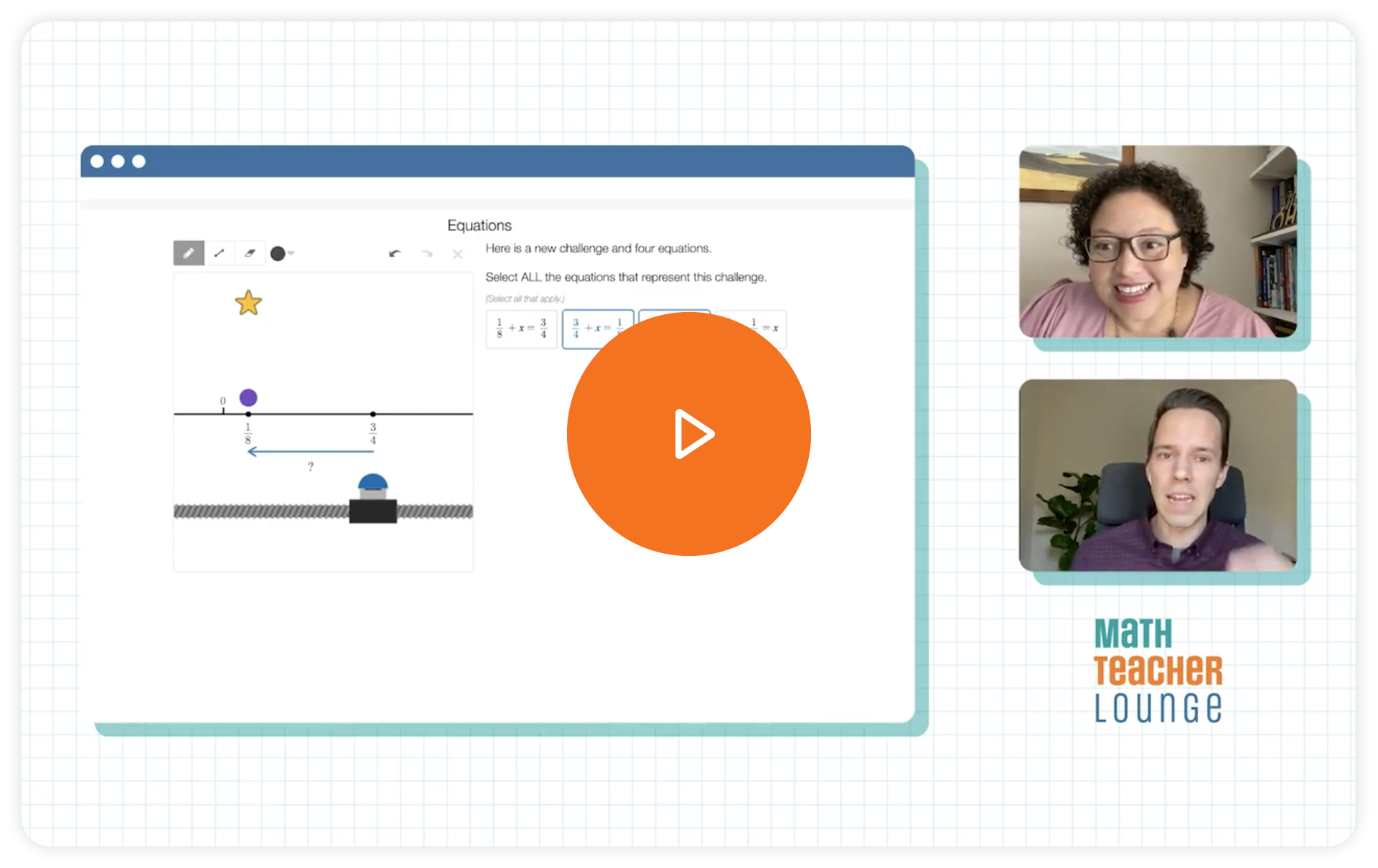
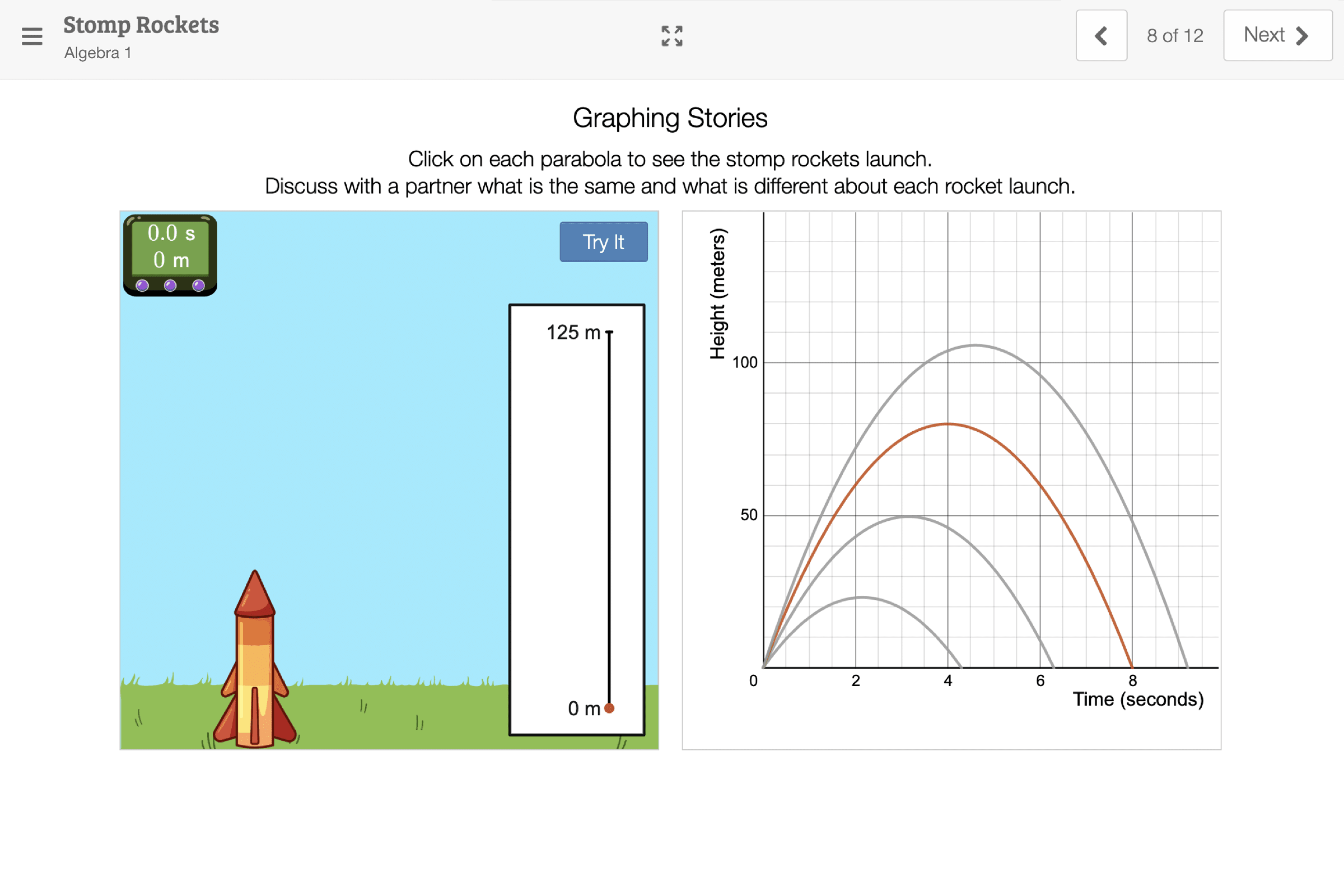
S5-02. Uncovering the causes of math anxiety
We’re continuing our season theme of math anxiety, going beyond the basics, diving deeper into what causes it, and how we can help students move forward. In this episode, we talk to Dr. Erin Maloney from the University of Ottawa to better understand what’s actually happening in the brain when a person experiences math anxiety, and how we can take steps to shift student mindsets in a positive direction.
Listen now and don’t forget to grab your MTL study guide to track your learning and make the most of this episode!
Enjoy this episode and explore more from Math Teacher Lounge by visiting our main page.
Dr. Erin Maloney (00:00):
It’s the anxiety itself in many ways that can cause people to underperform.
Bethany Lockhart Johnson (00:06):
Welcome back to Math Teacher Lounge. I’m Bethany Lockhart Johnson.
Dan Meyer (00:10):
And I’m Dan Meyer.
Bethany Lockhart Johnson (00:11):
This is episode two of our new season, all about math anxiety. Who has it? What is it? What do we do about it?
Dan Meyer (00:20):
I’m learning so much, learning a ton.
Bethany Lockhart Johnson (00:22):
I loved our first conversation with Dr. Gerardo Ramirez, episode one, our first episode of the season. Really, our goal with that conversation was just to—we need to talk about the basics of it, for reals. Like, what is math anxiety?
Dan Meyer (00:36):
What is it? How do you measure it? How’s it defined? Super-helpful stuff.
Bethany Lockhart Johnson (00:40):
There’s not only one way that it’s measured. But it’s like, in active research right now, how are folks making sense of it? And I think Dr. Ramirez did such a fantastic job of sharing that with our listeners. And I learned a lot. You learned a lot, Dan?
Dan Meyer (00:56):
I did. And I’m also super-excited to take that knowledge that we have developed together and go and build on top of it and keep on climbing up up the mountain here, and learn more about math anxiety. Which is why we’re super-excited to have a guest on, Dr. Maloney, who is going to help us learn more—especially about what happens to the brain when it’s experiencing math anxiety. There’s some really complex stuff that happens there, including the role of parents and educators in creating and resolving math anxiety. And I think we’ll also learn that the whole situation is a bit of a hot mess. And we’ll try to make it a little bit less messy together.
Bethany Lockhart Johnson (01:34):
Little bit less messy. Dan, if we do nothing else, can we make it a little less messy?
Dan Meyer (01:41):
I sometimes prefer more mess, but in this case I prefer less. So.
Bethany Lockhart Johnson (01:45):
I have a two-year-old, so everything is a mess.
Dan Meyer (01:47):
Your life is mess. Yes. <laugh> Right. Well, I’m excited for you folks to hear this. It was a delightful conversation, so yeah, tune in. We are joined by Dr. Erin Maloney.
Bethany Lockhart Johnson (01:56):
Let’s go. We are joined by Dr. Erin Maloney, associate professor in the School of Psychology at the University of Ottawa, where she directs the Cognition and Emotion Laboratory, as well as serving as the Canada Research Chair in Academic Achievement and Well-being. Welcome to the show, Dr. Maloney. We’re so excited to have you in the Lounge.
Dr. Erin Maloney (02:20):
Yeah, thank you so much for having me. This is fantastic.
Bethany Lockhart Johnson (02:24):
So our last season was all about math and joy. And even when I read your title, I felt more joyful. Like, somebody is thinking about academic achievement, but with well-being in mind. I love it.
Dr. Erin Maloney (02:39):
Aw, thank you.
Dan Meyer (02:40):
Cognition and emotion!
Bethany Lockhart Johnson (02:42):
E-mo-tion!
Dr. Erin Maloney (02:43):
I don’t think they can be separate. I think that you have to think about them together, ’cause they’re so intricately connected.
Dan Meyer (02:49):
Love that. People try, but we love that. Yeah. That’s our vibe here, too.
Bethany Lockhart Johnson (02:52):
People try. That was a big problem with my math anxiety. They just wanted…there was no room for my emotion. They’re like, stop weeping at your desk—
Dan Meyer (03:00):
It’s rearranging neurons….
Bethany Lockhart Johnson (03:01):
—you’re distracting the other children. So would you mind telling us the story of how you even got interested in this topic? You know, when you tell people that you study math anxiety—or, actually, I don’t know how you describe it to them; I’m hopeful you bring in that well-being part—but how did you get here? What do you, what do you, what do you…yeah, tell us! We love it!
Dr. Erin Maloney (03:23):
<laugh> I feel like what you’re actually asking is, “How did you make life choices that got you to here?” <Laugh>
Bethany Lockhart Johnson (03:29):
Justify your life choices! Ready? Go!
Dr. Erin Maloney (03:32):
<laugh> Whoo. OK. So, all right. So we often, in psychology, we joke that instead of doing research, we do “me-search.” And that’s, that’s admittedly true in my case. I was a student who absolutely loved math up until about eighth grade, and then something changed, and all of a sudden I was terrified of math and I had absolutely no sense of self-efficacy in it. Despite trying really hard, I was extremely anxious about it. And so I initially, I set out…my parents were completely convinced that I was absolutely capable of doing mathematics and that I was getting in my own way. And when I went to university, I decided to prove them wrong. So I set out to prove that some people just can’t do math, and that’s the end of it. And, you know, 20 plus years later, my parents were right. And it turns out that many people—well, I would argue virtually everyone—can do math. And that if you are really anxious about it, it can get in the way. And interestingly, you know, in, in the years that we’ve been doing this research, there’s really good strategies that can be used—that hopefully we get a chance to chat about—that can really help reduce the amount of anxiety that students are experiencing. But I really did set out, like the bold teenager that I was, to prove my parents wrong. And that backfired <laugh>. So I know it’s kind of a strange answer, but it’s the truth. So I was really interested in understanding why it was some people just could not do math.
Dan Meyer (05:10):
That makes two for two so far, on guests for this season who did a version of me-search. And I feel like this is pretty common for a lot of researchers. Like, I wanna figure out…my experience as a teacher, the part where you, I think, diverge from a lot of people I knew in grad school, myself included, is that you actually let counter evidence change your perspective on things. Whereas I feel like a lot of us go in: “I know this is true and I’m gonna gather data!” and lo and behold, I’m true! But only now, with the research TM, you know, trademarked research, attached to it. So that’s, really exciting. Thanks for sharing that.
Dr. Erin Maloney (05:43):
No, you’re welcome.
Bethany Lockhart Johnson (05:44):
But don’t people say that the more personal you get, the more universal it is? Right? So if you go and get your doctorate about something that you think is just your experience or in your brain, then people are gonna be gonna be like, “Wait a second; you think that too?” “Wait, that math anxiety isn’t just you?” I don’t know, it sounds like a pretty great path to me. When you tell folks that you study math anxiety or when you’re speaking to folks about your research, do you find that there is a lot of folks who relate to what you’re studying? Or how does that conversation typically go?
Dr. Erin Maloney (06:20):
Yeah, so it is I think an extremely relatable topic. Not in the sense that everyone experiences anxiety about math, but everyone seems to know somebody who’s really anxious about math. Or everyone’s at least aware of the stereotype that like some people are math people and some people aren’t, and that’s just the way it is. So it feels like everyone has feelings about math and everyone seems very happy to share those feelings. So one thing I’ve always found really interesting, and actually, so I, I know you mentioned that you had Gerardo on recently. Gerardo and I have had really interesting conversations about how people are really quick to tell you that they hate math and they can’t do math, and they’re anxious about math. And I’ve yet to have anyone ever tell me they hate reading, they can’t read, they’re really anxious about reading as an adult. So for some reason math seems really different. And in that sense people always seem to be pretty excited to talk about their feelings towards math.
Dan Meyer (07:23):
Yeah, definitely. Been on an airplane or two myself and had those conversations. You know, people asking to be reseated because they found out that I do math for a living or whatever. Or just unburdening themselves, for sure. I’m super-curious: I think that the fact that you are doing the me-search is reason enough to want to dedicate your life to this study. But I am curious: If you were gonna justify to someone else, why is math anxiety important to study? What are its consequences, even outside of math education? What would you say to that?
Dr. Erin Maloney (07:57):
So I think it’s probably not hard to convince people that success in math is important, right? So we know that children who start elementary school behind in mathematics tend to stay behind in mathematics, unless they have any kind of very targeted intervention. We know that children who do worse in mathematics throughout K to 12 education in general get lower-paying jobs when they’re older. We also know that when they do worse than mathematics relative to their peers, there’s fewer jobs that are open to them, relative to if they excelled in math. Right? And so I think in many ways there are really clear consequences for students who are not comfortable with math and who avoid it. But I think one of the really, really interesting things about math anxiety, and maybe part of why I’ve fallen in love with it as a research topic is that it’s the anxiety itself in many ways that can cause people to underperform. So it’s not just the case that people who are bad at math are anxious about it. It’s actually that the anxiety itself can cause you to do worse in math. And that for me is really exciting, ’cause it means that if we can change your mindset, then we can really set you on a path with several more options available to you career-wise. And I think that is really empowering.
Dan Meyer (09:18):
Hmm. Yeah, definitely. And I’d love for you to explore — your laboratory is the cognition and emotion laboratory, which I love, how you’re creating those linkages between how you feel about a thing and what your opportunities or your aptitude for learning it. I’m really curious, can you say more about the, the relationship there? How does feeling anxiety impair your ability to do mathematics?
Dr. Erin Maloney (09:41):
Yeah, so feeling anxiety, typically what you tend to experience is these negative thoughts and ruminations. So you can imagine, you’re somebody who doesn’t really love math, you’re pretty anxious about it; you know, Bethany, maybe you’ve had this kind of experience before. I’m gonna call you out on it. I’ve had it many times, where you sit down to do a math test and all of a sudden you’re not focusing on the actual math test in front of you. You’re focusing on things like the consequences of not doing well on this. Right? Or “my parents are gonna be really disappointed if I don’t pass this test,” or “my teacher is gonna think negatively negative of me,” or sometimes we see things like, “I’m a girl, girls don’t do math.” These types of stereotypes. And what happens is that those thoughts actually tie up really important cognitive resources, like, really important memory resources, that you need to do the math test. And so if you are trying to essentially do two things at once, right? You’re trying to deal with all these negative thoughts that are distracting you and you’re trying to do the math test, then you’re not going to do as well as someone who’s sitting down and doesn’t have all of these distracting thoughts to deal with. And we actually know that from research that we have in our lab right now, where we just ask people like, “Hey, when you did this math test, what kind of stuff are you thinking about?” what we find is that the people who are really anxious about math report a whole bunch of thoughts that are unrelated really to the math test, per se. It’s more about the consequences of doing poorly. And as a result of those thoughts, they actually end up doing worse.
Dan Meyer (11:14):
This has been really helpful to figure out, how the emotional state of doing math affects the ability to do math. And it’s really interesting how you’re saying that the direction of the causality can go from the emotions to the cognition. And I’m just curious then, what is the source of the bad emotions about math? Where does that come from? Is it nature? Is it nurture? Some combination? How do you see it?
Dr. Erin Maloney (11:39):
Yeah, so one, that’s a fantastic question. And there’s been a whole bunch of people all around the world that have been spending a lot of time really trying to pinpoint that down. And I think the answer is that it’s, you know, it’s complex. So most of what it’s looking like right now is that it is a combination of both. So essentially what we find is that kids who start elementary school who are a little bit behind in math—and for the question of why they’re behind, that’s also complex; it could be genetics, it could be just environmental input, before the child ever entered formal schooling kind of thing—but in essence, what we find is that kids that start school behind in mathematics, those are the children who are most likely to develop anxiety about math by the time they’re finished first grade. OK? But we also know that once they’ve developed the anxiety about math, then that’s when they get these thoughts and ruminations that kind of tie up those memory resources, that then is gonna make it harder for them to succeed in math tests. So you get into this sort of vicious cycle, right? Where maybe you start behind a little bit and then you develop the anxiety, the anxiety causes you to underperform relative to what you should be able to, so now you’re even further behind, you get more anxious because you’re not doing as well as you’d like to…but again, kind of coming back to the “Why are the children starting behind in the first place?” Some of that seems to be the role that parents are playing in the household. So some kids come from a household where parents are playing a lot more math games with them, talking about mathematical concepts on a regular basis. Maybe they have older siblings who are, you know, practicing arithmetic and, and mathematical processing in front of them. And so those kids are exposed to more math before they ever even start formal schooling. Those kids seem to do better. And then we also know that the parents’ attitudes matter a lot too. So what we find is that when parents are high in math anxiety themselves, especially when they help their children a lot with their math homework in really early ages, we find that those kids end up being more anxious about math by the end of the school year, and they also end up doing worse in mathematics. So it really does seem to be, you know, kind of a complex set of factors that have something to do with both maybe genetic predisposition to success in math and genetic predisposition to anxiety, but then also the social attitudes and stereotypes about math to which you’re exposed at home that really seem to be coming together to create this anxiety in young children.
Bethany Lockhart Johnson (14:24):
I feel like everything you’re saying is <laugh>…it makes so much sense and yet it’s so often not talked about, right? Because it’s just more like, it gets boiled down to, “Oh, they’re just not a math person,” instead of all these other factors that are at play. And I completely remember the anxiety I felt, whether it was a test or not, walking into my math classroom when I was in ninth grade. And there’s no way I was set up and ready to learn. Right? <Laugh>. And something with—we mentioned Dr. Ramirez, he was talking about validating that anxiety. If teachers validate that like, “Oh, you know what, sometimes you might feel stumped, or this might feel overwhelming.” Even the power in creating space for that in the classroom, right? And acknowledging that it doesn’t—math doesn’t have to “come easy” to you in order for you to have access or make sense, is such a powerful concept. And I love the way that you are looking at all these different factors and saying, “Hey, it’s both simple and also a lot more complicated than we’re we’re making it.” Right?
Dr. Erin Maloney (15:36):
No, and I agree with that sentiment so much. Like, I think, though—one thing I will sort of caution is that I think when teachers are validating the anxiety, or when parents are validating the anxiety, I think there’s a very fine line that needs to be walked where we need to be able to say, you know, “It’s OK to struggle with something. That’s, that is completely OK.” And as we’re, you know, as we’re working towards something that’s really valuable, right? We can, we can work hard at something and by working hard at it, we’re going to get better. And I think that type of validating is really, really important and valuable. I think what we wanna be careful of is not to say things like, “Oh, it’s OK. I also never loved math.” And, you know, “Oh, I was never a math person either.” And so even though we might be bringing comfort to the the child, I think that that’s sending the wrong message. And so sometimes it’s really well intentioned and really not great—
Bethany Lockhart Johnson (16:37):
A hundred percent.
Dr. Erin Maloney (16:38):
—in terms of the messaging. So that’s the only…so just for people listening, the only sort of caution that I would give there is that I think there’s nuances to the validating of the feelings that are important.
Bethany Lockhart Johnson (16:50):
I am so glad you said that because as a kindergarten teacher, I vividly remember—and this is as early as, you know, the kids are five years old, right?—and I remember in a parent-teacher conference, a parent saying, “Oh, I wasn’t a math person either,” or, “Oh, no, ugh.” And they were so quick, like you said, they wouldn’t say that about reading, but they were so quick to talk about their lack of natural math aptitude, right? And, and it was really interesting because you know that even if they’re not saying that specific thing at home, those attitudes are absolutely carrying over at home. And they’re absolutely carrying over to, to how they interact with their kiddo around math and around what’s happening in the conversations about math. And I felt like a lot of times my work as a teacher was also to help support parents through their own math anxiety, and help give them some new language for how they can talk about math. And that math is more than just getting to an answer quickly. Like, let’s talk about, let’s go on math walks, let’s go on number walks, what numbers are around the home? Or oh, is that bigger than this? Do you have more of this? And even those little things, I, my hope was that it was starting to shift the conversation around what math was possible in the home, particularly when you saw that it was the parents who had palpable math anxiety. Right? And how much you know that that’s gonna impact what’s happening when you sit down to do homework together.
Dr. Erin Maloney (18:22):
Yeah. And I love that you have worked to encourage parents to do that. So we do similarly. Like even from a research perspective, where I will often give talks to parents and teachers and we talk about the idea of trying to mathematize everything, right? So just the idea that math is absolutely everywhere, and you know, whether it’s a matter of playing games in the car with your kids where you’re thinking of a number and it’s “My number is higher than 42, but lower than 80, and what number do you think I might be thinking of?” And, and gradually trying to get the child to that number. Or, you know, asking questions like, “What’s your favorite even number and why?” And just little things like that that, that I think can make math fun for kids, that help—I don’t even know how to explain it, but just that idea of bringing joy into it, so it’s not always this heavy subject that kids have to come to. So we definitely try to talk to parents about the idea of, like I said, mathematizing everything. And usually it’s well-received, ’cause often parents find it empowering, right? They’re like, “Oh, well, I could do that! But like, that’s not math!” And you’re like, “No, but it is.”
Dan Meyer (19:33):
Yep.
Dr. Erin Maloney (19:34):
Like, it is! And sometimes parents will say like, “Well, I don’t know how to do fractions.” And you’re like, “OK, but how do you bake?” “Well, I don’t know! I just, like, I know how to do those fractions!” And you’re like, “OK, but that’s the starting point. Let’s work with that.” Like, let’s, you know. And I think a lot of times, it’s reminding the parents that they’re actually far more capable than what they think they are, despite the fact that maybe they struggled with math when they were younger.
Dan Meyer (19:58):
Yeah. This is so interesting. And I feel like part of the challenge around conversations about anxiety and math and how to, how to resolve it and where it comes from, is that it, like, it presupposes a single definition of math. And so, you know, we’re talking about like how to be more mindful about math. But you know, like if kids were walking every day through a treacherous street, you know, the solution might not be become more mindful about that street. It’s just like, we gotta fix the treacherous nature of the street, really. You know, I love that we’re talking also about redefining what math is, making it more playful. That feels like a super-important component here. I’d love to know more about what you know about the role of gender in all of this. Are there differences in the way boys and girls experience math anxiety and how it relates to achievement in math?
Dr. Erin Maloney (20:48):
Yeah, so, there’s really, really interesting research on gender in math anxiety. So in general, we find that girls tend to experience more anxiety about math than boys do. So one hypothesis is that it has to do with just social stereotypes that, you know, girls are, are good at reading; boys are good at math, kind of thing. So there’s some evidence to suggest that that might be playing a role. There’s other evidence to suggest as well that maybe boys actually do experience as much anxiety, they just don’t really own up to it.
Dan Meyer (21:20):
Ooh, yikes.
Dr. Erin Maloney (21:21):
So thoughts are, you know, there’s a bit of an apprehension for males to admit experiencing the anxiety. But I think one of the things that is extremely interesting about it—at least to me—is that we don’t tend to see gender differences in young children. So in early elementary school, even though we’ll see that kids as young as six years old will experience anxiety about math, and that that anxiety is related to how well they do in math and how much they enjoy math, it doesn’t seem to vary as a function of gender at that young age. It doesn’t seem to be related to gender until kids are at about sixth, seventh grade that we really start to see this gender difference coming online. And so that, to me, suggests that it’s probably something more social than biological at play. It probably has something more to do with these stereotypes and stuff. But another really interesting—or at least, I’m biased, but to me—another really interesting line of research that comes into play—and some of this is stuff out of my own lab—so we know that boys in general tend to do better at spatial processing than girls. And we know that spatial processing is really important for math, right? So math and space are pretty connected. And by spatial processing, I mean things like being able to picture something rotating in your mind or, you know, envisioning how these puzzle pieces might fit together. And so we know that boys tend to do better at that type of processing. And the gender difference there seems to be related to gender differences in math anxiety. So there’s some speculation, too, that it might be that as the math starts to become more reliant on spatial processing, that that’s when we see this separation between boys and girls with respect to how much anxiety they feel about math. So a lot of this is to say, I think the answer to the gender question right now is what I think what we would officially call a bit of a hot mess, <laugh> where I think there’s probably more questions than answers. But I think that there’s definitely something going on. And it really seems to be coming on later in elementary school.
Dan Meyer (23:32):
That’s a refreshingly honest admission from a social scientist, that it’s a hot mess and not perfectly clear, <laugh> so I appreciate that. It’s interesting what you said about the spatial reasoning. In our work creating curriculum at Amplify, I find we lean a lot on trying to tie abstract math towards spatial topics. Like, can you estimate a quantity before you calculate it? Can you identify a pattern and where it breaks before you prove it abstractly? And, I dunno, it’s just interesting to me. I’m just thinking out loud about how I feel like math becomes more abstract rather than more spatial. The farther you venture into secondary math…I’m wondering if I misunderstand what you’re meaning by spatial, and the progression of math from K–12.
Dr. Erin Maloney (24:20):
Yeah, so I think you can still have—you can have math be abstract, but still really relying on spatial processing. Right? And I think part of that is maybe a bit of us having different definitions of when we say “spatial.” So in cognitive science, when we talk about spatial representations or spatial reasoning, it’s really like anything you’re picturing in your mind, any time you’re really picturing these things in your mind and manipulating those images at all. So if you imagine, even like at a simple level, but it’s gonna hold when you’re going more complex as well. So doing like equivalence problems, for example, where you have to balance the equations.
Dan Meyer (24:58):
Yeah.
Dr. Erin Maloney (24:59):
Even just being able to envision things kind of moving around that equal sign and bringing one piece of the equation from this side to the other is actually an extremely spatial kind of reasoning. Right? Or when you’re expanding, that’s actually extremely extremely spatial, despite the fact that it might not feel like it initially. Obviously anything in geometry is going to be very spatial. So I think, in that sense, we would argue that the spatial processing is still playing a pretty important role. But it’s maybe a different type of spatial processing than what we’re seeing at a very early level in elementary school. That said, you can completely disagree with me too. ‘Cause I could also just be wrong, and that’s fair. My kids tell me I’m wrong all the time. So I’m used to <laugh> being told that I’m wrong.
Dan Meyer (25:47):
Well, we’re a bit more deferential on this here show, with our guests. So I would not do that. But it makes sense, what you’re saying about how these are things that you manipulate in your mind, whether they are Xs and Ys or numbers and fractions. These are all things that we manipulate. That ties into differences in this spacial reasoning category, it sounds like, which then contributes to math anxiety. And it does start to feel like there’s a lot going on here, is what it feels like.
Bethany Lockhart Johnson (26:14):
You mean hot mess?
Dan Meyer (26:16):
I meant hot mess.
Dr. Erin Maloney (26:17):
Yeah. <laugh>, I think that’s the technical term, right? I’m pretty sure that’s the technical term for it.
Dan Meyer (26:21):
I didn’t know the citation for it. So I didn’t say it. But I knew who in literature named that. But yeah.
Dr. Erin Maloney (26:28):
I’ll write something at some point.
Dan Meyer (26:30):
We’ll cite Maloney, 2022. Yeah. Yes.
Bethany Lockhart Johnson (26:34):
So I will say that one of my dreams in thinking about this season and last season, but particularly this season, since we’re really getting to talk to some researchers who get to think about this, and have really interesting conversations about it all the time…one of my dreams is that we’re bringing—’cause we do have some folks who are researchers that are listening, right? But then we also have teachers and folks who are in the classroom every day, and parents and caregivers listening. And so I think one of the beautiful things about the way that I hear you talking about it is you’re thinking about the research, but it’s so applicable. Right? And I wonder if there’s anything else you can say around it. I wanna reduce that divide, that gap, between the research that’s happening and then what’s happening with the kiddos and in the classroom and at home. And I don’t know if it’s like a magic wand thing where like <laugh> if there were changes you’d wanna see at a societal level, to try to combat math anxiety, but you see where I’m going. You know, it’s like <laugh>….
Dr. Erin Maloney (27:39):
- So I’m gonna answer maybe in two ways. So I think the first thing that I’m hearing from you is that idea of diminishing this divide, right? And so one thing I try to keep in mind, as someone who’s a researcher and working in the lab, I will often be called in to talk to teachers and give professional development sessions. And they often want the sage-on-the-stage academic, that stands up there and tells you the answers to things. And one of the first things that I’m gonna admit when I get up there is, “I am not on the front lines.” So what I do in the lab, for me to tell you that that’s gonna work in a classroom of 30 kids who may or may not have eaten dinner that day, and may or may not have snow pants, and may or not…like it’s–
Bethany Lockhart Johnson (28:23):
Mmm, yes.
Dr. Erin Maloney (28:24):
You know, I think we also need to be a little bit reasonable. So I try really hard in my own program of research to make sure that I’m always talking to teachers and to principals and to curriculum designers to make sure that the ideas that I have make sense. In fact, one of the most recent book chapters that I wrote, I wrote in collaboration with a really good friend of mine who’s a principal, an elementary school principal, and a former math consultant. And we wrote it together, to really say like, “Hey, here’s how we can help each other inform how research can inform practice and how practice can also inform research.” ‘Cause he can come to me and say, “I’m doing this. I can’t find anything in the literature to support this, but I’m sure it works!” And we can design something in the lab to test whether or not it seems like it’s gonna work.
Bethany Lockhart Johnson (29:11):
That’s huge. Yeah.
Dr. Erin Maloney (29:12):
Empirically. And so I think that open communication is massive. One thing that we’re doing in my own lab to try to keep that open communication available. So to anyone listening who’s ever tried to get access to a journal article, they’re held behind paywalls, right? So one, the way it works, my understanding of this anyway, is that the journal owns the formatted version of the paper. So what we do is we put up audio recordings of all of the research papers that we ever publish. So I’m pretty sure I own the words as the author, and the journal owns the prettified version that you can buy. So we audio-record all of our papers, so that if teachers or parents ever want to hear the actual science that’s going into some of these decisions, they have access to at least the stuff that we do in our lab. And we also put up an infographic for every paper, just highlighting kind of the main questions and main findings. And we do that because I think that the only way for the information to actually be useful is if it gets into the hands of the stakeholders that actually need that information.
Bethany Lockhart Johnson (30:21):
And is accessible. That’s huge. That’s huge!
Dr. Erin Maloney (30:24):
Yeah. Yeah. So that’s one way that we try to do it. And like I said, the other thing, we try to always be working with principals and with teachers. I joke that the way that I remedied this in my own life…so my husband’s a teacher; it’s like, I just married one! It’s fine! <laugh> I can grill him on a regular basis, and be like, “I wanna try this experiment. Do you think it’s gonna work?” And he can say, like, “It’s not going to. Here’s why.”
Dan Meyer (30:47):
That’s awesome. Marrying a participant—you know, a research participant—is unethical, of course. Would not clear IRB. But turning your partner into a participant? Like, what are you gonna do? That’s great.
Dr. Erin Maloney (30:57):
Yeah, no, that’s fair game.
Dan Meyer (30:58):
Yep.
Dr. Erin Maloney (30:59):
Yeah. So that’s—I think we we compensate each other <laugh>. So, no…so I do joke a little bit about that. He was a teacher simply ’cause he wanted to be one. Not ’cause I needed him to be one. But, I think that communication part is, is really key. That’s one thing. Then the other part of the question or the other sort of piece of the question that I was hearing is that idea of, how do we fix math anxiety. Right? Like, what’s the great, “I’m glad that there’s a whole bunch of time and effort and energy going into trying to understand this, but what, where are we at?” And I think with that, it’s really, really promising. So there’s been a lot of research coming out looking at how best to help children or even adults manage their own anxiety about math. And there’s a few really interesting strategies that seem to be quite effective. So one, and I don’t know if—um, it feels weird calling him Dr. Ramirez, just ’cause I know him well!—but I don’t know if Dr. Ramirez would’ve talked about this when he chatted with you, but he has some really interesting work on expressive writing. Did he chat about that at all?
Bethany Lockhart Johnson (32:07):
He didn’t, but I’ve read some of his work about it and I think it’s so fascinating.
Dr. Erin Maloney (32:11):
Yeah! So, OK, well, I’ll tell you about his work on it.
Bethany Lockhart Johnson (32:13):
Yes, please. Please.
Dr. Erin Maloney (32:14):
Because it’s super-useful. So when we talked about that idea of how anxiety causes these thoughts and ruminations, and they tie up the memory resources that you need, what Gerardo has found is that when you get students to write about their anxiety for about 10 minutes before they do a test, what ends up happening is they end up doing better on the test, relative to if they would not have written about their anxiety at all. And this is particularly true for students who are really high in anxiety. OK? And the idea is that all of those thoughts that they were going to have about the test or the consequences of the test, et cetera, you just kind of get ’em…it’s like a mind dump where you get ’em all onto the page at first before you even go to do the test. And now when you go to do the test, you’re not having to do two things at once. You’re no longer dealing with these thoughts ’cause you got ’em all out on the paper beforehand. And so Gerardo has some really interesting work showing that that works for math anxiety. And then it also works for just testing anxiety in general. And so that’s a strategy that I love. I also—part of what I really love about it is it’s so low-cost, right? You need a paper and a pencil and it’s great. So those are always my favorite strategies, the ones that don’t really cost us anything. So that’s one way of dealing with like the cognitive part of the anxiety. The other thing you can do is try to deal with the anxiety part of the anxiety. So for that, what we find is that the typical strategies that you’re gonna see for anxiety tend to work for math anxiety. So things like focused breathing. Right? Making sure you’re doing deep inhales and exhales. That really diaphragmatic breathing seems to be quite helpful. We know that what we call progressive desensitization is really key. That’s the idea of doing things, you know, starting with the questions that you know how to handle. And then gradually working up to the more difficult questions. So you’re sort of gradually exposing yourself to the more complex stuff. And how that can play out on an actual test at school is, you sit down, and instead of just starting with question number one, you actually read the whole test, see which questions you feel like you know the best, start with those questions, and that helps build your confidence so that you’re better able to tackle the questions that are maybe a little bit outside of where you’re currently at. So that seems to be really helpful. The other part that I will say, too, that’s extremely helpful: So we know that anxiety really ties up those memory resources. And so the more you can make the math automatic, the more immune it’s going to be to anxiety in the moment. And so I know that this part can be a little bit controversial, because we don’t wanna necessarily demotivate children, and kill the enthusiasm for math that we’re trying to cultivate…but really, you know, really committing your arithmetic facts to memory can be extremely helpful. So really learning those times tables, really learning your addition and subtraction facts. ‘Cause what happens is, then when you’re in a situation where you need that information, even if you’re anxious and you’re working with fewer cognitive resources than what you would normally have, you actually don’t need that many cognitive resources to be able to pull something from memory that you’ve memorized. So it really helps to kind of protect you against some of the negative impacts of the anxiety while you’re doing that test.
Bethany Lockhart Johnson (35:37):
And you’re not using all your cognitive resources to figure out seven times eight, because you can really focus on what you’re trying to do with that. Oh, that’s fascinating. Yeah. Yeah.
Dr. Erin Maloney (35:47):
Yes. No, a hundred percent right. And so I know that’s one that, like I said, I know it can be somewhat controversial because it’s…you know, we’ve talked about—or we haven’t talked about in this conversation, but we often talk about—the idea of drilling and killing. Right? So you drill the facts, you kill the, the enthusiasm. But I think that there are ways that we can drill arithmetic facts, or help make them automatic, but still fun, right? It doesn’t have to always be in a high-pressure kind of way.
Bethany Lockhart Johnson (36:16):
Totally. And we’ve talked about fluency, and I’m sure we’ll talk about it more in the Lounge. And that is interesting, that link between anxiety when the fluency isn’t there, that—or, of course we hear about anxiety with timed tests, but the idea of that IS something you can do to reduce it, because you have those facts just at your ready. Right?
Dr. Erin Maloney (36:37):
Yeah. So I actually, again, I’m gonna be a little bit controversial. So I don’t hate timed tests in the way that a lot of people do. But I love time to practice. So I think once we’ve got to a point where children have a fairly decent understanding of skills, of a skill, once they’ve got a fairly decent grasp on it, then I love the idea of the timed practice. So it can be still in a low-pressure situation, where in many ways it doesn’t matter if you get the answer to the question correct. But we’re practicing doing it in a situation in which you might be feeling a little bit of pressure, but it’s not real pressure, if that makes sense. And I think that can be really, really useful for students. And again, it can be done in a fun way, right? It doesn’t have to be these super-intense ways. It can be fun. But I think that in life there are situations in which the time that it takes you to complete a problem matter. And I think that we have to make sure that we don’t get too far away from that.
Dan Meyer (37:40):
Yeah. It feels like we should do an entire other episode thinking about ways to develop that fluency and automaticity that don’t contribute to anxiety, or create further disparities between people who are high math anxiety and low math anxiety. Not a small question, I’m sure. And I appreciate you alluding to all of that. You know, this whole thing, as you said, is quite the hot mess. And I feel like you, Dr. Maloney, have helped us make this a little less messy, in our heads, and hopefully the listeners’ heads. I really appreciate that. I just love…you’ve mentioned lots of resources that you have. You’ve alluded to them: audiobook-style readings of your research, which I need ’cause I just finished, you know, Harry Potter, the seventh book, so I need a new thing to listen to like that. Also infographics. Can you tell our listeners where they can find this work of yours, and if there are any other kinds of resources that you wanna plug for our listeners here?
Dr. Erin Maloney (38:32):
Yeah, for sure. So all of our resources can be found on my lab website. So the address for that is www.ErinMaloney.ca. So there we have, like you said, the infographics and the audio articles and all that stuff. And then we also have a link to a new kids’ book out, actually, that a colleague of mine and I have published recently, that really walks through some of these strategies on combating math anxiety. The book is written as a children’s book, so it’s Peyton & Charlie Challenge Math. But it secretly is a book that would also work for adults. So if you are a parent that’s a little bit anxious about math, or a teacher that maybe is a little bit anxious, and you wanna see how some of these strategies can play out, in that book—we linked to it on the website, but it is available for purchase on Amazon. And the one thing I will say about the book, ’cause this is something that we were pretty proud of, so Sheri-Lynn Skwarchuk, who is a school psychologist, and I wrote the book. And it’s available for purchase at our cost price, so we don’t actually make any money on the book. It was literally just a way of getting some of the science out to people who might be able to benefit from it.
Bethany Lockhart Johnson (39:45):
Reducing that divide!
Dr. Erin Maloney (39:46):
Yeah, well that’s what we’re trying to do! Right? So I think in the U.S., I think it’s like $6 on Amazon. And then in terms of other resources, we’re in the process right now of creating some informational videos and and stuff like that that hopefully will be useful for parents and for teachers, just in terms of understanding a little bit more about the anxiety and understanding how to deal with the anxiety in the classroom more, at home or wherever it might be coming up.
Dan Meyer (40:15):
Well, thanks so much. I really appreciate—we appreciate!—you coming on, and hearing about how you’re trying to bridge so many different barriers from research to practice, and school to home. It’s just really inspiring. And we’d love to have you back on sometime. So thank you so much for joining us.
Bethany Lockhart Johnson (40:29):
I feel like we’ve just hung out! Don’t you, Dan?
Dan Meyer (40:31):
Are we rolling here? Oh my gosh, we’re rolling. I just thought we’re just hanging. Yeah,
Bethany Lockhart Johnson (40:34):
I thought we were just hanging!
Dr. Erin Maloney (40:36):
I know, I do, I really appreciate that it has a very kind of chill vibe to it.
Dan Meyer (40:41):
Chill vibe. Like a lounge.
Bethany Lockhart Johnson (40:42):
It’s the lounge!
Dan Meyer (40:43):
Thank you. You get us; you get us. <laugh>
Bethany Lockhart Johnson (40:45):
Dan Meyer. I was shopping for children’s books, and there was this book, and it was talking about being at home with Mom. And it’s going through all the things that the child did that day with Mom. It’s like, “We played outside, we ran through the sprinklers, we even did some homework.” And it shows them sitting at the table with the homework, that’s clearly math homework, in front of them. And the mom is like, “Harrumph!” Like a very perplexed, anxious face. And there’s all these question marks above her. And it’s just like,
Dan Meyer (41:24):
“There should not be numbers on that paper!”
Bethany Lockhart Johnson (41:25):
Exactly. And the child is like, “Ohhhh,” you know. And I mean, I have to give credit to the illustrator, because they really did capture the clear message of this interaction, which was sitting down to do math homework or think about math together is a source of angst. Right? According to this author and according to too many people. And so I think what’s really important is that we recognize those images when we see them out there and speak back to them, and say, “Hey, wait a second.” Yeah, it can feel like that, and it doesn’t have to. And what’s going on that that’s just the assumed way that it’s gonna feel, to sit down and math together. You know?
Dan Meyer (42:11):
Yeah. It feels like we all have a lot of work to do on the whole math-anxiety front. Dr. Maloney helped us see how parents play a part, educators play a part, society and how they create people plays its own part in how we all define math as a thing where we evaluate student thought or where students play it with their thoughts, has its own huge part as well. So yeah, it was a really fantastic conversation with Dr. Maloney. I hope you folks will check out the show notes, where you will find links to Dr. Maloney’s website. A lot of her work, which as you heard, is very geared towards practitioners and parents and even directly at kids, especially the new children’s book she co-authored, Peyton & Charlie Challenge Math.
Bethany Lockhart Johnson (42:55):
Next time we’re gonna dive even more into the nitty gritty of combating math anxiety. To do that, we’re actually gonna be joined—I am so excited about this—by Dr. Rosemarie Truglio from Sesame Workshop.
Rosemarie Truglio (43:09):
Our core audience are two- to four-year-olds, and they love math. And what’s not to love? Children don’t come with this math anxiety. Math anxiety is learned.
Dan Meyer (43:23):
So excited.
Dr. Erin Maloney (43:24):
Sesame Street was a huge part of my childhood and my toddler doesn’t know it yet, but Sesame Street is coming. It’s coming. Like, we’re we’re gonna introduce Sesame Street to him. We just haven’t yet.
Dan Meyer (43:37):
Sesame Street straight raised me.
Bethany Lockhart Johnson (43:38):
Right?
Dan Meyer (43:39):
Yeah. Don’t tell my parents. But that’s, yeah, that’s true. I’m excited, too. It’s gonna be a blast.
Bethany Lockhart Johnson (43:45):
I’m really excited. I think that the more we dive into this topic—which, again, we’re gonna look at math anxiety from a lot of different angles—and I’m excited to talk to Dr. Truglio about how we can take this research and these conversations that are happening about math and how it can actually impact what’s happening in homes. ‘Cause we wanna help create positive relationships with mathematics, with kids in math. I’m so excited. And I hope you folks keep listening. We love having you here in the Lounge. And if you haven’t already, please subscribe to Math Teacher Lounge, wherever you get podcasts. And if you like what you’re hearing, please leave us a rating and a review. It helps more listeners to find the show, and let other folks know about this show. Recommendations are great. Thanks so much for listening.
Stay connected!
Join our community and get new episodes every other Tuesday!
We’ll also share new and exciting free resources for your classroom every month.
Meet the guest
Erin Maloney is an Associate Professor and Canada Research Chair at the University of Ottawa. Her research sits at the intersection of Cognitive Psychology, Developmental Psychology, and Education and focuses on cognitive and emotional factors that relate to academic achievement. She is a world-renowned expert on the study of math anxiety, conducting research in the lab, in homes, and in classrooms with children, parents, and their teachers. She is passionate about both knowledge mobilization and equity, diversity, and inclusion within education and science.

About Math Teacher Lounge
Math Teacher Lounge is a biweekly podcast created specifically for K–12 math educators. In each episode co-hosts Bethany Lockhart Johnson (@lockhartedu) and Dan Meyer (@ddmeyer) chat with guests, taking a deep dive into the math and educational topics you care about.
Join the Math Teacher Lounge Facebook group to continue the conversation, view exclusive content, interact with fellow educators, participate in giveaways, and more!
You might also like:

Early literacy assessment & intervention, grounded in the Science of Teaching Reading
mCLASSⓇ Texas is an all-in one system of universal screening, dyslexia screening, progress monitoring, and instruction for grades K–6, all built on the Science of Teaching Reading. Powered by DIBELS® 8th Edition, mCLASS Texas helps you measure and strengthen the foundational skills that all students need to become confident readers.
What is mCLASS Texas?
mCLASS Texas, the only digital provider of DIBELS 8th edition assessments, provides universal screening, dyslexia screening and progress monitoring to assess your students’ reading trajectory and determine what skills they still need to develop.
You’ll observe students as they form sounds or read words and text. Then, mCLASS Texas instantly scores and analyzes student response patterns to provide you with diagnostic data and instructional focus for each student and group.
With mCLASS Texas, you’ll have everything you need to support every type of learner in your classroom, including advanced learners, multilingual/English learners, and students with signs of dyslexia.
Research-based DIBELS 8th Edition assessments
Developed in partnership with the University of Oregon, mCLASS DIBELS 8th Edition is founded on the strongest-ever research base for predicting reading proficiency, including identifying those at risk for dyslexia.
For more than 30 years, the University of Oregon has led the research behind DIBELS (Dynamic Indicators of Basic Early Literacy Skills). mCLASS is the only licensed digital provider of the evidence-based DIBELS 8th Edition assessment. See more of our research.
Our approach
mCLASS Texas provides rich data to help you match your students’ precise needs with instruction based on the Science of Teaching Reading. The program enables you to monitor effectiveness and make timely decisions, providing students or classrooms with extra support.
Grounded in the Science of Teaching Reading
From phonics to fluency and comprehension, mCLASS Texas assesses the skills that are most critical for students to become successful readers. Once students are assessed, you’ll have the data you need to drive instructional decisions at the classroom, school, and district level.
- Data you can trust, with teacher-administered assessments
- Skill-level data aligned with the Science of Teaching Reading
- Data-driven instructional recommendations to support intervention, remediation, and enrichment


Precise, trustworthy data through direct observation
Our approach to assessment is focused on providing you with immediate insights you can trust. Through direct observation of students and detailed reports, including assessment transcripts and diagnostic error patterns, you’ll have total transparency into each student’s performance.
Instant analysis and next steps
With mCLASS Texas, you can interpret and act on data in real time with instant instructional guidance based on benchmark and progress-monitoring results. In one click, teachers can access differentiated skill-based groups and targeted resources to develop students’ foundational literacy skills.
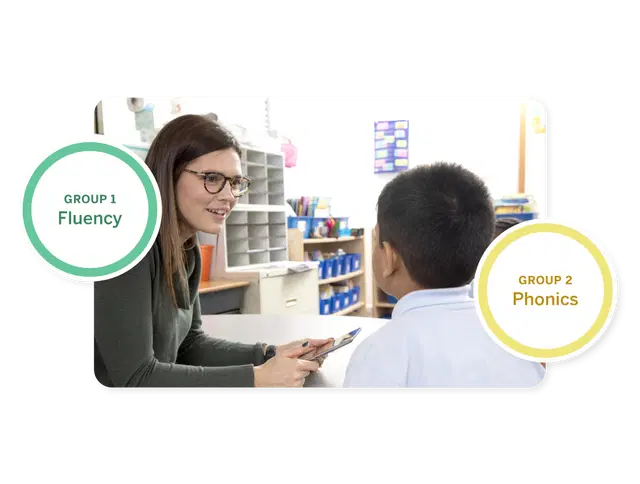

A complete picture of English and Spanish biliteracy
Amplify’s Spanish language assessment, mCLASS Lectura Texas, works in tandem with mCLASS Texas DIBELS 8th Edition’s English assessments to highlight areas of growth as students develop into bilingual readers. mCLASS Lectura Texas provides complete parity with English mCLASS Texas assessments in grade coverage (K–6), skill coverage, instructional tools, and reporting.

What’s included
The mCLASS Texas program includes quick assessments of critical reading skills, real-time reporting, and data-driven instructional recommendations.

Efficient one-minute measures
DIBELS 8th Edition’s predictive one-minute assessments of phonemic awareness, phonics, fluency, and comprehension are proven to identify risk as early as possible.
- Phonological awareness
- Alphabetic principle/phonics
- Reading fluency
- Reading accuracy
- Reading comprehension
Early detection of dyslexia symptoms
With mCLASS Texas, you can efficiently screen students and assess the full range of skills linked to dyslexia risk factors at the same time. mCLASS DIBELS 8th Edition and mCLASS Lectura Texas are both validated as dyslexia screeners for English and Spanish, with additional Vocabulary, Spelling, RAN, and Language Comprehension measures available at no additional cost.


Progress monitoring and goal setting
To help you target the right skills and areas of instruction, mCLASS Texas recommends progress-monitoring measures and automatically sets meaningful, attainable goals for each student. Our Zones of Growth goal-setting framework examines your student’s DIBELS scores to predict the rate of growth they need to reach end-of-year goals.
- Automatic progress monitoring recommendations
- Customizable goals
- Semester and full-year growth reports
Differentiated instruction for all students
Our library of more than 500 evidence-based activities makes it easy to plan lessons that reinforce your core instruction. The embedded professional development supports consider the varied language backgrounds of all students and provide cross-linguistic transfer and language variety guidance to inform phonological awareness instruction.


One-of-a-kind dual language reporting
When you use mCLASS DIBELS 8th Edition with mCLASS Lectura Texas, you can identify and develop students’ English and Spanish literacy skills regardless of your own Spanish-language proficiency. The dual language report shows you a side-by-side view of students’ assessment results and provides you with instructional guidance based on the data.
Educator and caregiver reports
Easy-to-use reports, ranging from classroom to school and district level, help you evaluate each student’s reading skills over time and pinpoint exactly when a change in instruction is needed.
To reinforce learning at home, the Home Connect feature provides letters to caregivers about their child’s reading development in English and Spanish, and includes activities for reinforcement at home or on the go.
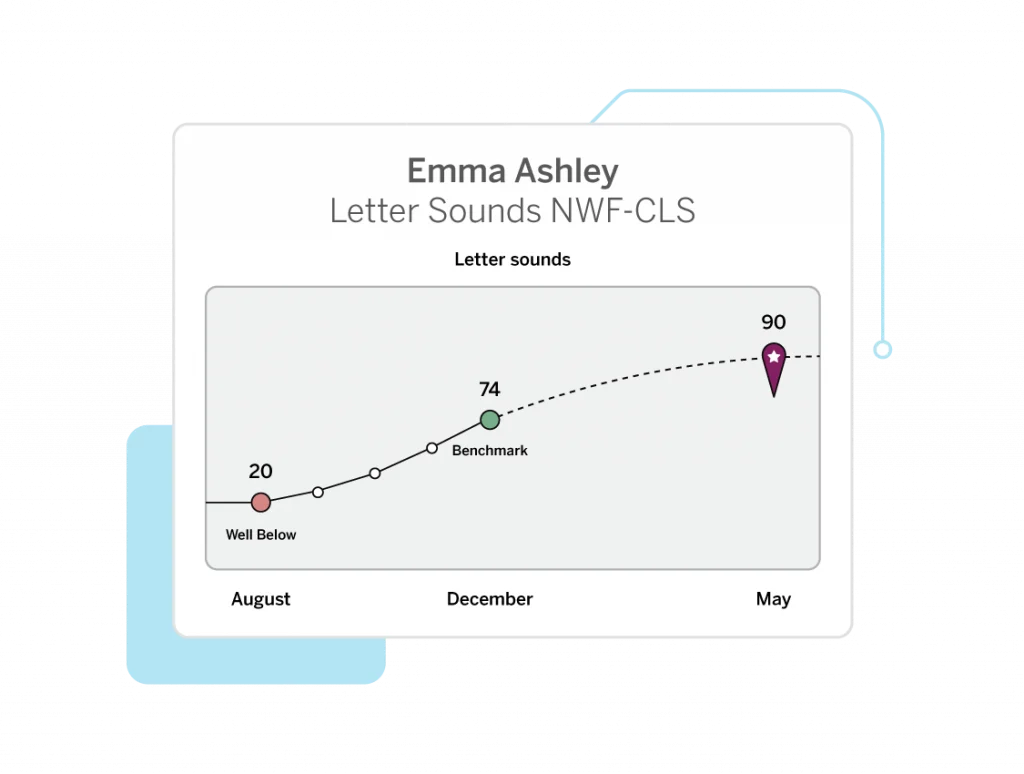
Instructional alignment across all tiers
Amplify’s early literacy system ensures that you have all the core, intervention, and personalized instruction you need to support each stage of a student’s literacy journey. mCLASS Texas data drives placement into mCLASS Intervention and Boost Reading Texas personalized learning. It also recommends core instruction resources within the Amplify ELAR Texas core curriculum based on the skills in which students need additional practice.
Explore more programs based on the Science of Reading.
Learn more about Amplify’s Texas literacy suite at texas.amplify.com.
Welcome to Amplify Desmos Math California!
California educators, welcome to math that motivates. Introducing Amplify Desmos Math California, a curiosity-driven TK–12 program that builds lifelong math proficiency. Each lesson poses problems that invite a variety of approaches before guiding students to synthesize their understanding of the learning goals. Students encounter math problems they’re eager to solve, while teachers spend more time where it’s most impactful—creating a collaborative classroom of learners.
Explore the California Adoption Toolkit resources and discover more about the program in the sections below.
Built for California
The Amplify Desmos Math California program is designed around the vision articulated in the Mathematics Framework for California Public Schools: Kindergarten Through Grade Twelve to enable all California students to become powerful users of mathematics. Our program incorporates the latest research in student learning, meaning that we:
- Focus on the Big Ideas: Amplify Desmos Math California’s courses, units, and lessons are centered around the Big Ideas. Big Ideas, like standards, are not considered in isolation. In addition to each unit and lesson’s focal Big Ideas, Amplify Desmos Math California also provides connections among the Big Ideas across units and lessons.
- Center on open and engaging tasks: Amplify Desmos Math California is grounded in engaging tasks meant to address students’ often-asked question: “Why am I learning this?” Students are invited into learning with low-floor, high-ceiling tasks that provide an entry point for all. Open tasks in Amplify Desmos Math California provide the space for students to try on multiple strategies and represent their thinking in different ways, and allow student explanation and discussion to serve as the center of the classroom. All lessons offer both print and digital representations.
- Provide enhanced digital experiences: Amplify Desmos Math California includes digitally-enhanced lesson activities, incorporating interactive digital tools alongside print materials. These purposefully-placed resources allow students to visualize mathematical concepts, receive actionable feedback while practicing, encounter personalized learning support from an onscreen tutor, and engage in discussions about their thinking and approaches.
- Treat core instruction and differentiation as integral partners: The Amplify Desmos Math California curriculum provides teachers with lessons, strategies, and resources to eliminate barriers and increase access to grade-level content without reducing the mathematical demand of tasks. Every activity has multiple entry points to ensure that all students are supported and challenged. Intervention and personalized learning activities are directly connected to lesson content and offer students individualized support as they dive into the mathematics.
California Adoption Toolkit resources
Program Description
Linked here is the Program Description for Amplify Desmos Math California.
Our Major Conceptual Ideas Strategy
The renowned mathematician William Paul Thurston said that mathematics is about understanding. The essence of this perspective is woven into the California Mathematics Framework. The Framework is clear that mathematics calls for “original thought and connections of concepts” and that mathematics teaching should “position students as thinkers and members of the classroom community…to support students in seeing themselves as young mathematicians.”
When Amplify developed Amplify Desmos Math California, we built it with one clear priority: grounding it in student understanding. The Framework provided a basis in the Big Ideas, of course, but also in the Drivers of Investigation (DIs), Content Connections (CCs), and Standards for Mathematical Practice (SMPs). Using those components of the Framework, we organized student learning around how students would make sense of the mathematics.
In addition to lessons and learning experiences specifically designated as Explore lessons or Investigations, we utilized the structure of the DIs, CCs, and SMPs in each lesson. Not only is every lesson in our program tied to one or more of the Big Ideas and their connections with one another, every lesson is also framed around these additional components. Each Lesson Overview centers around these questions:
Why? Why are students learning this content?
How? How are students grappling with the mathematical concepts?
What? What contexts encourage students to apply their knowledge?
Each of these questions maps to one of the additional aspects of the Mathematical Framework. Addressing the “Why?” grounds the lesson in one or more of the Drivers of Investigation. Focusing on “How?” encourages students to develop the habits of mind described by the SMPs, becoming explorers in mathematics rather than passive recipients. And maintaining attention on “What?” centers students and teachers on the precise mathematical topics that they are exploring aligned to the four Content Connections.
The Big Ideas and the conceptual and pedagogical shifts in the California Mathematics Framework reflect a shared goal to center education on student understanding. The Amplify Desmos Math California team is eager to support educators and students in their transition to conceptual understanding through our High-Quality Instructional Materials, professional development opportunities, and continued support.
Standards Maps
The links below provide the Standards Maps for Amplify Desmos Math California for each grade level.
Evaluation Criteria Map
Linked here is the Evaluation Criteria Map for grades K–8. Please note that you will need to be logged into the digital platform to access the links in the Evaluation Criteria Map.
Standards for Mathematical Practice
The links below provide the alignment of Amplify Desmos Math California to the Standards for Mathematical Practice at each grade level.
Big Ideas
Amplify Desmos Math California’s courses, units, and lessons are centered around the Big Ideas. In addition to each unit and lesson’s focal Big Ideas, Amplify Desmos Math California also provides connections among the Big Ideas across units and lessons. Please refer to Keeping the Big Ideas at the Center (linked below) for specific lesson designs and alignment with the Big Ideas for each grade level.
Drivers of Investigation and Content Connections
Amplify Desmos Math California incorporates the Drivers of Investigation and Content Connection throughout the program. Throughout the year, students engage with open and authentic tasks of varying durations — from lesson activities to unit-level Explore lessons and longer course-level Investigations. Every lesson and investigation opportunity is grounded around the why, how, and what of the learning experience, and helps teachers bring mathematical concepts to life.

California English Language Development Standards
The links below provide the alignment of Amplify Desmos Math California to the California English Language Development Standards at each grade level.
California Environmental Principles and Concepts
Select lessons, performance tasks, and investigations across grade levels in Amplify Desmos Math California are aligned to one or more of the California Environmental Principles and Concepts. Click the links below to view how the California Environmental Principles and Concepts are represented in each grade level.
Contact us
For questions, samples, or more information, please contact your local Amplify Account Executive:
Making reading comprehension connections

Comprehension isn’t just a process, or just a product—it’s both. And connecting reading and understanding is what most teachers are working on every day.
That fundamental connection was the focus of our recent Science of Reading Webinar Week: Comprehension Connections—Building the Bridge Between Reading and Understanding, a five-day, expert-filled series that unpacked what really drives comprehension, from early decoding to middle school mastery.
Here’s a quick look at what you’ll learn when you watch—and a few ideas you can use right away.
Day 1: What Is Reading Comprehension, Anyway?
Speaker: Susan Lambert, Ed.D., Chief Academic Officer, Literacy, Amplify; Host of Science of Reading: The Podcast
“Reading comprehension is more than just language comprehension. It’s language comprehension on the page, which makes it much more complex.” — Susan Lambert, Ed.D.
If you ask ten teachers to define comprehension, you might get twelve answers. Lambert opened the week by grounding everyone in the Science of Reading, including the Simple View of Reading and the Reading Rope. Skilled reading, she reminded viewers, is the result of multiple strands—decoding, language comprehension, and knowledge—woven together over time.
The takeaway? The most effective approaches don’t teach comprehension strategies—such as “find the main idea”—in isolation. Rather, they connect word recognition to meaning through rich texts, conversation, and writing. Whether you’re teaching second-grade reading comprehension or sixth-grade reading comprehension, students need the same thing: a clear path from sounding out words to making sense of ideas.
Day 2: Comprehension and Knowledge Building: A Two-Way Street
Speakers: Sonia Cabell, Ph.D., Sigmon Endowed Professor of Reading Education, Florida State University
HyeJin Hwang, Ph.D., Assistant Professor, Department of Educational Psychology, University of Minnesota Twin Cities
“Better background knowledge leads to improved reading comprehension, which in turn enables readers to learn more from text, thereby building additional knowledge.” —HyeJin Hwang, Ph.D.
In their session, Sonia Cabell and HyeJin Hwang explored one of the clearest findings in reading research: Comprehension and knowledge develop together. Cabell began by explaining how comprehension (including oral language, background knowledge, vocabulary, syntax, and verbal reasoning) forms one of the essential strands of the Reading Rope.
Students can’t activate knowledge they don’t yet have. Teachers need to help them build it early, and intentionally. Cabell’s research found that integrating literacy and content instruction produced gains in vocabulary and content knowledge.
Likewise, Hwang’s two large-scale longitudinal studies showed that better knowledge instruction leads to better reading, which leads to even more knowledge. These findings held true across languages and grade levels, underscoring the universal value of content-rich instruction.
Classroom takeaways:
- Plan literacy units around connected science or social studies topics to build coherent knowledge.
- Use content-rich interactive read-alouds with discussion before, during, and after reading.
- Ask inferential comprehension questions (“Why?” “How?”) that require students to connect ideas using their own words.
- Encourage quick writing or drawing tasks that help students show what they’ve learned.
Day 3: Where and How to Measure Comprehension to Drive Improvement
Speakers: Danielle Damico, Ph.D., Executive Director of Learning Science, Amplify
Gina Biancarosa, Ed.D., Ann Swindells Chair in Education, University of Oregon
“Reading comprehension is both a process and a product.” —Danielle Damico, Ph.D.
Too often, comprehension is measured only as a finished product—how well students answer questions after reading—without revealing how they built understanding along the way. This session explored what comprehension actually involves: reading words accurately, understanding their meaning, applying background knowledge, and making inferences. As researcher Sharon Vaughn, Ph.D., has described, these interconnected skills all work together as students learn to read.
Biancarosa showed how looking at comprehension as a complex process helps teachers see student thinking in action. She described the major types of inferences—lexical, bridging, gap-filling, and causal—and the importance of understanding how students connect ideas and construct meaning.
Try this:
- Treat comprehension as ongoing thinking, not a one-time test score.
- Use brief think-alouds or class discussions to get a look at how students connect ideas.
- Match assessments to the precise question you’re trying to answer.
- Let assessment guide instruction—data should lead directly to next steps.
Day 4: Comprehension in Middle School: More Important Than Ever
Speaker: Deb Sabin, Chief Academic Officer, Amplify ELA
“Writing done right encodes knowledge. And discourse done right gets into the realm of higher-order thinking.” —Deb Sabin
By the time you’re teaching fourth-grade reading comprehension through sixth-grade reading comprehension, decoding should be automatic. At this stage, the upper strands of the Reading Rope—vocabulary, background knowledge, and syntax—move to the forefront. In this session, Deb Sabin highlighted how comprehension in middle school relies on academic knowledge, disciplinary vocabulary, and structured discourse—and how it truly blossoms when reading, writing, and speaking reinforce one another.
Classroom moves that help:
- Pair writing with reading: Even short, text-based responses consolidate knowledge in long-term memory.
- Use structured discussion (“accountable talk”), where students cite text evidence and build on one another’s ideas.
- Center rich, grade-level texts that challenge thinking and vocabulary.
Day 5: Finding the Missing Link in Reading Comprehension to Boost Literacy Success
Speaker: Julie A. Van Dyke, Ph.D., Clinical Assistant Professor, Yale University Child Study Center; Research Scientist, Yale-UConn Haskins Global Literacy Hub
“Teach phonics for decoding. Teach syntax for understanding.” —Julie A. Van Dyke, Ph.D.
In the final presentation of the series, Julie Van Dyke explored an often-overlooked element of comprehension: syntax—the way words combine to create meaning. Van Dyke argued that syntax is to comprehension what phonics is to decoding.
She illustrated how the Science of Reading and the Reading Rope locate syntax within the language-comprehension strands—critical to understanding who did what to whom in complex sentences. Explicitly teaching sentence structure helps all learners, including multilingual/English learners, access higher-level meaning.
Simple practices can make a difference:
- Have students paraphrase tricky sentences. (Starter question: “Who’s doing the action?”)
- Pull strong sentences from your class texts to show how structure shapes meaning.
- Encourage students to mirror those structures in their own writing.
What linked all five sessions together? The understanding that comprehension develops when teachers connect the code, the language, and the knowledge. Whether students are decoding in second grade or crafting essays in sixth, they thrive when we help them move from reading to understanding—step by step, strand by strand.
Watch all five on-demand recordings.
More to explore:
- Download your Comprehension 101 bundle.
- Read (and comprehend!): Reading comprehension strategies grounded in science
- Listen to this special Essentials episode of Science of Reading: The Podcast, where Susan Lambert and other experts distill key reading comprehension insights.
Power up your Science of Reading knowledge: 2024 podcast recap
Amplify’s Science of Reading: The Podcast won both Silver and the Listeners’ Choice Award in the education category at the 2024 Signal Awards! If you haven’t already, we hope you’ll join those who have helped catapult the podcast to more than six million downloads.
You’re welcome to binge-listen all 29 podcast episodes released in 2024, but here, we’ve selected a few to highlight for you.
The power of the Science of Reading
Some context: As you probably know, the Science of Reading is a much-researched area alongside the science of learning. Applying cognitive, neuroscience, and educational principles, it helps us understand and improve how students acquire and develop reading skills. This knowledge is essential because, while humans typically learn to speak naturally, reading (and writing) require formal instruction. According to the Simple View of Reading, reading comprehension is the product of both decoding and linguistic comprehension. So kids must be taught the relationships between sounds and letters, and how to decode words. Systematic instruction presents these skills in a logical order, explicit instruction goes beyond just “exposing” kids to words and texts, and cumulative instruction builds on skills learned before.
The episodes below are a great start to exploring the fundamentals of evidence-based instruction beginning in early literacy. You’ll hear about the importance of knowledge building, the symbiosis between reading and writing, and the power of multilingual learning, just to name a few topics.
The power of knowledge
Season 8 focuses on why knowledge is so critical for literacy development and how educators can empower students to build it.
- Episode 10: Comprehension is an outcome, with Sharon Vaughn
Many of us (as students and educators) were taught or trained with comprehension framed as a skill. But award-winning researcher and author Sharon Vaughn, Ph.D., says (spoiler!) that comprehension is not a skill to be taught in a vacuum, but rather an outcome—of strong decoding, vocabulary, and background knowledge. “If students can’t read words or don’t know what they mean, emphasizing comprehension is just the wrong priority,” she says. Vaughn stresses the importance of systematically building background knowledge through coherent, high-level informational texts and relevant content lessons, enabling students to connect ideas and deepen understanding. By focusing on these foundational elements, educators can support comprehension and meaningful learning.
Episode 11: Cognitive load theory: Four items at a time, with Greg Ashman, Ph.D.
Drawing from his book A Little Guide for Teachers: Cognitive Load Theory, deputy principal and professor Greg Ashman argues that students need to build a strong foundation of knowledge in order to think and learn effectively. He challenges the idea of leaving students to “figure things out” on their own. “Kids are not little scientists,” he says, and advocates instead for structured instruction to build the schemas necessary for deeper learning.
Ashman also recommends reducing extra cognitive load—distractions that overwhelm working memory—and cautions against overrelying on approaches like “productive failure,” which can frustrate students who happen to lack relevant foundational knowledge. His advice: Use evidence-based methods and prioritize clear, incremental instruction.
The power of evidence-based literacy instruction
Season 9 dives deep into the key principles of and latest developments in the Science of Reading.
Episode 3: Know the non-negotiables in a program aligned to the Science of Reading, with Kari Kurto
Kari Kurto, national Science of Reading project director with the Reading League, discusses the organization’s curriculum evaluation tool designed to assess research-based practices in reading programs. Drawing from her experience teaching students with dyslexia, Kurto emphasizes the necessity of explicit, systematic instruction in phonics and (like Ashman) the importance of reducing extraneous cognitive load.
She says one must-have for any effective, evidence-based curriculum is explicit instruction in phonics through a clear scope and sequence, which ensures that students build foundational skills, such as phonemic awareness, in a systematic way. “No program is perfect, but understanding both its strengths and areas for improvement allows schools to maximize its impact,” she says.
Episode 4: Comprehension is not a skill, with Hugh Catts, Ph.D.
Hugh Catts, like Vaughn, continues to challenge us to rethink reading comprehension. “Comprehension isn’t the purpose of reading,” says Catts, a professor at Florida State University. “The purpose of reading is whatever you’re reading for.” Whether scanning for a fact, grasping the gist, or diving deep into a complex topic, comprehension varies based on the reader’s intent and context. He also urges educators to do what the evidence asserts: Move beyond isolated skill drills to content-rich instruction that builds knowledge and engages students meaningfully. Catts notes that comprehension grows over time, as students develop mental models and apply critical thinking in a variety of reading contexts.
The power of multilingualism
In this special miniseries, our podcast focuses on how the Science of Reading serves multilingual/English learners (ML/ELs).
Episode 1: Language is always an asset, with Kajal Patel Below
Kajal Patel Below, Amplify’s vice president of biliteracy, highlights why language is such a powerful asset, and how multilingualism is not a barrier, but a gift. “Literacy in a new language builds from literacy in the home language,” she says.
But that’s not—yet—the prevailing view. Multilingual and English learners often face challenges like being left out of research or misidentified in assessments. Below also notes schools focus too much on phonics and foundational skills, sometimes overlooking the equally important elements of language comprehension, vocabulary, and speaking skills.
With the number of multilingual learners growing fast in the U.S., Below calls for schools and educators to embrace bilingual education, create stronger resources, and celebrate the unique strengths these students bring to the classroom.
More to explore
Early literacy assessment and intervention, grounded in the Science of Reading
mCLASS® is an all-in-one system for Science of Reading-based universal screening, dyslexia screening, progress monitoring, and instruction for grades K–8. Powered by DIBELS® 8th Edition, mCLASS helps you measure and strengthen the foundational skills that all students need to become confident readers.
What is mCLASS?
mCLASS, the only digital provider of DIBELS 8th edition assessments, provides universal screening, dyslexia screening and progress monitoring to assess your students on their reading trajectory and what skills they need to develop.
You’ll observe students as they form sounds or read words and text. Then, mCLASS instantly scores and analyzes student response patterns to provide you with diagnostic data and instructional focus for each student and group.
With mCLASS, you’ll have everything you need to support every type of learner in your classroom, including advanced learners, multilingual learners, and students with signs of dyslexia.
Valid and reliable DIBELS 8th Edition assessments
Developed in partnership with the University of Oregon, mCLASS DIBELS 8th Edition is founded on the strongest-ever research base for predicting reading proficiency, including identifying those at risk for dyslexia.
For more than 30 years, the University of Oregon has led the research behind DIBELS (Dynamic Indicators of Basic Early Literacy Skills). mCLASS is the only licensed digital provider of the evidence-based DIBELS 8th Edition assessment. See more of our research.
Our approach
mCLASS provides rich data to help you match Science of Reading-based instruction with your students’ precise needs. You’ll be able to monitor the effectiveness of instruction and make timely decisions when students or classrooms need extra support.
Grounded in the Science of Reading
From phonics to fluency and comprehension, mCLASS assesses the skills that are most critical for students to become successful readers. Once students are assessed, you’ll have the data you need to drive instructional decisions at the classroom, school, and district level.
- Data you can trust, with teacher-administered assessments
- Skill-level data aligned with the Science of Reading
- Data-driven instructional recommendations to support intervention, remediation, and enrichment
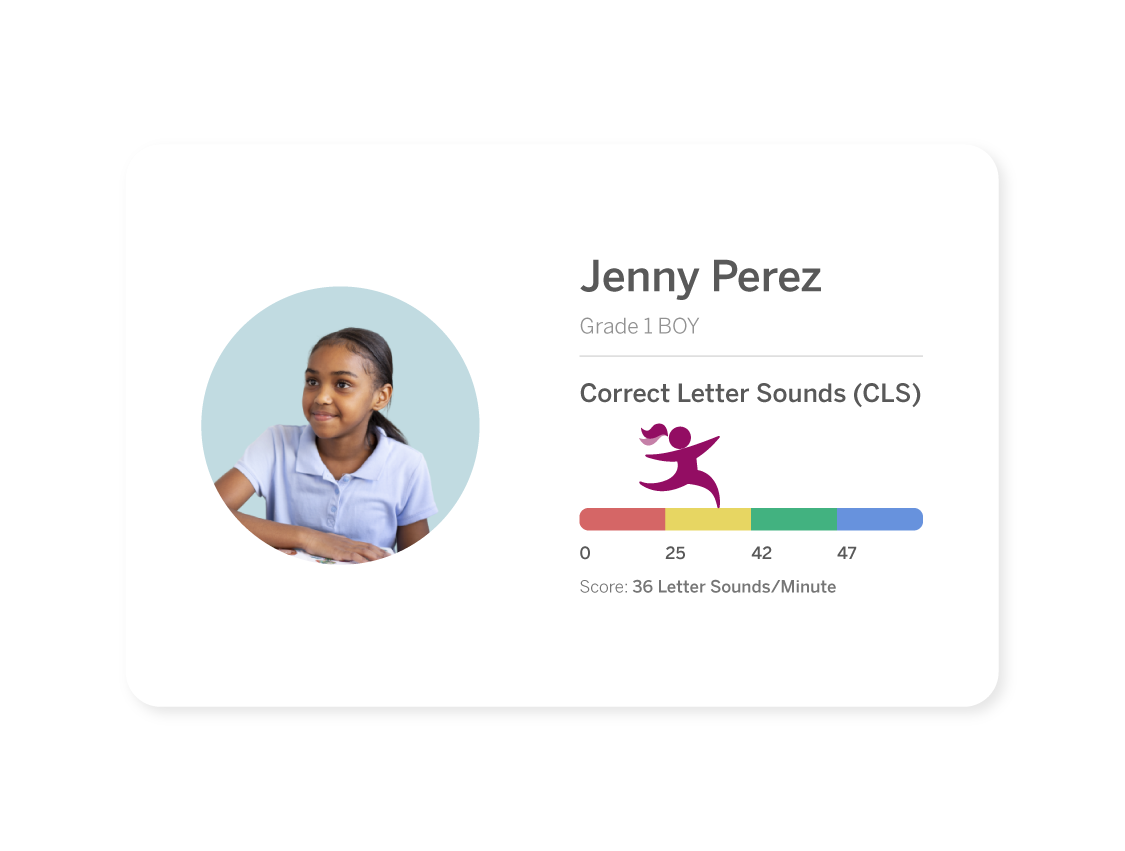
Precise, trustworthy data through direct observation
Our approach to assessment is focused on providing you with immediate insights you can trust. Through direct observation of students and detailed reports, including assessment transcripts and diagnostic error patterns, you’ll have total transparency into each student’s performance.
Instant analysis and next steps
With mCLASS, you can interpret and act on data in real time with instant instructional guidance based on benchmark and progress-monitoring results. In one click, teachers can access differentiated skill-based groups and targeted resources to develop students’ foundational literacy skills.
A complete picture of English and Spanish biliteracy
Amplify’s Spanish language assessment, mCLASS Lectura (K–6), works in tandem with DIBELS 8th Edition’s English assessments to highlight areas of growth as students develop into bilingual readers. mCLASS Lectura provides complete parity with English mCLASS assessments, skill coverage, instructional tools, and reporting.
Ready to continue your learning journey?
Help build teacher confidence and improve effectiveness of intervention delivery with mCLASS professional development. Launch sessions help your team get up and running, while Strengthen sessions help teachers go beyond the basics.

What’s included
The mCLASS program includes quick assessments of critical reading skills, real-time reporting, and data-driven instructional recommendations.
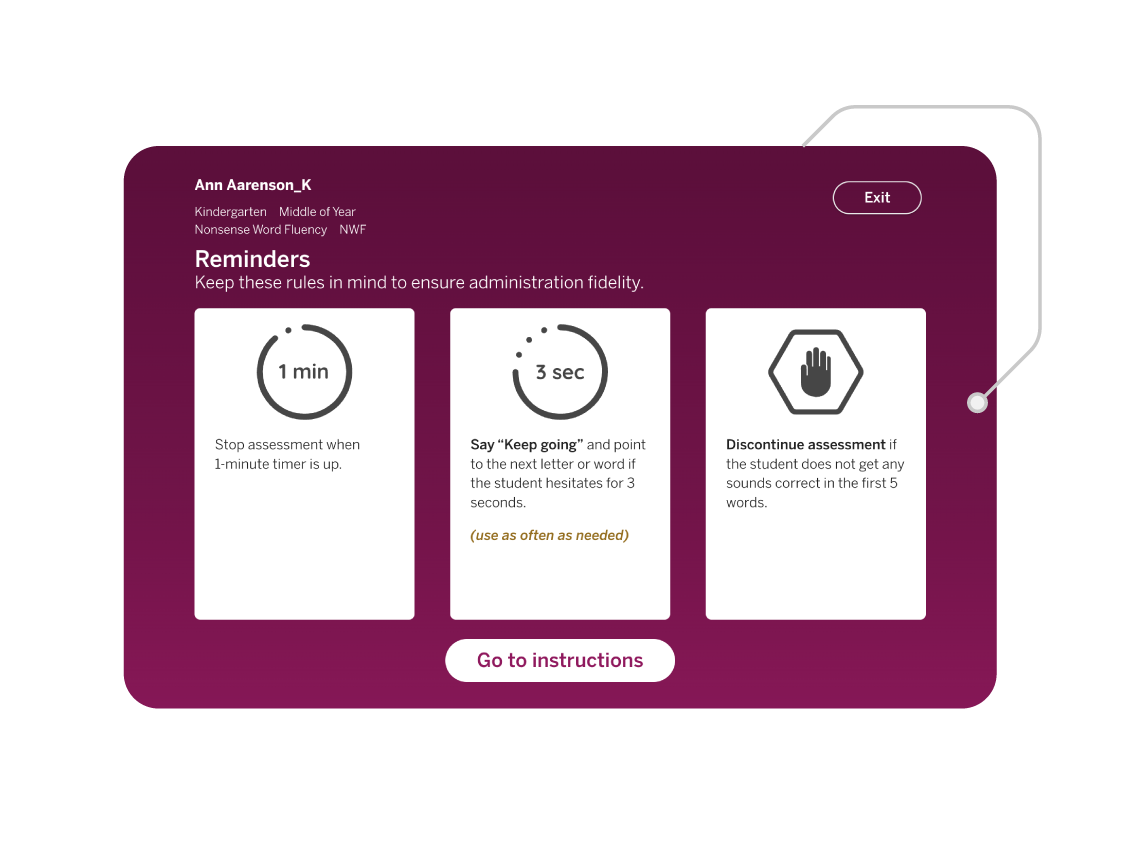
Efficient one-minute measures
DIBELS 8th Edition’s predictive one-minute assessments of phonemic awareness, phonics, fluency, and comprehension are proven to identify risk as early as possible.
- Phonological awareness
- Alphabetic principle/phonics
- Reading fluency
- Reading accuracy
- Reading comprehension
Early detection of dyslexia symptoms
With mCLASS, you can efficiently screen students and assess the full range of skills linked to dyslexia risk factors at the same time. mCLASS DIBELS 8th Edition and mCLASS Lectura are both validated as dyslexia screeners for English and Spanish, with additional Vocabulary, Spelling, RAN, and Language Comprehension measures available at no additional cost.
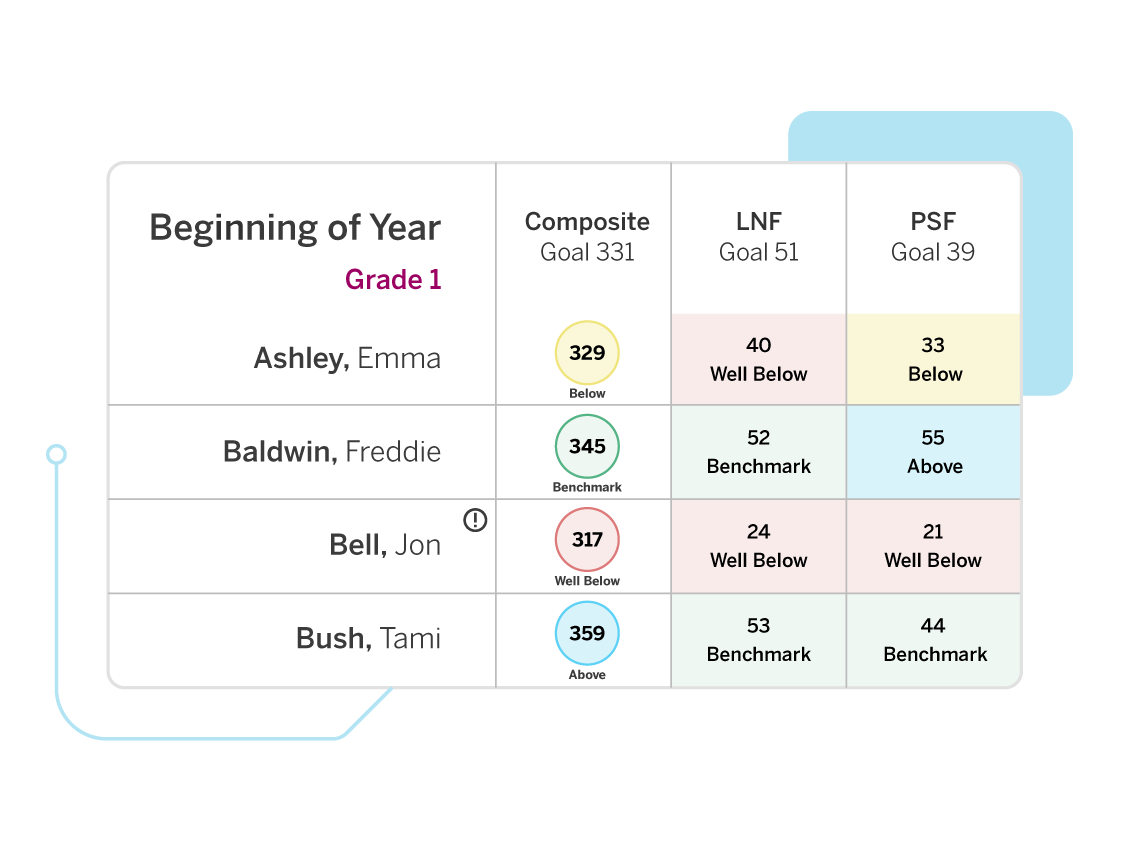
Progress monitoring and goal setting
To help you target the right skills and areas of instruction, mCLASS recommends progress-monitoring measures and automatically sets meaningful, attainable goals for each student. Our Zones of Growth goal setting framework examines your student’s DIBELS scores to predict the rate of growth they need to reach end-of-year goals.
- Automatic progress monitoring recommendations
- Customizable goals
- Semester and full-year growth reports
Differentiated instruction for all students
Our library of more than 500 evidence-based activities makes it easy to plan lessons that reinforce your core instruction. The embedded professional development supports consider the varied language backgrounds of all students and provide cross-linguistic transfer and language variety guidance to inform phonological awareness instruction.
One-of-a-kind dual language reporting
When you use mCLASS DIBELS 8th Edition with mCLASS Lectura, you can identify and develop students’ English and Spanish literacy skills regardless of your own Spanish-language proficiency. With the dual language report, you can see a side-by-side view of students’ assessment results and receive instructional guidance based on the data.
Educator and caregiver reports
Easy-to-use reports, ranging from classroom-level to school- and district-wide, help you evaluate each student’s reading skills over time and pinpoint exactly when a change in instruction is needed.
To reinforce learning at home, the Home Connect feature provides letters to caregivers about their child’s reading development in English and Spanish, and includes activities for reinforcement at home or on the go.

Instructional alignment across all tiers
Amplify’s early literacy system ensures that you have all the core, intervention, and personalized instruction you need to support each stage of a student’s literacy journey. mCLASS data drives placement into mCLASS Intervention and Boost Reading personalized learning. It also recommends core instruction resources within Amplify CKLA core curriculum based on the skills in which students need additional practice.
Explore more programs based on the Science of Reading
Our literacy programs are designed to support and complement each other. Learn more about our related programs.

What’s included in our literacy curriculum for 6–8
Amplify ELA is a blended literacy curriculum designed specifically for grades 6–8. The heart of every lesson is the text. Our core English Language Arts curriculum enables teachers to teach skills through texts and develop their students’ muscles for building meaning through reading. With Amplify ELA, students learn to attack any complex text and make observations, grapple with interesting ideas, and find relevance for themselves.
Year at a glance
Each grade includes six core units centered on literary or informational texts, delivered in several forms of media. In addition to these main units, students will engage with targeted Grammar lessons and a dedicated Story Writing unit, plus two to three immersive learning experiences called Quests.
Grade 6 core units

Dahl & Narrative
1 assessment lesson
4 sub-units | 28 lessons | 4-6 weeks

Mysteries & Investigations
1 assessment lesson
5 sub-units | 32 lessons | 4-6 weeks

The Chocolate Collection
1 assessment lesson
5 sub-units | 25 lessons | 4-6 weeks

The Greeks
Myth World Quest
1 assessment lesson
4 sub-units | 25 lessons | 4-6 weeks

Summer of the Mariposas
1 assessment lesson
2 sub-units | 27 lessons | 4-6 weeks

The Titanic Collection
1 assessment lesson
5 sub-units | 25 lessons | 4-6 weeks
Grade 7 core units

Red Scarf Girl
1 assessment lesson
4 sub-units | 31 lessons | 4-6 weeks

Character & Conflict
1 assessment lesson
4 sub-units | 29 lessons | 4-6 weeks

Brain Science
Perception Academy Quest
1 assessment lesson
4 sub-units | 25 lessons | 4-6 weeks

Poetry & Poe
The “Who Killed Edgar Allen Poe” Quest
1 assessment lesson
5 sub-units | 29 lessons | 4-6 weeks

The Frida & Diego Collection
1 assessment lesson
5 sub-units | 25 lessons | 4-6 weeks

The Gold Rush Collection
1 assessment lesson
5 sub-units | 25 lessons | 4-6 weeks
Grade 8 core units

Perspectives & Narrative
1 assessment lesson
4 sub-units | 27 lessons | 4-6 weeks

Liberty & Equality
1 assessment lesson
6 sub-units | 38 lessons | 4-6 weeks

Science & Science Fiction
1 assessment lesson
3 sub-units | 29 lessons | 4-6 weeks

Shakespeare’s Romeo & Juliet
1 assessment lesson
2 sub-units | 22 lessons | 4-6 weeks

The Holocaust: Memory & Meeting
1 assessment lesson
6 sub-units | 21 lessons | 4-6 weeks

The Space Race Collection
1 assessment lesson
5 sub-units | 25 lessons | 4-6 weeks
Units at a glance
Amplify ELA lessons follow a structure both grounded in regular routines and flexible enough to allow for a variety of learning experiences. Lesson structures vary from day to day, ensuring that students are always engaged.
Learn more in the Amplify ELA Grade Overview.
Unit 6A
Dahl & Narrative
Students begin with narrative writing to develop foundational Focus skills and establish key classroom routines. Teachers use this work to create targeted feedback cycles and build a vibrant community centered on diverse experiences. Students then apply observational skills to Roald Dahl’s Boy: Tales of Childhood, learning to work closely with textual evidence.
Unit 6B
Mysteries & Investigations
Students read like an investigator to embark on a multi-genre study into the mesmerizing world of scientific and investigative sleuthing. The Secret of the Yellow Death: A True Story of Medical Sleuthing by Suzanne Jurmain, and Sir Arthur Conan Doyle’s Sherlock Holmes stories take place in the late 19th century, when medical diagnostics and criminal investigations were still evolving into scientific fields.
Unit 6C
The Chocolate Collection
Students explore primary documents and research the diverse cultural roles chocolate has played over 3,700 years, from its various uses in ancient Mexico to issues with modern production. Along the way, they build information literacy skills, craft research questions, and collaborate in Socratic seminars. Students also learn how to construct an evidence-based argument and use those skills to write pieces aimed at convincing readers about chocolate preferences, school lunch policies, and recommendations for local candy stores.
Unit 6D
The Greeks
Students closely explore and analyze three stories from Greek mythology: “Prometheus,” “Odysseus,” and “Arachne.” Drawing on the routines and skills established in previous units, these lessons ask students to move from considering the state of a single person to contemplating broader questions concerning the role people play in the world and the various communities they inhabit.
Unit 6E
Summer of the Mariposas
Students read Summer of the Mariposas by Guadalupe García McCall, a contemporary Latino retelling of The Odyssey. Following five sisters on their journey into Mexico and back, students explore this reimagining of the hero’s journey as they encounter Mexican folklore and Aztec legends along the way. Students analyze character development, compare the novel to Homer’s original, research Aztec mythology, explore symbolism, and engage in collaborative discussions before writing an essay about what makes the heroes successful.
Unit 6F
The Titanic Collection
Students explore primary documents and conduct research to understand the 1912 Titanic disaster, building information literacy skills by examining artifacts such as dining menus, ship photos, telegraph transcripts, and newspaper accounts. Each student is assigned a passenger from the manifest and writes a narrative account from that person’s perspective, considering different views. Students also participate in Socratic seminars to examine the complicated issues within the Titanic story.

Unit 7A
Red Scarf Girl & Narrative
Students begin with narrative writing to develop foundational Focus skills while teachers establish targeted feedback cycles and build a classroom community centered on diverse experiences. After exploring how they describe their own experiences and emotions, students apply the same close attention to analyzing details in Ji-li Jiang’s Red Scarf Girl: A Memoir of the Cultural Revolution.
Unit 7B
Character & Conflict
Students analyze characters’ responses to conflict and examine how authors use character interactions to develop theme and perspective. They read Carson McCullers’ “Sucker” and Lorraine Hansberry’s A Raisin in the Sun, both texts that explore how families facing hardships can support and harm one another. Students observe complex character growth and discuss issues of identity, family obligations, and differing notions of success.
Unit 7C
Brain Science
Students explore narrative nonfiction and informational texts about brain science to understand what it means to be human and how their developing brains impact daily experiences. They also build awareness of their cognitive strengths and analyze the structures of informational texts and scientific arguments. Key texts include Phineas Gage, Inventing Ourselves: The Secret Life of the Teenage Brain, and Oliver Sacks’ The Man Who Mistook His Wife for a Hat.
Unit 7D
Poetry & Poe
Students learn visualization techniques to read like a movie director, beginning with poems by D.H. Lawrence, Federico García Lorca, and Emily Dickinson to form mental images. They then read three Edgar Allan Poe texts, creating storyboards and analyzing narrative elements to learn about unreliable narrators. Students also participate in the murder-mystery Quest “Who Killed Edgar Allan Poe?” and write an essay arguing whether they can trust a narrator in the unit’s texts.
Unit 7E
The Frida & Diego Collection
Students explore primary source documents and research on Mexican artists Diego Rivera and Frida Kahlo, learning how they drew inspiration from Latin American folklore, politics, and customs. Along the way, students build information literacy by generating research questions and visual analysis skills through close reading of key paintings. They also compare the artists’ descriptive writing to Shakespeare’s and analyze figurative language. The unit culminates in a research project showcasing their interpretation of Frida and Diego’s work and legacy.
Unit 7F
The Gold Rush Collection
Students explore primary documents and conduct research on the California Gold Rush, building information literacy skills and constructing research questions. They also learn about the diverse people who participated, compare fictional and historical accounts, and participate in Socratic seminars. Students write narrative accounts from specific perspectives and complete a culminating research assignment combining essay and media project elements.
Unit 8A
Perspectives & Narrative
Students learn to read like writers, paying attention to craft and writing moves that shape reader experience and developing Focus and Showing skills as they build collaborative classroom routines. Students study three narrative texts, exploring themes of belonging and identity through close reading. They also practice alternating between analytic and narrative writing, and conclude with an essay arguing whether the mothers in Amy Tan’s “Fish Cheeks” are role models.
Unit 8B
Liberty & Equality
Students study Civil War-era writings that debate the meaning of “all men are created equal,” exploring various perspectives on American ideals. Key texts include Walt Whitman’s Leaves of Grass, Frederick Douglass’ Narrative, and Harriet Ann Jacobs’s Incidents in the Life of a Slave Girl. The unit culminates with an essay examining Douglass’s arguments and Lincoln’s Gettysburg Address to consider what America means by “all men are created equal.”
Unit 8C
Science & Science Fiction
Students read Gris Grimly’s Frankenstein, a graphic novel adaptation of Mary Shelley’s novel, exploring themes of creator responsibility, societal influence, and the risks of scientific inquiry. They trace Victor’s sympathy for his creation, rewrite scenes from the creature’s perspective, and debate whether Victor owes the creature a companion. The unit concludes with an essay determining whether the creature should be considered human.
Unit 8D
Shakespeare’s Romeo & Juliet
Students read five excerpts from Shakespeare’s Romeo and Juliet to learn key elements of Shakespearean English through close reading. They practice memorizing and reciting the famous “Prologue,” put on stage performances, translate Shakespeare’s language into contemporary terms, and study the Shakespearean sonnet form. The unit concludes with an essay arguing whether love or hate is responsible for Romeo’s death.
Unit 8E
Holocaust: Memory & Meaning
Students use close reading to explore memoirs and primary sources that address two key Holocaust questions: How do societies become participants in atrocity, and what are our responsibilities as witnesses? Students analyze multiple perspectives through texts, including Alexander Kimel’s “I Cannot Forget,” Irene Butter’s Shores Beyond Shores, 1936 Olympics propaganda, and excerpts from Maus and Night.
Unit 8F
The Space Race Collection
Students explore primary documents and conduct research on the Space Race. They build information literacy skills, construct research questions, and learn about diverse participants from Soviet cosmonauts to American heroes like Buzz Aldrin and Katherine Johnson. Each student researches an assigned cosmonaut or astronaut and writes space blog entries from their perspective. Students also complete a capstone research essay and media project.
Print & digital components
The program includes instructional guidance and student materials for a year of instruction, with lessons and activities that keep students engaged every day.

Teacher materials
Teacher Edition
Available digitally and in print, the Teacher’s Edition contains all the information teachers need to facilitate classroom instruction, including detailed lesson plans, video teacher tips, presentation slides, standards alignment, Exit Tickets, real-time differentiation strategies, and robust reporting.
Student materials
Student Edition
Available digitally and in print, student materials guide middle schoolers through complex texts and writing by engaging them with high-quality narrative and informational texts—providing videos, audio supports, and a digital experience that captures their attention. They also keep all of their writing in one place with a personal Writing Journal.

Explore more programs
Our programs are designed to support and complement one another. Learn more about our related programs.

Putting equity first
When so much about the world needs to shift, so urgently… here are a few places to start.

Listen: Educator, author, and leader Shawn Joseph shares his passion for social justice and discusses his work advocating for equity in education, shedding light on what he calls the “silent crisis” in literacy instruction.

Learn: Share Shawn Joseph’s discussion guide with your colleagues. Which insights are the most relevant to your district this year?

Lead: Take a look at this curated collection of multicultural and social justice books. Could one spark discussion for your students?

Lead: Share this infographic on the journey to freedom with your class. Ask students to select an event to research and present a two-minute video talk.
Leveraging the science of reading
Go deep on the insights and practices that will help our classrooms (remote or otherwise)–based on the latest science, and adaptable to every shift in the educational landscape.

Learn: Susan Lambert talks to Language Magazine about the science of reading and what it means right now.
Building strong foundational skills
Strong, systematic sound-first instruction is critical to helping students learn to decode and can increase student success. Learn how specific skills can increase your impact.

Learn: Start with Emily Hanford’s “Hard Words” article.

Listen: Jasmine Lane on the importance of equity, and how early literacy teachers can make a difference.

Listen: Bruce McCandliss on the changes a child’s brain shows when learning to read

Lead: Challenge a colleague to this Scarborough’s Rope activity–work through a sample lesson from your district and point out elements of the reading rope.
Sharing knowledge resources
Students need to be able to both read words and get the meaning of what they’re reading. Find out how to help them build key background knowledge from the get-go, so that it compounds over time.
Learn: Begin with Why knowledge matters–then follow up with Natalie Wexler’s podcast

Learn: Take a look at Achieve the Core’s overview of the importance of building knowledge and the groundbreaking “baseball study“

Listen: Anne Lucas on the importance of comprehension and the specific skills that can boost it.
Listen: Tim Shanahan on four crucial aspects in teaching reading and his views on teaching reading in middle school as an extension of evidence-based early literacy practices
Learn: Begin with Why knowledge matters–then follow up with Natalie Wexler’s podcast

Learn: Take a look at Achieve the Core’s overview of the importance of building knowledge and the groundbreaking “baseball study“
Assessing what students need
Assessment this year is more important than ever before–and also more challenging. What does this extended summer slide look like? How can you find time to review what’s needed, while still moving forward?
Learn: Education for Global Development’s thoughts on formative assessment in the time of COVID-19.
Learn: District Administration on why educators want more data– and more guidance on how to use it
Learn: Catch up on dyslexia risk factors and state legislation with our dyslexia toolkit.
Listen: Nancy Nelson on the importance of universal screeners in literacy instruction.
Lead: What can you offer struggling readers and their caregivers? Take a look at the IDA’s COVID-19 Resource Guide.
Thriving through remote learning
Everything about this school year has changed–yet your work is more important than ever before. How can you support your students, and your colleagues, in this new normal? Stop by Amplify Anywhere for ideas that may help.
And while you’re here–please download your free PDF “20 Self-Care Tips for Educators Right Now” (and please take care of yourselves!).
Alana Mangham on Teaching Now
Natalie Wexler on the New Normal
Thinking about back-to-school
Though it feels like the landscape is changing every day, we know we’ve got to find a way to get students back to learning. What will your school day look like? What reinforcement might you need to do in order to ensure equity? We will continue to share resources to support your journey.
Learn: In this recorded webinar, explore some ways CARES Act funding might support your students.
Learn: Hear from Baltimore educator Lucas Drerup on making middle school ELA both enjoyable and rigorous for students.
Listen: Jackson-Madison CAO Jared Myracle shares his thoughts on change management and the science of reading.
Listen: Doug Lemov, managing director of Uncommon Schools, discusses the role of technology in the classroom and remote instruction, and how educators can reconsider how they approach literacy.
Lead: As you consider how and when to reopen, review this article from The Atlantic on Eight steps that will let us reopen schools.
Lead: Guidance from District Administration on reopening safely this fall.
Finding high-quality instructional materials
If you were already thinking about new literacy resources–you’ve now got even more ideas about what high quality looks like. How will your literacy program work for all students? How do you need your literacy resources to support you in the classroom, in remote learning, and for every scenario in between?
Learn: Review this guide to a high-quality curriculum adoption. What factors matter most now, in literacy and in every subject?
Listen: Hear nationally recognized reading experts and authors David and Meredith Liben discuss evidence based solutions and more.
Lead: Download this K-8 ELA Instructional Materials Evaluation Guide. Share with your district leadership. What resources will you all need next year (and beyond) to do the best job possible for your students?
Lead: Talk to a few colleagues in the coming weeks. What are they seeing right now? What are they planning to improve next year?
Staying strong and staying connected!

Looking for ways to connect with other educators and stay updated on the latest research and trends in the science of reading? Check out a few more ways to do so below.
Science of Reading: The Podcast delivers the latest insights from researchers and practitioners in early reading. Further your professional development with each episode by subscribing and downloading them now.
Science of Reading: The Community is built for those committed to fostering conversation around the science of reading and implementing best practices in the classroom (including the virtual classroom).
Ready for more? Complete the form below to stay up-to-date on the latest resources.
Achieve next-level literacy growth with a cohesive Science of Reading suite.
The Science of Reading programs in Amplify’s early literacy suite empower you to meet the dynamic needs of every student learning to read. Discover the programs that best fit your literacy priorities and how they work together for a seamless teaching and learning environment.

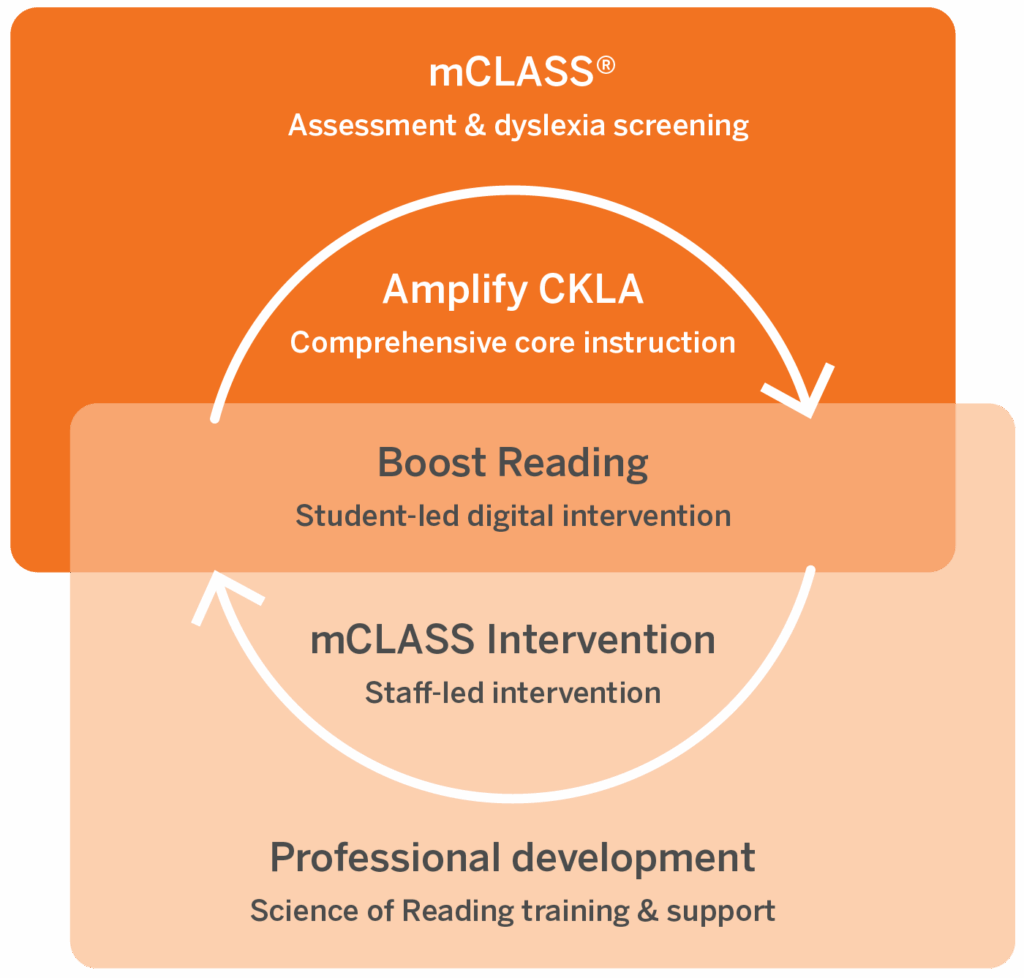
A true Science of Reading early literacy suite for grades K–5
Amplify has combined the critical elements of a Science of Reading system of assessment, core curriculum, personalized learning, and intervention. Based on 20 years of experience with the Science of Reading, this complete system saves you time and aligns your literacy practices.
- Assess with mCLASS®: A universal and dyslexia screener, powered by DIBELS® 8th Edition
- Instruct with Amplify Core Knowledge Language Arts (CKLA)®: Core curriculum to build foundational skills and knowledge
- Support with Boost Reading: Student-led digital intervention to extend and reinforce core instruction
- Intervene with mCLASS Intervention: Staff-led Tier 2 and 3 intervention for intensive support
- Science of Reading professional development: Amplify training, events, and podcasts to strengthen instruction
mCLASS assessment
Powered by DIBELS 8th Edition, mCLASS is a universal and dyslexia screener, plus a progress monitoring tool, all in one. With this comprehensive tool, you have precise one-minute measures delivered one-on-one that give you the data you can trust to make informed instructional decisions.

mCLASS data informs instructional needs and identifies whole-class and small-group areas of focus.
mCLASS can replace Amplify CKLA’s benchmark assessments in K–2 and can identify appropriate Amplify CKLA instruction for small groups.
Boost Reading digital intervention
Boost Reading and mCLASS integrate to provide adaptive, student-led practice in targeted skill areas.
mCLASS data automatically places students at the appropriate Boost Reading starting point.
You can track student progress with side-by-side mCLASS and Boost Reading growth data.
mCLASS assessment identifies risk early on and places students in and out of mCLASS Intervention groups.
mCLASS progress monitoring data creates intervention groups and daily lesson plans for 10-day cycles.

Amplify CKLA core curriculum
Amplify Core Knowledge Language Arts (CKLA) provides explicit, systematic foundational skills instruction combined with intentional knowledge building. Rich content spans topics in history, science, literature, and the arts to build deep background knowledge.
Amplify CKLA instructs in the same critical literacy skills measured by mCLASS, aligning your assessment and core curriculum.
mCLASS can replace Amplify CKLA’s benchmark assessments in K–2 and can identify appropriate Amplify CKLA instruction for small groups.
Boost Reading digital intervention
Boost Reading reinforces skills through a shared scope and sequence with Amplify CKLA.
Instruction adjusts, providing differentiated skill development where needed and advancing students to the next level.
Dynamic growth reporting offers insight into how Amplify CKLA skills are developing over time.
mCLASS Intervention allows you to support Tier 1 instruction to get at-risk readers on track.
mCLASS Intervention lesson plans extend skills learned in Amplify CKLA curriculum.
Phonological awareness and phonics focus complements Amplify CKLA’s Skills Strand.
Boost Reading digital intervention
Boost Reading is a digital intervention program that adapts to every learner, reinforcing core instruction while providing support for remediation and intervention. The program delivers differentiated, student-led practice and clear growth reporting data, helping you understand how students are progressing at a glance.

Boost Reading and mCLASS integrate to provide adaptive, student-led practice in targeted skill areas.
mCLASS data automatically places students at the appropriate Boost Reading starting point.
You can track student progress with side-by-side mCLASS and Boost Reading growth data.
Boost Reading reinforces skills through a shared scope and sequence with Amplify CKLA.
Instruction adjusts, providing differentiated skill development where needed and advancing students to the next level.
Advanced growth reporting offers insight into how Amplify CKLA skills are developing over time.
Boost Reading and mCLASS Intervention provide a complete system for intervention support.
Use mCLASS Intervention for staff-led small groups and Boost Reading for student-led digital intervention.
Together, they provide continuous intervention support across all tiers.

mCLASS Intervention
mCLASS Intervention is a Tier 2 and 3 targeted, staff-led intervention program made easy with automatic data-driven grouping and sequenced explicit, systematic skills lesson plans to support at-risk students.
mCLASS assessment identifies risk early on and places students in and out of mCLASS intervention groups.
mCLASS benchmark and progress monitoring data creates groups and daily lesson plans for 10-day cycles.
mCLASS Intervention allows you to support Tier 1 instruction to get at-risk readers on track.
mCLASS Intervention lesson plans extend skills learned in Amplify CKLA instruction.
Phonological awareness and phonics focus complements Amplify CKLA’s Skills Strand.
Boost Reading digital intervention
Boost Reading and mCLASS Intervention provide a complete system for intervention support.
Use mCLASS Intervention for staff-led small groups and Boost Reading for student-led digital intervention.
Together, they provide continuous intervention support across all tiers.

A 20% boost in literacy rates:
Our Science of Reading programs are helping Aldine Independent School District in Texas rewrite its literacy narrative.
The cohesive early literacy system teachers and students deserve
Support your MTSS and RTI models
A strong Multi-Tiered System of Supports (MTSS) enables you to make data-based decisions and confidently meet every student’s needs. Our integrated early literacy suite includes universal and dyslexia screening, core curriculum, personalized learning, intervention, and ongoing professional development.
Each program in the suite is directly aligned to the Response to Intervention (RTI) model of tiered instruction.
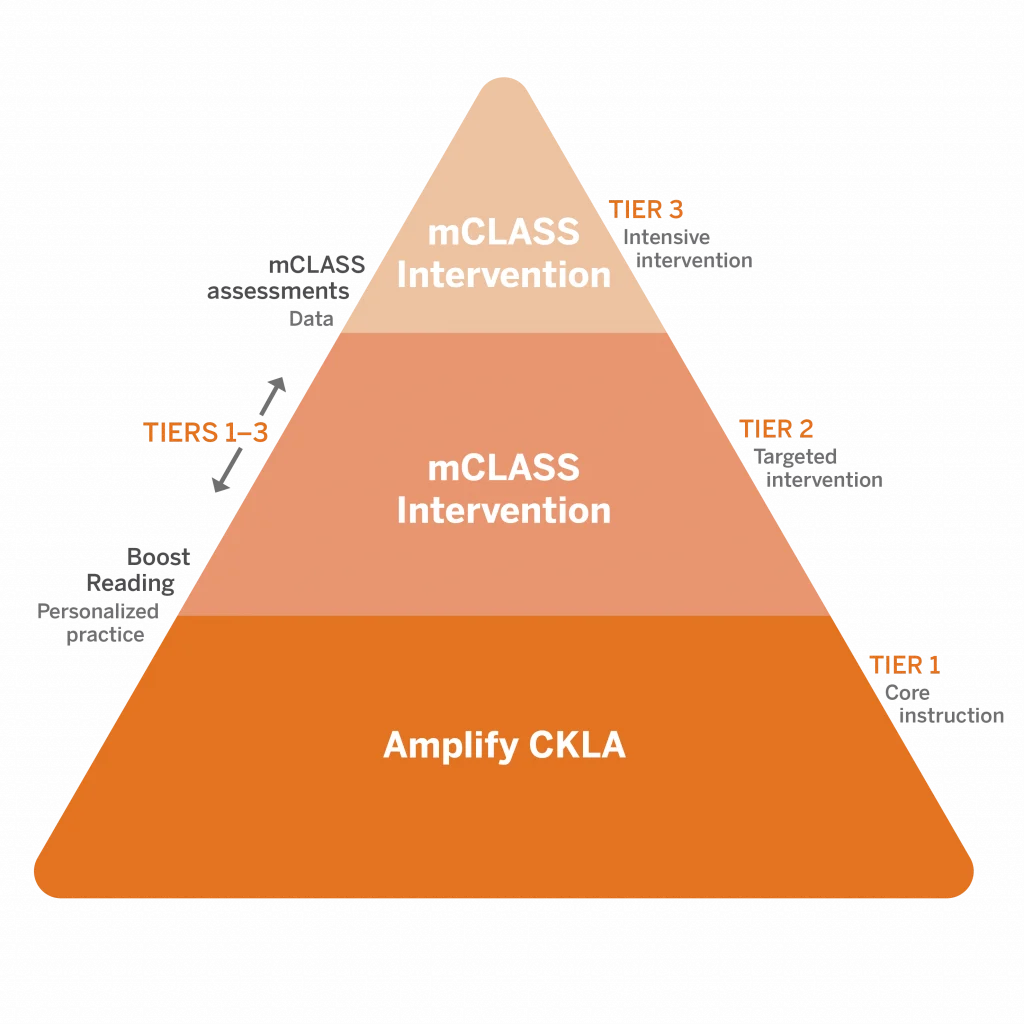
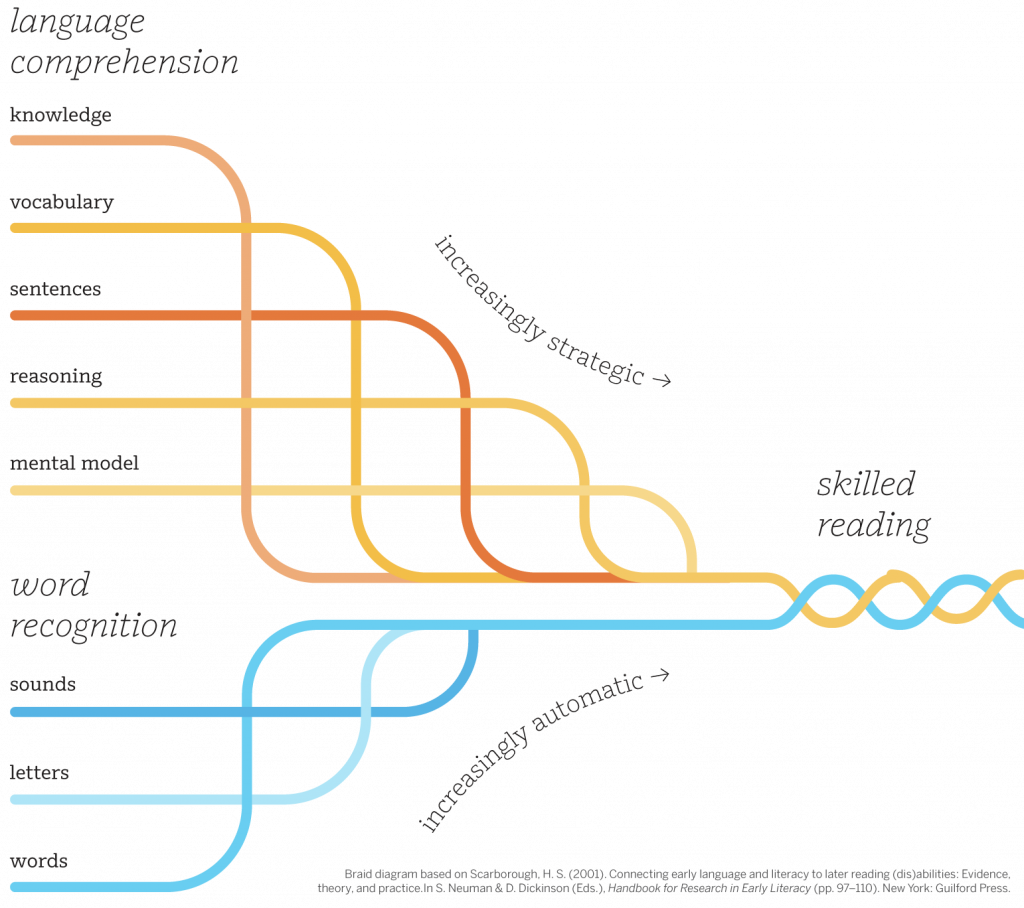
Aligned resources that do away with piecemealing
A literacy ecosystem built on the same Science of Reading principles and pedagogical foundation ensures that students experience a cohesive and reinforced literacy journey. Our programs allow you to support all students without cobbling together additional resources to fill in the gaps.
They follow an explicit and systematic structure, build knowledge, and assess and instruct on all of the foundational skills essential to literacy development.
The data you need to make informed decisions
Our universal and dyslexia screening data is predictive and reliable, and it’s aligned to the entire instructional system. It enables you to make informed decisions for whole-group, small-group, and individual instruction, as well as resource allocation at the school and district level.
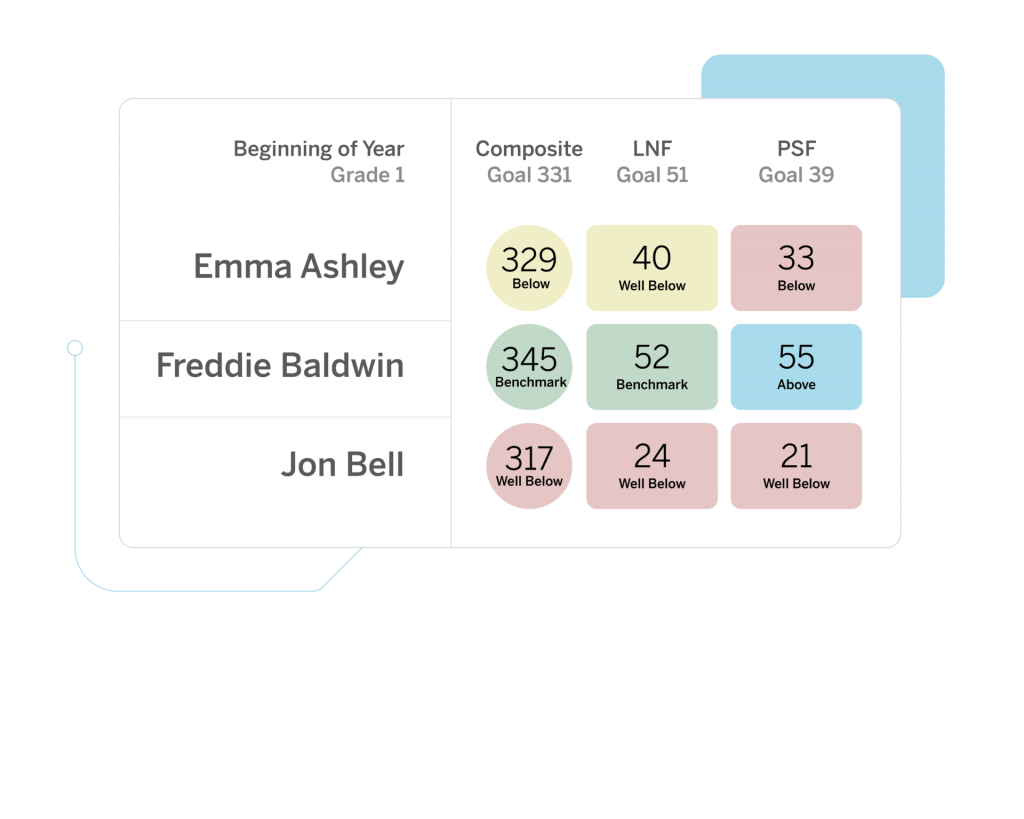
Amplify’s early literacy programs support you wherever you are in the Science of Reading journey. Download our Science of Reading roadmap to help you determine where to start.
Download nowOur early literacy programs in action

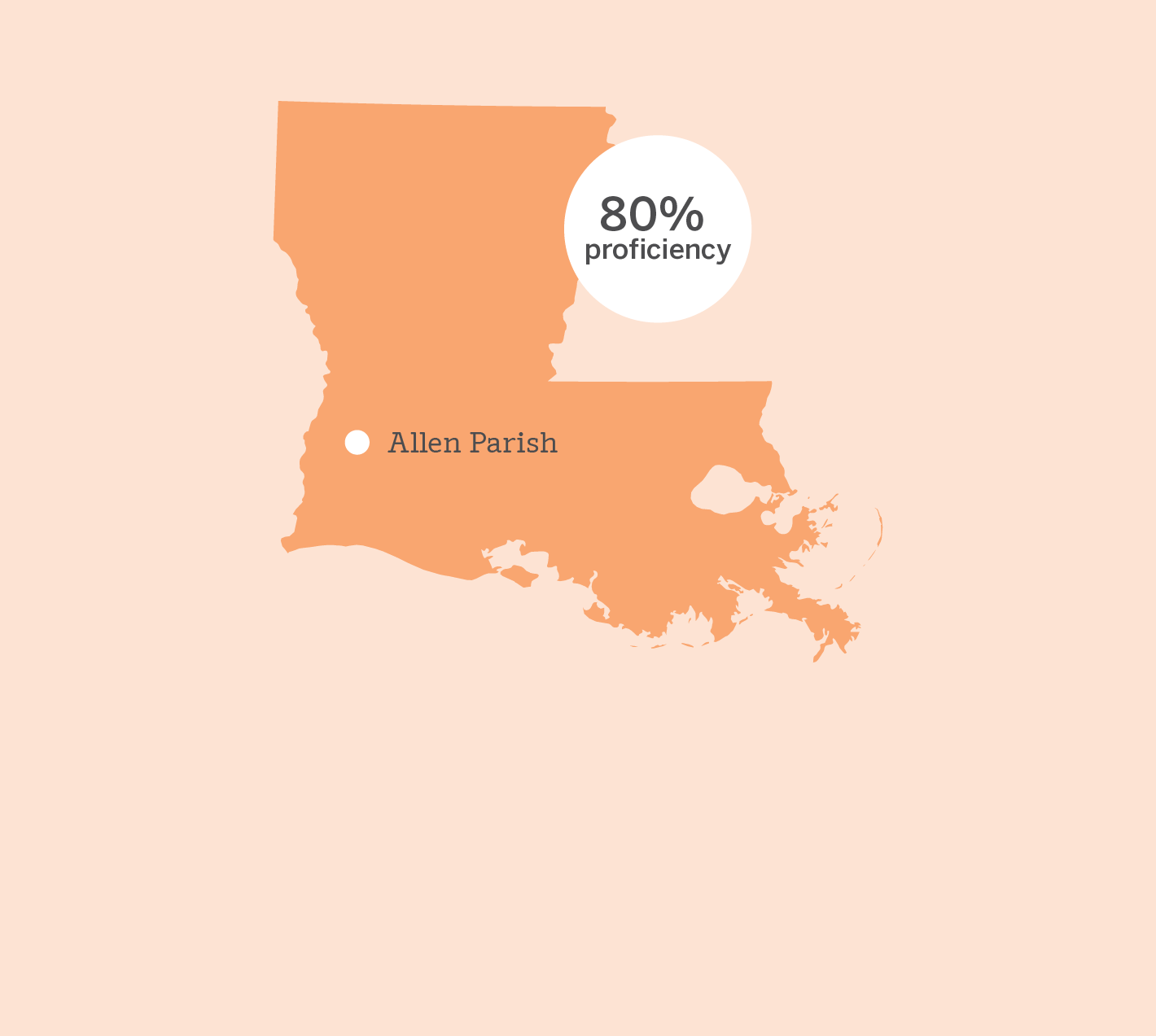

Science of Reading resources
Successfully adopting new Science of Reading literacy programs will change lives. We provide extensive resources, professional learning, and complementary events and webinars so you can begin using your new programs with fidelity.
Science of Reading essentials
Champion research-based literacy programs in your classroom with our extensive Science of Reading resources.

Science of Writing: A Primer
Unlock writing mastery! Explore our new primer on literacy research and the Science of Writing.

Passion for reading in Sampson County, NC
Mia and Grade 2 teacher Jenny Denning explored the power of the Amplify early literacy suite together.
Inspiring confidence in Tennessee
Kaleb and Assistant Principal Casey Price tackled reading from the ground up with Amplify’s early literacy programs.
Real results, rooted in the Science of Reading: Amplify success stories
The Science of Reading is all about the evidence we have of how our brains learn to read. We also have evidence that it works—not just from science, but from real Amplify educators using it to transform their classrooms every day.
Learn More
District spotlights



Program efficacy
More and more districts are choosing Amplify because they know they’ll see results. Amplify programs meet the criteria for Tier I (Strong) and Tier II (Moderate) evidence as education interventions under ESSA.
Amplify + North Carolina: The power of a Science of Reading curriculum
Discover how Sampson County, North Carolina, schools use Amplify’s early literacy suite based on the Science of Reading to unlock the magic of reading for their students—and ensure results.
Sparking literacy success in Tennessee
Learn how Tennessee uses Amplify programs to change lives and create new futures for kids every single day.
Explore More
Customer voices



On-demand roundtable discussions
Learn how you can start making the shift to improved literacy instruction with the Science of Reading right now by hearing from educators across the country who used Amplify programs and saw incredible results.
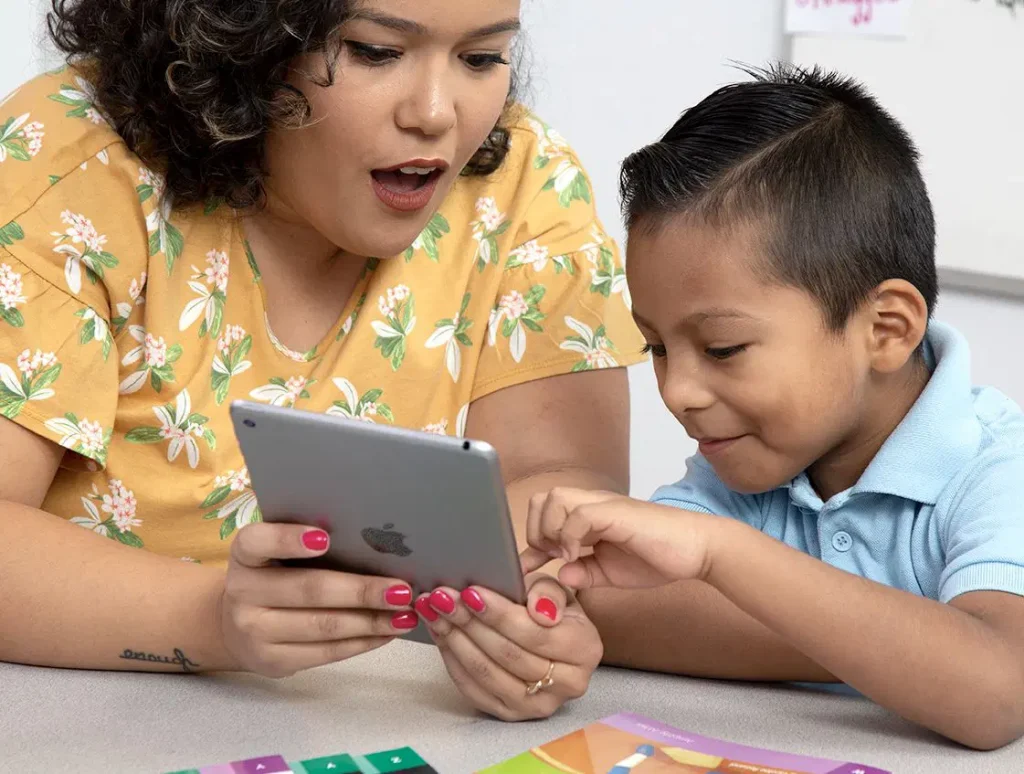


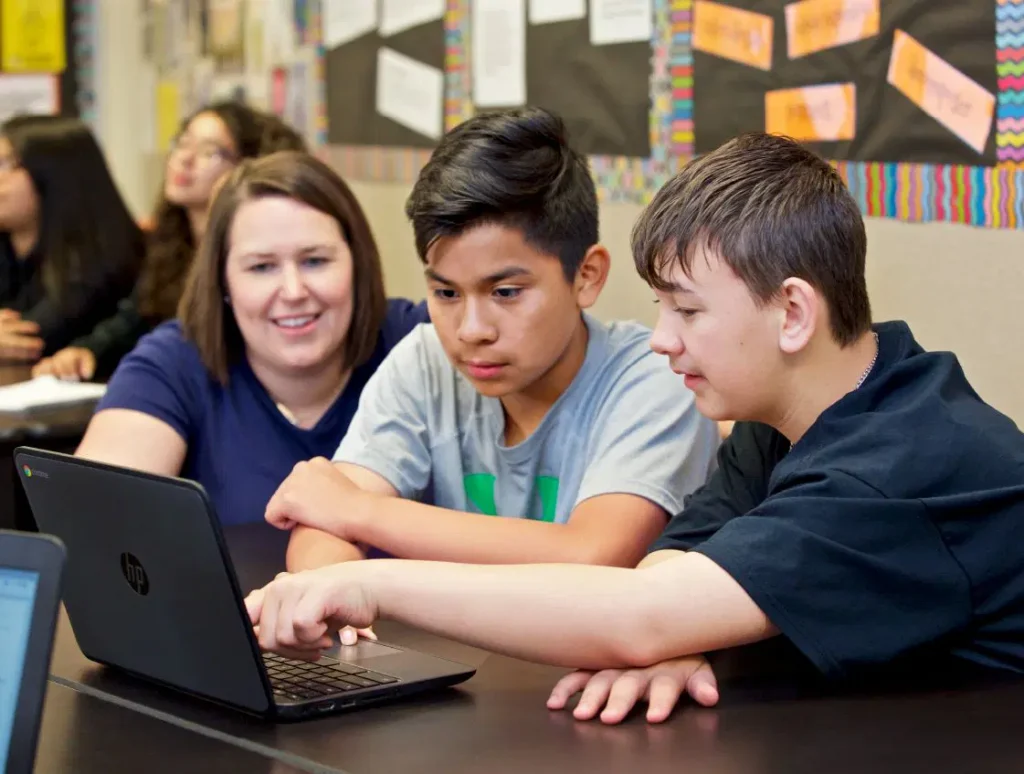



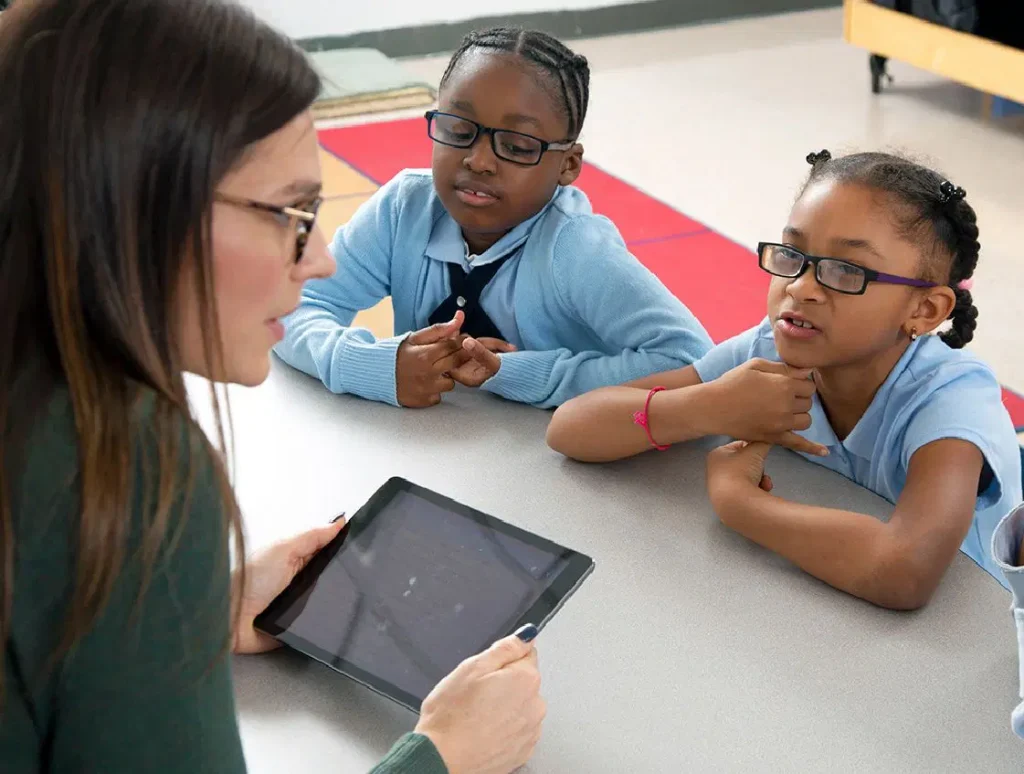
Screen and intervene faster with mCLASS DIBELS 8th Edition.
California educators, did you know mCLASS® DIBELS® 8th Edition is the industry’s first all-in-one universal and dyslexia screener? This means with just one screener, you’ll gain a complete picture of your students’ grade-level reading abilities and dyslexia risk factors. Our gold-standard assessment identifies students who need more support, then recommends targeted instruction they’ll love.
About the program
mCLASS offers teacher-administered assessment, intervention, and personalized instruction for grades K–6. Know exactly how to monitor and support every student in your classroom, with features like:
- Precise one-minute measures based on over three decades of predictive data.
- Universal and dyslexia screening in one tool.
- Instruction that highlights observed patterns and recommends activities.
- Robust reports for teachers, specialists, administrators, and parents.
The right measures at the right time
With mCLASS DIBELS 8th Edition, you’ll assess students based on grade-specific curriculum and instructional standards, in accordance with International Dyslexia Association (IDA) guidelines.
mCLASS DIBELS 8th Edition offers one-minute, easy-to-administer measures of processing speed, phonological awareness, alphabetic principle, and word reading.
| DIBELS® 8th Edition subtest alignment with IDA Guidelines | ||||||
|---|---|---|---|---|---|---|
| Dyslexia Screening Area | mCLASS DIBELS 8th Edition Measure | Grade K | Grade 1 | Grade 2 | Grade 3 | Grade 4–6 |
| Rapid naming ability | Letter Naming Fluency (LNF) | | | |||
| Phonological awareness | Phoneme Segmentation Fluency (PSF) | | | |||
| Alphabetic principle | Nonsense Word Fluency (NWF) | | | | | |
| Word reading | Word Reading Fluency (WRF) | | | | | |
| Word reading | Oral Reading Fluency (ORF) | | | | | |
| Comprehension | Maze | | | | ||
Validated as a universal screener and a dyslexia screener
Strong reliability and validity evidence shows that DIBELS 8th Edition can effectively assess students in key skills linked to both dyslexia and broader reading difficulty. The research supporting DIBELS 8th Edition, conducted by the University of Oregon, is rigorous, meets high technical standards, and empowers educators to make well-informed decisions.
Read the DIBELS 8th Edition Dyslexia White Paper.
A complete system for data-based decision making
mCLASS DIBELS 8th Edition provides rich data that helps you make informed instructional decisions and seek out further dyslexia screening evaluation if needed:
- Assess skills: mCLASS DIBELS 8th Edition and optional dyslexia screenings in Rapid Automatized Naming (RAN), Spelling, Vocabulary, and Oral Language accurately assess students’ abilities.
- Identify risk: The DIBELS 8 composite score shows each student’s risk level, with ‘Well Below Benchmark’ indicating a need for intensive support. Students who are also ‘Well Below Benchmark’ in RAN and/or Spelling have an additional Risk Indicator icon next to their name.
- Provide instruction: The mCLASS Instruction feature analyzes student error patterns to key dyslexia-related subtests, then recommends small groups and explicit, multi-sensory activities for reinforcing skills.
- Progress monitor: mCLASS includes progress-monitoring measures to track student growth in letter sounds, alphabetic principle, word reading, oral reading fluency, and comprehension, so that informed instructional decisions can be made.
- Adapt instruction: mCLASS displays indicators based on progress monitoring performance that indicate when a change in instruction may be needed. It also updates instruction recommendations using the latest data.
Differentiated literacy instruction
mCLASS DIBELS 8th Edition lays the groundwork for a strong Multi-Tiered System of Supports (MTSS).
In addition to identifying students with symptoms of dyslexia, mCLASS DIBELS 8th Edition data recommends early intervention, personalized instruction, and core instruction within Amplify’s early literacy suite. Based on the Science of Reading, Amplify’s early literacy suite programs follow an explicit and systematic structure, build knowledge, and instruct on all of the foundational skills essential to literacy development.
- Intervene with mCLASS Intervention and Amplify Tutoring: Staff-led Tier 2 and 3 intervention for intensive support.
- Practice with Boost Reading: Personalized learning program to extend and reinforce core instruction.
- Instruct with Amplify Core Knowledge Language Arts (CKLA): Core curriculum to build foundational skills and knowledge.
Bilingual dyslexia screening
By assessing with mCLASS DIBELS 8th Edition and its Spanish counterpart, mCLASS Lectura, you’ll know with confidence whether a student truly shows signs of dyslexia or is experiencing difficulties learning a new language.
When used together, mCLASS DIBELS 8th Edition and mCLASS Lectura feature a Dual Language Report that analyzes dyslexia screening results in both languages. The report also details how each student can leverage their strengths from one language to support growth in the other.
Equal skill coverage in English and Spanish
| Dyslexia screening areas | English measure | Spanish measure | Description* |
| Letter Naming and RAN | Letter Naming Fluency (LNF) | Fluidez en nombrar letras (FNL) | Grades K–1: Naming letters in print. 1 minute, 1:1 administration. |
| Phonological Awareness (Segmentation) | Phonemic Segmentation Fluency (PSF) | Fluidez en la segmentación de sílabas (FSF) & Fluidez en la segmentación de fonemas (FSF) | Grades K–1: Hearing and using sounds or syllables in spoken words. 1 minute, 1:1 administration. |
| Phonological awareness (Elision) | ¿Qué queda? (QQ) | Grades K–2: Produce the part of a word that remains after deleting a syllable or phoneme. 1 minute, 1:1 administration. | |
| Letter-Sound Knowledge | Nonsense Word Fluency Correct Letter Sounds (NWF-CLS) | Fluidez en los sonidos de letras (FSL) | English: Grades K–3: Identify letter-sound correspondences in the context of pseudo-words. Spanish: Grades K-1: Identify letter-sounds in isolation. 1 minute, 1:1 administration. |
| Letter-Sound Knowledge (Receptive) | Fluidez en los sonidos de las letras K-Inicio (FSL K-Inicio) | Grade K: Identify (point to) which letter makes a certain sound. Untimed, 1:1 administration | |
| Decoding | Nonsense Word Fluency Words Recoded Correctly (NWF-WRC) | Fluidez en los sonidos de las sílabas (LSS) | English: Grades K–3: Decode orthographically regular pseudo-words Spanish: Grades K-1: Decode orthographically regular syllables 1 minute, 1:1 administration |
| Word Reading | Word-Reading Fluency (WRF) | Fluidez en la lectura de palabras (FEP) | Grades K–3: Reading common words easily, quickly and correctly.1 minute, 1:1 administration. |
| Fluency | Oral Reading Fluency (ORF) | Fluidez en la lectura oral (FLO) | Grades 1–6: Reading connected text with accuracy and automaticity. 1 minute, 1:1 administration. |
| Reading Comprehension | Maze | ¿Cuál palabra? (CP) | Grades 2–6: Understanding meaning from texts. 3 minutes, group administration. |
| Vocabulary | Vocabulary | Vocabulario | Grades K–3: Knowledge of grade-specific words. 15 minutes, group administration. |
| Encoding | Spelling | Ortografía | Grades K–3: Arranging letters correctly to spell words with grade appropriate features 15 minutes, group administration. |
| RAN (Numbers) | Rapid Automatized Naming | – | Grades K–3: Correctly and quickly naming visual symbols, such as numbers. 3-4 minutes, 1:1 administration. |
| Language Comprehension | Oral Language | Lenguaje oral | Grades K–2: Demonstrate the ability to use words and phrases acquired through conversations, reading and being read to, and responding to texts. 5 minutes, 1:1 administration. |
Dyslexia resources for families
Families play a crucial role in helping children overcome reading challenges. mCLASS DIBELS 8th Edition and mCLASS Lectura provide a Home Connect letter after each dyslexia screening to explain the results in family-friendly language, recommend activities, and direct families to a free website for additional at-home support.
Developmentally appropriate
Computer-based assessments that require students to complete tasks silently or independently may over-identify students for intervention services, especially young learners who are still developing focus and attention abilities.
mCLASS requires students to actively demonstrate their proficiency in producing letter sounds, forming words, and reading texts. This approach to assessment aligns with IDA guidelines for effective screening of reading challenges. By choosing mCLASS for dyslexia screening, you’ll gain accurate information about a student’s risk for dyslexia, and gain the capability to monitor every student’s path to reading proficiency.
Additional resources
- 4 tools to help teachers better understand dyslexia
- Science of Reading: The Podcast, Season 7, Episode 7: Debunking the “gift” of dyslexia in children, with Dr. Tim Odegard
- Science of Reading: The Podcast, Season 1, Episode 6: The facts and myths of dyslexia, with Emily Lutrick
- Dyslexia Fact vs. Fiction
- mCLASS Dyslexia Toolkit
- mCLASS Research Hub
- mCLASS Program Guide
- mCLASS Digital Access Guide
- mCLASS Reporting Guide
- mCLASS Help Site
- Supporting multilingual and English learners in literacy
Demo access
Watch the navigation video above and then follow the instructions below to access your demo account.
TEACHER ASSESSMENT LOGIN
- Click the mCLASS Demo button below.
- Select Log in with Amplify.
- Enter this username and password:
- Username: mflores1800
- Password: 1234
- For more demo teacher logins and for detailed navigation instructions, please click here and start at page 1.
STUDENT ASSESSMENT LOGIN
- Click the mCLASS Demo button below.
- Select Log in with Amplify.
- Enter the username and password for each particular grade:
- Grade K username / password: mfloresk / matthew-k
- Grade 1 username / password: mflores1807 / matthew-1
- Grade 2 username / password: mflores1808 / matthew-2
- For more demo student logins and for detailed navigation instructions, please click here and scroll to page 17.
Questions?
For questions about mCLASS or the CA RFP review, please contact:
Erin King
Sales Director, CA
(512) 736-3162
eking@amplify.com
and CC: proposals@amplify.com
About the program
mCLASS offers teacher-administered assessment, intervention, and personalized instruction for grades K–6. Know exactly how to monitor and support every student in your classroom, with features like:
- Precise one-minute measures based on over three decades of predictive data.
- Universal and Reading Difficulties screening in one tool.
- Instruction that highlights observed patterns and recommends activities.
- Robust reports for teachers, specialists, administrators, and parents.
The right measures at the right time
With mCLASS DIBELS 8th Edition, you’ll assess students based on grade-specific curriculum and instructional standards, in accordance with International Dyslexia Association (IDA) guidelines.
mCLASS DIBELS 8th Edition offers one-minute, easy-to-administer measures of processing speed, phonological awareness, alphabetic principle, and word reading.
| DIBELS® 8th Edition subtest alignment with SB 114 requirements | ||||||
|---|---|---|---|---|---|---|
| RDRP Screening Area | mCLASS DIBELS 8th Edition Measure | Grade K | Grade 1 | Grade 2 | Grade 3 | Grade 4–6 |
| Rapid naming ability | Letter Naming Fluency (LNF) | | | |||
| Phonological awareness | Phoneme Segmentation Fluency (PSF) | | | |||
| Alphabetic principle | Nonsense Word Fluency (NWF) | | | | | |
| Word reading | Word Reading Fluency (WRF) | | | | | |
| Word reading | Oral Reading Fluency (ORF) | | | | | |
| Comprehension | Maze | | | | ||
| Language Comprehension | Oral Language | | | | ||
| Vocabulary | Vocabulary | | | | | |
| RAN | Rapid Automatized Naming (Numbers) | | | | | |
| Encoding | Spelling | OPTIONAL | ||||
Validated as a universal screener and a dyslexia screener
Strong reliability and validity evidence shows that DIBELS 8th Edition can effectively assess students in key skills linked to both dyslexia and broader reading difficulty. The research supporting DIBELS 8th Edition, conducted by the University of Oregon, is rigorous, meets high technical standards, and empowers educators to make well-informed decisions.
Read the DIBELS 8th Edition Dyslexia White Paper.
A complete system for data-based decision making
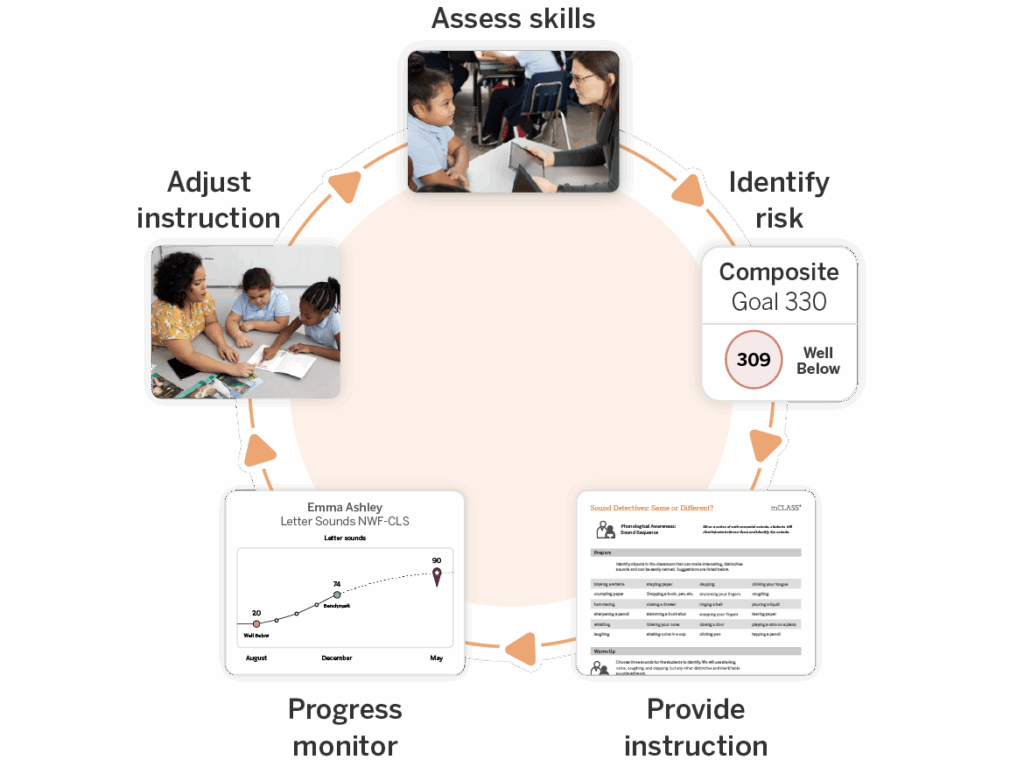
mCLASS DIBELS 8th Edition provides rich data that helps you make informed instructional decisions and seek out further dyslexia screening evaluation if needed:
- Assess skills: mCLASS DIBELS 8th Edition and optional dyslexia screenings in Rapid Automatized Naming (RAN), Spelling, Vocabulary, and Oral Language accurately assess students’ abilities.
- Identify risk: The DIBELS 8 composite score shows each student’s risk level, with ‘Well Below Benchmark’ indicating a need for intensive support. Students who are also ‘Well Below Benchmark’ in RAN and/or Spelling have an additional Risk Indicator icon next to their name.
- Provide instruction: The mCLASS Instruction feature analyzes student error patterns to key dyslexia-related subtests, then recommends small groups and explicit, multi-sensory activities for reinforcing skills.
- Progress monitor: mCLASS includes progress-monitoring measures to track student growth in letter sounds, alphabetic principle, word reading, oral reading fluency, and comprehension, so that informed instructional decisions can be made.
- Adapt instruction: mCLASS displays indicators based on progress monitoring performance that indicate when a change in instruction may be needed. It also updates instruction recommendations using the latest data.
Differentiated literacy instruction
mCLASS DIBELS 8th Edition lays the groundwork for a strong Multi-Tiered System of Supports (MTSS).
In addition to identifying students with symptoms of dyslexia, mCLASS DIBELS 8th Edition data recommends early intervention, personalized instruction, and core instruction within Amplify’s early literacy suite. Based on the Science of Reading, Amplify’s early literacy suite programs follow an explicit and systematic structure, build knowledge, and instruct on all of the foundational skills essential to literacy development.
- Intervene with mCLASS Intervention and Amplify Tutoring: Staff-led Tier 2 and 3 intervention for intensive support.
- Practice with Boost Reading: Personalized learning program to extend and reinforce core instruction.
- Instruct with Amplify Core Knowledge Language Arts (CKLA): Core curriculum to build foundational skills and knowledge.
Bilingual Reading Difficulties screening
By assessing with mCLASS DIBELS 8th Edition and its Spanish counterpart, mCLASS Lectura, you’ll know with confidence whether a student truly shows signs of of reading difficulties or is experiencing difficulties learning a new language.
When used together, mCLASS DIBELS 8th Edition and mCLASS Lectura feature a Dual Language Report that analyzes Reading Difficulties screening results in both languages. The report also details how each student can leverage their strengths from one language to support growth in the other.
Equal skill coverage in English and Spanish
mCLASS Lectura subtest alignment with SB114
| RDRP screening areas | English measure | Spanish measure | Description* |
|---|---|---|---|
| Letter Naming and RAN | Letter Naming Fluency (LNF) | Fluidez in nombrar letras (FNL) | Grades K–1: Naming letters in print. 1 minute, 1:1 administration. |
| Phonological Awareness (Segmentation) | Phonemic Segmentation Fluency (PSF) | Fluidez en la segmentación de sílabas (FSS) & Fluidez en la segmentación de fonemas (FSF) | Grades K–1: Hearing and using sounds or syllables in spoken words. 1 minute, 1:1 administration. |
| Phonological Awareness (Elision) | – | ¿Qué queda? (QQ) | Grades K–2: Produce the part of a word that remains after deleting a syllable or phoneme. 1 minute, 1:1 administration. |
| Letter Sound Correspondence Knowledge | Nonsense Word Fluency Correct Letter Sounds(NWF-CLS) | Fluidez en los sonidos de letras (FSL) | English: Grades K–3: Identify letter-sound correspondences in the context of pseudo-words. Spanish: Grades K-1: Identify letter-sounds in isolation. 1 minute, 1:1 administration. |
| Letter-Sound Knowledge (Receptive) | – | Fluidez en los sonidos de las letras K-Inicio (FSL K-Inicio) | Grade K: Identify (point to) which letter makes a certain sound. Untimed, 1:1 administration. |
| Decoding | Nonsense Word Fluency Words Recoded Correctly (NWF-WRC) | Fluidez en los sonidos de las sílabas (FSL) | Grades K–3: Identify letter-sound correspondences in the context of pseudo-words. Spanish: Grades K–1: Identify letter-sounds in isolation. 1 minute, 1:1 administration. |
| Word Reading | Word-Reading Fluency (WRF) | Fluidez en las palabras (FEP) | Grades K–3: Reading common words easily, quickly and correctly.1 minute, 1:1 administration. |
| Fluency | Oral Reading Fluency (ORF) | Fluidez en la lectura oral (FLO) | Grades 1–6: Reading connected text with accuracy and automaticity. 1 minute, 1:1 administration. |
| Reading Comprehension | Maze | ¿Cuál palabra? (CP) | Grades 2–6: Understanding meaning from texts. 3 minutes, group administration. |
| Vocabulary | Vocabulary | Vocabulario | Grades K–3: Arranging letters correctly to spell words with grade appropriate features. 15 minutes, group administration. |
| Encoding | Spelling | Ortografía | Grades K–3: Arranging letters correctly to spell words with grade-appropriate features. 15 minutes, group administration. |
| RAN (Numbers) | Rapid Automatized Naming | – | Grades K–3: Correctly and quickly naming visual symbols, such as numbers. 1-2 minutes, 1:1 administration. |
| Language Comprehension | Oral Language | Lenguaje oral | Grades K–2: Demonstrate the ability to use words and phrases acquired through conversations, reading and being read to, and responding to texts. 5 minutes, 1:1 administration. |
*Students can be assessed using off-grade measures when information on specific skills is needed.
Resources for families
Welcome California Caregivers! Please click here to learn more about mCLASS assessments.
Families play a crucial role in helping children overcome reading challenges. mCLASS DIBELS 8th Edition and mCLASS Lectura provide a Home Connect letter after each screening to explain the results in family-friendly language, recommend activities, and direct families to a free website for additional at-home support.
Developmentally appropriate
Computer-based assessments that require students to complete tasks silently or independently may over-identify students for intervention services, especially young learners who are still developing focus and attention abilities.
mCLASS requires students to actively demonstrate their proficiency in producing letter sounds, forming words, and reading texts. This approach to assessment aligns with IDA guidelines for effective screening of reading challenges. By choosing mCLASS for universal screening, you’ll gain accurate information about a student’s risk for reading difficulties, and gain the capability to monitor every student’s path to reading proficiency.
Additional resources
mCLASS Resources
- mCLASS Research Hub
- mCLASS Program Guide
- mCLASS Digital Access Guide
- mCLASS Reporting Guide
- mCLASS Help Site
- mCLASS self-guided walkthrough
Dyslexia Resources
- mCLASS Dyslexia Toolkit
- Dyslexia Fact vs. Fiction ebook
- Blog post: 4 tools to help teachers better understand dyslexia
- Science of Reading: The Podcast, Season 7, Episode 7: Debunking the “gift” of dyslexia in children, with Dr. Tim Odegard
- Science of Reading: The Podcast, Season 1, Episode 6: The facts and myths of dyslexia, with Emily Lutrick
Multilingual and English learners Resources
Your California team
Looking to speak directly with your local representative?
Get in touch with a California team member to learn more about our early literacy suite or request a demo account.
Dan Pier
Vice President, West
(415) 203-4810
dpier@amplify.com
Erin King
Sales Director, CA
(512) 736-3162
eking@amplify.com
NORTHERN CA
Wendy Garcia
Senior Account Executive
(510) 368-7666
wgarcia@amplify.com
BAY AREA
Lance Burbank
Account Executive
(415) 830-5348
lburbank@amplify.com
CENTRAL VALLEY and CENTRAL COAST
Demitri Gonos
Senior Account Executive
(559) 355-3244
dgonos@amplify.com
VENTURA and L.A. COUNTY
Jeff Sorenson
Associate Account Executive
(310) 902-1407
jsorenson@amplify.com
ORANGE and L.A. COUNTY
Lauren Sherman
Senior Account Executive
(949) 397-5766
lsherman@amplify.com
SAN BERNARDINO and L.A. COUNTY
Michael Gruber
Senior Account Executive
(951) 520-6542
migruber@amplify.com
RIVERSIDE AND L.A. COUNTY
Brian Roy
Senior Account Executive
(818)967-1674
broy@amplify.com
SAN DIEGO COUNTY
Kirk Van Wagoner
Senior Account Executive
(760) 696-0709
kvanwagoner@amplify.com
BUTTE, DEL NORTE, HUMBOLDT, and SHASTA COUNTY and DISTRICTS UNDER 2250 ENROLLMENT
Kevin Mauser
Lead Account Executive
(815) 534-0148
kmauser@amplify.com
Contact an Amplify Science representative today

Contact a sales rep
Dan Pier
Vice President, West
dpier@amplify.com
415-203-4810
Dianne Lee
Sales Director
dilee@amplify.com
949-246-2083
Demitri Gonos
Senior Account Executive
dgonos@amplify.com
559-355-3244
Francis Ogata
Senior Science Specialist
fogata@amplify.com
916-521-1467
Kirk Van Wagoner
Senior Account Executive
kvanwagoner@amplify.com
760-696-0709
Lisa Marinovich
Senior Account Executive
lmarinovich@amplify.com
831-461-4187
Wendy Garcia
Senior Account Executive
wgarcia@amplify.com
510-368-7666
Patti Savage
Senior Account Executive
psavage@amplify.com
626-224-3174
Lauren Sherman
Senior Account Executive
lsherman@amplify.com
949-397-5766
Kevin Mauser
Lead Account Executive – Inside Sales
kmauser@amplify.com
815-534-0148
We are the program for Indiana’s middle school students and teachers.
Amplify ELA is a blended curriculum. We built Amplify ELA to help you make sure the standards are covered, the skills are taught, the test is prepped for, and your students are scaffolded and encouraged. What’s more, everything is done in the background. That way, you can spend your time bringing the text to life, making the classroom hum, and letting each student know you are paying attention to their growth.

Program overview

Amplify ELA is a hybrid curriculum designed specifically for grades 6–8. The heart of every lesson is the text. Each grade includes six units centered on literary or informational texts, delivered in several forms of media. Your classroom will also benefit from two or three immersive learning experiences called Quests and a dedicated Story Writing unit.
- Full standards coverage: Standards are clearly labeled in each lesson overview, so teachers can save time planning and get back to what they love: teaching.
- Five levels of differentiation: Based on each student’s needs and the performance measures within Amplify ELA reports, a teacher can choose the differentiation level that’s the right fit for everyone.
- Embedded assessments: Teachers benefit from uninterrupted instructional time and a continuously updated picture of each student’s progress with key skills and standards.
- Powerful feedback tools: Comprehensive tools help teachers maximize both the quantity and quality of feedback.
- Robust reporting: Our reporting app offers information on student progress to help inform instructional decisions.
- All in one place: Embedded teacher support, differentiation tools, student data, text and other curriculum features—they’re all right there.
Materials
Discover print and digital materials included in the program.
Student edition
Available digitally and in print, the student materials guide middle schoolers through complex texts and writing by:
- engaging students with high-quality narrative and informational texts, providing videos, audio supports, and digital experiences that capture their attention, and
- keeping all of their writing in one place with the personal writing journal.

Teacher edition
Available digitally and in print, the Teacher edition contains all of the information teachers need to facilitate classroom instruction, including:
- detailed lesson plans
- video teacher tips embedded in the lesson
- standards alignment and exit tickets
- real-time differentiation strategies
- robust reporting

Interactive Quests
Fun, week-long explorations where students practice analytical reading, writing, speaking, and listening skills, all while building a strong classroom community.

Digital library for independent reading
Amplify Library: Our expansive digital library includes more than 650 fiction and nonfiction, classic, and contemporary titles.
Resources
Learn more about Amplify ELA and how we address the unique needs of middle school students.

Program sample guide

Table of Contents


Experts & presenters

Deb Sabin
Chief Academic Officer, Amplify ELA
Deb Sabin leads Amplify’s curriculum development teams for ELA. Previously she was Director of Instruction and Training for The Writer’s Express. She’s been an ELA teacher in a variety of classrooms from alternative high schools to elite prep schools and international dual language programs.

Jeff Dannemiller
Product Specialists, Amplify
Jeff works with educators across the country, helping them get the most out of their middle school students with reading, writing, and developing all the other skills necessary for high school and beyond.
Contacts

Nathan Toles
Field Manager
ntoles@amplify.com
(317) 430-7879

Jackie Roper
Senior Account Executive
jroper@amplify.com
(312) 202-2598

Casie Rayes
crayes@amplify.com
(480) 549-7531
Get to know Amplify ELA
Start by taking a look at the Amplify ELA Program Guide, where you’ll find:
- Grade-level overviews for grades 6–8 (pages 11–31)
- Amplify ELA pedagogy (page 10)
- Sample lesson routine (page 38)
- Amplify ELA foundations (pp 70-80)
Want to go deeper or look at Amplify ELA’s approach to writing, vocabulary, grammar, and differentiation? Check out the Table of Contents for all this and much more!
Navigating the curriculum
Amplify ELA is a truly blended curriculum, designed specifically for grades 6–8. The program includes instructional guidance and student materials for a year of instruction, with lessons and activities that keep students engaged every day. Materials can be accessed either digitally or through print materials, depending on what your class needs.
Navigating in print
- Watch this video exploring the print resources available for students and teachers in Amplify ELA.
- Follow this link to open an ebook version of the print materials for your grade level and explore Unit A (the first unit).
Navigating digital
- Watch this video exploring the digital curriculum platform and the many resources available for teachers and students.
- Log in to the curriculum at learning.amplify.com using the demo account and password provided by your Sales rep.
- Once you have finished the tour, try out the scavenger hunt below!
Amplify ELA Scavenger Hunt
Inside a lesson
1. Overview & planning

The Lesson Brief equips teachers with the tools they need to plan instruction. It begins with an Overview, which describes the big ideas students will grapple with and summarizes the lesson’s sequence of activities. Next, there is a Preparation section, which points out key moments and materials to prepare. The Preparation section also describes the location and content of the lesson’s Exit Ticket.
The Lesson Brief also includes: the Lesson Objective, which details the reading, writing, and/or speaking and listening objectives; Words to Use, which points out key vocabulary from the reading; Skills & Standards, which lists the focus and coverage standards; and Differentiation, which describes differentiated supports and provides additional suggestions for modifying activities.
2. Vocab App

The Vocab App helps students master vocabulary words through game-like activities based on morphology, analogy, synonyms/ antonyms, and deciphering meaning. These activities help students develop dictionary skills by focusing on parts of speech, etymology, and multiple meanings. There are also activities for ELL-appropriate words from the unit’s texts, asking students to match an English definition, Spanish translation, context sentence, audio pronunciation, and visual definition. These activities also align to vocabulary standards.
Vocab App (Teacher View)
3. Work Visually

Visualization activities are an essential part of Amplify ELA, as they open the door to more comprehensive understanding of complex texts. In these learning experiences, students break apart the text in visual ways or use visual cues to “see” key details as they construct meaning.
In this early lesson from grade 7, students unpack propaganda images and short videos from the Chinese Cultural Revolution to build their understanding of the setting before beginning the memoir Red Scarf Girl.
Other units include visualization activities such as using an app to “see” the evidence for and against scientific theories, making storyboards and planning visual adaptations of texts to “read like a movie director,” and comparing and contrasting illustrations with key textual moments.
4. Author Videos & Dramatic Readings

Students benefit from using listening comprehension skills as they build fluency with complex texts. In these close reading experiences, students listen to the text, perform the text out loud, or watch a dramatic reading of the text.
In this lesson, students listen and watch as author Ji-Li Jiang reads the opening prologue of her memoir, Red Scarf Girl. Her facial expressions, tone of voice, and emphasis help students develop early ideas about what matters to this narrator.
Additional author videos and dramatic readings are embedded in other units. In Unit 8D: Shakespeare’s Romeo & Juliet, students watch WordPlay Shakespeare videos where actors perform each selected scene next to the text of that excerpt. In Unit 8B: Liberty & Equality, two members of the Marvel cinematic universe—Chadwick Boseman and Elizabeth Olsen—offer masterful performances of Narrative of the Life of Frederick Douglass, an American Slave and A Confederate Girl’s Diary.
5. Reading/eReader

Reading standards establish high expectations for all students, even as they enter the middle grades at a variety of reading levels. In Amplify ELA lessons, students access universal supports embedded in the eReader (and built into the print versions of the text) to help them participate fully in grade-level activities.
Point-of-use vocab in print: The print Student Edition places key vocabulary words and their relevant definitions in the text margin to support students and keep them reading.
Reveal: By clicking on these pre-selected words, students access short contextual definitions for key and challenging vocabulary.
Highlight, Bookmark, and Notes: The digital highlighting, bookmarking, and annotation tools allow students to save and review any text notes from any lesson.
Text size and line spacing: Students can adjust text size and line spacing to find what works best for them
6. Writing

Two or three times a week, students complete their reading work by developing a piece of writing to refine their reading analysis. They write for 10–15 minutes, focusing on one claim in response to a prompt, and using evidence from the text in support of their claim.
In this lesson, students build on their discussion of the setting and their analysis of the passage to determine the author’s point of view at the start of her memoir.
Differentiated supports: Five levels of differentiated supports can be assigned in the moment or in advance to help every student work productively. Levels can be assigned ahead of time (by simply dragging and dropping students into groups) and students remain in their assigned levels until they’re changed by the teacher. For more information on differentiation in Amplify ELA, click here.
Automated Writing Evaluation: The Automated Writing Evaluation (AWE) tool has been developed in conjunction with Amplify’s regular writing activities, which ask students to use textual evidence to develop one focused idea or claim about the text and communicate that idea clearly and effectively to an audience. AWE is a tool designed to help teachers understand, track, and support student skill progress with these key foundational skills, which are a strong indicator of a student’s analytic writing proficiency. AWE provides auto scores for Focus and Conventions, allowing teachers to prioritize their assessment of a student’s progress with Use of Evidence, a skill that is relatively new for many middle-grade students.
7. Share

Establishing a supportive writing community in the classroom helps students develop their voices as writers. Each writing activity is coupled with a sharing session, where clear routines and student-facing feedback protocols support students as they share and respond to each other’s writing. Here, students try out their writing with an audience of their peers to figure out how to express their ideas in a clear and convincing way. In addition, these sharing sessions allow students to learn from the range of perspectives in the classroom.
Clear and consistent Response Starters ensure that students provide feedback that targets key skills and focuses on where a student is using a skill effectively, fostering an effective and supportive feedback environment.
8. Solos
Solos are an important part of the ELA curriculum, and are designed to be completed as homework—but not every student has a computer at home. However, most students DO have access to a mobile device. The new Mobile Solos give every student access to this part of the curriculum, protecting valuable classroom time for lessons and group activities.
Navigating the first unit
Dig into Unit A
It’s time to continue your journey by exploring the first unit!
- Choose a 6th-, 7th-, or 8th-grade Unit A.
- Find the Print Materials for your grade level’s Unit A and review the unit overview. (password: middle678school)
- Log in to the curriculum and navigate to your chosen unit.
- Scroll down to the unit guide. Open each section and read it.
- Read the background and context document in the Materials section.
- Go to Sub-unit 3 and read the Sub-unit Overview.
- Choose two lessons to explore further.
- Open the first lesson and read the Lesson Overview. Be sure to open and read each section in the Lesson Overview.
- Open each activity tab and read the teacher Instructional Guide. Familiarize yourself with the entire lesson and note where students are building reading and writing skills
- Repeat with the second lesson.
Diving Deeper
Check out Amplify ELA’s professional learning website, featuring self-guided training modules and videos to help you with planning and pacing, navigation, and learning key curriculum features.
You can log in using your Amplify credentials or the demo account and password provided by your sales rep.
Additional support
As you continue to explore the curriculum, you may also want to take a look at the Amplify ELA Resources Website, which is full of additional information on the program. If you have any questions, please contact us through the Amplify Help section.
And you’ll find even more information by watching this session from our Literacy Symposium, in which Sarah Kitzmiller from the Niswonger Foundation and Teddy Redding from Amplify discuss some of the challenges of the 2020–21 school year.
Amplify’s Literacy Symposium session: Focusing on the Fundamentals to Start the Year Right
You may choose to view other sessions from the Literacy Symposium as well, all accessible from the schedule menu in the top left corner.
This webinar also offers valuable insight, with Baltimore City middle school ELA teacher Lucas Drerup describing his experiences with Amplify ELA and discussing how he brings middle school ELA to life, even in a remote teaching setting.
How to bring middle school ELA to life: A teacher’s perspective
Support
- elahelp@amplify.com
- Amplify Help Center
- 1(800) 823-1969
Program overview

Amplify ELA is a hybrid curriculum designed specifically for grades 6–8. The heart of every lesson is the text. Each grade includes six units centered on literary or informational texts, delivered in several forms of media. Your classroom will also benefit from two or three immersive learning experiences called Quests and a dedicated Story Writing unit.
- Full standards coverage: Standards are clearly labeled in each lesson overview, so teachers can save time planning and get back to what they love: teaching.
- Five levels of differentiation: Based on each student’s needs and the performance measures within Amplify ELA reports, a teacher can choose the differentiation level that’s the right fit for everyone.
- Embedded assessments: Teachers benefit from uninterrupted instructional time and a continuously updated picture of each student’s progress with key skills and standards.
- Powerful feedback tools: Comprehensive tools help teachers maximize both the quantity and quality of feedback.
- Robust reporting: Our reporting app offers information on student progress to help inform instructional decisions.
- All in one place: Embedded teacher support, differentiation tools, student data, text and other curriculum features—they’re all right there.
Materials
Discover print and digital materials included in the program.
Student edition
Available digitally and in print, the student materials guide middle schoolers through complex texts and writing by:
- engaging students with high-quality narrative and informational texts, providing videos, audio supports, and digital experiences that capture their attention, and
- keeping all of their writing in one place with the personal writing journal.
Teacher edition
Available digitally and in print, the Teacher edition contains all of the information teachers need to facilitate classroom instruction, including:
- detailed lesson plans
- video teacher tips embedded in the lesson
- standards alignment and exit tickets
- real-time differentiation strategies
- robust reporting
Interactive Quests
Fun, week-long explorations where students practice analytical reading, writing, speaking, and listening skills, all while building a strong classroom community.
Digital library for independent reading
Amplify Library: Our expansive digital library includes more than 650 fiction and nonfiction, classic, and contemporary titles.
Resources
Learn more about Amplify ELA and how we address the unique needs of middle school students.
Program sample guide
Table of Contents
Four Principles of True
Engagement in Middle School ELA
Empower students to become
critical thinkers webinar recording
Provide opportunities and supports
for all students to work “up”
webinar recording
Support feedback systems that
develop strengths webinar
recording
Experts & presenters

Deb Sabin
Chief Academic Officer, Amplify ELA
Deb Sabin leads Amplify’s curriculum development teams for ELA. Previously she was Director of Instruction and Training for The Writer’s Express. She’s been an ELA teacher in a variety of classrooms from alternative high schools to elite prep schools and international dual language programs.
Jeff Dannemiller
Product Specialists, Amplify
Jeff works with educators across the country, helping them get the most out of their middle school students with reading, writing, and developing all the other skills necessary for high school and beyond.
Contacts
Chasity O’Quinn
Account Executive for East Tennessee
coquinn@amplify.com
(865) 599-5101
Ann Patterson
Account Executive for West Tennessee
apatterson@amplify.com
(704) 813-7757
Empowering multilingual learners
Welcome back to Science of Reading: The Podcast!
For most teachers, it’s no longer a question of if you’ll have a multilingual learner in your classroom, but rather a question of how many, and what languages they bring with them. While the Science of Reading can help all learners, its insights should be applied differently when students are learning a home language as well. The more we’re able to read, the more we’re able to learn.
—Dr. Elsa Cárdenas-Hagan
In this episode, Susan Lambert is joined by Dr. Elsa Cárdenas-Hagan to discuss the unique challenges and opportunities presented when teaching multilingual learners how to read. Dr. Cárdenas-Hagan is a bilingual speech-language pathologist and certified academic language therapist who serves as director of Valley Speech Language and Learning Center in Brownsville, Texas. In this episode, she discusses how teachers can make connections between students’ home languages and English in order to celebrate their language and give them new tools to better understand English. She also stresses the importance of teachers educating themselves on their students’ home languages so they can spot orthographic and phonological similarities and differences. She also highlights the importance of educator collaboration for student success.
Listen now!
For more wisdom and research on the best ways to teach reading, subscribe to Science of Reading: The Podcast.
Math strategies that build community in your classroom

It’s tough to do math without sets, sums, and multipliers, so it stands to reason that it’d be tough to learn math solo, outside of a group.
Indeed, research shows that math is best learned in a community. In this post, we’ll explain why that is, what it looks like in a classroom, and how you can create a community for your math students.
What math community means: Creative classroom ideas
There are many types of math communities: online interest groups, professional organizations, the Mathletes.
In the context of a math classroom, a math community refers to the collaborative environment a teacher can create using both math strategies and social strategies (and by involving students’ parents and guardians). In a robust math community, all students feel comfortable sharing ideas, asking questions, and engaging in mathematical conversations.
In other words, math communities are student-centered. Rather than delivering information, teachers guide students. They encourage students to explore math concepts, make connections to the real world, and ask questions—of each other, and the teacher.
And in a math community, wrong answers aren’t dismissed—in fact, they’re an essential part of the learning process. In our webinar What Amazing K–12 Math Looks Like, educator and director of research at Desmos, Dan Meyer underlines the importance of students understanding “the value in their thinking—which means the value in their wrong answers.”
Benefits of math community: Equity in schools and more
A community-oriented math classroom can help each student learn, and all students learn. Here’s how.
- Increased engagement. When students feel a sense of belonging and connection in their math class, they’re more likely to be engaged and motivated. By promoting open discussions, group activities, and cooperative problem-solving, teachers can help students—even those who don’t think they’re “math people”—develop a genuine interest in math.
- Reduced math anxiety. Math anxiety affects at least 20% of students. It can hinder their growth in math and beyond. But in a supportive math community—where different styles and wrong answers are considered part of the process—those students can thrive. Embracing and working from incorrect answers encourages students to focus on the “how” of math, and to participate without fear of getting it wrong. They feel more comfortable asking questions, taking risks, and making mistakes as well as learning from them.
- Improved communication skills. In a math community, all students get the chance to communicate their mathematical thinking and reasoning. Explaining their ideas to others and listening to their classmates enhances their speaking and writing skills—in math, and across other subjects, too.
- Learning from diverse perspectives. A supportive math classroom community allows students from different backgrounds and with varying abilities to contribute to class and feel valued. Encouraging—and observing—the sharing of diverse perspectives fosters critical thinking, creativity, and problem-solving skills.
- Positive reinforcement. A strong math community creates an environment where students feel valued, respected, included, and supported. It’s fertile ground for a growth mindset, one in which students believe they actually can do math regardless of challenges or errors. A math community encourages risk-taking, resilience, and perseverance—in math, and beyond.
How to engage students in math lessons that build community
Want to know how to make math fun and build community? Here are some ways to get started.
- Encourage collaboration. Promote a culture of cooperation and teamwork by incorporating group activities, peer support, and class discussions into your lessons.
- Celebrate brilliance. Recognize a variety of efforts, insights, and accomplishments among students—including taking risks, and making mistakes. This will motivate all students to appreciate different ways of learning and the value of both process and product.
- Personalize support. Offering individualized help to students who need it shows commitment to their success and builds a supportive environment for everyone.
- Develop a growth mindset. Create a culture where mistakes are inevitable, even welcomed, as part of the learning process. Encourage perseverance and persistence.
- Choose meaningful tasks. Assign problems with real-world relevance. Working together to solve them helps students see the “why” of math—and connect with each other in the process.
- Play. Game-ifying problems and introducing friendly competition builds camaraderie and helps students find shared joy in math—a win-win!
More to explore
Pseudoscience examples for critical thinking skills

MIRACLE HAIR GROWTH!
Quantum hair activation technology: This groundbreaking innovation goes beyond conventional science, delving into the realm of quantum energy to stimulate hair growth at the subatomic level. Blended with rare botanicals from ancient civilizations for luster and shine. Limited-time offer: Act now and receive a vial of stardust-infused hair serum!
Effective product…or pseudoscience? We’ll bet you guessed it. (Sorry, no stardust serum for you!)
While this hair product itself sounds like junk, reading about it can be a valuable experience for science students.
Teaching your students to identify pseudoscience in the world around them helps them learn to protect themselves from false claims that can be money-wasting at best, dangerous at worst.
And as they learn to discern, they also develop lifelong critical thinking skills!
We say knowledge is power but it’s not enough to know things, and there’s too much to know. Being able to think and not fall for someone’s bunk is my goal for my students.
—Melanie Trecek-King, biology professor and guest in Science Connections podcast Season 3, Episode 5: Thinking is power
Let’s explore how educators can use examples of pseudoscience to develop critical thinking skills—and incorporate NGSS (Next Generation Science Standards) science and engineering practices into their approach.
What’s the difference between science and pseudoscience?
Science is grounded in empirical evidence, rigorous testing, and the scientific method. Pseudoscience presents itself as scientific but lacks the fundamental elements of genuine scientific inquiry: evidence, peer review, and the capacity to generate accurate predictions.
Though pseudoscience may make vague claims, it has clear characteristics. When something is pseudoscience, it:
- Can’t be proven wrong: Makes claims that are unobservable or too vague.
- Professes “proof” without presenting actual evidence: Presents only anecdotal evidence, if any.
- Uses technobabble: See: “Quantum hair activation technology.”
For more characteristics of pseudoscience, check out Melanie Trecek-King’s episode of Science Connections!
To be sure, not all pseudoscience is harmful—pursuits and activities such as aromatherapy and astrology can be positive experiences in people’s lives—it just should not be defined as or considered science.
How addressing pseudoscience encourages critical thinking
When you teach students to identify pseudoscience, you are teaching them to use an evidence- and research-based approach when analyzing claims. Which is…science!
You are also:
- Teaching them to engage in thoughtful and educational argument/debate.
- Encouraging them to use their knowledge of science in the real world.
- Creating real-world impact.
When students learn to identify pseudoscience—faulty products, myths, and disprovable “discoveries”—they’ll be prepared and informed when making real-world decisions.
Critical thinking exercises inspired by pseudoscience
We’ve talked about “miracle” hair growth treatments, which are more commonly targeted to adults. Students may have more commonly encountered claims about or ads for alkaline water or detox diets, conspiracy theories and instances of science denial, astrology, and more. These examples offer great opportunities to discuss how to determine the difference between science and pseudoscience.
Suggested activities:
- Pseudoscience Sherlock: Ask students to find examples of pseudoscience in real life via social media, products sold in stores, or on the internet. Tell them to pay close attention to “articles” that are really ads.
- Pseudoscience lab: Prompt students to back up their claim that a given example represents pseudoscience with evidence: e.g., lack of empirical evidence, controlled experiments, or unbiased sample; absence of peer-reviewed research; reliance on anecdotes; hyperbolic and unprovable claims.
- Snake oil! Ask students to practice identifying pseudoscience by creating their own advertisements, commercials, or news segments for fake products or scientific “advancements.”
- Spread the word: Ask students to create flyers, PSAs, or articles on how to identify the characteristics of pseudoscience.
Other activities that incorporate the NGSS while also sniffing out pseudoscience:
- Asking questions: Encourage students to ask probing questions about pseudoscientific claims. How does this claim defy our current understanding of the natural world? What empirical evidence is missing?
- Developing and using models: Have students create models that illustrate the differences between a pseudoscientific claim and a well-established scientific concept. This visual representation supports understanding and critical analysis.
- Engaging in argument from evidence: Arrange debates where students argue for or against a pseudoscientific claim using evidence-based reasoning. This practice sharpens their ability to critically evaluate information.
- Obtaining, evaluating, and communicating information: Ask students to research the history and impact of a specific pseudoscientific belief. Have them present their findings, highlighting how critical thinking could have prevented widespread acceptance of the claim.
Using examples of pseudoscience in your science classroom can help students learn to not only think like scientists, but navigate the real world, too.
Bertha Vasquez, former teacher and current director of education at the Center for Inquiry, has used these approaches with her students. As she shared on Season 3, Episode 6 of Science Connections: “I guarantee you that those students, when they walked into a store with their parents and they saw a product [with] a money-back guarantee [that] cures way too many things, and it’s based on ‘ancient plant wisdom’ and has ‘scientific’ language on the box, they may go, ‘Mom, I think these people are trying to sell you some pseudoscience.’”
More to explore
- Science Connections
- Season 3, Episode 5: Thinking is power
- Season 3, Episode 6: Identifying and addressing pseudoscience
The importance of reading fluency in effective literacy instruction
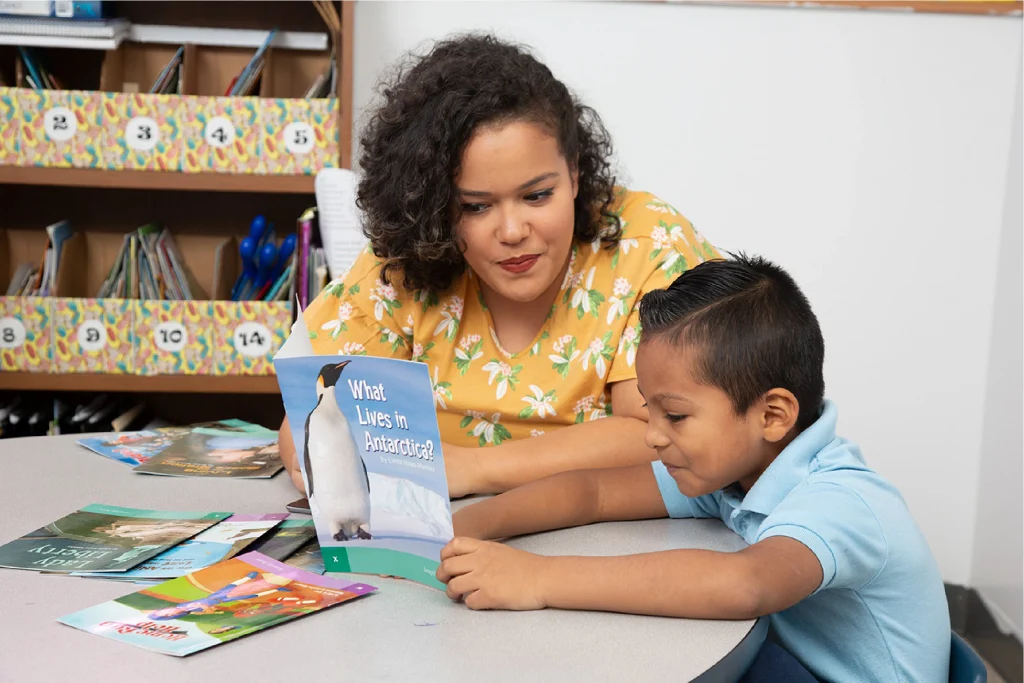
There’s a difference between the ability to sound out words on a page and the ability to truly understand their meaning. That difference? Reading fluency.
Fluency is one of the five foundational reading skills. (The other four, as you likely know, are phonological awareness, phonics, vocabulary, and comprehension.) Fluency connects readers not just to words, but to emotions and expressions, characters and connotations. And it’s also where reading really starts to foster joy.
In this post, we’ll explore what fluency is, why it matters, and how to successfully incorporate it into your literacy instruction.
Defining fluency
The International Literacy Association defines reading fluency as “reasonably accurate reading, at an appropriate rate, with suitable expression, that leads to accurate and deep comprehension and motivation to read.”
In other words, fluency is not just reading fast. And it goes beyond merely decoding words, to developing a deep understanding of what they’re trying to say. Fluency allows readers to connect ideas, recognize patterns, and infer meanings.
“I call fluency the bridge to comprehension,” says Kent State literary education professor Tim Rasinski, discussing the topic on Amplify’s Science of Reading: The Podcast.
Why fluency in reading matters
Rasinski is also director of Kent State’s award-winning reading clinic, and in his podcast episode, he describes encountering students as old as grade 5 who have decoding skills, but not fluency. “[These students] can sound words out, but if you were to hear them read orally, it would be slow, laborious reading in a monotone,” he says. According to Rasinski, these students aren’t getting “much joy and satisfaction, or even comprehension” from their reading.
While oral expression in reading is not the ultimate goal, it is an indicator. “The way you read orally reflects the way you read silently,” Rasinski says. “Most of us would say when we read silently we ‘hear’ ourselves with our internal voice.”
When readers develop fluency, they also develop:
- Comprehension. As decoding becomes more effortless, readers can focus on understanding meaning. Fluent readers recognize words automatically, allowing them to dedicate cognitive resources to complex sentence structures and connections among ideas. They grasp both main points and nuances. All told, they get what they’re reading.
- Confidence. Fluent readers are more likely to feel accomplished, proud, and motivated with regards to their reading abilities. And it’s a virtuous cycle: As their confidence grows, they’re more likely to engage in and enjoy reading—and continue to improve.
- Vocabulary. Fluency plays a significant role in vocabulary acquisition and language development. Fluent readers encounter a larger variety of words in context. This exposure enhances their language and communication skills across academic topics and life experiences.
- Academic success. Fluency helps students read to learn. As students advance through school, fluency becomes increasingly important for comprehension and analysis of more advanced and content-rich texts.
- Emotional connection. Fluency enables readers to connect with the characters, emotions, experiences, and implications in a given text. That’s what makes reading immersive and enjoyable—in the moment and for a lifetime.
The fluency journey: learning and assessment
The Science of Reading tells us that foundational reading skills must be taught explicitly and systematically, and fluency is no exception. Developing reading fluency is a gradual process that requires consistent practice and exposure to different types of texts. There are several stages and skills that support the development of reading fluency.
- Fluency starts with accuracy in decoding. As students practice and improve their phonics skills, they can accurately recognize and decode more and more words. This helps them move from laborious reading toward more efficient reading.
- Speed comes as a result of accuracy. As students become more accurate in decoding, they can read words more quickly. Accuracy helps reduce the time it takes to identify and process each word, allowing for a smoother and faster reading experience.
- Fluency practice helps with automaticity. And the more students develop both accuracy and speed, the more they develop automaticity.
As you may know, there’s a tool called Oral Reading Fluency (ORF) that reading professionals use as a quick-read thermometer of sorts to measure reading speed and accuracy. It’s a simple assessment, measuring how many words a student reads correctly in an unpracticed passage. It’s considered one of the best indicators of a student’s reading progress.
“It works! It has validity. It gives us good, useful information,” says researcher, educational consultant, and author Dr. Jan Hasbrouck on Science of Reading: The Podcast. That’s why it’s widely used—but, she adds, it’s also widely misunderstood.
It is a reliable and helpful measure of fluency in terms of reading rate and accuracy, she says. At the same time, “It was unfortunate to put the label ‘fluency’ on it,” she says. “We reading teachers think of fluency as something much more multifaceted and complex that at minimum includes prosody, or expression. It is accuracy, rate, expression, metacognition, background knowledge—it’s all of this stuff that really experienced reading teachers think of as fluency.”
Fluency best practices for literary instruction
Automaticity frees up cognitive space for comprehension, but fluency isn’t just about reading fast—it’s also about making meaning, which is where prosody comes in.
Prosody refers to the rhythm, intonation, and expression used by someone reading aloud.
But it’s not just for the natural performers in the classroom. Prosody can be influenced. How do we help students develop that external, and internal, prosodic voice?
Through targeted read-aloud practice. By explicitly teaching students about prosody and providing systematic practice opportunities, educators can nurture fluency and comprehension simultaneously—a connection to overall reading success that is well-supported by evidence-based research.
Some fluency strategies include:
- Reader’s Theater in the classroom: Students don’t have to be skilled actors to take on roles and read from scripts. Theater activities allow them to practice recognition and expressions of drama and emotion as they bring the lines to life.
- Assisted reading: When students read aloud simultaneously with a more fluent reader, they practice their own skills while also hearing someone else make meaning of the same text. This can also take the form of choral reading, i.e., students reading aloud as a group, focusing on using appropriate intonation and expression. Reading together allows them to practice prosody in a supportive and collaborative environment.
- Consistent reinforcement and rewards: Rasinski works with students on snippets of text, first with prosody modeled by teachers, then practiced alone and together (repeated reading), then performed for each other or even parents or other adults who offer praise. This regular practice helps boost the confidence and motivation that assists students in developing fluency. “We want children to experience reading success every single day,” says Rasinski.
More to explore
Amplify’s professional services for educators
We work together with educators to create meaningful learning experiences in schools—whether it’s designing a customized professional development plan, working alongside teachers in the classroom, or providing engaging and effective high-impact tutoring services to help students thrive.
Amplify’s professional development
When educators grow, students grow. Our goal is to support your team’s professional development with training designed to nurture, develop, and refine instructional practices, enhancing student achievement. We offer flexible PD training and coaching, both in-person and online, with a range of support to fit districts’ needs and educators’ busy schedules.
Amplify’s high-impact tutoring
Every child deserves to be a confident reader and mathematical thinker. Amplify Tutoring, grounded in evidence-based practices and high-quality instructional materials, delivers meaningful gains for students and data-driven insights for educators. Our flexible high-impact tutoring models for literacy and math help schools meet students’ unique needs.
Leading education into the future, together
Collaborative partnerships to strengthen educator success
Partnering with leading organizations, Amplify offers robust Amplify Desmos Math professional development that complements and enriches your learning journey and ensures access to comprehensive educational resources. Together, we align district and school leader support, enhance instructional practices, and boost student engagement to drive enduring outcomes.
Partner organizations


Nurturing young children’s curiosity and wonder in the math classroom
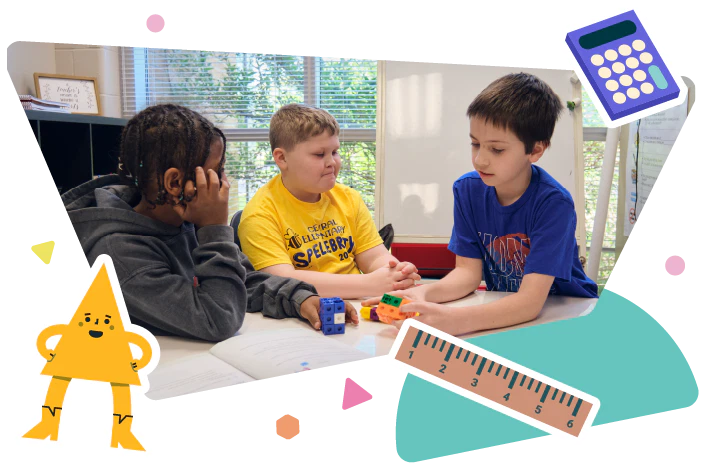
Based on my experience in math education, I find that many pedagogical structures or moves sound great in theory, but are often easier said than done. Because of the complexity, asking students to construct mathematical arguments has been one of those things for me. Fortunately, over the years, I have had the joy and privilege to work with Jody and Chepina, whose thinking around math argumentation is grounded in theory and paired with practical and actionable advice and structures. I am so excited for others to share in their deep thinking and look forward to seeing the impact their work will have in classrooms.
—Kristin Gray, Executive Director, Math suite, Amplify
Mathematical argumentation as an opportunity for curiosity
Students bring curiosity and wonder to the classroom every day. When we’re attending to their ideas, we can find more opportunities for mathematical argumentation in our math lessons. Let’s look at how these opportunities arise in a first-grade classroom.
The lesson and card sort activity
The purpose of the lesson was for students to identify equivalent addition expressions by sorting cards, each with a different expression. Students quickly noticed that there is more than one way to get the same value. They could even begin to see the commutative property in action when shown cards with addends in opposite order: 4 + 3 = 3 + 4.
While sorting addition expressions, rather than organizing the cards in piles by their value, one student named Jenna organized the cards in columns. This student-led creative modification to the card sort structure allowed for different noticings and wonderings to emerge. She started by creating a row across the top with cards showing one addend of 0. At first, she wasn’t consistent with the top card being 0 + x or x + 0, but over time changed them so that they were all 0 + x. Then she filled in the last column with expressions equal to 10. As she added cards, she started to change the order so that the first addend on the cards increased going down the column and the second addend decreased.

As Jenna added each card to her organizational structure, the teacher asked where that card would go and how she knew. When asked about the 2 + 6 card, for example, Jenna said, “Because this is counting to 8, and this”—she pointed to a gap—“has to be 7, because [the 6 is] 2 less than 8. It fits here because these are all twos” (in the row). Jenna was coordinating several characteristics of rows and columns within the structure of the chart.
As Jenna continued to fill in the chart, she noticed yet another pattern. Pointing to the step pattern, Jenna noticed that, “There is a stair step. The pattern keeps going. There’s one more way to make the total as it gets bigger.”

We could state this conjecture more precisely as: “For any whole number n, there are n + 1 ways to add two whole numbers to get a sum of n.” Jenna was making sense of big math ideas and noticing structure embedded in arithmetic.
Reflecting on the experience
As we step back and reflect on what we experienced with Jenna, we wonder what could happen next. How might Jenna justify her thinking? She noticed the stair-step pattern and multiple ways to arrive at the total. What might she say if we asked her, “Why is that happening?” Or if we gave her a tool such as linking cubes and asked if she could use the cubes to show why that works? Are there other questions that could have nudged her to extend her thinking, such as, “Will that always work?” or “What numbers does it work for?” Is there a tool or representation that would help her continue her reasoning?
We can also think about what might happen if we shared Jenna’s idea with the other students. How might they respond to Jenna’s noticing? Would her ideas lead others to see and use structure in similar ways? How would they make sense of her ideas? Perhaps this is an opportunity to engage students in each other’s ideas.
Opportunities for curiosity
The opportunity for Jenna and her classmates to make sense and explore their natural curiosity emerges from a classroom environment that’s playful and filled with wonder—where children are given time to explore and interact with materials and each other. We noticed that as Jenna progressed through the cards, she refined and added on to her thinking. This is evident in the first row of cards. She grouped cards with 0 as an addend, then began to sequence them, and later considered the positioning of the addends to 0 + x. As we might infer from the interaction of the teacher, there isn’t one right way to think about the task, nor one way for the teacher to encourage students to think about it. We hear the teacher ask Jenna to share her reasoning: It’s not a question posed to evaluate Jenna’s thinking, but rather to gain insight into her thinking—something the teacher is genuinely curious about.
In addition to the classroom environment, the card sort also presented an open-ended opportunity. Students made sense of the sort in many different ways, some finding related pairs and starting to identify (not yet naming) the commutative property, others grouping problems with a common addend in piles. All students had access to the task and time to make sense of it.
We share the story of Jenna as one of many instances where young children have shared their brilliance with us. Their wonder and curiosity inspired us to explore their ideas along with K–2 teachers. We saw students notice, wonder, conjecture, justify, and extend ideas that led to a deep understanding of key mathematical concepts while integrating mathematical argumentation.
We share ideas like the brilliance from Jenna in our new book, Nurturing Math Curiosity with Learners in Grades K–2, where we also make connections among instructional routines, center, and card sorts. Our book also discusses supporting students in curious exploration, building on what they already bring to the classroom as a way to bring opportunities for mathematical argumentation into our lessons.
Rumsey, C., & Guarino, J. (2024). Nurturing Math Curiosity with Learners in Grades K–2. Solution Tree. Bloomington, IN. ISBN: 9781960574367
Explore more
- Read Nurturing Math Curiosity with Learners in Grades K–2.
- Encourage student curiosity with the K–5 lessons available in Desmos Classroom.
- Check out our math webinar library for on-demand professional learning opportunities.
Una evaluación auténtica del español creada específicamente para estudiantes bilingües que están aprendiendo a leer
Como parte del paquete mCLASS® Español, mCLASS Lectura es un evaluador universal para K a 6.º grado basado en investigaciones recientes sobre alfabetización en español que ayuda a los educadores a acelerar el progreso en la lectura para los estudiantes de habla hispana al ofrecer una paridad total entre las evaluaciones de lectura en inglés y en español. For English version, please click here.

Abordar las desigualdades que enfrentan en el salón de clase los estudiantes de habla hispana en la alfabetización temprana
Los estudiantes de habla hispana han estado desatendidos y clasificados erróneamente durante décadas. Al combinar mCLASS Lectura y mCLASS con DIBELS® 8.ª edición, podrá comprender dónde se encuentran sus estudiantes de habla hispana en su trayectoria de alfabetización en inglés y español.
Basado en la ciencia que subyace a cómo los estudiantes aprenden a leer en inglés y español, el sistema mCLASS permite a los maestros conectarse con sus estudiantes de habla hispana cara a cara, uno a uno y en el idioma que les resulte más cómodo. Los maestros pueden identificar en qué punto del desarrollo de sus destrezas de lectura y escritura se encuentran realmente sus estudiantes hispanohablantes o bilingües emergentes y qué instrucción deben priorizar.

Desarrollado por reconocidos expertos en alfabetización
El evaluador universal mCLASS® Lectura fue desarrollado conjuntamente con el Centro de Enseñanza y Aprendizaje de la Universidad de Oregon. La evaluación fue validada por Amplify en colaboración con la Dra. Lillian Durán de la Universidad de Oregón.
El desarrollo de mCLASS Lectura también involucró a un equipo de expertos reconocidos a nivel nacional que representan una variedad de regiones (México, América Central, América del Sur y el Caribe), junto con grupos focales con maestros regulares, maestros de educación especial, especialistas y administradores.
Nuestro enfoque
Alineado con la Ciencia de la lectura, mCLASS Lectura permite a los maestros conectarse con sus estudiantes a través de una evaluación observacional y en el idioma que les resulte más cómodo. Creamos mCLASS Lectura para que, cuando se use en conjunto con mCLASS con DIBELS 8.ª edición, los educadores puedan lograr una paridad completa entre las destrezas de alfabetización en inglés y español.
Paridad total entre inglés y español
mCLASS Lectura es una evaluación auténtica en español que ofrece paridad total cuando se combina con mCLASS con DIBELS 8.ª edición, que incluye informes paralelos entre evaluaciones en inglés y español así como informes únicos en dos idiomas.


Escuche a sus estudiantes leer en ambos idiomas, uno a uno
mCLASS Lectura proporciona evaluaciones en español administradas por maestros, que brindan mediciones precisas y confiables del progreso de alfabetización de cada estudiante.
Creado a partir de las últimas investigaciones sobre el desarrollo de la alfabetización en español
mCLASS Lectura es una evaluación de alta calidad que tiene en cuenta las principales diferencias entre inglés y español, no simplemente una traducción directa o transadaptación entre los dos idiomas.

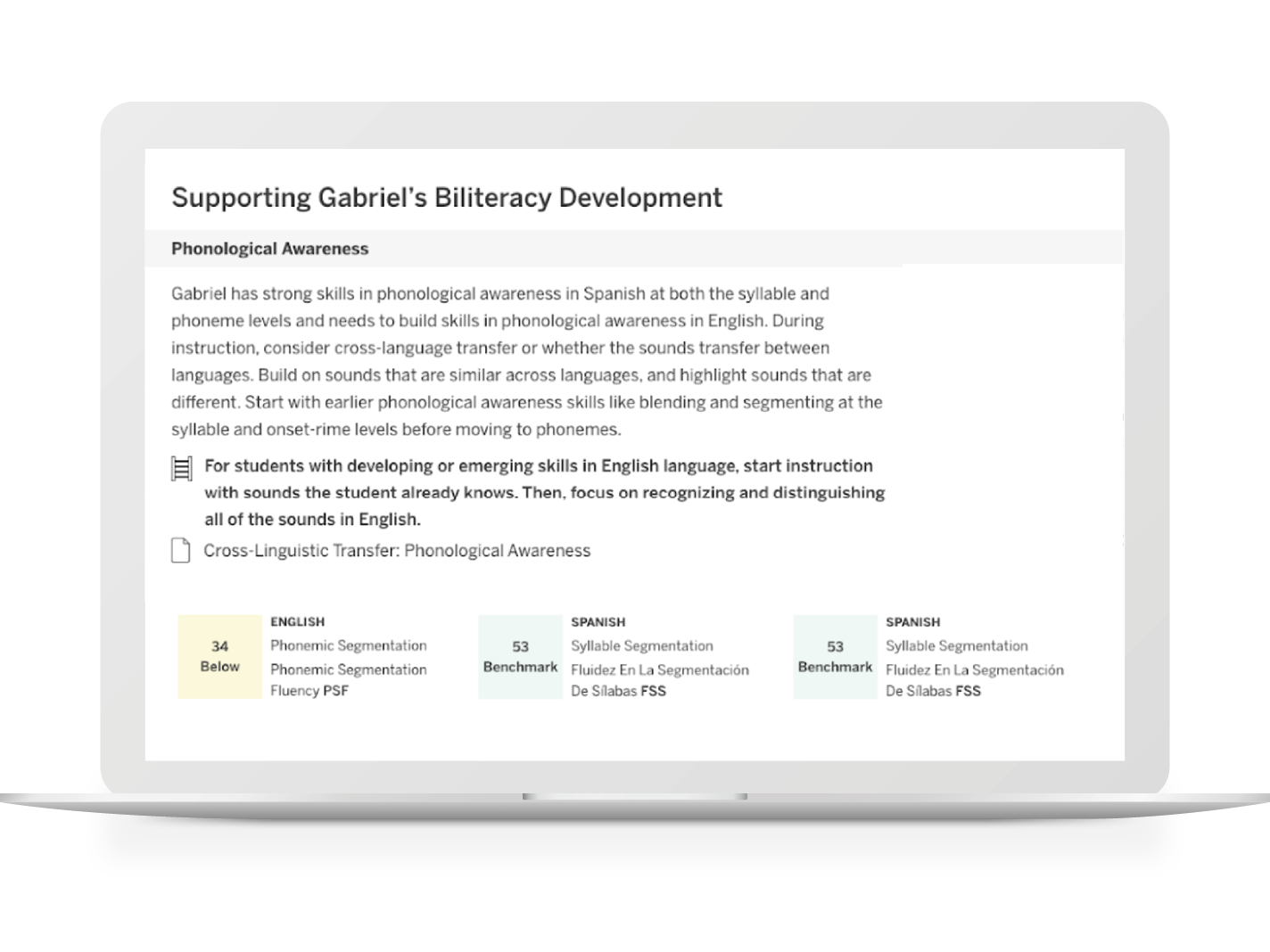
Transferir destrezas de un idioma a otro
Al brindar a los maestros información sobre las áreas de destrezas que sus estudiantes dominan en su idioma nativo, el programa ayuda a los hispanohablantes a desarrollar sus fortalezas y establecer conexiones con su segundo idioma. Los educadores también reciben orientación sobre la transferencia interlingüística de destrezas fundamentales en ambos idiomas.
Conozca las desigualdades que enfrentan en el salón de clase los estudiantes de habla hispana y cómo los educadores pueden abordarlas
Descargar ahoraQué se incluye
mCLASS Lectura incluye medidas de un minuto validadas para la detección universal y de dislexia, y proporciona informes en dos idiomas para maestros y administradores.
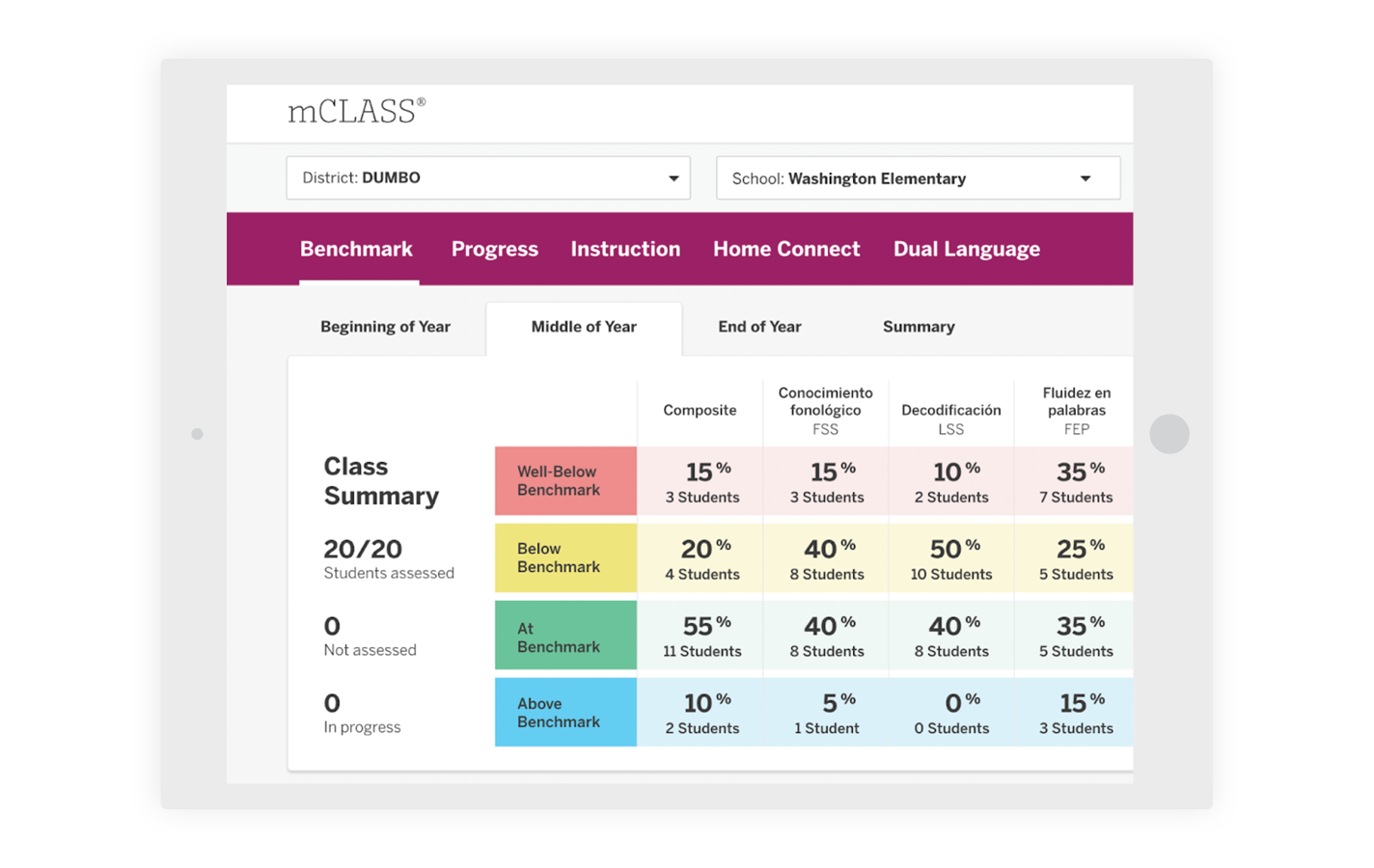
Medidas integrales de alfabetización en español en mCLASS Lectura
mCLASS Lectura está validado para evaluar todas las destrezas fundamentales para K a 6.º grado, que incluyen:
- Nombrar las letras
- Conciencia fonológica
- Principio alfabético
- Fluidez
- Comprensión
Informes en inglés y español
mCLASS Lectura analiza la alfabetización en español y el desarrollo de la alfabetización en inglés en paralelo, lo que le permite ver en qué nivel se encuentran los estudiantes en ambos idiomas. Conozca más sobre los informes de mCLASS Lectura.


Actividades de instrucción para desarrollar destrezas de alfabetización en español
Con mCLASS Lectura, los educadores obtienen cientos de actividades de instrucción paso a paso para grupos pequeños o estudiantes individuales y reciben actividades eficaces para enfocarse en las destrezas de alfabetización en español en las que los estudiantes necesitan más apoyo.
Informes integrales
mCLASS Lectura proporciona informes para todos en todos los niveles, desde maestros y especialistas en alfabetización hasta directores y líderes distritales, así como padres y cuidadores en el hogar. Conozca más sobre sobre los informes de mCLASS Lectura.
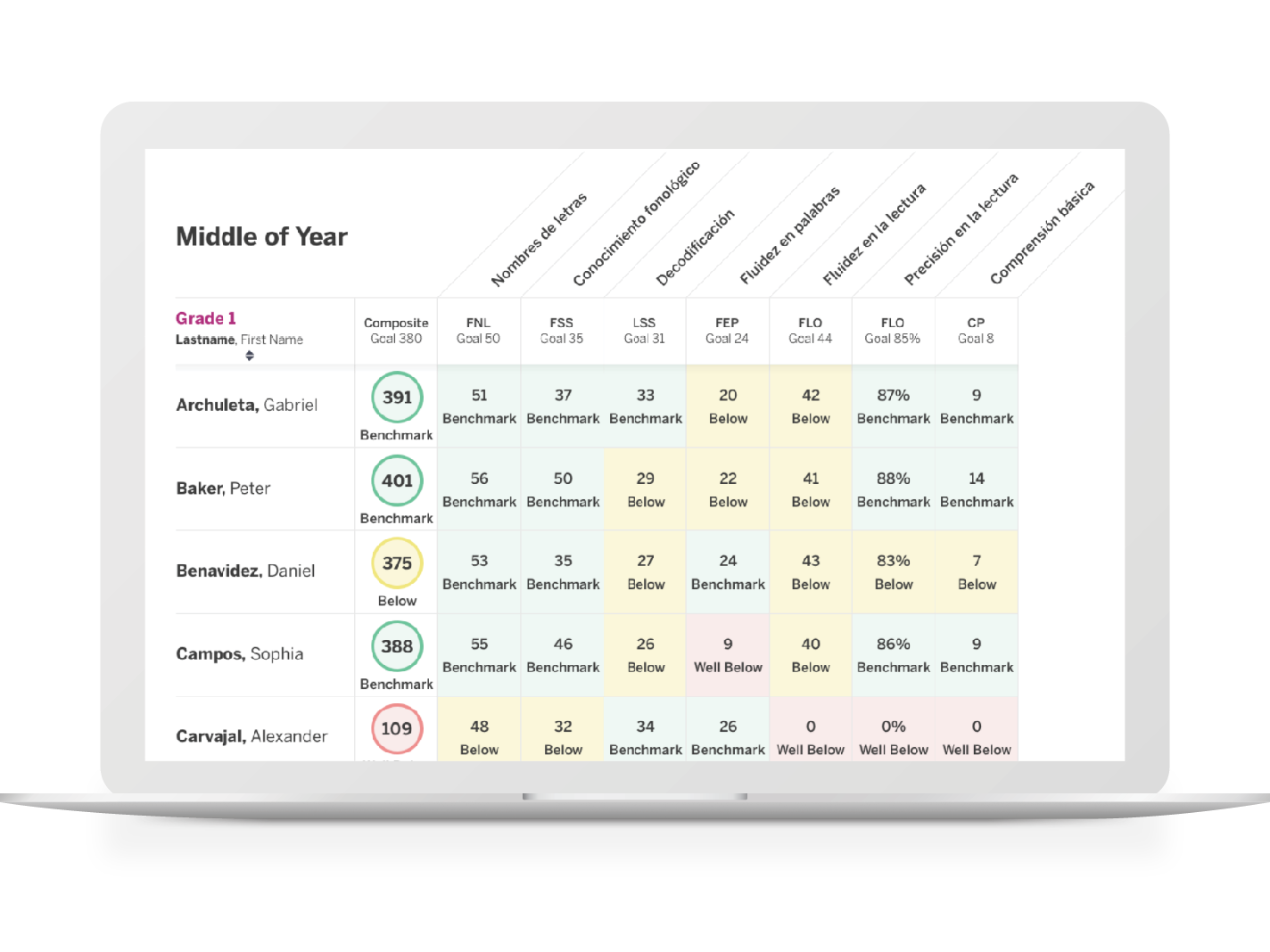
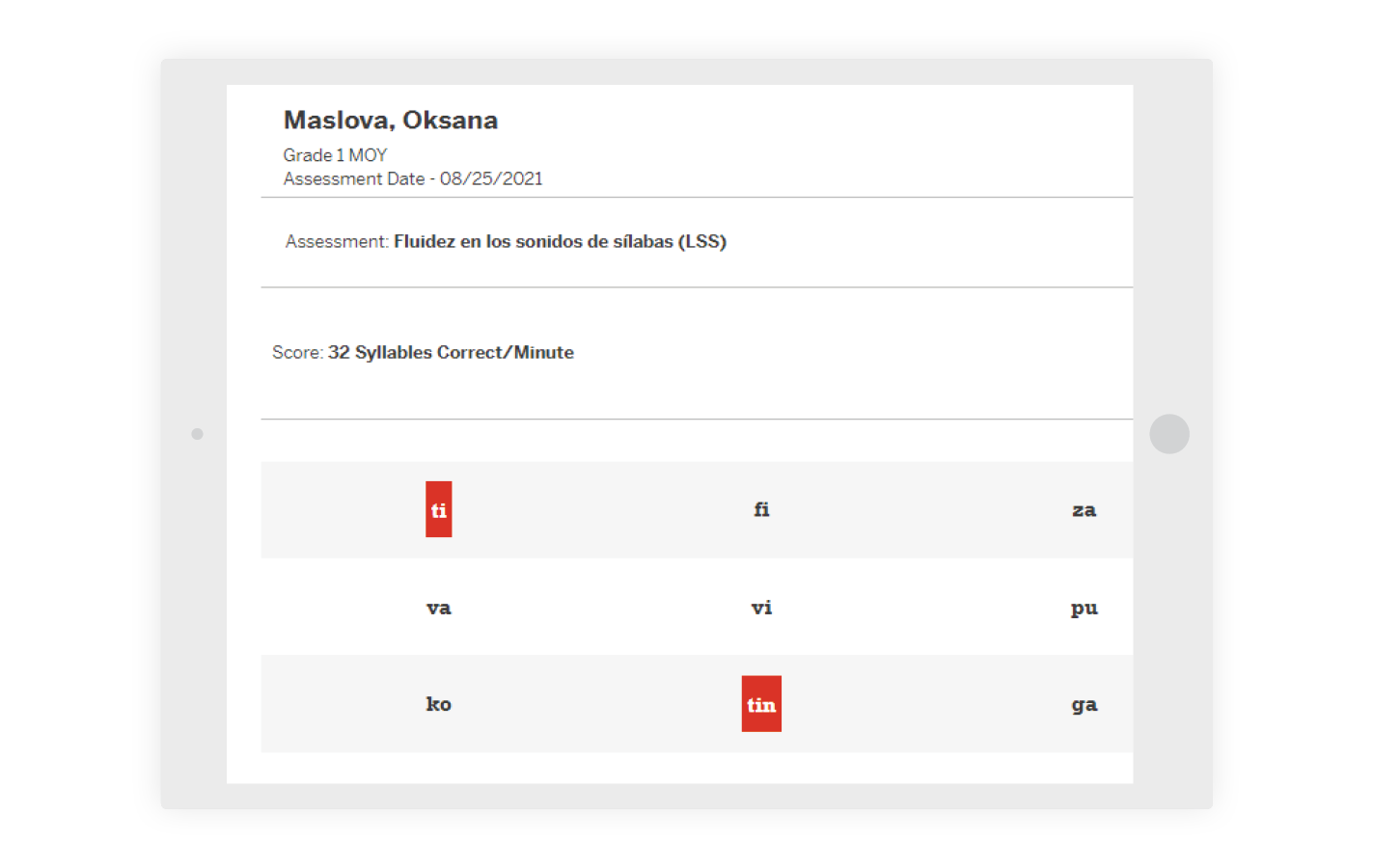
Datos de evaluación detallados
mCLASS Lectura proporciona transcripciones de cada evaluación e identifica patrones de error para ayudar a los educadores a tomar decisiones didácticas sobre las habilidades que más necesitan reforzar los estudiantes. El programa también incluye cartas con resultados y análisis de las evaluaciones de los estudiantes para enviar a casa o usar como base para discusiones durante las conferencias.
Lea sobre la investigación y validación que respaldan a mCLASS Lectura
Descargar nuestro informe técnicoSparking literacy success in Tennessee
Meet Kaleb.
Not that long ago, he couldn’t read. And now he’s a confident, engaged reader who wants to write his own stories.
What changed? Mr. Price, a caring educator, connected with Kaleb and joined him on his literacy journey.
Like Mr. Price, you’re changing lives and creating new futures for kids every single day—and we’re here to help you do that.
Providing structured practice, support, and guidance that makes a difference
When students struggle with reading, their relationships with their teachers become more important than ever—and so does the support, instruction, and guidance you give them.
How can you take your students from not knowing the alphabet to decoding dozens of words in one school year? Research-backed intervention, remediation, and practice can certainly help. And so can Amplify.

Change lives forever with the Science of Reading
In making the shift to the Science of Reading, you can give every teacher and student what they need, and guarantee reading and literacy success.
Think of how that would transform your school and district—and most importantly, your students’ lives.
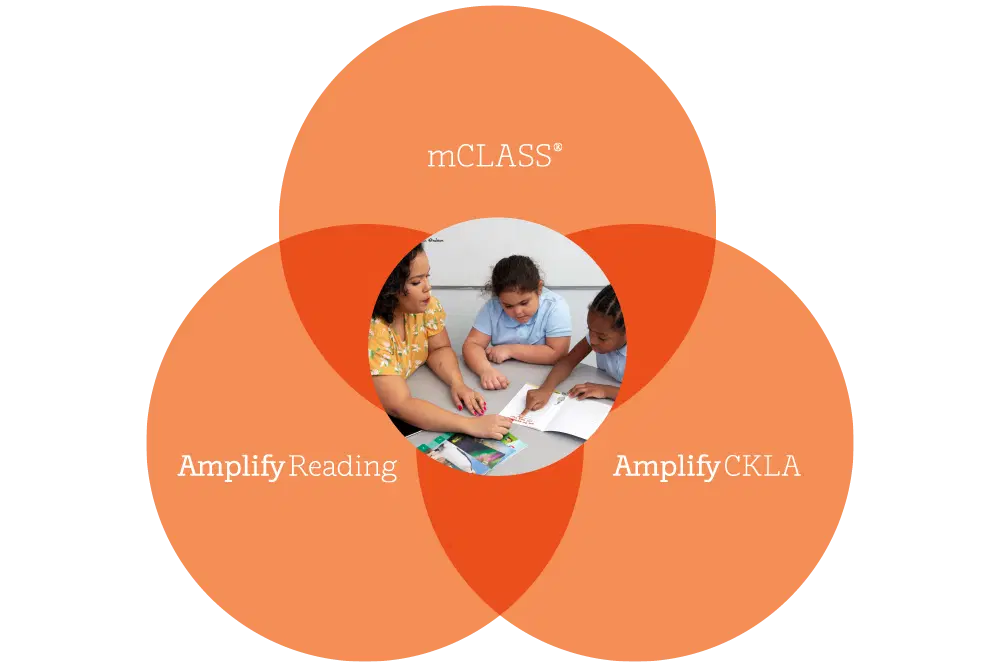
Support every student with the only full Science of Reading-based literacy system
The Science of Reading tells us that learning to read is not a natural or automatic process. You see this every day—with students like Kaleb. Students with dyslexia. Students who haven’t gotten the explicit instruction, support, and guidance needed to experience real literacy success and joy.
To be powerful and effective, and to help all students achieve success, a literacy system needs to bring together assessment, curriculum, intervention, and personalized learning. And Amplify has done exactly that with the only full Science of Reading suite, made up of Amplify Core Knowledge Language Arts, mCLASS®, and Boost Reading (formerly known as Amplify Reading).
We are the program for Florida’s middle school students and teachers.
We built Amplify ELA to help you make sure the standards are covered, the skills are taught, the test is prepped for, and your students are scaffolded and encouraged. What’s more, everything is done in the background. That way, you can spend your time bringing the text to life, making the classroom hum, and letting each student know you are paying attention to their growth.

Program overview
Amplify ELA is a hybrid curriculum designed specifically for grades 6–8. The heart of every lesson is the text. Each grade includes six units centered on literary or informational texts, delivered in several forms of media. Your classroom will also benefit from two or three immersive learning experiences called Quests and a dedicated Story Writing unit.
- Full standards coverage: Standards are clearly labeled in each lesson overview, so teachers can save time planning and get back to what they love: teaching.
- Five levels of differentiation: Based on each student’s needs and the performance measures within Amplify ELA reports, a teacher can choose the differentiation level that’s the right fit for everyone.
- Embedded assessments: Teachers benefit from uninterrupted instructional time and a continuously updated picture of each student’s progress with key skills and standards.
- Powerful feedback tools: Comprehensive tools help teachers maximize both the quantity and quality of feedback.
- Robust reporting: Our reporting app offers information on student progress to help inform instructional decisions.
- All in one place: Embedded teacher support, differentiation tools, student data, text and other curriculum features—they’re all right there.
Materials
Discover print and digital materials included in the program.
Student edition
Available digitally and in print, the student materials guide middle schoolers through complex texts and writing by:
- engaging students with high-quality narrative and informational texts, providing videos, audio supports, and digital experiences that capture their attention, and
- keeping all of their writing in one place with the personal writing journal.
Teacher edition
Available digitally and in print, the Teacher edition contains all of the information teachers need to facilitate classroom instruction, including:
- detailed lesson plans
- video teacher tips embedded in the lesson
- LAF standards alignment and exit tickets
- real-time differentiation strategies
- robust reporting
Interactive Quests
Fun, week-long explorations where students practice analytical reading, writing, speaking, and listening skills, all while building a strong classroom community.
Digital library for independent reading
Amplify Library: Our expansive digital library includes more than 650 fiction and nonfiction, classic, and contemporary titles.
Resources
Learn more about Amplify ELA and how we address the unique needs of middle school students.
Program sample guide
Table of Contents
Four Principles of True Engagement in Middle School ELA
Empower students to become critical thinkers webinar recording
Provide opportunities and supports for all students to work “up” webinar recording
Support feedback systems that develop strengths webinar recording
Experts & presenters

Deb Sabin
Chief Academic Officer, Amplify ELA
Deb Sabin leads Amplify’s curriculum development teams for ELA. Previously she was Director of Instruction and Training for The Writer’s Express. She’s been an ELA teacher in a variety of classrooms from alternative high schools to elite prep schools and international dual language programs.
Jeff Dannemiller
Product Specialists, Amplify
Jeff works with educators across the country, helping them get the most out of their middle school students with reading, writing, and developing all the other skills necessary for high school and beyond.

Dr. William McBride
National Education Consultant
Dr. Bill McBride is a well-known international speaker and educator. He has trained middle, high, and adult education teachers for over 30 years in literacy and student engagement. Some of his books include Building Literacy in Social Studies, If They Can Argue Well, They Can Write Well, Entertaining an Elephant, and two successful reading programs for secondary struggling readers. He has also been a contributing author on a number of state-adopted literature series for grades 6 through 12.
Contacts
Ronda Baggett
rbaggett@amplify.com
(347) 452-6988
Melinda Lyon
mlyon@amplify.com
(704) 813-7757
Jeff Rutter
jrutter@amplify.com
(727) 512-8440
Welcome, Ohio educators!
What should every teacher know about the Science of Reading?
We have disseminated all the research into practical pedagogical strategies you can implement in your classroom today. On this site, you will find a variety of resources to build your background knowledge of what the Science of Reading looks like in practice.

Sparking literacy success
Meet Kaleb.
Not that long ago, he couldn’t read. And now he’s a confident, engaged reader who wants to write his own stories.
What changed? Mr. Price, a caring educator, connected with Kaleb and joined him on his literacy journey.
Like Mr. Price, you’re changing lives and creating new futures for kids every single day—and we’re here to help you do that.

Deepen Your Understanding
If you’re not already teaching Science of Reading, how can you start? And if you are teaching some or all of these, are there ways to do it more effectively? Use the resources below to get a better understanding what a true Science of Reading curriculum looks like.


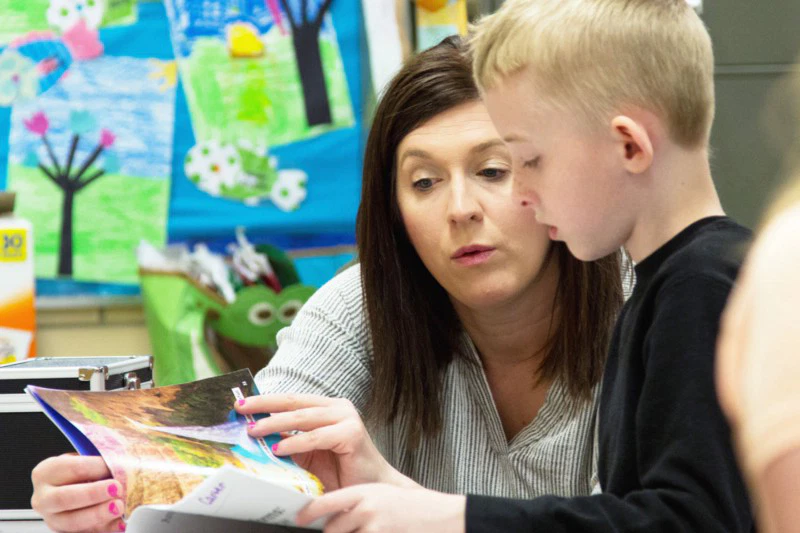

Providing structured practice, support, and guidance that makes a difference
When students struggle with reading, their relationships with their teachers become more important than ever—and so does the support, instruction, and guidance you give them.
How can you take your students from not knowing the alphabet to decoding dozens of words in one school year? Research-backed intervention, remediation, and practice can certainly help. And so can Amplify.
Change lives forever with the Science of Reading
In making the shift to the Science of Reading, you can give every teacher and student what they need, and guarantee reading and literacy success.
Think of how that would transform your school and district—and most importantly, your students’ lives.
Support every student with the only full Science of Reading-based literacy system
The Science of Reading tells us that learning to read is not a natural or automatic process. You see this every day—with students like Kaleb. Students with dyslexia. Students who haven’t gotten the explicit instruction, support, and guidance needed to experience real literacy success and joy.
To be powerful and effective, and to help all students achieve success, a literacy system needs to bring together assessment, curriculum, intervention, and personalized learning. And Amplify has done exactly that with the only full Science of Reading suite, made up of Amplify Core Knowledge Language Arts, mCLASS®, and Boost Reading (formerly known as Amplify Reading).
Research and Efficacy
Using a fundamentally different approach to language arts, Amplify Core Knowledge Language Arts® (CKLA) is built on decades of early literacy research that demonstrates the importance of wide-ranging background knowledge and explicit and systematic instruction in foundational skills. Visit our research and efficacy page to learn more.

Welcome to Amplify Desmos Math California!
California educators, welcome to math that motivates. Introducing Amplify Desmos Math California, a new, curiosity-driven TK–12 program that builds lifelong math proficiency. Each lesson poses problems that invite a variety of approaches before guiding students to synthesize their understanding of the learning goals. Students encounter math problems they are eager to solve; teachers spend more time where it’s most impactful: creating a collaborative classroom of learners.
Scroll to learn more about the program and explore sample materials.
About the program
Amplify Desmos Math California is a TK–12 core math program designed to meet the CA Math Framework and the Common Core State Standards for Mathematics. Offered in English and Spanish, Amplify Desmos Math California thoughtfully combines conceptual understanding, procedural fluency, and application through a structured approach to problem-based learning. Through engaging activities, Amplify Desmos Math California invites curiosity and math discourse into the classroom to create lifelong math proficiency.
Please scroll to learn more about the K–8 program and explore sample materials. (TK and high school materials are in development and will be available soon.)
A powerful math suite
Amplify Desmos Math California combines the best of assessment, problem-based core lessons, personalized practice, and intervention into a coherent and engaging experience for both students and teachers.

Assessment
mCLASS benchmark assessments, along with daily formative checks, measure not only what students know, but also how they think. The asset-based assessment system provides teachers with targeted, actionable insights, linked to core instruction and intervention resources. Unit- and lesson-level core assessments give teachers data at their fingertips to guide and differentiate instruction. In grades 3–8, core assessments and performance tasks are designed to prepare students for success on the Smarter Balanced Assessment Consortium (SBAC) testing.
Core instruction
Amplify Desmos Math California core lessons pair problems students are eager to solve with clear instructional moves for teachers. Each lesson is designed to tell a story by posing problems that invite a variety of approaches before guiding students to synthesize their understanding of the learning goals. With built-in differentiation and Multilingual / English Learner support, Amplify Desmos Math California will allow every student to find success in the math classroom.


Personalized learning
Boost Personalized Learning activities help students access grade-level math through engaging, independent digital practice. Responsive Feedback adjusts to students’ work, providing item-level adaptivity to further support their learning.
Intervention
Integrated resources like Mini-Lessons, Fluency Practice, and Math Adventures provide targeted intervention on a specific concept or skill connected to the daily lesson. Extensions are also available to stretch students’ understanding.

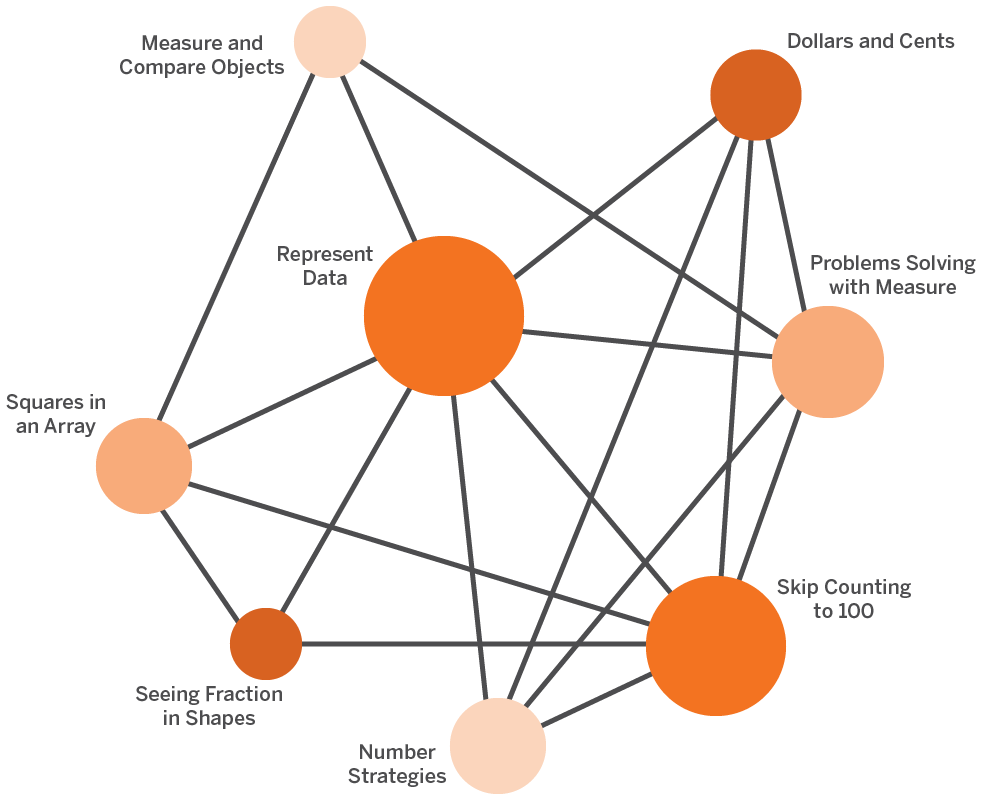
Big Ideas
The CA Mathematics Framework encourages a shift from power standards to thinking about math as a series of connected Big Ideas. Each Amplify Desmos Math California lesson supports one or more Big Ideas and the connections between Big Ideas. The grade-level diagram changes through the course based on the math concepts being addressed.
Focus, coherence, and rigor
Each lesson highlights why the content being covered is important, how students will engage with the mathematics, and what students will do with the learning. Our lesson opener helps teachers understand the most important concepts of the lesson, and includes the Drivers of Investigation (DI), Content Connections (CC), and Standards for Mathematical Practice (SMP) that drive learning in each lesson.


Built-in authentic tasks
Mathematics is not learning in isolation. Students are connected to each other’s thinking and can use math to understand the world. With accessible invitations to authentic tasks, all students can experience mathematical success. Amplify Desmos Math California provides these authentic invitations in a variety of ways:
Each unit begins with an “Explore” lesson, which allows students to engage with authentic exploration in low-floor, high-ceiling tasks. These tasks are designed in such a way that all students can access the basic mathematical concepts, but they also offer possibilities for advanced exploration and problem-solving for those ready for more complex work, promoting an inclusive and differentiated learning environment.
Our innovative course-level investigations are designed to facilitate multipart exploration. Students grapple with Big Ideas, diving deep into key concepts that encourage comprehensive understanding. Data science is infused into the approach, equipping students with a strong foundation in interpreting and applying data-driven solutions. The Environmental Principles and Concepts (EP&Cs) are also a focus of our investigations, enabling students to understand and appreciate the coherence and interrelationship of Earth’s environmental systems.
A focus on multilingual and English learners

In building Amplify Desmos Math California, we partnered with the English Learner Success Forum (ELSF) to provide guidance on our multilingual/English learner support for teachers. ELSF is a national nonprofit organization that advocates for high-quality instructional materials that are inclusive of multilingual learners. ELSF’s guiding documents reflect research-based instructional strategies that are critical to curriculum design and were created by researchers, linguists, and practitioners from across the country. ELSF reviewed our materials and provided directional guidance and feedback to ensure that the program fully supports multilingual/English learners.
A component of our K–5 curriculum is the engaging unit stories that interweave mathematics with real-life situations and relatable narratives. These unit stories are specifically crafted to inspire curiosity and foster a deep connection between the learner and the math concepts being explored. This unique approach not only makes learning fun and interesting, but also allows our young learners to see themselves in the math.
To help students grow their domain-specific and academic vocabulary, Amplify Desmos Math California provides embedded vocabulary routines, such as prompting teachers to use a Frayer Model. These routines allow students to make connections to new language and offer repeated opportunities to develop and refine language.
Amplify Desmos Math California recognizes the diverse language needs of our students and is designed to be inclusive. Each lesson in the program features a parallel language activity, designed to be available to all students, in the form of teacher guidance and student activities. The activities in the Math Language Development Resource has leveled ELD (Emerging, Expanding, Bridging) differentiation to support all levels of Multilingual and English Learners. This approach ensures that all students, regardless of their language skills, can participate fully, grasp the material, and excel in their mathematical journey.
Uploaded digital glossary for languages other than Spanish. Up to nine languages of translations will be provided for.
Amplify Desmos Math California will include support resources for Spanish-speaking students across TK–Algebra 1/Integrated I beginning in the 20262027 school year.

K–5 sample materials
Click the links in the drop-down sections below to explore sample materials from each grade.
For helpful navigation tips and more program information, download the Amplify Desmos Math Program Guide.
You can also watch a product expert walk through a lesson and the available program components.
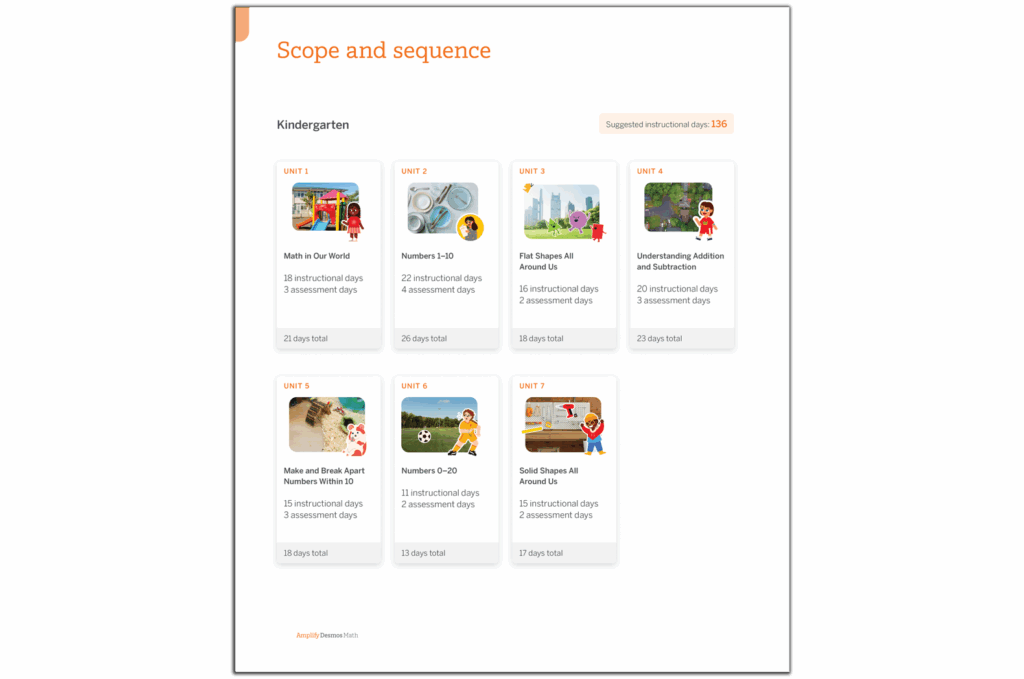
Program structure
Get to know the content and structure of Kindergarten Amplify Desmos Math California.
Teacher Edition pages
Planning and instructional guidance is visual, organized, and easy-to-follow. To help you review the program, we have included samples from a complete sub-unit on this site: Unit 2, Sub-Unit 1: Counting and Comparing Objects.

Digital experience
Explore our digital experience! Every lesson in Amplify Desmos Math California has student print materials and digital recommendations.

Student Edition pages
Motivate students with mathematics that is both rigorous and delightful.

Centers Resources
Engaging, hands-on games for students to play collaboratively to strengthen their understanding of key skills and concepts.
Intervention and Extension Resources
Additional resources to reinforce and extend key concepts, including Mini-Lessons and Extensions.
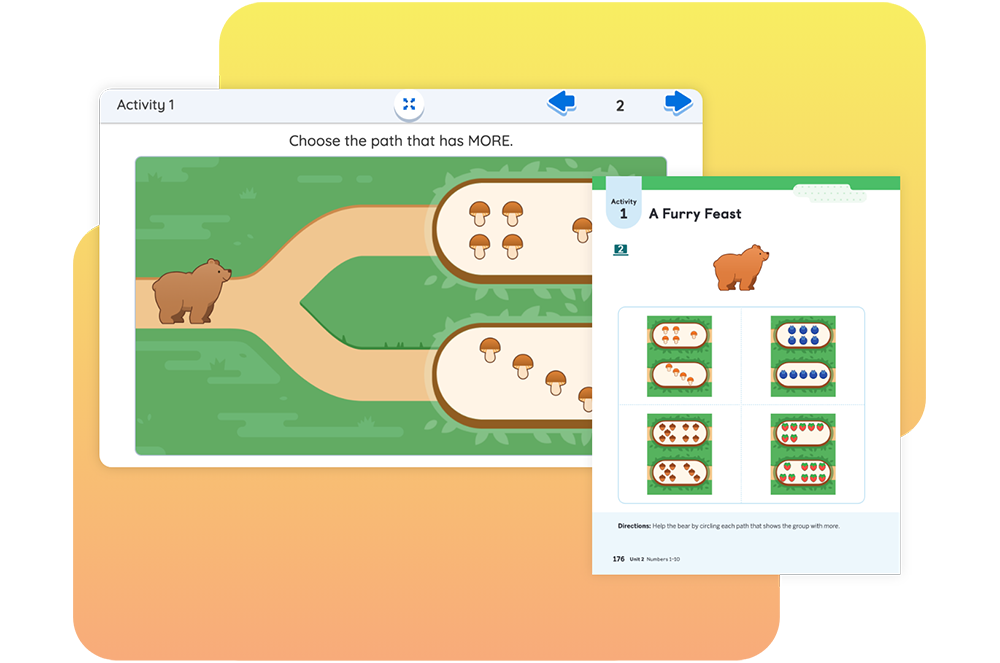
Featured digital lesson: Forest Friends
In this lesson, students apply their understanding of how to compare groups of images as they determine which group has more or fewer and then compare their strategies by guiding a bear through a path that has more mushrooms than the other.
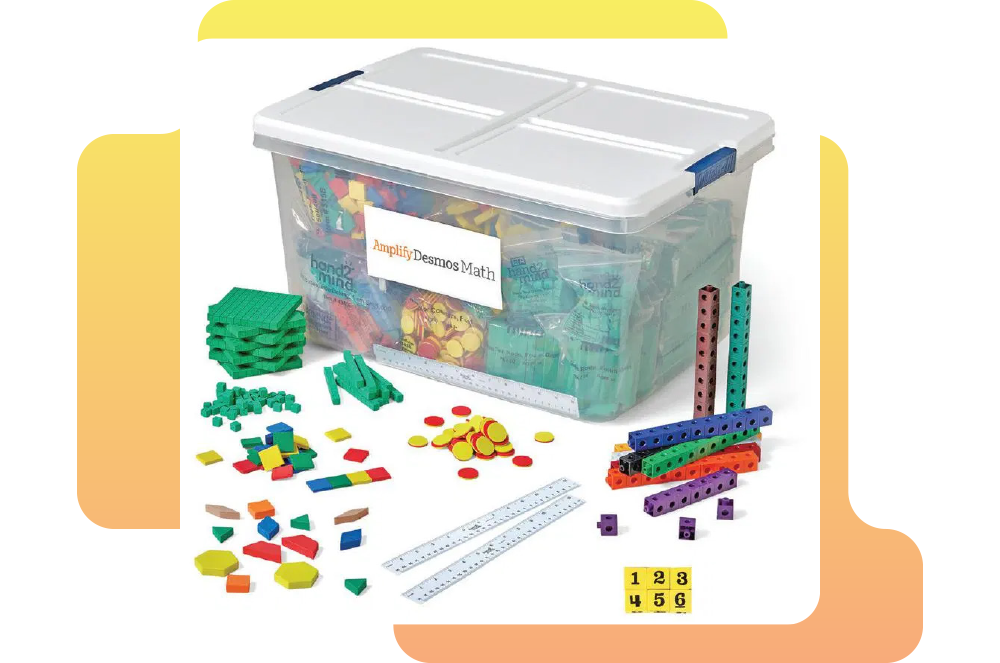
Hands-on manipulative kit
An optional add-on to your Amplify Desmos Math California program, the manipulative kit provides hands-on learning tools designed to simplify and illustrate complex mathematical concepts.
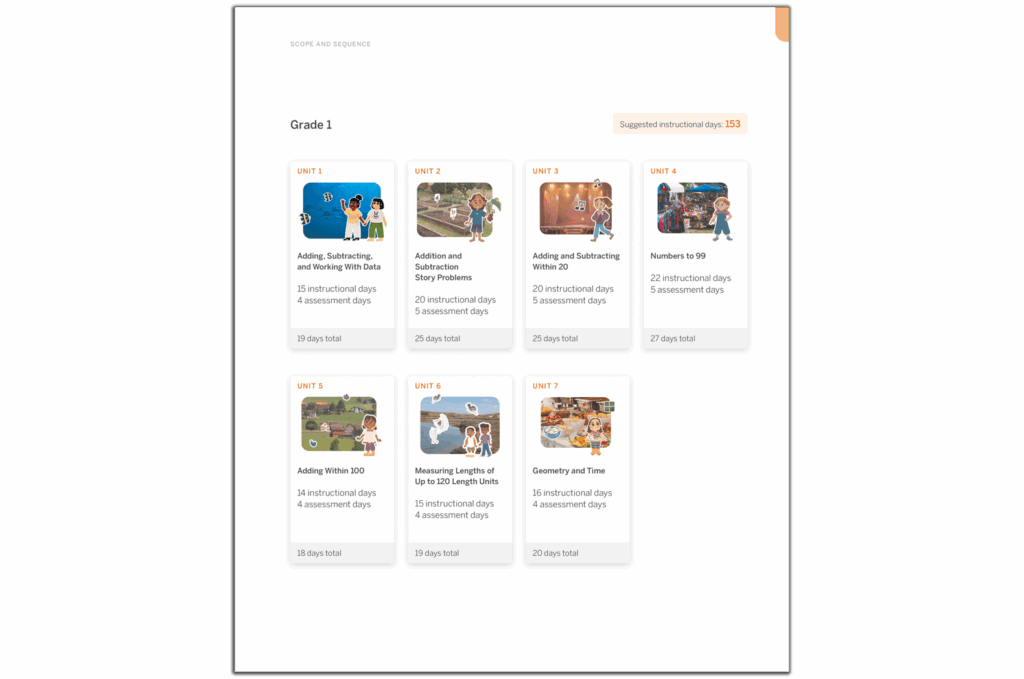
Program structure
Get to know the content and structure of Grade 1 Amplify Desmos Math California.

Teacher Edition pages
Planning and instructional guidance is visual, organized, and easy-to-follow. To help you review the program, we have included samples from a complete sub-unit on this site: Unit 2, Sub-Unit 1: Story Problems in Maui.
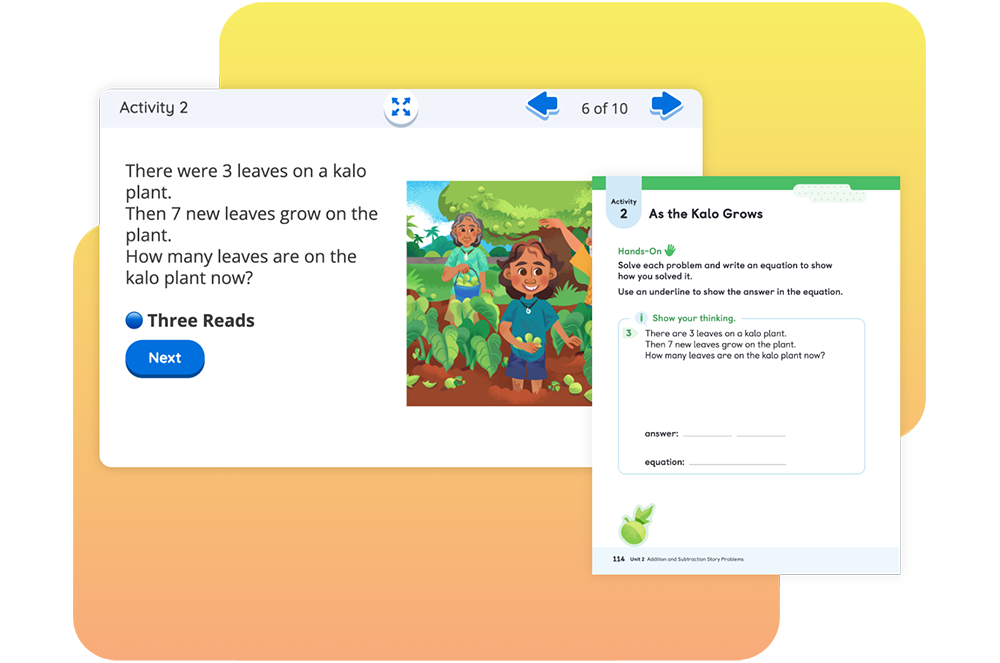
Digital experience
Explore our digital experience! Every lesson in Amplify Desmos Math California has student print materials and digital recommendations.

Student Edition pages
Motivate students with mathematics that is both rigorous and delightful.

Centers Resources
Engaging, hands-on games for students to play collaboratively to strengthen their understanding of key skills and concepts.

Intervention and Extension Resources
Additional resources to reinforce and extend key concepts, including Mini-Lessons and Extensions.
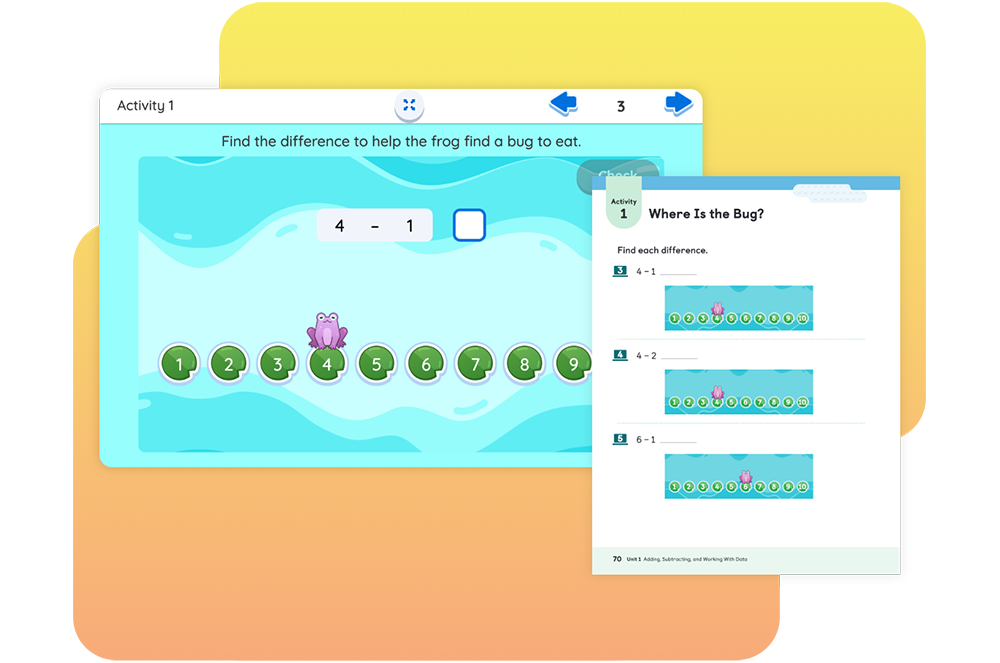
Featured digital lesson: Leaping Lily Pads!
In this lesson, students find differences when subtracting 1 and 2 from the same number by helping a frog reach a lily pad where it can eat a bug.
Hands-on manipulative kit
An optional add-on to your Amplify Desmos Math California program, the manipulative kit provides hands-on learning tools designed to simplify and illustrate complex mathematical concepts.
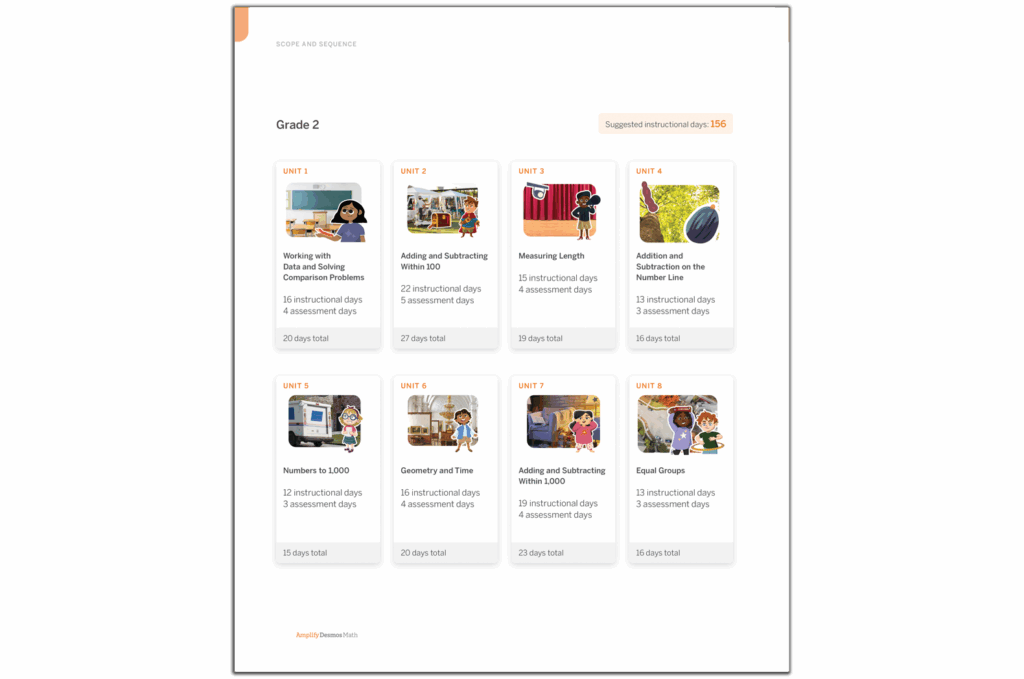
Program structure
Get to know the content and structure of Grade 2 Amplify Desmos Math California.
Teacher Edition pages
Planning and instructional guidance is visual, organized, and easy-to-follow. To help you review the program, we have included samples from a complete sub-unit on this site: Unit 2, Sub-Unit 1: Adding and Subtracting.
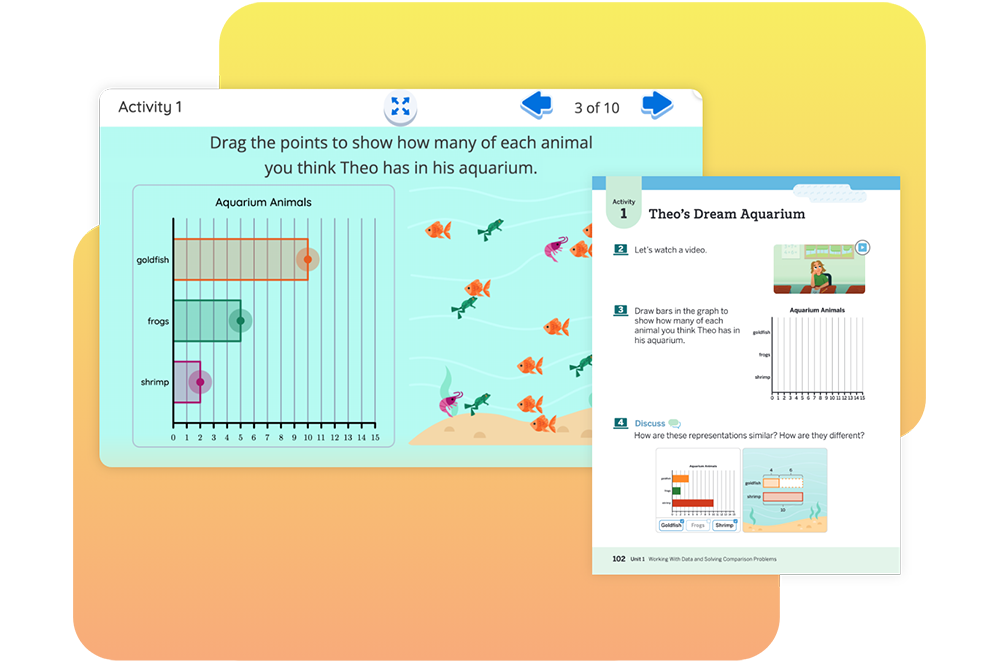
Digital experience
Explore our digital experience! Every lesson in Amplify Desmos Math California has student print materials and digital recommendations.

Student Edition pages
Motivate students with mathematics that is both rigorous and delightful.

Centers Resources
Engaging, hands-on games for students to play collaboratively to strengthen their understanding of key skills and concepts.

Intervention and Extension Resources
Additional resources to reinforce and extend key concepts, including Mini-Lessons and Extensions.

Featured digital lesson: Ways to Make 10
Students continue to develop fluency by finding the number that makes 10 by helping a millipede reach its favorite food – a clump of leaves!
Hands-on manipulative kit
An optional add-on to your Amplify Desmos Math California program, the manipulative kit provides hands-on learning tools designed to simplify and illustrate complex mathematical concepts.
Program structure
Get to know the content and structure of Grade 3 Amplify Desmos Math California.

Teacher Edition pages
Planning and instructional guidance is visual, organized, and easy-to-follow. To help you review the program, we have included samples from a complete sub-unit on this site: Unit 2, Sub-Unit 1: Concepts of Area Measurement.
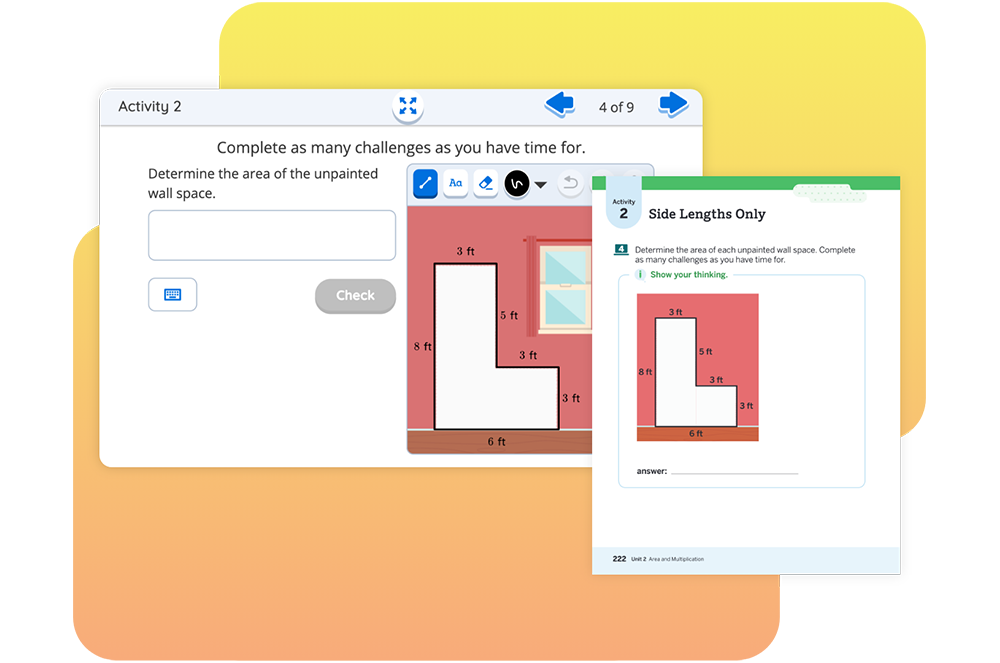
Digital experience
Explore our digital experience! Every lesson in Amplify Desmos Math California has student print materials and digital recommendations.

Student Edition pages
Motivate students with mathematics that is both rigorous and delightful.

Centers Resources
Engaging, hands-on games for students to play collaboratively to strengthen their understanding of key skills and concepts.
Intervention and Extension Resources
Additional resources to reinforce and extend key concepts, including Mini-Lessons and Extensions.
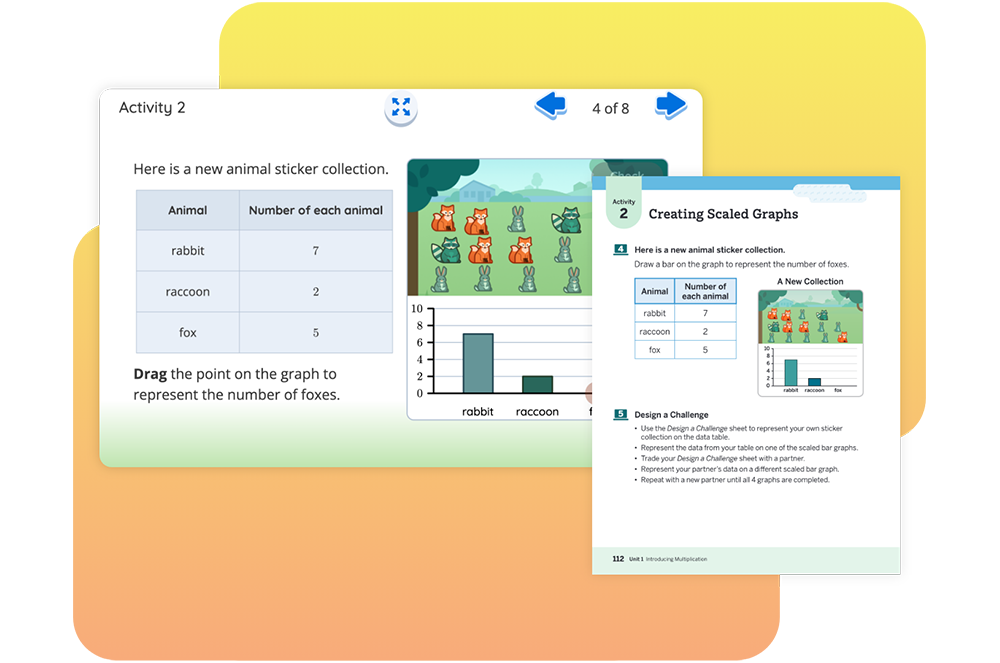
Featured digital lesson: Puppy Pile
Students compare data represented on bar graphs with different scales by using animal stickers to create scaled bar graphs.
Hands-on manipulative kit
An optional add-on to your Amplify Desmos Math California program, the manipulative kit provides hands-on learning tools designed to simplify and illustrate complex mathematical concepts.

Program structure
Get to know the content and structure of Grade 4 Amplify Desmos Math California.

Teacher Edition pages
Planning and instructional guidance is visual, organized, and easy-to-follow. To help you review the program, we have included samples from a complete sub-unit on this site: Unit 2, Sub-Unit 1: Size and Location of Fractions.

Digital experience
Explore our digital experience! Every lesson in Amplify Desmos Math California has student print materials and digital recommendations.
Student Edition pages
Motivate students with mathematics that is both rigorous and delightful.

Centers Resources
Engaging, hands-on games for students to play collaboratively to strengthen their understanding of key skills and concepts.
Intervention and Extension Resources
Additional resources to reinforce and extend key concepts, including Mini-Lessons and Extensions.

Featured digital lesson: Hamster Homes
Students choose tube lengths to connect to platform heights for hamster homes, identifying possible heights using what they know about multiples.
Hands-on manipulative kit
An optional add-on to your Amplify Desmos Math California program, the manipulative kit provides hands-on learning tools designed to simplify and illustrate complex mathematical concepts.
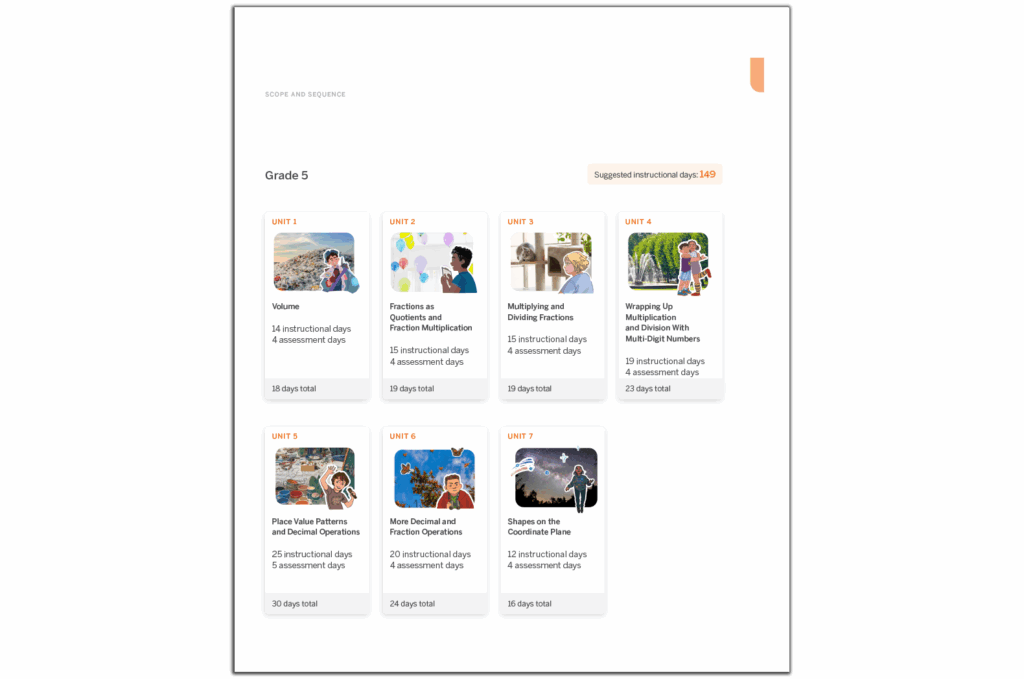
Program structure
Get to know the content and structure of Grade 5 Amplify Desmos Math California.

Teacher Edition pages
Planning and instructional guidance is visual, organized, and easy-to-follow. To help you review the program, we have included samples from a complete sub-unit on this site: Unit 2, Sub-Unit 1: Fractions as Quotients.

Digital experience
Explore our digital experience! Every lesson in Amplify Desmos Math California has student print materials and digital recommendations.
Student Edition pages
Motivate students with mathematics that is both rigorous and delightful.

Centers Resources
Engaging, hands-on games for students to play collaboratively to strengthen their understanding of key skills and concepts.

Intervention and Extension Resources
Additional resources to reinforce and extend key concepts, including Mini-Lessons and Extensions.
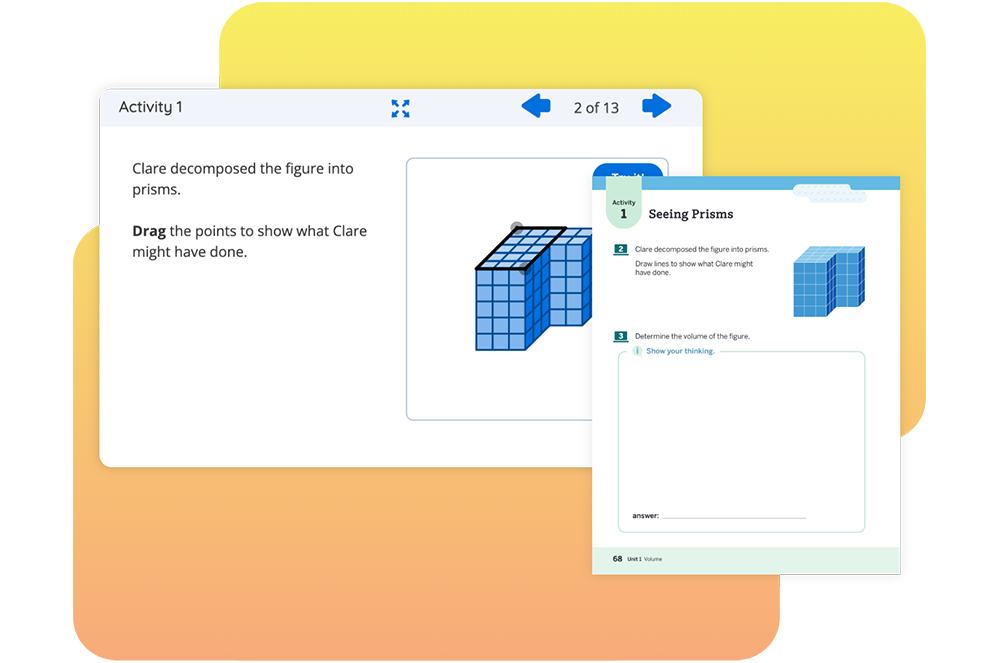
Featured digital lesson: Figures Made of Prisms
Students decompose a figure into rectangular prisms and determine the volume of the figure by adding the volumes of the individual prisms.
Hands-on manipulative kit
An optional add-on to your Amplify Desmos Math California program, the manipulative kit provides hands-on learning tools designed to simplify and illustrate complex mathematical concepts.
6–A1 sample materials
Click the links in the drop-down sections below to explore sample materials from each grade.
For helpful navigation tips and more program information, download the Amplify Desmos Math Program Guide.
You can also watch a product expert walk through a lesson and the available program components.

Program structure
Get to know the content and structure of Grade 6 Amplify Desmos Math California.

Teacher Edition pages
Planning and instructional guidance is visual, organized, and easy-to-follow. To help you review the program, we have included samples from three sub-units on this site: Unit 1, Sub-Unit 1: Area; Unit 3, Sub-Unit 1: Units and Measurement; and Unit 6, Sub-Unit 1: Solving Equations.

Digital experience
Explore our digital experience! Every lesson in Amplify Desmos Math California has student print materials and digital recommendations.

Student Edition pages
Motivate students with mathematics that is both rigorous and delightful.

Intervention and Extension Resources
Additional resources to reinforce and extend key concepts, including Mini-Lessons and Extensions.
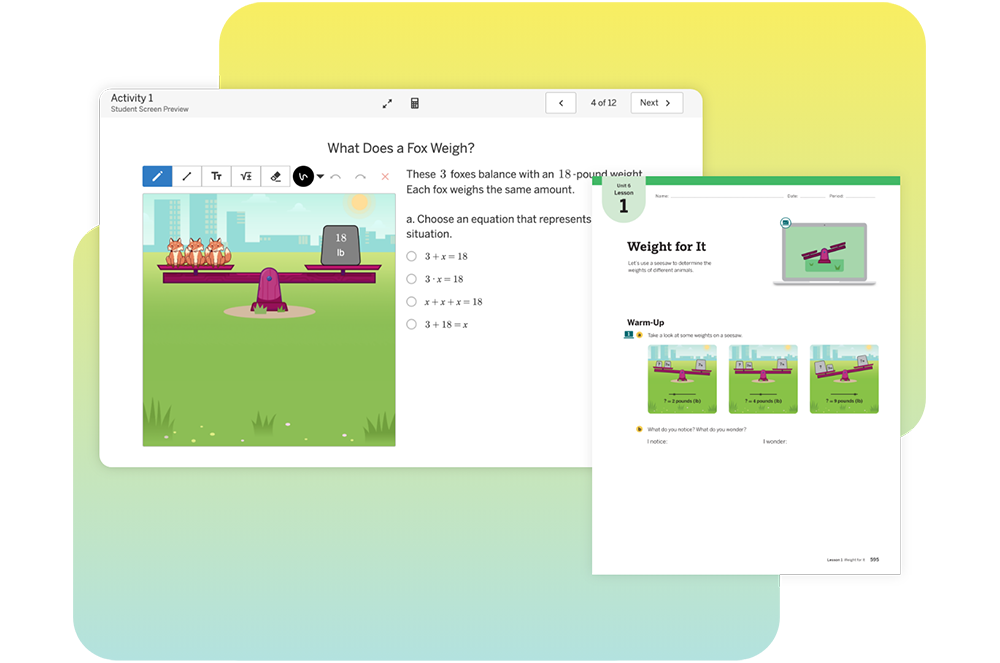
Featured digital lesson: Weight for It
Students use equations and tape diagrams to represent seesaw situations and to determine unknown animal weights, helping them make connections between diagrams that represent equations of the form `x+p=q` or `px=q`.

Hands-on manipulative kit
An optional add-on to your Amplify Desmos Math California program, the manipulative kit provides hands-on learning tools designed to simplify and illustrate complex mathematical concepts.
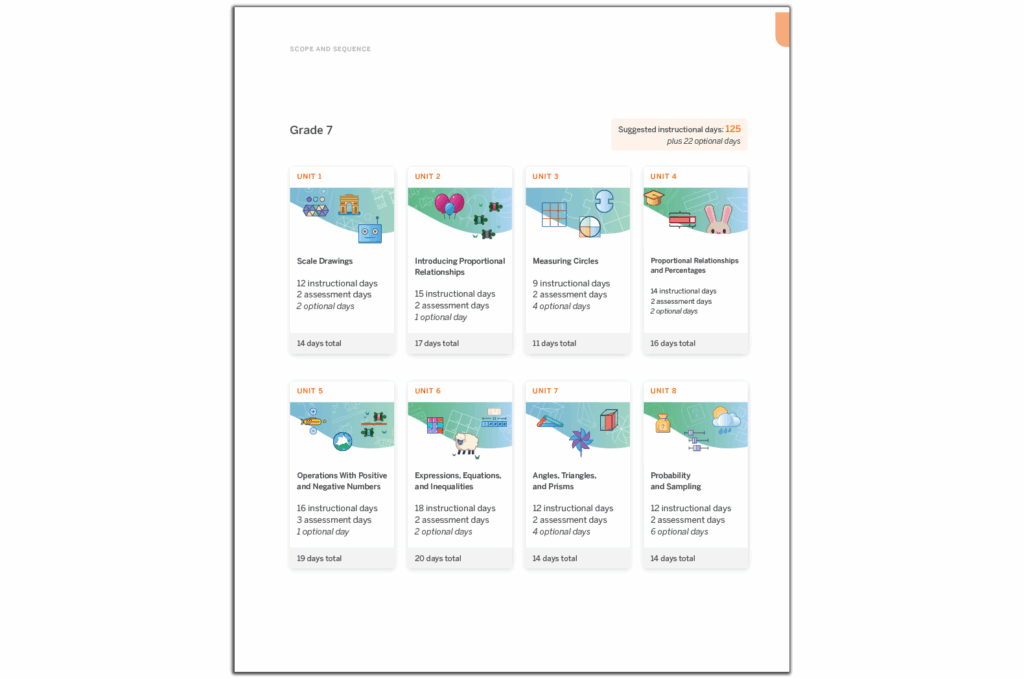
Program structure
Get to know the content and structure of Grade 7 Amplify Desmos Math California.

Teacher Edition pages
Planning and instructional guidance is visual, organized, and easy-to-follow. To help you review the program, we have included samples from three sub-units on this site: Unit 1, Sub-Unit 1: Scaled Copies; Unit 4, Sub-Unit 1: Percentages as Proportional Relationships; and Unit 6, Sub-Unit 1: Equations and Tape Diagrams.
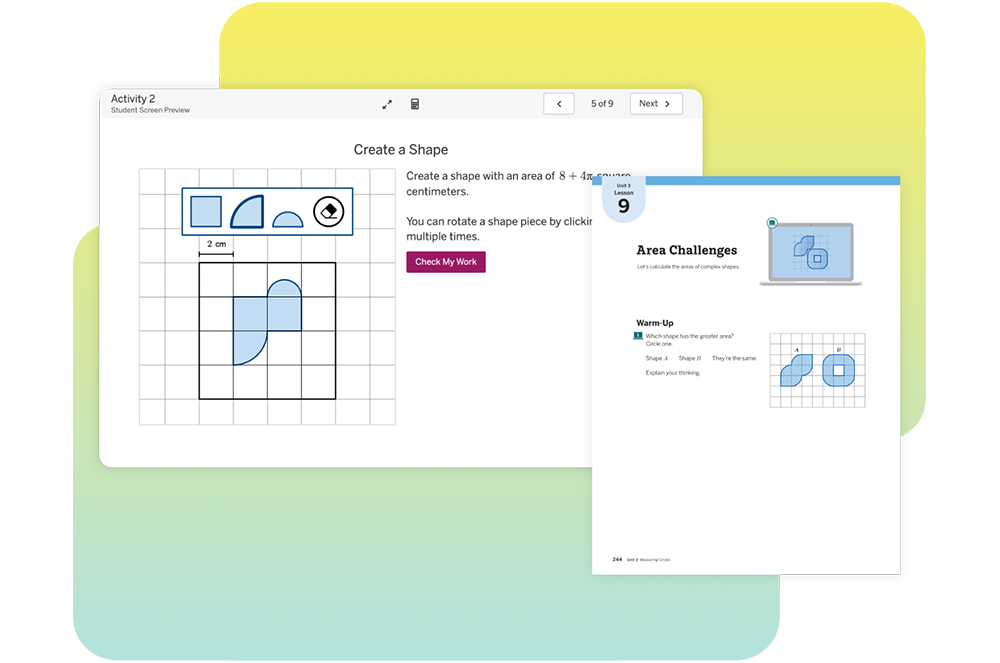
Digital experience
Explore our digital experience! Every lesson in Amplify Desmos Math California has student print materials and digital recommendations.

Student Edition pages
Motivate students with mathematics that is both rigorous and delightful.

Intervention and Extension Resources
Additional resources to reinforce and extend key concepts, including Mini-Lessons and Extensions.
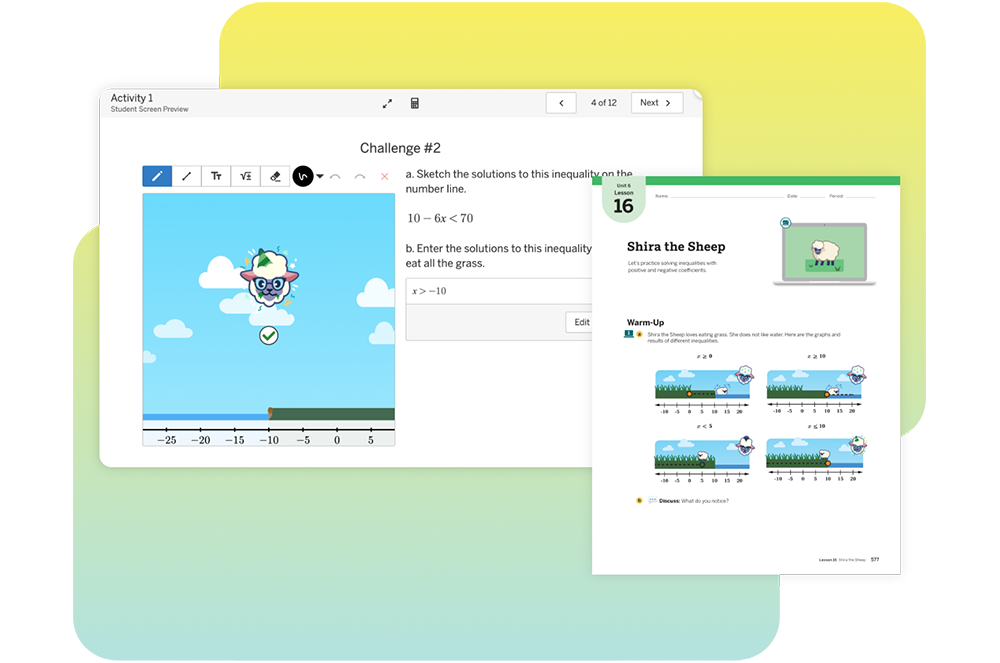
Featured digital lesson: Shira the Sheep
Students solve inequalities with positive and negative coefficients to solve a variety of challenges featuring a fictional sheep who eats grass according to an inequality.
Hands-on manipulative kit
An optional add-on to your Amplify Desmos Math California program, the manipulative kit provides hands-on learning tools designed to simplify and illustrate complex mathematical concepts.
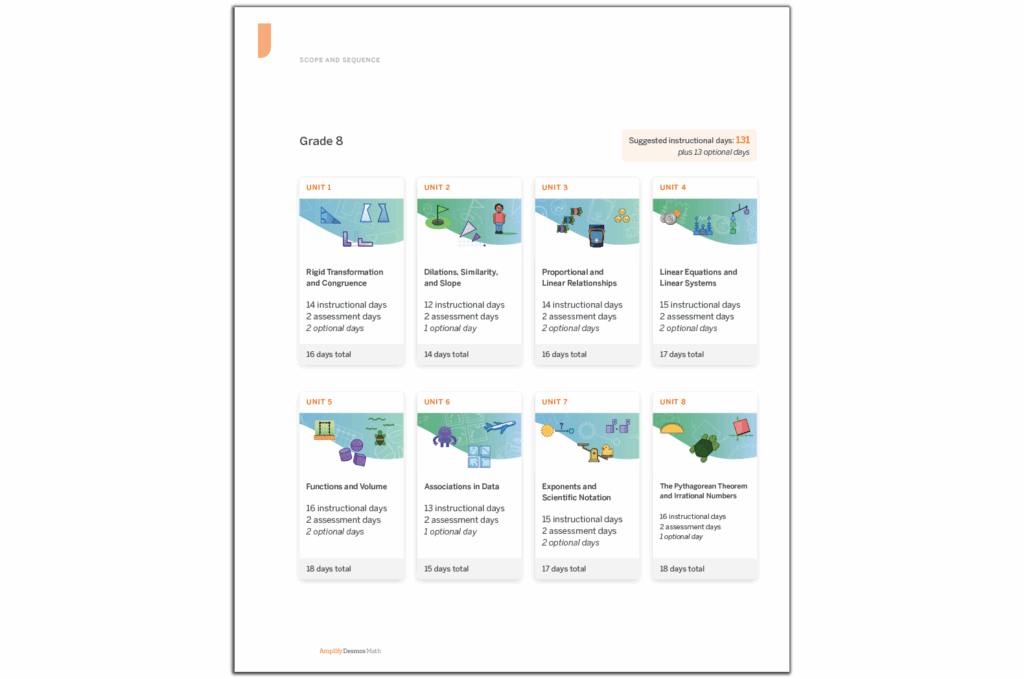
Program structure
Get to know the content and structure of Grade 7 Amplify Desmos Math California.

Teacher Edition pages
Planning and instructional guidance is visual, organized, and easy-to-follow. To help you review the program, we have included samples from three sub-units on this site: Unit 1, Sub-Unit 1: Rigid Transformations; Unit 3, Sub-Unit 2: Linear Relationships; and Unit 6, Sub-Unit 2: Analyzing Numerical Data.

Digital experience
Explore our digital experience! Every lesson in Amplify Desmos Math California has student print materials and digital recommendations.

Student Edition pages
Motivate students with mathematics that is both rigorous and delightful.
Intervention and Extension Resources
Additional resources to reinforce and extend key concepts, including Mini-Lessons and Extensions.
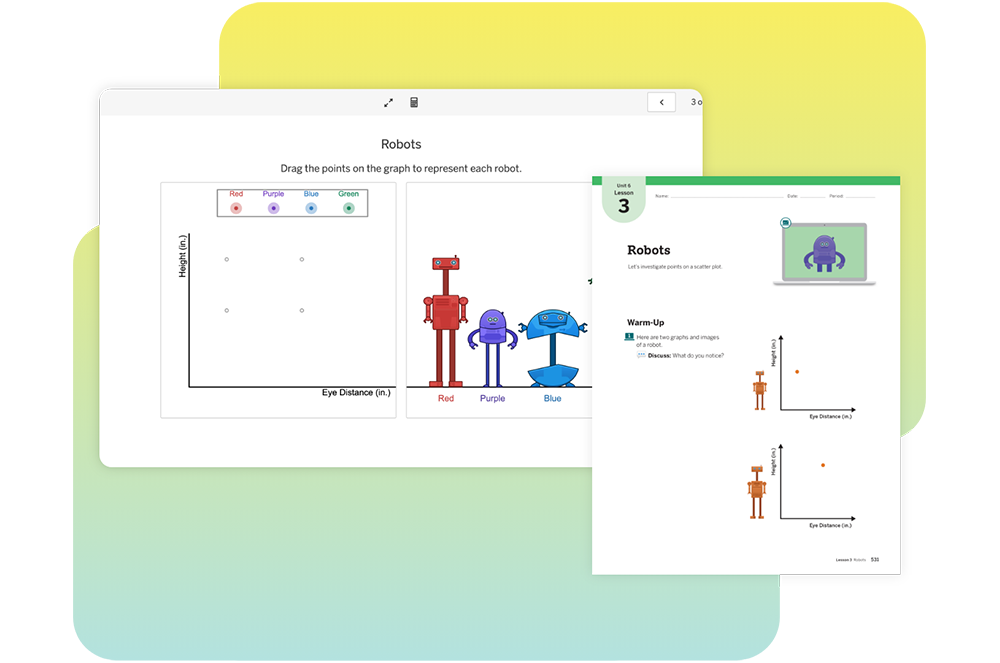
Featured digital lesson: Robots
Students connect points on a scatter plot with individuals in a population and rows of data in a table. The analysis of scatter plots continues with data about the eye distances and heights of robots.
Hands-on manipulative kit
An optional add-on to your Amplify Desmos Math California program, the manipulative kit provides hands-on learning tools designed to simplify and illustrate complex mathematical concepts.
Program structure
Get to know the content and structure of Algebra 1 Amplify Desmos Math California.

Teacher Edition pages
Planning and instructional guidance is visual, organized, and easy-to-follow. To help you review the program, we have included samples from two complete sub-units on this site: Unit 2, Sub-Units 1–2: One-Variable Equations and Multi-Variable Equations.
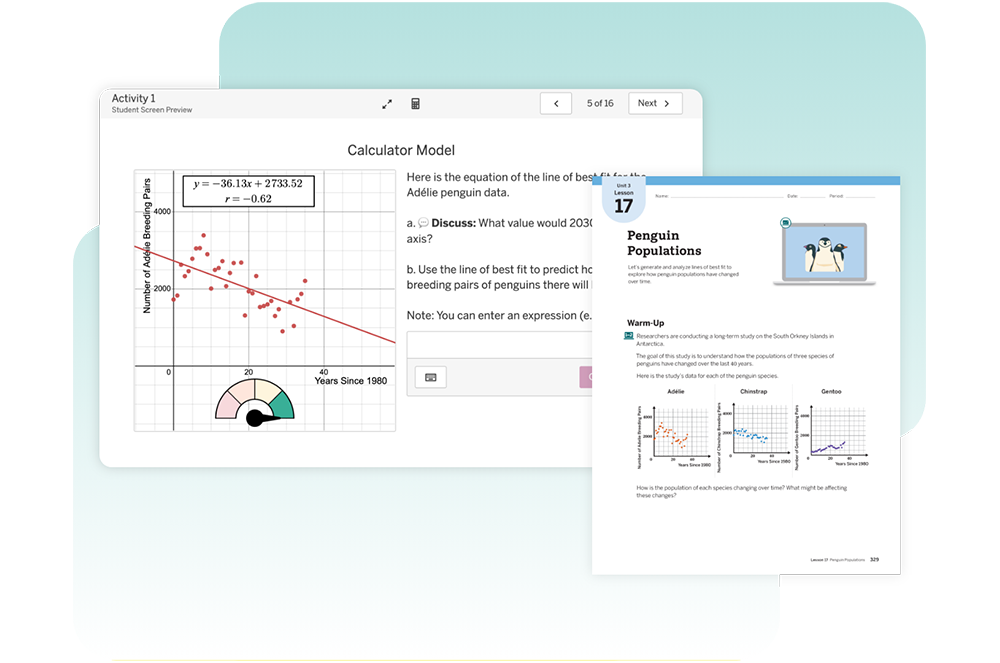
Digital experience
Explore our digital experience! Every lesson in Amplify Desmos Math California has student print materials and digital recommendations.

Student Edition pages
Motivate students with mathematics that is both rigorous and delightful.

Featured digital lesson: Shelley the Snail
Students represent the solutions of a situation using a table, a graph, and multiple forms of an equation to identify multiple combinations of blocks that can help Shelley the Snail cross a gap.
Contact us
For questions, samples, or more information, please contact your local Amplify Account Executive:
Erin King
Sales Director, CA
(512) 736-3162
eking@amplify.com
Northern CA
Wendy Garcia
Senior Account Executive
(510) 368-7666
wgarcia@amplify.com
Bay Area
Lance Burbank
Account Executive
(415) 830-5348
lburbank@amplify.com
Central Valley and Central Coast
Demitri Gonos
Senior Account Executive
(559) 355-3244
dgonos@amplify.com
Ventura and L.A. County
Jeff Sorenson
Associate Account Executive
(310) 902-1407
jsorenson@amplify.com
Orange and L.A. County
Lauren Sherman
Senior Account Executive
(949) 397-5766
lsherman@amplify.com
San Bernardino and L.A. County
Michael Gruber
Senior Account Executive
(951) 520-6542
migruber@amplify.com
Riverside and L.A. County
Brian Roy
Account Executive
(818) 967-1674
broy@amplify.com
San Diego County
Kirk Van Wagoner
Senior Account Executive
(760) 696-0709
kvanwagoner@amplify.com
Under 2300 students in Bay Area, Sacramento Valley, and Northern Counties
Kevin Mauser
Lead Account Executive
(815) 534-0148
kmauser@amplify.com
Under 2300 students in Southern CA, Central Coast, and Southern Central Valley Counties
Charissa Snyder
Account Executive
(720) 936-6802
chsnyder@amplify.com
Welcome, California educators!
Thank you for taking the time to review Amplify’s complete early literacy system for TK–8.
Our curriculum, assessment, practice, and intervention solutions work in tandem to ensure classroom teachers have what they need to provide multi-tiered literacy support to every student.
On this site, you’ll find a variety of resources designed to support your review and evaluation, including links to sample materials, demo access, and additional materials.

Complete literacy system
Strong core instruction is crucial–but in isolation, even that’s not enough. A truly effective literacy system needs to bring together assessment, core instruction, personalized practice, targeted intervention, and ongoing professional development.
Together with leading experts in reading instruction, Amplify has built a proven early literacy system grounded in the latest reading research and designed to ensure every student receives the multi-tiered support they need to grow as a reader. Our partners include:
- The University of Oregon
- Core Knowledge Foundation
- Recognized language, literacy, and biliteracy experts such as Dr. Lillian Durán, Dr. Desiree Pallais, Dr. Catherine Snow, and others.

Assessment
Not only should an assessment systems include universal screening, dyslexia screening, diagnostic assessments, and progress monitoring, it must also be easy and efficient to administer, and provide classroom teachers with actionable data that guides instruction.
The mCLASS® Assessment System delivers all that and more!
When the DIBELS® 8th Edition assessment is paired with:
- The Text Reading and Comprehension (TRC) assessment, teachers unlock the ability to record reading behaviors through running digital records.
- The Vocabulary, Encoding, and Rapid Automatized Naming (RAN) measures, teachers are empowered to screen for dyslexia risk.
- mCLASS Lectura, teachers gain a holistic view of their students with biliteracy insights that support students in both English and Spanish.
Ready to learn more? Click the buttons below to review mCLASS with DIBELS 8th Edition with TRC and mCLASS Lectura.
Core instruction
Core instruction should include explicit, systematic lessons in foundational skills and a coherent approach to building background knowledge, developing vocabulary, and reading complex text with confidence.
With Amplify Core Knowledge Language Arts® (CKLA) and Amplify Caminos, all students have the opportunity to become strong readers, writers, speakers, and thinkers. Through a powerful combination of proven, evidence-based practices and engaging, interactive content, these core curricula enable students to develop a deep mastery of foundational skills as well as a robust knowledge base–both of which are necessary for accessing and comprehending complex texts.
Ready to learn more? Click the buttons below to review Amplify CKLA and Amplify Caminos.
Personalized practice
Student needs are multidimensional, which is precisely why practice must be personalized and provide opportunities for remediation and acceleration across multiple dimensions.
Through its integration with mCLASS and Amplify CKLA, Boost Reading’s adaptive personalized pathway makes practice more purposeful and productive. mCLASS automatically places students on an adaptive path within Boost Reading, which provides them the exact practice they need. That very practice follows the same approach and scope and sequence as Amplify CKLA, which further reinforces the core instruction.
Ready to learn more? Click the button below to review Boost Reading.
Targeted intervention
Getting students caught up on reading skills requires more than just “extra help” in small groups. It requires data-informed instruction focused directly on the specific skills each group needs to learn next.
mCLASS® Intervention is a staff-led reading intervention that does the heavy lifting of data analysis and lesson sequencing, freeing up teachers to teach the reading skills each student needs. mCLASS Intervention connects directly to mCLASS data, automatically groups students with similar needs, follows a research-based skills progression, includes ready-to-teach engaging lessons, and updates skill profiles and groups every ten days.
Ready to learn more? Click the button below to review mCLASS Intervention.
Review resources
- Amplify’s Early Literacy Suite
- Science of Reading Roadmap
- Making the Shift to the Science of Reading
- Science of Reading: The Podcast
Program-specific review resources can be found within each of the review microsites referenced above.

Your California team
Looking to speak directly with your local representative? Get in touch with a California team member to learn more about our early literacy suite or request a demo account. Simply email HelloCalifornia@amplify.com or email a team member directly.

Dan Pier
Vice President, West
(415) 203-4810
dpier@amplify.com
Erin King
Sales Director
(512) 736-3162
eking@amplify.com
NORTHERN CA
Wendy Garcia
Senior Account Executive
(510) 368-7666
wgarcia@amplify.com

BAY AREA
Lance Burbank
Account Executive
(415) 830-5348
lburbank@amplify.com

CENTRAL VALLEY and CENTRAL COAST
Demitri Gonos
Senior Account Executive
(559) 355-3244
dgonos@amplify.com

VENTURA and L.A. COUNTIES
Jeff Sorenson
Associate Account Executive
(310) 902-1407
jsorenson@amplify.com

ORANGE and L.A. COUNTIES
Lauren Sherman
Senior Account Executive
(949) 397-5766
lsherman@amplify.com

SAN BERNARDINO and L.A. COUNTIES
Michael Gruber
Senior Account Executive
(951) 520-6542
migruber@amplify.com

RIVERSIDE and L.A. COUNTIES
Brian Roy
Senior Account Executive
(818) 967-1674
broy@amplify.com
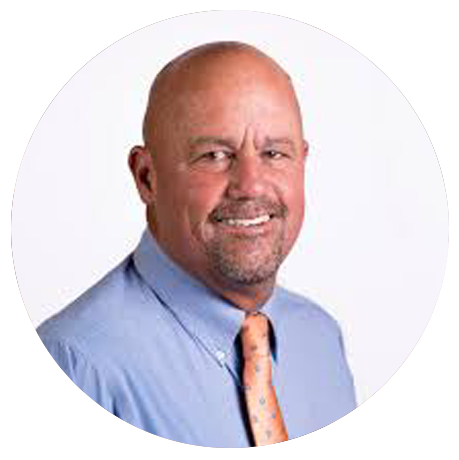
SAN DIEGO COUNTIES
Kirk Van Wagoner
Senior Account Executive
(760) 696-0709
kvanwagoner@amplify.com

BUTTE, DEL NORTE, HUMBOLDT, and SHASTA COUNTY and DISTRICTS UNDER 2250 ENROLLMENT
Kevin Mauser
Lead Account Executive
(815) 534-0148
kmauser@amplify.com
GREAT NEWS!
High-Impact Tutoring Grant for 2025–26 is released by DESE!
Built on the Science of Reading, Amplify Tutoring engages students and achieves real results. Let’s partner and support Arkansas students to become confident, proficient readers.

Arkansas Districts, Welcome to Amplify Tutoring
At Amplify Tutoring, we’re dedicated to assisting you every step of the way. From grant writing and planning to full implementation — including tutors, materials, and everything you need — we’re here to help you.
- Maximize Your Opportunity
Watch our quick 3-minute video to discover how Amplify Tutoring can help you make the most of this chance and ensure Arkansas students receive the support they deserve! - Our Impact
Interested in how we’re already making a difference? Explore our impact across Arkansas here. - Connect with Us
Schedule a 1:1 meeting with us today to learn more and get grant writing support. - Learn More About Us:
Visit amplify.com/tutoring for more information.Register for an information session:- Register for an information session:
- August 19: 10 a.m. CT or 2 p.m. CT
- August 20: 10 a.m. CT or 2 p.m. CT
- August 21: 10 a.m. CT or 2 p.m. CT
- August 25: 10 a.m. CT or 2 p.m. CT
- August 26: 10 a.m. CT or 2 p.m. CT
- August 27: 10 a.m. CT or 2 p.m. CT
- Resources to Support
See the Commissioner’s Memo here and 2025–2026 grant application here. - Questions?
Contact us at tutoring@amplify.com
Hear from leaders like you!
See what other district leaders are saying about Amplify Tutoring.
Overview

Accelerate student achievement.
Amplify Tutoring supports and accelerates student proficiency in foundational literacy skills. Results show that students in Amplify Tutoring outperformed similarly at-risk peers on a nationally normed reading assessment, and those who attended most consistently made the largest gains.

Reimagine instructional supports.
Amplify’s scaled tutoring offerings can be customized to help you meet the needs of your students. Whether you need high-quality tutoring materials, help designing your tutoring program, professional development, or tutors, Amplify can support you at every stage.

Increase insight into student learning.
Grounded in data, mCLASS® Intervention provides educators and tutors with visibility into lessons, progress monitoring, and instruction tailored to the needs of each student.
Our approach
Amplify Tutoring offers research-aligned tutoring materials, services, and training. From design consultations to full-service tutoring programs, our models reflect the principles of high-impact tutoring.


Data-driven instructional materials that are aligned with the Science of Reading and meet ESSA criteria
Amplify Tutoring features research-backed lessons aligned with the Science of Reading and grounded in mCLASS Intervention (an ESSA aligned program). This program groups students with common strengths and needs and provides progress monitoring.
Frequent and consistent sessions
Tutors engage with students in three or more 30-minute skill-building sessions per week to build confidence in students’ early literacy skills.


Positive relationship building
When students feel safe and cared for, they are motivated to achieve their goals. Our approach supports consistent, positive tutor-student relationships.
Training for district and tutoring personnel
District and tutoring personnel receive flexible, comprehensive training, enabling high-quality tutoring instruction to meet student needs.

S3-02: How science strengthens literacy and language development
In our second episode of the season, we continue finding ways that science is overlooked and how it can be better utilized in schools—and as an ally to other subjects!
We sat down with Susan Gomez Zwiep, former middle school science teacher and senior science educator and staff advocate at BSCS Science Learning. She shared past experiences and research that shows the benefits of integrating science and literacy, as well as strategies for applying these ideas in the classroom.
We hope you enjoy this episode and explore more from Science Connections by visiting our main page!
Dr. Susan Gomez Zwiep (00:00):
We started to see this trend of students communicating more in English because they were excited about the science that they had been learning.
Eric Cross (00:10):
Welcome to Science Connections. I’m your host Eric Cross. In this third season, we’re exploring the theme of science as the underdog. And last time around, we delved into the data showing that compared to other subjects, science is often put on the back burner. Now it’s time to explore why it’s so important to change that and how to do it effectively. So over the course of these coming episodes, we’re gonna make the case for science and equip you with data and strategies for advancing science in your own home, school, or community. To kick things off, we’re going to spend a few episodes going in depth on the integration of science and English instruction. We know we need to dramatically improve literacy rates in this country, and as we’ll show in the coming episodes, science can be a key ally in that goal. We’ll also show how language development and literacy instruction can support science. Yes, it can be a win-win, folks. To start out, I’m joined by someone who has been studying science and language development for more than a decade. Dr. Susan Gomez Zwiep is a senior science educator and staff advocate for BSCS Science Learning. On this episode, she talks about her own experience as a middle school science teacher and share some key insights and strategies from the research on integrating science and English language development. Please enjoy this conversation with Dr. Susan Gomez Zwiep.
Eric Cross (01:36):
Welcome to the podcast. Thank you for being here and having this really important conversation. So I’m so glad you can make it, Susan.
Dr. Susan Gomez Zwiep (01:43):
Yeah, I’m excited to be here.
Eric Cross (01:44):
We’re gonna talk all about language development and science. But first I was hoping that you can just kind of set the stage and tell the listeners about yourself and how you came about to studying this specific subject.
Dr. Susan Gomez Zwiep (01:57):
Sure. So I am a California native. I grew up in the San Gabriel Valley and that’s where I started teaching. I have an undergraduate degree in integrated biology from UC Berkeley. And I thought I was gonna go be a field scientist. And while I was waiting for grad school applications to run their course, I took a substitute job in Montebello to kind of bide my time. And because I had a science degree, they asked if I would take a permanent placement, well, a temporary permanent placement. And I said sure. And found myself teaching seventh and eighth grade general science to a population that at the time was about 68% English language learners, in a school that you would consider urban, under-resourced with a community that was large percentage immigrants from Mexico, Central and South America. And I never looked back. I kept that job.
Dr. Susan Gomez Zwiep (03:04):
I loved it. I love the middle school classroom. I love teaching science to my middle school students and truly, truly just found a really good home for my love of science, but also my love for talking about science and helping other people understand science. So at some point I was entertained with the idea of going to graduate school. So while I was still teaching, I actually did a Ph.D. At the University of Southern California in the science education field. And once there, realized that I actually had a unique experience in higher ed, that experience of teaching with populations that are learning English or have home languages other than English, was actually not common in higher ed circles. And being from that community was also not common. And so I pretty quickly leveraged that experience to combat what I think is universally agreed as an equity issue that in my school where I taught, the district had advocated for ELs to get an extra hour of language development in order to promote their English language proficiency.
Dr. Susan Gomez Zwiep (04:28):
And, our principal wisely said, there are not enough English-only students in this school to do that without losing all of our science teachers because there’s not enough kids left to actually fill a day, a teacher’s day. And she said, these kids learn more language in their science courses than they do anywhere else, so I don’t wanna remove that. But the reality is, is that at that time–this was in the late nineties, early two thousands–if you were not proficient in English, you went to more time with language development. And that makes a lot of sense in some ways. But when you look at the big picture, you realize, well, that means those kids aren’t going to science and they’re not having opportunities to have consistent quality science learning opportunities simply because they spoke a language other than English at home. And so that’s really how I fell into this work.
Eric Cross (05:28):
And that has a downstream effect. I mean, once you start pulling students from a course, that automatically sets the trajectory for later outcomes, which we ultimately see in STEM fields where we, we don’t see the population of our students represented in the STEM fields. Now, I know this goes back a few years, but you were doing research for your Ph.D. What did you start to follow?
Dr. Susan Gomez Zwiep (05:50):
Yeah, so I eventually took a position at Cal State Long Beach, which was not by chance, it’s a Hispanic-serving institution, and that’s where I wanted to do my academic work. And once I was there, sought funding with a district to support elementary science learning. So it had a teacher professional learning component that was both summer and in-class, sort of like PD in the classroom component. And the district came back and said, the only way you are gonna get time to even talk about science in elementary school is if it’s attached to language development. And so that’s what we did. It was a three-year grant, there was a sister grant that followed–so all told, it was about a five-year program where we basically said, what if instead of following the traditional ELD, English Language Development curriculum, we modified and put science as the context for language development in the K2 bands.
Dr. Susan Gomez Zwiep (07:01):
Teachers at the district traditionally had not been excited about their language development curriculum until we said, we’re gonna take that and we’re gonna do some science instead. And then they were like, no, no, no! We love our ELD curriculum. But they hung in there with us. The project was successful enough that it actually became a K4 and then a K5 project. The district ended up having to put in a ton of money into this because the grant only paid for so much. But their schools actually wanted “in” ’cause what they heard is when we put science as a context for language development, kids were talking more. Kids were speaking in English more. Kids were writing more. Kids were engaged. And the ultimate, kids were developing English quickly and in a community where you could actually operate within the community without speaking English. These are Spanish-speaking communities and the schools operated in Spanish outside the classroom. So if you walked into the school’s office, the principal secretary, the person who manned the door, spoke Spanish. The field supervisors that the lunch supervisors spoke Spanish.
Eric Cross (08:17):
The non-teaching staff that are supporting the rest of the students outside of the classroom.
Dr. Susan Gomez Zwiep (08:23):
Yeah. Everybody spoke Spanish and they spoke Spanish at school. And even the principals came back and said, from being in this project, that the kids were coming into the office and had transitioned to communicating in English, especially when they wanted to talk about science, and they really wanted to talk about science ’cause they were super excited about the stuff that they were learning. So we started to see this trend of students communicating more in English because they were excited about the science that they had been learning. And yeah, that sold itself and we had schools jumping in.
Eric Cross (09:01):
So you started off in a situation where you were told that you had to, if you wanna get science and you had to merge it into English, basically. And is it fair to say that that’s because of testing requirements that schools have on them? Like this is what gets analyzed or what was the purpose behind that?
Dr. Susan Gomez Zwiep (09:15):
It was district policy and it was site policy and those policies were put into place for very good intentions. Students don’t get reclassified into English only, and reclassification is how you traditionally got access to all this other programming, electives, AP college prep, all those other things. And the best way to get them reclassified was to learn English, and to learn it sooner rather than later. So it was in an attempt to get kids reclassified from English learner to English proficient.
Eric Cross (09:55):
And then during that process it was able to be expanded to K4. And then with these open-minded teachers, you gave them the content, they used science as the context for learning. And then your students who were mostly emerging bilinguals and multilingual students, you found that they started speaking English more frequently. What did you make of that result? Like what did you come to after seeing all that happen?
Dr. Susan Gomez Zwiep (10:20):
So I do wanna say that there’s a couple of reasons why we think this works so well. But I have to really acknowledge that there were linguistics, second language acquisition experts that were part of this team. And we wouldn’t have been able to make any of this work if it was purely science educators leading this cause. There’s a lot we didn’t understand about language development, and they really helped us. But one of the things that we think is unique about science, there’s a few really important aspects–one is that we all have experiences in the natural world, since we can process outside information, right? We all have observations, things we’ve observed with our eyes, we’ve heard, we’ve felt, and all of those experiences build some pretty good science ideas before we enter formal schooling. You know, kids already have ideas about this.
Dr. Susan Gomez Zwiep (11:20):
We don’t have to give them language for it. They already have these concepts and experiences. The other thing is that we are inherently interested in the natural world we occupy. And so we’re curious, science is often considered cool, there are science channels and science fiction movies and science fiction books and magazines–and this is just … it’s just cool. And that tended to be the trigger, you know, when we gave kids something interesting to observe. A Ziploc bag with water that we added an Alka-Seltzer to, and strange things starts happening in the baggie. That curiosity, that excitement allowed kids to leap over any concerns they had about the language they were supposed to use in the classroom. One of the most difficult things about learning a language is using a language that is imperfect. So saying things and communicating in a language that you are not a hundred percent confident about, that you’re not sure you’re using the right words or the right tenses. But when kids were excited about this thing in a Ziploc bag, they didn’t care. They communicated however they could, sometimes in their primary language or their home language, sometimes in imperfect English, but by and large they just communicated. They did it in oral language, like listening and speaking, but they also did it in writing. And that was easy. Like we didn’t have to do anything other than provide interesting science experiences. And that’s, that’s pretty common.
Eric Cross (13:06):
Yeah. I feel like, to co-sign on the science is cool, it is objectively, if a matter of fact, even just looking at the Oscars, like we have multiverse, you know, we have sci-fi you know, the costume designer of Wakanda Forever. We have all of these different movies that are all founded in some kind of these scientific principles. And so the idea that science is cool and organic, naturally engaging is something I think we, we all can connect to and it resonates with all of us. So I feel like is sort of your origin story too.
Dr. Susan Gomez Zwiep (13:33):
That’s the origin story.
Eric Cross (13:34):
That’s the origin story right there, to continue with this like movie theme. Now if we fast forward to today, based on all the research that you’ve seen since then, and your experience, why would you advocate merging English language development and science?
Dr. Susan Gomez Zwiep (13:49):
Well, for one, the research that we conducted actually provided some really nice evidence that showed, even though we had essentially stole minutes from language development time and inserted science. And on state mandated tests and on their students’ language proficiency measures, the kids in the program with the blended, did significantly better than students who were getting ELD instruction alone. Traditional ELD instruction. And that kind of blew our mind. We would’ve been happy if they had done just fine. Like we could put science into a student’s day and do no harm. They could get their language development; they could get science. But in fact, what we found was that they did better. That they actually gained English more quickly and it showed up in multiple measures, including the state English language arts assessment, which again, kind of blew our mind.
Eric Cross (14:55):
So just to be clear about the study that you did, you looked at two groups and one was the blended science and English language development, and then the other one was a control group. And the blended group ended up showing more improvement.
Dr. Susan Gomez Zwiep (15:09):
Yes. So there’s quite a bit of research now, this research was done in the early two thousands, and the research has built around it to really suggest that this does seem to be a more efficient way to promote language development while still maintaining students’ access to a core content area. But in recent years, the standards have shifted and that has been just a remarkable, wonderful change. And both standards have shifted. So when we did our research, we did it under the old California Science standards that were fairly heavy in technical terms. They were heavy in science concepts rather than kids doing things. And they were a much narrower focus.
Eric Cross (16:04):
And these are the standards that most of us grew up on, right? Those of us who are pretty much teachers in the classroom today pretty much grew up on what you’re talking about. Is that fair to say?
Dr. Susan Gomez Zwiep (16:12):
That’s fair to say, yes. So the new standards that we have now, the California NGSS Standards emphasize not just ideas, but they also emphasize students doing things in science. And we didn’t have to build-in language portions to the standards. They now exist. The NGSS is a very, very rich linguistic opportunity for students. And at the same time, the way we’ve thought about language development has also shifted. We used to talk about language and science… we used to think about science as a lot of words, and you had to know the words, you had to have this technical language. And we’ve sort of shifted that to really thinking about, language is no longer a prerequisite for science learning. Language is now developed through the science learning or the content learning experiences.
Eric Cross (17:11):
So now there’s more chances to integrate English into science. Have you seen success stories or have you seen examples of this? Maybe just anecdotes of teachers kind of doing this since you’ve been doing this research and kind of watching. If so, would you mind sharing one or two?
Dr. Susan Gomez Zwiep (17:30):
Yeah. And I will just give a nod to Dr. Dr. Okie Lee who’s now at NYU who has really led sort of this reconception of language and science. And one of the ways she talks about it is this notion that I enter this learning experience, I enter this observation of this phenomena with fairly naive, simple scientific ideas. And my language about it is equally simple. But as I develop more and more ideas, as my understanding of the phenomenon, what I figured out becomes more sophisticated, I need more sophisticated language. And so what we’re starting to see are these spaces where teachers are building science ideas and science and understanding along with the language. And in order to do that, you really need to know what’s the storyline arc of my science lesson? What do they figure out in lesson one? What do they figure out in lesson two?
Dr. Susan Gomez Zwiep (18:35):
What do they figure out in lesson three? How are the science ideas building over time? So that I can then look at the language that they’re using and what language supports do I need in order to allow students to not only engage and figure things out, but communicate their ideas about it. And so we’re seeing teachers blow up what we call language, what we call text. It’s not just words. It’s not just sentences written on a paper, but it’s models, it’s pictorial representations, it’s gestures, it’s this wide range. We pretty much said, let’s blow language up. Let’s like use all of the linguistic registers that we have in order to make meaning of what we’re seeing it in together in this classroom. So that’s one thing that we’re starting to see. The other thing is that teachers are really allowing students opportunities to use what we call social language, non-standard dialects.
Dr. Susan Gomez Zwiep (19:40):
The language I use at home and with my friends. Because earlier I had said, we have all these experiences and those experiences in the world are tied up in my social register. They’re tied up in my home language ’cause that’s where I experience them. And to let students have access to using that language in the classroom, especially initially in a unit, means we’re giving ’em access to those experiences that they have that are related to the phenomena under study. So I totally understand the benefit of promoting academic language and promoting language frames and forms that we use in more academic settings. But it’s a sticky wicket. You have to be careful how you tell students about the way you want them to communicate. Because when we tell them that language that you use at home with your friends and family is not welcome here, we can send a message that they’re not welcome here. And that those experiences that they have outside of classroom about how things fall, the way sunlight heats up different surfaces, where you’ll find plants and what plants you will find based on conditions. All of those experiences, we’re sending a message that those are not welcome in the classroom. And so this expansion of language, including non-standard dialects and even home language, is really important for letting students bring their whole selves into the classroom.
Eric Cross (21:23):
I love what you just said. It legitimizes the funds of knowledge, the language, the cultures that our students are bringing to the table. I remember when I first learned the word code-switching in college and you know, I’m biracial, I grew up in my home community and my school community were two different communities and I ethnically, culturally belonged to both. And I had to code-switch in order to kind of survive and be accepted into different communities. And not until I was in college did I actually understand what I was doing. Now there were all kinds of teasing and jokes that went on to how I would talk if I code-switched improperly. And in my classroom, I would see students who would explain concepts in a way that was maybe like a casual register. They just were explaining it the best way they could.
Eric Cross (22:10):
And the way they were speaking was kind of denigrated or it was seen as negative even though they were communicating their concept. And when I became a middle school teacher, one of my, I don’t know, it’s like sometimes when you teach, you get to, you change how you were taught or what you experience and legitimizing my students’ language, and they would tell these beautiful stories and in their most common like, casual language, but they’re explaining the concept brilliantly. And it was phenomenal to see this barrier be removed of saying, you have to talk like this in order to be a scientist or you have to say these right words. And, and that’s what I feel like I’m hearing that in how you’re describing kind of how science has been done and what language can do to certain groups of students.
Dr. Susan Gomez Zwiep (22:58):
Yeah, very much so. And you know, back to the origin story, you know, I grew up in a multi-generational household. My mom, my aunt, my grandmother, Spanish was their first language, but they lost it because my mom was raised in Riverside and she, you know, went to school in the, the fifties and sixties and back then you weren’t allowed to speak Spanish at school. And so they lost the language.
Eric Cross (23:27):
They weren’t allowed to speak it at all.
Dr. Susan Gomez Zwiep (23:29):
At all. I didn’t directly observe it, but that is the story that my family tells, that there was no English spoken anywhere on school grounds. And that was a different issue. Right? That was very much for people unfamiliar with some of the history in Southern California. Their segregated schools, severe racism, linguistic racism, racial racism against Mexicans was a real thing. But yet I grew up in this household where the sort of way of speaking, like I think many Mexican households, the context is everything. So you can’t get to the facts until you’ve told the whole context of everything happening around it. So we used to joke that we couldn’t send my grandmother to the doctor by herself ’cause he had 15 minutes, and she was gonna take 20 just to tell him how she got there before she got to why she was there. But this telling of the context, the telling of the story around the idea is part of the linguistic, this sort of linguistic way of my household. When I got to school, I had to learn to drop it because teachers found me off topic. You know, I still have to be careful how I express things and sometimes I’m not a fast storyteller <laugh>, and I monitor that for myself. So I can only imagine what it’s like to be a kid in a classroom.
Eric Cross (24:59):
Right. And there are so many constraints in the school day, you know, especially if you’re multi-subject and you’re elementary and you’re teaching multiple subjects and someone’s trying to tell a story and you’re just like, land the plane! And they’ve, you know, gotta tell ’em the story, but realizing that when you look at it through a lens of like, culturally, this is how we communicate, then it reframes what the student is trying to do. They’re communicating to you based on how they’ve learned to communicate and they’re including essential parts of the story. And so how do you both honor that while also, you know, certain things like brevity and being concise and things like that that they’ll have to learn. But also honoring that and making sure that there’s space for that in your classroom. Even me, I’m thinking about this where I had students record this video and it was one minute to two-and-a-half minutes explaining three concepts. And I had students coming up to me afterwards saying, Mr. Cross, I need to record two videos because two-and-a-half minutes is not long enough. And I was like, how? I even extended it. But I’m realizing and listening to you and going, they’re probably not just getting to the point. They’re probably including more context into this because that’s how they story tell and that was actually part of the lesson.
Eric Cross (26:12):
So now I need to go back and extend their time that I’ve given them for <laugh> that project. I wanna come back to kind of, since we’re on this topic about why this is also an equity issue. Mm-hmm. <affirmative>. So we were talking about language, you touched on this a bit, and we were talking about integrating into science, but can we go a little bit further into how this integrated approach maybe can benefit English language learners in particular? And maybe anything else that’s related to equity that comes to mind.
Dr. Susan Gomez Zwiep (26:40):
So there’s a couple of layers of the equity issue. The most tangible and clear is student access. If we wait until students develop English proficiency to allow them access to quality science learning, we lose a tremendous number of students that could not only could they benefit from science, we could benefit from their entering this science conversation. And I was at a university and I was in a college of natural sciences and we were dedicated to increasing the diversity of the faculty. And it was a struggle ’cause the number of Ph.D. science ed or biology or chemistry academics that come from marginalized populations is very, very small. And it’s not by accident. You know, the number of students that make it into the next level, that make it into college prep courses, that make it into STEM majors, that complete STEM majors and go on to either careers or advanced degrees narrows at every possible step.
Dr. Susan Gomez Zwiep (28:01):
And so the equity issue is really one of access. And as basic as that is, it’s the easiest to solve. So that’s the first layer of equity. But the second issue around equity is how we engage these students once they’re in this space. Do we make it possible for them to see themselves as a scientist or an engineer? Are we creating learning experiences that not only allow them to use all the sense-making resources that they have, but do we make them feel like they’re valuable and useful in that space? Because there’s a lot of people that will say, I could be successful as a scientist, but I’m not willing to give up who I am in order to do that. And that’s a real thing. There’s a lot of research about like, why are they leaving? Like why, you know, is it because they’re not able?
Dr. Susan Gomez Zwiep (29:05):
Is it because they don’t see themselves as being capable? And now I think we’re looking at this as a different issue. It’s not that students don’t see themselves as capable and not that they’re not achieving. They see the cost that it will take to enter these fields and essentially not be able to be their full selves. So that’s the second equity issue. And in both cases we lose. As a society, we lose. We lose access to the full range of human resources that we have, and we lose access to their unique perspectives that they would bring to real problems facing us. It’s like all hands-on deck. We need to stop making it too difficult to participate in the conversation and we need to be more inclusive about how we invite these other perspectives and how we respect and utilize their ways of sense-making. That may not be Western science ways that we have in our books now, but hopefully those science materials are gonna change and we’re gonna start to see other ways of sense-making and other people involved in the stories that we tell around science concepts.
Eric Cross (30:29):
And just to be clear, this practice in integration, while it lifts up equity for marginalized or underrepresented groups or students who are emerging bilinguals or students who typically we don’t see representation of, this approach also benefits native speakers as well. Correct?
Dr. Susan Gomez Zwiep (30:47):
Yeah. And there’s actually a group of native speakers that come from text poor homes. It’s typical in underserved communities. Poor people living in poverty that may be native English speakers. They may not be marginalized populations. But they don’t have access to like text. And so that’s another group altogether that needs linguistic support. And then once you have all voices in the room contributing, everybody benefits because now the conversation, the building understanding conversation we’re having or the sense-making conversation that we’re having has everybody involved. And we all benefit from that.
Eric Cross (31:33):
And we see, I think one of the benefits about a country like the U.S., is we have such a heterogeneous group of people. And when we’re moving in the same direction, we’re all coming to the same problem, but from different perspectives and we’re able to come up with more innovative and novel solutions to them. And that’s kind of what I’m hearing is like as we generate scientists that are all coming from different backgrounds, we’re gonna be able to solve future problems, current problems a lot more effectively because nobody has a monopoly on perspective. Nobody has a monopoly on knowledge or the fastest way to do something or the best way to do something.
Dr. Susan Gomez Zwiep (32:11):
Right. Right. And traditionally we really have privileged particular experiences, particular ways of sense-making particular linguistic registers. And if we could just kind of put that privileged ways aside and open up space for everybody to feel like they have a voice, I think the next generation could change the world. I think they could solve some real problems. I’m truly hopeful that they would see themselves not just as capable, but as necessary in these pursuits.
Eric Cross (32:50):
So what does it actually look like today to do this work in instruction well? So to integrate the science, to integrate literacy, to take the benefits of the things that we’ve been talking about. What are some practical things that educators could do to get started, whether it’s in early, you know, K5 or middle school or even high school.
Dr. Susan Gomez Zwiep (33:13):
So I will say, I’m gonna kind of separate ’cause in the elementary space, students are primarily developing literacy in multiple languages. The language of the classroom, typically English, home language, languages, they may be multilingual. In the secondary setting where students tend to have developed social language in some language, it’s a little different. So I’m gonna kind of separate those two. So for elementary spaces where teachers tend to teach multiple things, I recommend that you get a partner. Don’t do this work alone. You cannot do this work alone. I mean you can, but it’s very frustrating and not nearly as much fun. So you really wanna take a look at what is the science that kids are going to be engaged in. Because when we look at science first and build language development around it, the experience tends to be more authentic and organic.
Dr. Susan Gomez Zwiep (34:18):
And what we used to do is we used to, like when we were talking about the science, we’d monitor the language we were using and then use that to say these are the registers. This is the language that we use when we were thinking about this. So if students are gonna use this, these are the scaffolds they’re gonna need. ‘Cause to do it, well, to do it efficiently, the scaffolds need to be specific to the science learning. So if we’re doing cause and effect, those are specific linguistic scaffolds that are different than if, say we’re doing model and systems and systems models, those are a whole other slew of scaffolds. And so you wanna be really tending to, what is the science being discussed and what is the language that kids are going to use and build scaffolds around it.
Dr. Susan Gomez Zwiep (35:10):
And then you also wanna think about what is the social language? What are the experience that kids will have either in words or pictures that I can leverage in this space. And then you wanna do that for the arc of the unit and slowly increase sophistication around those linguistic supports, as well as the science learning. But if kids have social language and they’re now in, there’s a group we call long-term English learners who have not been reclassified way beyond what the typical reclassification is. And that actually is important to think about because if you think about the kinder group, the group of kindergartners that enter a school when they’re five or six, those kids are going to go from grade to grade to grade. And as students develop proficiency, will get reclassified and they move out of this group that we’re still calling English learners.
Dr. Susan Gomez Zwiep (36:10):
So by the time you get to like seventh, eighth, ninth grade, if they’re still students in that category, they have very different needs on average than the group we started with. Often when we talk about secondary or these long-term English learners, we can leverage social language a lot more, but have to build the scaffolds more carefully around, for lack of a better word, the more academic content transferring that those social nonverbal language into more sophisticated forms. I think in any setting, you wanna utilize your resources. If I’m in a secondary space and I have a language development teacher and I’m not talking to her or him or they, that’s a problem. You need to go talk to the other people that have these same kids and talk to them about, how are you engaging in language, what are you doing?
Dr. Susan Gomez Zwiep (37:07):
Because you know, you could actually have a lesson, maybe this is a lesson about energy and you’re using a model and the kids are creating an initial model. And over in ELD land, they’re doing some linguistic supports. They’re working on some forms and functions of language. You could talk about the catapult, you could talk about the solar heater. You could use the context of the science conversation, which has a whole bunch of tangible experiences. You know, there’s the solar heater in front of you. I don’t need to keep it all in my head ’cause it’s in front of me and we can point to things and talk about things by manipulating the materials. And then I can take all of that and my ELD partner can use that as context when available. But it takes collaboration, but it’s collaboration well spent. And it’s more challenging in the initial phases of the collaboration. Once you kind of the get into the groove, it becomes a lot easier.
Eric Cross (38:16):
The meta of this, as we talk about integrating science and literacy is, and this is great advice, but it’s basically integrate your science teachers with your English teachers and co-plan and do this work together. It’s a force multiplier. One, you’re both, you’re getting two specialists together. It also, I’m just listening to just the parallels. It also resembles what you actually do in the STEM fields of collaboration working together to problem-solve, and you’re modeling for your students what you want to happen. And if I was an administrator listening to this, someone who had control, like master schedules and things like that, there also needs to be space created for these teachers to talk to each other and plan and do all these other things to kind of maybe come up with like interdisciplinary units or even just meet and begin the conversation. It just seems like such great advice.
Dr. Susan Gomez Zwiep (39:07):
Yeah. We’re professionals. We have academic degrees and credentials and experience in the classroom and yet more often than not, we leave it to the students in the seats to make the connections between my class and the class they go to next. And that’s not fair. We need to be talking to each other. So if we’re talking about argumentation, argumentation in science and argumentation in ELA and argumentation in math–we’re not even talking about the same thing. I mean, cognitively we’re talking about taking some evidence and creating a claim and supporting it, but what we mean by evidence is very different in the different disciplines. What counts as more convincing evidence changes. And yet we assume that because we say evidence in one class, the kids know what we’re talking about. And the kids are sitting there going, which one is this? Which evidence are you talking about? Because last period it was something else. And so I think we also need to really consider who’s in the best position to clarify the connections and the integration because we leave it to kids more often than not right now.
Eric Cross (40:19):
I agree. Just having those conversations and defining your terms and agreeing on them just to make it easier for students. ‘Cause you’re right, they are left to make those connections or bridge the gaps. And when you have an education system for many schools, I think most of us, it’s still pretty siloed. You’re still kind of like, especially when you’re in secondary, it’s we’re doing this or even elementary, different times of the day you do different subjects, versus the way that we experience life itself or even our professions. We’re actually integrating science and math and reading and writing throughout the day, and ebbs and flows going back and forth. And without making those explicit connections, we’re leaving a lot of things to chance, hoping that the learning’s there in such a valuable moment. Before we go, I’m wondering if you have a parting message for listeners about the topic of integrating science and literacy. You’ve already said so many amazing things, but you have the platform speaking to educators and folks out there. What would you wanna say to them?
Dr. Susan Gomez Zwiep (41:18):
This is not an easy endeavor. The system that we operate in does not make this effort easy, but it is worth it. It is worth it to the kids in our classrooms. It is worth it to the building of a scientific community and a scientifically literate populace. It’s important to solving problems in the future. It’s important to have kids feel like regardless of how they say things, that they belong in a classroom. If we can relax the sort of linguistic demands on kids and let them enter science learning in a way that allows them to use all their resources and they’re curious, they can really leverage both areas in a way that they don’t do individually. It’s really hard to think about what it is I’m trying to say if I’m worried about how I have to say it. And so we really need to think about, when are those times that we’re gonna let kids just tell us what it is that they’re excited about and when is it that we’re going to help them craft a more formalized language around those ideas. Right now we do a really good job at that second half. We need to do better at the first.
Eric Cross (42:46):
Susan, thank you so much for joining us today and for sharing your expertise and your wisdom and your passion for serving the students and for bringing everybody to the table through language and through science. We really appreciate it and the listeners will too.
Dr. Susan Gomez Zwiep (43:03):
Thank you so much. This is my favorite topic.
Eric Cross (43:06):
Thanks so much for listening to my conversation with Dr. Susan Gomez Zwiep, senior science educator and staff advocate at BSCS Science Learning. And please remember to subscribe to Science Connections so that you don’t miss any of the episodes in this exciting third season. And while you’re there, we’d really appreciate it if you can leave us a review. It’ll help more listeners find the show. Next time on the show, we’re going to continue exploring the how and why of integrating science and literacy instruction.
Speaker 3 (43:35):
When we interview scientists, they spend a lot of their time reading the work of other scientists and writing their findings, writing grant proposals, presenting at conferences. A huge part of the work of a scientist is not just at a bench conducting experiments, but even if you’re conducting experiments, you’re using your literacy processes to think about what you’re seeing in your experiment.
Eric Cross (43:57):
That’s next time on Science Connections. Thanks so much for listening.
Stay connected!
Join our community and get new episodes every other Wednesday!
We’ll also share new and exciting free resources for your classroom every month!
Meet the guests
Susan Gomez Zwiep began her career in science education as a middle school science teacher in Los Angeles where she spent over 12 years working in urban schools. Prior to joining BSCS, Susan worked at California State University, Long Beach as a Professor of Science Education.
Susan has also worked as a Regional Director for the K-12 Alliance, providing high-quality professional development in science and mathematics for K12 educators, including the CA NGSS Early Implementer Initiative. Susan consistently works toward establishing equitable access for all students to rigorous, inquiry-based science instruction and supporting teachers in their journey to become advocates for students, science education, and their own professional development.

About Science Connections
Welcome to Science Connections! Science is changing before our eyes, now more than ever. So…how do we help kids figure that out? We will bring on educators, scientists, and more to discuss the importance of high-quality science instruction. In this episode, hear from our host Eric Cross about his work engaging students as a K-8 science teacher.
You might also like:

S2-04: Gamification in the K–8 classroom

In this episode, Eric Cross sits down with his colleague and friend Fabian Hofmann to talk through gamification in the K–8 classroom. They discuss Fabian’s experience teaching outside of the United States, and the differences in classrooms outside of the country. Fabian explains the integration of game mechanisms in the classroom, standard-based grading, and shifting student thinking about learning by forming strong relationships. Fabian also shares how he created a new STEM course at his school revolving around his own passion for Star Wars. Explore more from Science Connections by visiting our main page.
Fabian Hofmann (00:00):
In Mr. Hofmann’s class, I get to earn points and I get to be a Jedi. I can suspend my disbelief and I’m learning history, but at the same time, I’m traveling through the galaxy.
Eric Cross (00:13):
Welcome to Science Connections. I’m your host, Eric Cross. My guest today is Fabian Hofmann. Fabian is a middle school IB educator, currently teaching seventh grade multimedia design and history at Albert Einstein Academy’s middle school here in San Diego, California. He also hosts the podcast Rebel Teacher Alliance, a podcast dedicated to encouraging and supporting teachers to rethink student engagement. Fabian’s one of the most innovative teachers that I’ve ever met. His use of technology and gamification makes learning fun and accessible for our students. And I have firsthand experience with these students because we teach on the same team and have worked alongside each other during my entire career as a teacher. In this episode, we discuss gamification of the classroom, how he approaches grading from an innovator’s mindset, and his newest STEM class, Immersive Design, where his students are working with former Disney Imagineers to completely renovate their classroom into an interactive Star Wars-themed learning environment. And now, please enjoy my conversation with my good friend and colleague, Fabian Hofmann. We’ve worked together for how many years now? How many years have you been at Einstein?
Fabian Hofmann (01:23):
Well, I started when you started, like after you were student teaching, so 2014.
Eric Cross (01:28):
OK, so it’s been a while.
Fabian Hofmann (01:30):
Yeah. And then I took two years off and I went to Hawaii. I couldn’t handle the pressure. And then I came back. So we’ve worked together for six years but known each other for eight.
Eric Cross (01:39):
What’s your origin story? We’re gonna talk about your origin story. I told you.
Fabian Hofmann (01:42):
All right, cool. Right. So when I was a little boy…no. <Laugh>
Eric Cross (01:46):
This podcast is not that long!
Fabian Hofmann (01:49):
So no, I started out, teaching in 2009. I started student teaching in Germany and was teaching history and English. Did this two-year student-teaching program there. And then, when I was done, my wife and I, she’s American, we got married and we decided to move to the States. And then I started teaching at a German cultural center called the Goethe-Institut in San Francisco. We lived in the Bay Area. And from there, after a year we moved down to San Diego; I started subbing; I worked for a year at High Tech High. I taught humanities there. And then, after that year, I ended up at Einstein teaching German because that was what was available. I didn’t want to teach German. That wasn’t like, on the top of my list. But it made sense because I had taught German in San Francisco and it kind of was like, “Well, I can do that, I guess.” And then, yeah, and then I went back to—we went to Hawaii for a couple of years and then I came back here to start teaching history. So I’ve taught like a million things essentially.
Eric Cross (02:52):
And then during that time, what’s your evolution been like in the classroom? Kind of like your view of education? And how does that play out in your day-to-day with kids?
Fabian Hofmann (02:59):
So when I started teaching here in the States, I noticed that it’s very different. Technology was much further along here than it was in Germany. So when I got here and we had like an iPad cart; I helped setting up the iPad carts. And I worked with the Chromebooks and I was like, holy, holy crap, this is so cool. Like, kids can like actually do things with this technology. And then, I mean, I love technology. I’ve had an iPad when it came out and stuff like that. And so I was like, “Oh, so how about we use this in our classroom?” And so I always moved—I moved very quickly to having students create on the iPad. And at first it was like, “Oh, we use the Apple apps and stuff.” And then I went to an ed-tech teacher summit here in San Diego and my eyes were like opened to, “Oh my God, there’s so much more than just the Apple apps.” And ever since then I was like, “OK, we’re gonna use this; we’re gonna do that.” It’s just crazy stuff that I thought was cool and that students really seemed to enjoy, because it wasn’t like a typical language class; it was more like, “Well, what can we do to create, and how can we somehow still use the language but we are learning coding at the same time, or we are creating something in 3D at the same time?” Like, I was always trying to make it have two angles: the language angle, obviously, and then also the technology angle.
Eric Cross (04:25):
What was it that kept you kind of pushing? ‘Cause I remember the beginning in the Classcraft days to where you are now, I feel like you’re like light-years ahead of where you started.
Fabian Hofmann (04:37):
So you were actually the one who showed me Classcraft, which is like a gamification portal, kind of off-the-shelf thing that you can subscribe to. It has some free features and it’s like a gamification platform where students can create characters. And then these characters go on adventures. That’s like their avatar, and they get experience points in the classroom game and stuff happens. You can create, like, adventure paths for them. So if you have an assignment that you want students to do that has different steps, so, that could be an adventure path. That’s what I liked about Classcraft, is like this idea of like, “OK, we’re taking a game and applying it.” But it wasn’t enough for me. And so I started developing my own classroom game. I did some reading. I met online with John Meehan, worked with him. I read the book by Michael Matera, Explore Like a Pirate. And so it just broadened my whole world to, or just opened the world of gamification to me.
Eric Cross (05:38):
You present on gamification; you mentor other teachers on gamification. You host a podcast where you talk about it. But for those people who haven’t done it or gotten into it or maybe have a perception of it maybe that’s not quite accurate, can you talk a little bit about like what gamification is and what it’s not?
Fabian Hofmann (05:54):
- So the biggest difference…we all know game-based learning, because we all do it. We use Quizlet; we use quizzes; we use Gimkit, Blookit, Jeopardy, anything like that. Those are game based. That’s game-based learning. So using a game to facilitate learning. Which is great. I love game-based learning too. But the difference is with gamification, in the pure definition of gamification, is that you’re using game mechanics and elements and apply them to a non-game setting. A couple of smart educators were like, “Why don’t we just do that in our classroom?” And so we borrow these elements, these mechanics, these game mechanics, like getting experience points, and applying them to the classroom. So anything that students do, they earn points. So they turn in an assignment, that gets you a hundred points. They go and do something extra for the class, they get 50 points. Whatever it is, whatever your value is. That’s one aspect, like a leaderboard, virtual money, stuff like that that just in reality is not necessary, but you’re putting it somewhere where it doesn’t exist. And all of a sudden students have this weird shift in their view where it’s like, “Well, school is school, but in Mr. Hofmann’s class, I get to earn points and I get to be a Jedi and I can suspend my disbelief and I’m learning history, but at the same time I’m like traveling through the galaxy.” And it’s just amazing how that shift happens just because we’re changing the language a little bit.
Eric Cross (07:29):
Yeah. You seem to have like tapped into something that is already kind of in that zeitgeist culture thing. We’re gaming and it appeals to—I know it appeals to our students regardless of how they feel about even the subject that’s being taught, the fact that they’re immersed into this environment where they’re taking on this character role and they’re part of this bigger narrative. And you’ve so dynamically constructed this whole storyline and these experiences, and they’re learning experiences, like, they’re learning, but they’re enjoying it in a different way. But I wanted to ask you about something that I really admire that you do, and it’s how you grade. And I remember the first time you said this, we were in a parent-teacher conference and we’re all talking on Zoom with these parents and we’re all sharing our spiel. And you go, I don’t grade kids. They grade themselves. Can you talk a little bit about your conferencing with students? The rubric you use like that that, I’ve really been paying close attention to lately.
Fabian Hofmann (08:24):
Yeah. So, when I was working in Hawaii, I noticed I was teaching English, and grading papers in English is really not fun. Like, that is like my least favorite thing. Some teachers are like, “Yeah, it’s grading! Awesome! I can read stuff!” For me, it’s like, yes, I like to read stuff, but I—and it was the same in German class. I gave them feedback. Sometimes I would use oral feedback, I would, like, record stuff for them, and they would listen to it, and then they would work on it. And so I noticed when I’m giving them feedback and its oral feedback, they’re more inclined to actually work on the stuff that I was critiquing, versus when I sat down and I wrote something. They would never read it. Or some would, and most of them would not. And so I was like, this sucks. <Laughs> And I encountered this book called Hacking Assessment, because it’s such a waste of time, right? You spend so much time, because you wanna do the due diligence. And for those few kids who actually do care, that benefits them. But I want this to benefit everybody. And so I read this book called Hacking Assessment, by Starr Sackstein. And she talks about how she put the onus of grading into the student hands, essentially. And so she did standard-based grading and essentially said, “You know what? Here’s the thing. I am not going to grade you anymore. You are going to get a rubric that we are going to dissect and explain and make sure that you understand. And then you sit down and you give yourself a grade based on this rubric.” And I was like, “Wow, what? That is….I can do that? And the cool thing about this book is that she covers all the roadblocks that we as teachers have. And she explains, like, she gives examples on what we can do to convince parents, to convince admin, to convince the community, convince other teachers why what we’re doing is much, much better for a student than the previous system is. If you think about it, when a student comes into school, they start at a hundred, they start the year at a hundred, and all they’re doing is just lose points. And they’re just trying to keep up. Right? And it kind of flips this on its head, because not only with the gamification, I’m changing the name of the game, literally, but I’m also now with ungrading, I’m giving them the responsibility and the accountability to really look at their stuff and really be critical about how they’re doing. And I taught like normal in my first year in Hawaii when I was teaching English, by me grading everything and turning it and giving it to them. And I used peer grade and I did all that kind of stuff. But in the end, I was always the one responsible for the grade. But then I started to do the ungrading move and I just started to conference with kids and started giving them feedback, with the help of gamification, because there’s like a bunch of rubrics you can use to make it more fun. But all of a sudden, kids that in the year before would’ve failed my class in English, because they were English learners; they were just not into it; they didn’t care as much…all of a sudden that flipped completely. I did the exact same content again. We had to write an essay and all of a sudden, the essays were all like, up there, because we sat down, we talked about it, we went through this review process, gave them feedback. In the end, they could say, “Hey, I want this grade. And then I still have the last say. I would say, say, “Yep, sounds good.” Or “If you wanna get an A on this, or whatever it was, a 4, then here are the things you still need to do.” And because I did that, all of a sudden, the students are like, “Oh, that’s all I need to do?” And then they did it and turned it in, and all of a sudden, they got a 4. It’s, it’s amazing how that the conferencing with students, how that shifted their attitude. And I got to know my students way better than I ever had.
Eric Cross (12:20):
Yeah. That’s, that’s one of the things that I’ve noticed. And I watch you get so much more facetime with students having conferences than I do. I find myself grading…and, you know, at our school, it’s mastery-based instruction, so students can retake assessments, but you’re absolutely right: I give a grade; they get a score; and some of ’em score lower, but in their minds it’s like, OK, I’m done with that. And even though they can retake it, such a small percentage actually do. But the information that I give them in the feedback is often not read. But you’re sitting down and having a conversation and really listening and there’s so much more of a connection that you have. I just think it’s so rich. But the question I have now is how do you make the time for those conversations with those kids in your class?
Fabian Hofmann (13:01):
Yeah, it’s definitely a learning curve. Like the first year I did it, it was horrible. Like <laugh>, it cost so much time. Because kids came, because when it was time to grading, because I had not figured it out yet, I had not streamlined it. And I’m still learning. I’m still trying to figure this out and do it even better. But the idea is that you do something, you check in with me really quick. That doesn’t have to be like a full-on conference. It’s—I walk around or I call them up and say, “Hey, I saw you working on this. How did, how are you doing there? How many—” Like, let’s say I use a rubric that gives them crystals for different parts. They write the introduction; they write a bibliography; whatever, so I can bring them up and say, “Hey, how is the bibliography looking?” And they’re like, “Oh yeah, I’m missing…like, I only have like one or two sources.” And then we say, “OK, so right now you would get two crystals out of three because you have something. When you come back, you get all the crystals.” And so that’s a gamified aspect again, right? They’re coming back to get more crystals, not because they wanna do better necessarily. But because they’re like, “Hey, I wanna get those crystals because it gives me points in the game.” They are very good about like grading themselves and kind of like, they’re really hard on themselves sometimes too. And I have students who are like—
Eric Cross (14:08):
Yeah, they are.
Fabian Hofmann (14:09):
“Well, how can you make sure that people don’t just give themselves an eight?” And I’m like, “Because there’s a system in place that that does not happen. Like, there is a rubric, and if they cannot back up what they want, then it’s not gonna happen. They can write an eight all day long. I’m still the person entering it into the grade book!” <Laugh>
Eric Cross (14:27):
And let me premise this for listeners who don’t teach at IB schools, which is probably like most people.
Fabian Hofmann (14:31):
Yeah.
Eric Cross (14:32):
So IB, we teach zero through eight on a rubric system. And seven-eight is kind of like the A, kind of, quote-unquote. I know IB people are probably cringing when I say that, but <laugh>, you know, when you transfer it to like a high school? Seven, eight would be the highest score, you know. Four, five, six. So when we say eight, we’re talking about the highest score.
Fabian Hofmann (14:49):
Yeah. And so it’s really interesting because I can call them out on stuff, and it’s a one-on-one conversation, right? And if, especially if they turn something in that is not great, and they give themselves like a—I don’t know, like a C, let’s say, or a four, or whatever it is—and they’re like, “And you’re happy with that?” And then they’re standing there and they’re like, like, “No…?” <Laugh> And all of a sudden there’s a conversation. Where it’s like, and then I can be very intentionally like, “Hey man, I know you can do better. I would not—I’m not gonna accept this. I’m gonna push you to turn this in again.” And most of them actually sit down and do more. It’s a process. It takes a while. It’s not pretty in the beginning. But the payout is, so it’s incredible. Just like the amount of time that I get to spend with students, like specifically talking to them about things that they still need to work on, celebrating stuff they do, it’s incredible. Like the relationships are just so different than what I had years ago.
Eric Cross (15:50):
And you’ve also created a system where we preach—and schools always talk about this Dweck growth mindset and not having a fixed mindset, but I wonder how many opportunities or how systems are set up that are actually fixed, where it’s like one and done, OK, you did this exam and then that’s it, but there’s no opportunities to grow until the next exam! Which is gonna be….or whatever the assessment is, which is a whole different area of content or different topic or whatever. But here, you’re actually able to facilitate this growth mindset and push back if a student says, like, “Well that’s—I just got a four,” and you can actually pour into them and talk to them. And do you ever hear more about a student’s story as to why they were where they’re at, as you’re having these conferences?
Fabian Hofmann (16:29):
Oh, absolutely. Like for some kids who, who are just like not getting the work done or whatever, there’s always something where it’s not because they’re not smart or because they’re lazy. It’s like, sometimes, literally they tell you, well, ’cause I ask them, “Hey, can you work on this at home?” Or “Can you come in during lunch, after school, whatever? I’m always here.” And then they drop some bombs on you, like, “Hey, my parents, like, divorced. My mom lives in Mexico.” ‘Cause we live in San Diego. So some students live in Mexico and come to school here in San Diego and they get stuck at the border or, even though they have internet at home, they have to share. It’s like kind of what we experienced during the pandemic, where it’s like, there’s like three kids at home and one computer. Stuff like that. Right? And it’s these stories where you’re like, first of all, it’s very humbling ’cause they’re going through stuff that I never had to go through. I mean, my childhood was not amazing, but compared to what they’re going through, it’s like, “Oh yeah, that exists.” And it kind of like puts you in your place a little bit. It’s also because of the system that I use. There’s no late, really, in my class. Some of the students are like, “I need to subtract points from my grade because I turned it in late.” And I’m like, “No, no, no, no, no. The fact that you’re doing it is quote-unquote punishment enough ’cause you have to do it outside of class, you have to do it at home; you have to do it during lunch. Like, that is, that is not comfortable. You’re still doing it. So why would I punish you by taking a grade away? That doesn’t make sense. You got the work done. That’s all that matters.” I try to be that person that like is understanding. It’s still pushing them to do their best and reminding them and harping on them. And with the spark that I threw in there and fanning that flame of them becoming a better student because I’m supporting them. You’re supporting them. We’re all—our seventh-grade team is incredibly supportive. And then some people might push back, like “That’s not preparing them for the real world.” This is the real world.
Eric Cross (18:20):
There’s a lot of life skills that they’re gonna need…but like, they’re 12 right now! Or 11 or six, you know, whatever it is! Let’s—we can hold off on taxes and the crushing weight of adult reality later on. You got it done! Well-done! I do wanna talk about this thing that is your baby lately, this embryonic thing that you’ve been growing and I’ve been fortunate to be able to watch it since its inception. But you have this class that you created from scratch that’s essentially a STEM class. Two questions: Why did you create the class? And you’ve done some uncommon things. I’m gonna leave it wide open just for you to talk about it because it’s your baby and I’ve been fortunate to be able to watch it from the start. So can you talk about that?
Fabian Hofmann (19:01):
So yeah, so I’m obsessed with Star Wars. I think that’s putting it mildly. I love Star Wars. Always have. My classroom game is called Jedi Academy. And I’ve been playing around with this idea of creating a room that is more immersive. So I put a space, like a window to space, on my wall. I have the Millennium Falcon in my room. I have like a bunch of Resistance stuff or whatever. Anything Star Wars, you can find in my classroom. It’s not like overloaded, but I was very intentional in the things that I put in there, because I want my students to come in and feel like they are playing the game. And one of those things that I used was like smells; I used sounds to try to immerse them more. And then so one day I was like, wouldn’t it be cool to create a classroom that looks literally like a Star Wars set? Like you walked onto a set. Onto a spaceship, onto a rebel base, onto whatever it is. And how can I, how can I make that happen? And then we talked about it and you were like, “Yeah, how about you let the kids do it?” And that’s kind of how the course was born. And now I have students in my classroom who are in the process of designing a classroom based on Star Wars. And they’re gonna build everything. And we’re all learning at the same time. I’ve never done anything like this. I do like STEM, but I’ve never like actually made it a class. And so I contacted a bunch of people on LinkedIn ’cause I was like, it would be cool to talk to an Imagineer and to get like my foot in the door at Disney and then have an Imagineer come in and tell us about what they did. I have this book called The Art of Galaxy’s Edge, which is like the Star Wars land in Disneyland. And I just looked at the list and was like, “Who could be a good person to contact here?” And it said one of them was Eric Baker, and it said, “Executive Creative Director.” And I googled him or I looked for him on LinkedIn and I found him and I was like, “I’m just gonna send him a message. I’m just gonna tell him what I do in my class in history, gamification and all that, and they’re Jedi, and blah, blah, blah.” And he wrote back! Like, he was the only person that wrote back. I wrote a bunch of people and he was like, “Yeah, I’d be super-interested. I don’t know what you want me to do, but I’m down.” And so it created this relationship between me and Eric Baker who used to work for Imagineering, who are like the people at Disney who create the rides in the park and all that. And I talked to him and he gave me some feedback on the room. And then he was like, “Oh, so if you ever want me to talk to students, I’m down.” I was like, “Uh, yes!” And so we had him Zoom in. He talked about his life and how he became one of the people to look for when it comes to theme park design and to create immersive experiences. And I contacted other people on YouTube, like somebody who is like a Star Wars room builder. He’s willing to chat with us about this project. And then, I discovered that there is this thing called Imagination Campus at Disneyland, which they offer workshops on immersive storytelling. And I was like, “Oh, that’s what I want! I want my students to tell a story with my room!” And so I wrote up a proposal. Took a long time, but they signed—our admin signed it off. We kind of financed it. And then, about two weeks ago, you came along, another teacher, and we took 30something students to Disneyland and they did this workshop where they learned all about like how the Imagineers design story elements and put them in the parks. And then we took all of the kids to Galaxy’s Edge. And we took a bunch of photos. We went on the rides together. We had this collective experience. And it was life-changing for a lot of students. Because, I mean, we’re a Title One school; there’s like, we have about 60% free or reduced lunch. And a lot of them had never been to Disneyland. About half of them had never been. Some of them went when they were little. And so just watching their faces, going to Disneyland, watching them walk into Galaxy’s Edge, experiencing all these things, it was just, my mind was just blown. And I like literally, I don’t know if you noticed, but I was just smiling. Literally.
Eric Cross (23:19):
You were loving it.
Fabian Hofmann (23:20):
Yeah. Then we come back and we have these amazing conversations about design and what they noticed and how they created this immersive experience in their world. And we talk about how we can bring this back to our classroom. And parents are sending emails saying, “Oh my God, we’re so happy that you did this for our kids and you’re the coolest teacher.”
Eric Cross (23:39):
You touched on something that I wanted to ask you about. So you stay connected to people that inspire you, I feel like, or you have a pretty broad network of educators and professionals. Like, how much does that play into what you do in the classroom and the ideas that you have, as your network or your community of people?
Fabian Hofmann (23:57):
So the one network that helped me the most is Twitter. And I know people have opinions about Twitter, for good reason. But when I started to gamify, I just started to follow specific hashtags for areas that interested me. And that was gamification; eXPdup, which is like Explore like a Pirate—it’s an acronym. And it just opened up all these people, all these people, all these educators who are out there just like doing cool stuff and sharing it on Twitter. And I started connecting with them. And one of them is on my podcast. We met through Twitter; we started sharing stuff. We started talking about the things that we do. We both happened to have a gamified classroom. And so we connected over this thing Twitter, and now we’re like friends and we’re presenting together at Q and all those places. Teacher Twitter is incredibly supportive and people want to show you the stuff that they work on, just like I do. Like when I have stuff that I worked out, I shared it on there. And it’s so fun to hear back from teachers saying, “Hey, this looks awesome.” It’s just, it makes you feel good and it makes you feel like, “Oh, what I’m doing is not a total waste of time.” <Laugh>
Eric Cross (25:10):
<laugh> Those thoughts do creep in, right? Like, even though you’re doing something awesome and you might think so, we become our own worst critic sometimes, or we always see the things that we can improve and we overlook the things that we’re doing well. Fabian, where can people hear more about you, about gamification, about what you’re doing in the classroom, about how you’re innovating? I know you talk about this stuff with some—and you talk about it with some pretty legit people in the education industry. So can you tell some folks where they can hear more about it?
Fabian Hofmann (25:37):
So you can find me on Twitter at Hofmann edu—one F, two Ns—edu, and then I also host a podcast called Rebel Teacher Alliance. There’s three of us, where we talk all things gamification. But we also talk to teachers who don’t gamify at all. And we just, we just invite people who are interesting, who have stuff to share, who do cool stuff. You can find the podcast on the internet at Rebel Teacher Alliance dot com. Follow us there. If you wanna be a guest, just send a message and we’ll get you on.
Eric Cross (26:10):
Fabian, I’m gonna gush on you right now, but when you came back to Einstein, I was so happy because I knew that you sharpened me; you make me a better science teacher. Your innovation, your passion for kids, your sense of humor, your outside-the-box thinking, all of that. And when you got onto the seventh-grade team and you were here, I just knew that it was going to be awesome. And it has been. And so as a teaching colleague, as a friend, dude, you just rock, man. I’m super proud of you. And thank you for making me better.
Fabian Hofmann (26:40):
Aw, now I’m starting to cry. It’s like, don’t…
Eric Cross (26:43):
<laugh>. All true, dude. All true, my brother.
Fabian Hofmann (26:46):
Thank you.
Eric Cross (26:46):
All true. And thank you for letting me be part of the journey and I will definitely be walking down the hall asking you questions as I try to implement some of these great ideas that you’re doing with kids. Thanks so much for listening. And now we wanna hear more about you. Do you know any inspiring educators? Nominate them as a future guest on Science Connections by emailing STEM at amplifycom.wpengine.com. That’s S T E M at amplifycom.wpengine.com. Make sure to click subscribe wherever you listen to podcasts and join our Facebook group, Science Connections: The Community. Until next time.
Stay connected!
Join our community and get new episodes every other Wednesday!
We’ll also share new and exciting free resources for your classroom every month!
Meet the guest
Fabian Hofmann is a middle school International Baccalaureate teacher and host of the Podcast, Rebel Teacher Alliance. He is currently teaching 7th grade History and Multimedia Design just down the hall from Eric Cross at Albert Einstein Academies Middle School in San Diego. To engage students, he uses technology and gamification. Students embark on a year-long journey through a galaxy far, far away to learn the ways of the “Force” and some world history along the way. Follow him on Twitter and check out the Rebel Teacher Alliance podcast.

About Science Connections
Welcome to Science Connections! Science is changing before our eyes, now more than ever. So…how do we help kids figure that out? We will bring on educators, scientists, and more to discuss the importance of high-quality science instruction. In this episode, hear from our host Eric Cross about his work engaging students as a K-8 science teacher.
You might also like:

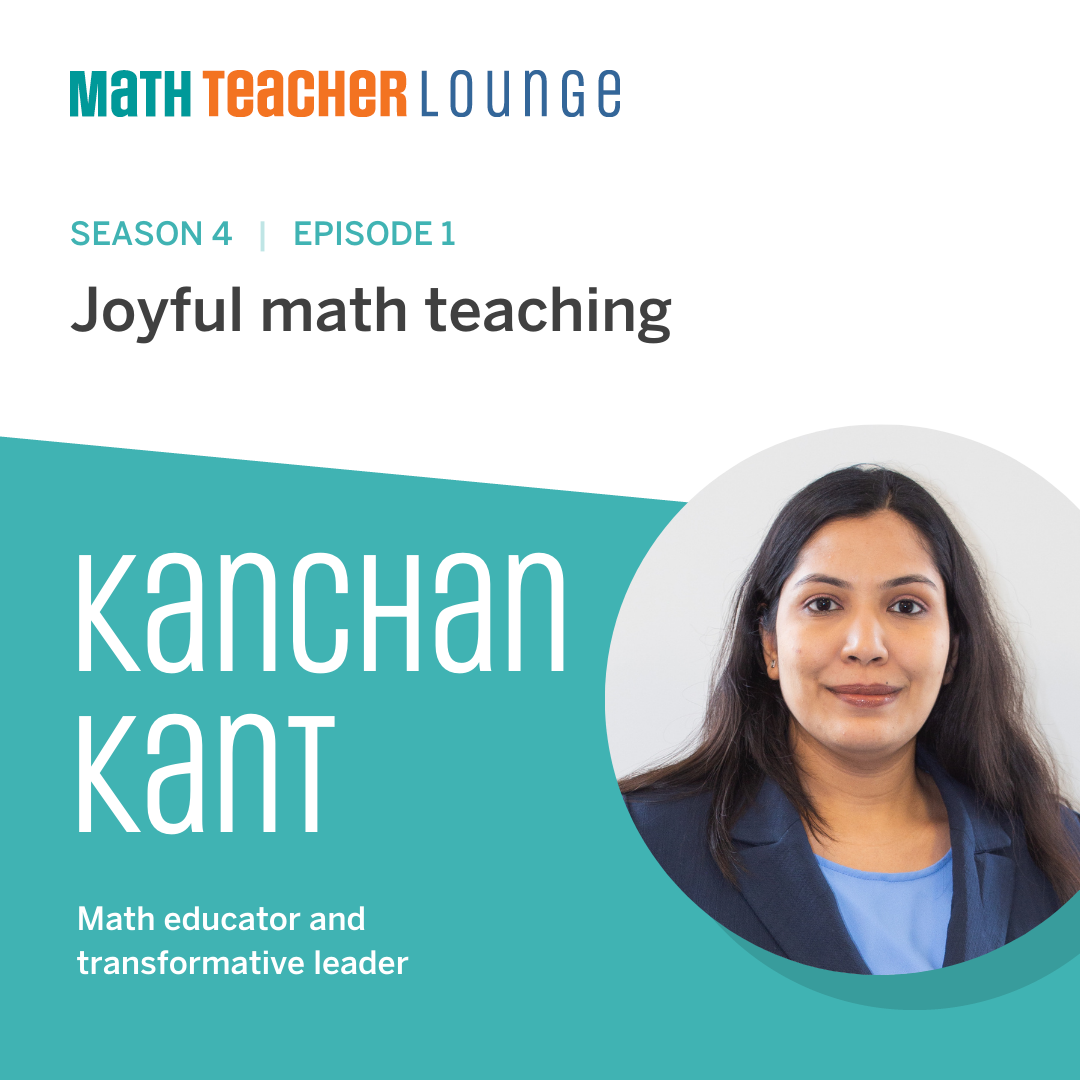
S3 – 06. Bethany and Dan take on Twitter!

In this episode, Bethany and Dan take a look at several tweets that caught the most fire on Twitter during the 2021-2022 school year. The pair answer questions about viral teaching methods, the best teaching advice you can give in three words, and if students should use pencils or pens in class. Join them as they take on those questions and several others in a fast-paced episode.
Explore more from Math Teacher Lounge by visiting our main page.
Dan Meyer (00:02):
Hey folks. Welcome back to the Math Teacher Lounge. I’m your co-host, Dan Meyer.
Bethany Lockhart Johnson (00:07):
And I am Bethany Lockhart Johnson. And I’m your co-host, Dan! Hi!
Dan Meyer (00:12):
We’re co-hosts! Hey! Great to see you.
Bethany Lockhart Johnson (00:13):
Dan, this is the last episode of Season 3. Three seasons!
Dan Meyer (00:19):
It’s gotta have a cliffhanger. What will the cliffhanger be? You know?
Bethany Lockhart Johnson (00:22):
The cliffhanger is that we love having guests! It’s one of our most favorite things, because selfishly, we love to talk to all of these amazing folks who are doing this interesting research and thinking about amazing things. But for this last episode, it’s just you and I, Dan. Cliffhanger!
Dan Meyer (00:40):
Yeah. I like this. I like this. So the cliffhanger was last episode, and people are all like, “So who’s the last guest gonna be of the season before we roll out into summer?” And yes, as Bethany said, we love all the fascinating guests we’ve had on throughout these last few seasons. And we realized…who is more fascinating to each other than both of us? You know, let’s talk to each other about things, right? <Laughs> You get that! You get that! Or am I alone here in this? We had this idea about what we should talk about here, and that’s this: I am on Twitter a lot. I’m @DDMeyer on Twitter; throw me a follow; might follow back; who knows? I don’t tweet much. Bethany, what’s your handle on Twitter? Let ’em know.
Bethany Lockhart Johnson (01:22):
I’m @LockhartEdu, and I was much more active pre-mamahood. But I’m still up in there. Go ahead.
Dan Meyer (01:30):
Yep. In there. Yeah, great. So I’ve been keeping track of the hottest conversations in math education Twitter, the conversations that the most people who kind of describe themselves as math teachers in their bios and whatnot have been replying to. We’ve got some little things working in the background, keeping track of this sort of thing. And so we are gonna bring you folks some of those extremely hot conversations, and even better than the questions—which we hope you’ll reply to and tag us in your replies—even more than those questions, we’ll bring you our answers—our answers!—to those questions. Can you believe that? We’ll fully settle these questions! Won’t we, Bethany? My gosh, won’t we?
Bethany Lockhart Johnson (02:15):
Jeez Louise! No! Dan Meyer, the point is not our final word on it! The point is this episode, we’re furthering the conversation. We wanna hear from listeners about what do you think?
Dan Meyer (02:25):
Right. You’re right. You all need someone in your life like Bethany who will help you become the best version of yourself. So here’s the deal. We have several questions in a few different categories. We’re gonna bust through some quick ones, pretty quick. And, uh, there’s some meaty ones as well. Let’s get into it! The first questions come to you all, and us, courtesy of MTL guest Howie Hua, who has a renowned knack for just creating math memes, but also conversation starters that really capture the curiosity and answers of of a grateful nation. So Howie’s first question, which I’ll pose to Bethany, is, “What’s your favorite number?” Bethany? And why is it your favorite number?
Bethany Lockhart Johnson (03:14):
Oh, I love it. OK. Well, the first thing that came to my mind is 12. ‘Cause It’s a highly divisible number. I mean, 2, 6, 3, 4—I love it. And it coincides with the day and month of my birth. Which, like, the double-digit…come on, 12, 12, 12, 12. I dunno, am I giving away, like, my bank security code <laugh> or anything by saying that?
Dan Meyer (03:41):
Yeah. What’s your favorite PIN?
Bethany Lockhart Johnson (03:43):
Let me change my PIN. Yeah, it’s just such a happy, happy number. Well, 12 is, you know, 10 and 2. Two more. Anyway. Love it. What about you, Dan? What’s your favorite number and why?
Dan Meyer (03:55):
I’m into it. I’m into it. I think I would choose 16. Because it’s the first number for me when it was like, “Oh, you can keep on making numbers forever!” Where I’m like, OK, 2times 2 is 4. Great. That’s kind of an elemental expression in mathematics. Four times 2 is 8. OK. But then, 8 times 2 is 16, and it’s like, “Oh, you can just keep doubling that thing over and over and over again!” And I can recall feeling pretty excited that numbers are just like, out there for the finding. For the taking. Cool stuff.
Bethany Lockhart Johnson (04:33):
I’m sorry. Wait, I have to interrupt. You went 2 times 4 is 8 and you didn’t go 4 times 4 is 16? You went 8 times 2 is 16? You wanted to keep the 2 the same?
Dan Meyer (04:49):
Yup. Yup. You can keep on doubling. You can keep on doubling numbers and it just keeps on going.
Bethany Lockhart Johnson (04:53):
More evidence that our brain works very differently.
Dan Meyer (04:56):
We learn more about each other…let me keep this rolling with Howie questions. OK? Howie says, “If you could co-teach with one teacher from Twitter, who would you choose?”
Bethany Lockhart Johnson (05:06):
Oh, oh, it has to be a teacher?
Dan Meyer (05:11):
Or anybody, I guess. I mean, like, I know you love Oprah.
Bethany Lockhart Johnson (05:15):
Can I co-teach with Oprah?
Dan Meyer (05:16):
Yup, yeah, so there we are. <Laugh> Yup. OK. Fair enough. We have to work Oprah into every single episode.
Bethany Lockhart Johnson (05:23):
I’d just love to sit and like, we’d read together, we’d read to the students, and then we’d talk…I mean, obviously it’d be Oprah. But if we’re thinking more of like MTBoS, like math Twitter blogosphere-land, I suppose the person I would wanna co-teach with honestly would probably be Allison Hintz. One of our former guests as well. Her book, Mathematizing Children’s Literature, with Antony Smith, that book—I just love the idea of sitting and doing a read-aloud and then diving into some juicy math that’s inspired by what comes out of that read-aloud. So yes, that’s who I pick. Allison! Let’s co-teach!
Dan Meyer (06:00):
<Laugh> Shout-out to Allison.
Bethany Lockhart Johnson (06:01):
What about you?
Dan Meyer (06:03):
I would choose MTL guest Idil Abdulkadir—because, and this relates to Allison and also Elham Kazemi—they talked about, in our episode about teacher time-outs. And I’m choosing someone who I think is—like I’ve never seen Idil teach, but I work with Idil at Desmos and think she’s fantastic. But what I really want in a co-teacher is someone that I can say, “Whoa, time out, do you see what’s going on here? This is really interesting. What should we do next about this?” And have a little strategy sesh in front of the kids and no one gets freaked out by that. And I think that that’d be a pile of fun. Idil seems like she’d be receptive to that kind of interaction, teacher to teacher. So that’s my vote right there.
Bethany Lockhart Johnson (06:48):
Opportunity for you to grow your own practice, Dan.
Dan Meyer (06:52):
Yeah, yeah, exactly. 100%.
Bethany Lockhart Johnson (06:56):
So Dan, I actually have a question for you from Howie. If we’re on the Howie tweet train, I have one from Howie too.
Dan Meyer (07:04):
Howie had some fire tweets, some fire tweets this current year. Yep.
Bethany Lockhart Johnson (07:08):
Dan, I wanna know: Do you prefer doing math in pen or pencil?
Dan Meyer (07:16):
Ooh, yeah. Oh, I see that Howie says, “I don’t mean to start any drama, BUT,” and then asks the question–
Bethany Lockhart Johnson (07:23):
But!
Dan Meyer (07:24):
I think that Howie lives for drama. I think he knows he’s messy. He lives for drama. He knows what he’s doing this with this question here. He knows.
Bethany Lockhart Johnson (07:32):
DRAAAAMAAAA!
Dan Meyer (07:32):
He knows what he’s doing. Yup. So I would just say it depends. Is that cheating? Like if I’m doing math to learn, or if we are learning in that process, then I want to use pen, actually. I wanna see the tracks of the thinking. And if we’re doing it for presentation, like if I’m presenting something, I wanna…I guess that’s an area where I’d be fine to not erase things. I don’t wanna prep it so it’s, you know…I guess you could use pen for presentation also. Just pen. Period. But I wanna see the tracks of the thinking if we’re doing some learning versus presentation. What about you?
Bethany Lockhart Johnson (08:09):
Well, I heard the voice in my head telling one of my kindergartners, “No, you cannot do that in sparkly pen. You need to do it in pencil.” And I was like, “Wait, whose voice is that?” It was one of my math teachers telling me I couldn’t do it in pen! Why couldn’t this kid do it in pen? Sure! Do it in a sparkly pen! So I wanna say do it in pen. And since usually pen is what I have around…I mean, I do crosswords in pen, Dan.
Dan Meyer (08:36):
Wow, wow. With a piece of paper and math, you have lots of room to re-revise and cross off…but those little, little boxes on the crossword, that says a lot about your commitment to pen.
Bethany Lockhart Johnson (08:46):
I got really good at making an A into an H or a P or whatever we need. So I would say, “Hey, if you’re in the room with your kiddos and you’re doing math, if somebody wants to do pen, let them do pen.” But I do know that I’ve seen teachers say you need to do pen so that I can see all of your thinking. So I think I hear what you’re saying. But do you think it should be like a classroom rule or something?
Dan Meyer (09:13):
Oh, no, no, no. I mean, I’m gonna ask you like, “How’d you get to this destination?” And I wanna know process somehow, and I think you’ll get tired of having to explain it verbally rather than just, like, showing. Just don’t erase stuff. Don’t scratch stuff off. Let’s let’s see how you’re getting there. That is what I’m into.
Bethany Lockhart Johnson (09:30):
Thanks, Howie, for that trio of thought-provoking tweets, because I genuinely wanted to know what Dan thought and what our listeners think. I mean, Dan, I gotta say: Howie, you say you don’t wanna cause drama, but I gotta say I’m with Dan on that—
Dan Meyer (09:50):
Got the gift. Got the gift for drama. We’re still friends though. So I’m happy about that. Our next section, I got a few more questions queued up here and these ones relate to advice for educators, advice for yourself. Good advice, bad advice, that kind of thing. So let’s jump in. I would love to know—this one’s from Pernille Ripp—I’m very curious, Bethany, what is the worst teaching advice you have gotten in your life, ever?
Bethany Lockhart Johnson (10:19):
<Laugh> Ooh. OK. Um, worst teaching advice was: “That’s OK, just move on anyway.” And that was in terms of pacing. It was like, students needed to do a deeper dive and the teacher who I was chatting with said, “No, no, it’s fine; it’s fine; just move on. Just move on to the next chapter.” That was probably the worst advice, because no, I don’t think that’s what I should have done at all! <Laugh>
Dan Meyer (10:48):
Right.
Bethany Lockhart Johnson (10:48):
But I was a first-year teacher and I was trying to figure it out. And I learned that that was not good advice. And I understand the pressure of pacing. But it was totally antithetical to the type of listening to my students that I want to do in my craft. And this teacher meant well, but that was not good advice, teacher! <Laugh> What about you, Dan? What is the worst teaching advice?
Dan Meyer (11:13):
I dig that. That feels similar to one of the replies to Pernille here. Frances Klein says, “Never let them know you’ve made a mistake” being particularly bad advice. You know, just this like idea of like moving along, covering your tracks, not backtracking or admitting mistakes, those all feel kind of a piece. The worst advice I think I’ve ever received, and I wasn’t given this often, but it’s echoed by a lot of the commenters here on this tweet, which is “Don’t smile until X, Y, or Z,” where X, Y, and Z are like Christmas, October, December, January. Just the idea that you’ve gotta develop—
Bethany Lockhart Johnson (11:54):
Wait, what?
Dan Meyer (11:55):
<Laugh> Did you never hear this from anybody? Don’t smile until Christmas? Perhaps this is more—
Bethany Lockhart Johnson (11:59):
I’m a kindergarten teacher! Can you imagine? If I don’t smile the second they walk in? The tears?! The parents’ tears?! The kids’ tears?! If I’m just like, stoic?
Dan Meyer (12:07):
Yeah. Well.
Bethany Lockhart Johnson (12:08):
So explain it to me.
Dan Meyer (12:10):
Well, the idea is, is that, you know, for older kids, they’re scoping you, they’re clocking you for weakness, they’re looking at you, they’re looking to take advantage. And so “don’t smile until Christmas” is like, hey, you can always relax. You can always relax your discipline, but you can’t UN-relax it if you start out, you know, Mr. Happy Pants Meyer. Which—
Bethany Lockhart Johnson (12:33):
Smile perceived as weakness.
Dan Meyer (12:36):
Yeah. Very obviously poor advice. Eventually you come to realize that like having a rapport and a relationship that is trusting and warm and demanding, that has high expectations, that’s the best kind of classroom management. Not some kind of persona built around intimidation or stoicism, that kinda thing. So, terrible, terrible advice!
Bethany Lockhart Johnson (13:01):
I feel like I did have a few of those math classes. Yeah.
Dan Meyer (13:04):
Yeah, exactly. <Laugh> You loved them, right? They were like your favorite math classes. It was a blast, right?
Bethany Lockhart Johnson (13:11):
<Laugh> So we have to ask the opposite. Thank you, Daniel Willingham, who said, “What’s the best advice you got?” But hold on, Dan, he didn’t just want the best advice. He wanted the best advice in three words.
Dan Meyer (13:26):
Oh yeah. He doesn’t, he doesn’t want a book or dissertation or even a blog post or even a tweet. He wants just three words.
Bethany Lockhart Johnson (13:32):
I think maybe that might have been to me. <Laugh>
Dan Meyer (13:34):
This is someone who’s doesn’t have much time for this advice, wants it distilled down. I’m just obviously stalling here as I try to think about this. I don’t know, there’s just like so much nuance lost here. I would say, listen to students, listen to students. I can’t say more that, I guess. I guess I’m done. I can’t say more than that there. But you’re in a bad place if you’re not listening carefully to students. How about you?
Bethany Lockhart Johnson (14:04):
- Mine is “Ask…lots…questions.”
Dan Meyer (14:11):
Nice. ‘Cause I filled in the word! I filled in the word! I was able to kinda infer that. I did that. I got that.
Bethany Lockhart Johnson (14:17):
Wait, wait, wait, wait! I could have said many! Wait, I could have said “Ask many questions.”
Dan Meyer (14:22):
Strong, strong.
Bethany Lockhart Johnson (14:25):
So yeah. You know, no isolation, like don’t put yourself in a bubble. Ask, not just, not just your students, but the teachers! Ask a lot of questions. You don’t have to have it all figured out.
Dan Meyer (14:34):
Into it. Very much into it.
Bethany Lockhart Johnson (14:37):
Thanks. Daniel. Thanks, Pernille.
Dan Meyer (14:40):
Yeah. Daniel and Pernille, Both great questions there about advice, best and worst. Another fire tweet popped up earlier this year from Dr. Khristopher Childs, which was “Name one thing every educator should stop doing.”
Bethany Lockhart Johnson (14:57):
Oh, I don’t know. This kind of ties into my best advice about asking questions.
Dan Meyer (15:03):
Stop not asking questions?
Bethany Lockhart Johnson (15:06):
<Laugh> Avoid the isolation. I really love this idea of when we can, popping into each others’ classrooms, co-teaching, building this collaborative nature. Elham Kazemi, in our interview, talked about this idea of, like you said, the teacher time-outs, learning from each other. So I feel like if we could stop isolating ourself…and I don’t mean at lunch—sometimes you need to not be in the teacher lounge at lunch. Like if you need a minute, take the minute! But in general, as a practice, how can we not be isolated and instead be learning with, and from, each other? How can we stop the isolation? That’s what I would hope every educator would stop doing. What about you, Dan?
Dan Meyer (15:54):
I think that educators should…this is gonna require a little bit of elaboration. I think educators should stop taking responsibility for things that are not in their zone of influence. I think that as a society we are asking teachers to do more and more, to become more and more of a central fixture holding together with chewing gum and twine all the various parts of a student’s life. From their health, their fitness, emotional health, that we feed students at school. It becomes very tempting, I think, there’s a lot of pressures to blame outcomes, disparate and unjust outcomes later on in life, on teachers. And teachers should just flatly refuse. And to yeah, understand what the job has been set up to do. What it’s good for. And do that with excellence and intent and a lot of effort. And then not take responsibility for the rest of it.
Bethany Lockhart Johnson (16:53):
If I asked five different people about the definition of what a teacher should be doing, I would get five different answers. So I think it’s really interesting that you say that because yeah, many, many hats, which I think, yes, can lead to burnout. Can lead to all sorts of things. We’re asking schools to be all things to all, all people. Interesting. I’m gonna think about that more. I need to hear folks’ response on that, Dan.
Dan Meyer (17:18):
Mm-Hmm. I’m curious too. I mean, yeah, there are definitely things that are in teachers’ responsibility and some that are not. That’s a tough one.
Bethany Lockhart Johnson (17:26):
OK, for help, name an example of each. And what’s something that you think every teacher should not and should be doing. ‘Cause I feel like my brain goes to some things like, you know, I had teachers who were saying, “Well, I don’t wanna have my kids have to have breakfast in my classroom in the morning. That shouldn’t be my responsibility to serve breakfast in the morning.” But I’m like, “But then your kids are eating and they’re gonna be able to learn and be more focused.” Should that be the teacher’s responsibility? I’m not saying it necessarily should, but I’m saying…I don’t know. It gets murky for me.
Dan Meyer (18:06):
Yeah, for sure. I mean, I think that we should, as a country, have a really generous social welfare net so that everyone has food at home. Where a school is not the place where some students have to go to in order to receive nutrition and nourishment. That seems sad to me. And uncommon in developed nations. I think that teachers should watch out for, should be responsible for, the mathematical development of the students they teach, up to a point, they should be responsible for learning math and creating relationships in their classes. I don’t think that teachers should accept responsibility for larger kinds of outcomes, like the health of a democracy or international competition, who goes to the moon first. That kind of thing has historically been placed at the feet of teachers. And it’s tempting when you’re a teacher, I think, to take on that responsibility because it kind of develops your social importance. And I just say, we should say no to that. And get compensation, not in terms of social importance, but rather like in spendable dollars and monies.
Bethany Lockhart Johnson (19:10):
I’m learning more about you, Dan. And you know, this is what I’ve gotten from that answer: If you’re gonna dream, dream big. Right?
Dan Meyer (19:17):
Is that what you got from that? I don’t know. I think I’m trying to dream realistically.
Bethany Lockhart Johnson (19:23):
No, like if we’re gonna say, “Maybe teachers shouldn’t be responsible for serving breakfast in the morning,” well, because we want every child to have access to nutritious and filling food at home and time to eat it in the morning, right? It’s bigger than just, “I don’t want the teacher to have to do this.” So we’re dreaming big. We’re saying this should be the LEAST that students have access to, right?
Dan Meyer (19:53):
Yeah. Yeah. I’m here now. I’m with you. I like that dream. Where we take care of folks in their lives outside of schools. So schools don’t have to be the one linchpin for every kind of social outcome. Like currently a lot of them run through a school ’cause we don’t do a good job of setting up other ways to meet those needs. And we should.
Bethany Lockhart Johnson (20:16):
And we’re also recording this in, what, two weeks, a week, after a tragedy where students and teachers were killed in the classroom. And I think both of us are taking some deep breaths and recognizing that there’s a lot of debate that is happening about what teacher’s role should be in preventing this in the future. And I don’t know if you’ve done drills in your classroom that are supposed to help mitigate disaster, but you know—collective deep breaths— <laugh> is where we’re at right now.
Dan Meyer (20:52):
Yep. The idea of “we should arm teachers” is another example of no, we should not do that. We should solve the tendency towards violence outside of the classroom so that teachers and students can teach and learn. That sounds awesome to me.
Bethany Lockhart Johnson (21:06):
Collective deep breath. Whew. OK. So what else you got for me, Dan?
Bethany Lockhart Johnson (21:33):
Ooh. So I feel like I’ve heard that in many teaching PDs. “I Do, you do, we do.” Actually I feel like I’ve seen like more “I do, we do, you do.” Like graduated release. I do it, then we’ll do it a little bit together, and then now you have permission to do it. And I feel like in directed draw, that’s a hundred percent true. Like I’m gonna show you this and then you draw it. And then you cut here and then you do it. If we’re trying to create this, like I’m teaching this new art technique. But in mathematics, I feel like that’s really not what I want my classroom to look like. I want to support my students and set them up for sense-making, and then I want them to try it out and I don’t want them to solve it the way it first comes to mind for me. I wanna see how they make sense of it and how they solve it. And then I want us to share it with each other so we can grow together. So I think time and place for “I do, you do, we do,” or “I do, we do, you do.” Or shoo-be-doo-be-doo-be. Yeah. You?
Dan Meyer (22:44):
I’ve got nothing. I have nothing to add. I thought that was just an excellent summary of a classroom I would love to be a part in, love to teach. I think it’s a certain tool in the toolbox that I think is overused. But it’s also a tool that can be useful in the case of certain kinds of operations. There are some operations that do benefit from “let me just show you how, like one way you might do this.” I don’t know. I’m like helping my kid whack a nail into a board and there’s a moment where it’s like, “Hey, actually, lemme just show you one way you can do this,” and do it, and then that’s helpful in some moments. But for so much of math, a lot of math does not relate to the operational kinds of fluency. And in those instances, it’s a little bit…it’s not a useful tool, I don’t think, for those kinds of skills and ideas.
Bethany Lockhart Johnson (23:34):
I’m thinking of tool talks in my classroom. So in kindergarten, many of the tools that we use in math and just in class in general, are new to the students. And if I tell them, this is exactly how you should use this tool, then I feel like I’m taking a lot of the sense-making away from them. But if I introduce the tool, show them how to use the tool safely, show them this is not a safe way to use the tool, chewing on this is not safe. That’s not how we use this tool. This is how we take care of it, et cetera. But then support different modes of using the tool that are gonna help them use it to solve problems and make sense, I think…but I guess—Dan, have you heard “I do, you do, we do,” or is it “I do, we do, you do”?
Dan Meyer (24:22):
I’m with you. And I think that it got clarified post-tweet. But yeah, it typically is “I do, we do, you do,” the gradual release of responsibility it’s often called. And I, I have heard people do what you described, which is…what is it? It’s “You do, we do, I do”? Like an inversion of that? Like have people do a thing that I can do that’s not too, too abstract for them, and then like “We all do something together, and then I’ll offer a summary of what we learned,” is one way that goes. I like that tool as well.
Bethany Lockhart Johnson (24:53):
I think particularly, at least I’ve seen in elementary classrooms, there’s sometimes this fear of letting students just try it out before I’ve really showed them, “but this is how it has to be.” And what I am most excited about is supporting students and creating a classroom environment where students don’t need my permission or need my direct “this is the only way to do it.” Instead, it’s like, yes, there’s lots of things we model. But there’s also like, “Hey, what do you think? How do you think this should be used?” And the joy of that exploration.
Dan Meyer (25:30):
Yeah. There’s a feeling of efficiency that comes from “I do, we do, you do,” for some kinds of math, but it’s undercut in my experience by what it cultivates in the students, which is “I’ve gotta wait until the teacher does before I can do anything.” So it pays off real diminishing returns over time. And it’s, just for me, an exhausting way to teach. Always being the bottleneck for new learning is a total drag.
Bethany Lockhart Johnson (25:55):
Ooh, what a great way to describe it. You do not wanna be the bottleneck. You want to be…what’s the other thing? The facilitator? What’s the opposite of a bottleneck? The flowing river? The…The…Help me!
Dan Meyer (26:10):
Hit us up in the replies. I dunno. The opposite of a bottleneck. That’s what you wanna…you wanna not be the opposite? No, you want, yeah. We got this here. We’ll figure it out. We’ll get back to you. <Laugh> OK. Well, folks, those were a few of this year’s fire tweets. It’s been fantastic chatting with you—
Bethany Lockhart Johnson (26:29):
Dan.
Dan Meyer (26:29):
—Bethany, About all those—
Bethany Lockhart Johnson (26:32):
Dan. You know, my favorite thing to do is interrupting you, Dan. I have to interrupt you because we can’t end fire tweets, Dan, without including a tweet from you.
Dan Meyer (26:43):
Oh, that’s true. I do have my moments. Yeah, we should. We really should. <Laugh> Do you have one in mind?
Bethany Lockhart Johnson (26:50):
No. Dan. Yes. I loved…you tweeted recently, “How many years have you been teaching?” Which, OK. “What Has been like the most influential? Like, what, OK, blah, blah, blah.” <blathering noises> You tweeted, “How many years have you been teaching? And at this point, what has most influenced how you teach?” And you gave some ideas: A methods course, PD sessions, curriculum, TV and movies, et cetera, et cetera. And I love that you put that out there because this episode is coming out as we’re wrapping up another school year. And it also got me thinking about summer and what teachers sometimes do during the summer, but what we might need to do this summer for self-care. But I’m really curious. I love that tweet. And I’m curious, Dan, what did folks say was the thing that had most influenced their teaching and what’s most influenced your teaching?
Dan Meyer (27:49):
Ooh, yeah. People’s responses to this one were really fantastic. I came into this, I was flying to the Association of Mathematics Teacher Educators conference. And I just found myself wondering, so, the pre-service year, the one year of, like, you’re learning how to teach, is how we did it in California. Like how much of that has still infused my practice? And in what ways? I don’t think I think about that stuff consciously, but I think that did like set me up with a lot of images that I would be unpacking for going on two decades now working in education. I think conversations with people, I think observing classes, I don’t think that like the one-day PDs, the one-day development days throughout the year, four times per year, I don’t think those stuck to me much. I think that this summer, I have learned so much, just an embarrassment of riches, from non-educational sources. From other disciplines. From storytelling, for instance. From how people have constructed movies I like. I am proud of the way…one of the aspects of my character that I’m proud of—it takes a lot to admit this, as I’m sure you understand, Bethany—but to integrate lots of wacky stuff and pick from it and use that to affect my practice and teaching has been really positive. So for this summer, I hope that people read a good beach book and just kinda let your teaching mind rest a little bit. And in doing so, create some openings for new ideas about education from other parts of the world. Kids! Having kids has been helpful. I don’t know! Just everything! It’s such a big job, education. Everything has so helpful. What about you? What’s an influence on your practice that might surprise me or other folks out there in MTL land?
Bethany Lockhart Johnson (29:52):
Well, I don’t know about surprise. I mean, I definitely feel similarly, like methods courses absolutely impacted my teaching. But I feel like opportunities where I was able to observe other teachers and where I was able to have conversations with folks about their practice, that has deeply impacted me. And books I’ve read. I mean, honestly, I’ve learned so much from sharing with other teachers. Like, for example, maybe I’ll bring student work and we’ll talk about it. And we kind of create this conversation together about how we wanna come back to the students based on the work we see. Those type of moments where we’re collaborating and we’re bringing multiple perspectives to the table, that I think, has really often shifted me out of my first initial reaction or what I thought I was going to do in the classroom the next day. So that continues to surprise and delight me. And thinking about this summer, I think there’s a lot of creativity and joy that can come out of the marination process, when you’re just kind of sitting back and healing yourself, whether through sleep or sunshine or time with friends and family or whatever that looks like for you. I think there’s a lot of creativity that can come from that place of fertile, you know, wellness. I never think of that as wasted time. I think of that as getting the soil ready for all that’s gonna come in the fall. And that being said, I also think it could be a fun time to dip your toes into something that you are excited to read, that you might not have a chance to read during the school year that could be teaching-related. So it’s like very low pressure, like, “Oh, I’ve really wanted to read more by this author. I’ve wanted to read this article. I’ve wanted to dip into this topic.” And not with a pressure, but just with a curiosity. And, yeah, I think so often we as teachers love learning, and to give yourself space to learn in whatever that looks like can be a real gift.
Dan Meyer (32:09):
Yes. And if you need book recommendations, hit the MTL back catalog of episodes. Loads of folks that we interviewed have real good books out.
Bethany Lockhart Johnson (32:16):
Yes!
Dan Meyer (32:16):
Think about it. Think about it.
Bethany Lockhart Johnson (32:22):
One quick recommendation: Again, gotta plug Antony Smith and Allison Hintz’s book. I read Mathematizing Children’s Literature before we did the interview, but this summer I wanna read all the children’s books that they mention. I just wanna go to the library and read all those children’s books. I wanna read them to my son. I wanna read ’em to myself. So, you know, diving into some good YA, children’s books, just, like, TLC. Dan, thank you for such a rich season and a chance to have so many interesting conversations. It is genuinely a joy to learn with and from you.
Dan Meyer (33:00):
Likewise. And always hope to see you folks on Twitter now and then. Let us know what you’re up to this summer at MTLShow on Twitter or in our Facebook group, Math Teacher Lounge. We’ll be there tuning in now and then. It’s been a treat interacting with you folks over this last season. Take care and until the new season, so long.
Stay connected!
Join our community and get new episodes every other Tuesday!
We’ll also share new and exciting free resources for your classroom every month.
Meet the guests
Dan Meyer
Dan Meyer taught high school math to students who didn’t like high school math. He has advocated for better math instruction on CNN, Good Morning America, Everyday With Rachel Ray, and TED.com. He earned his doctorate from Stanford University in math education and is currently the Dean of Research at Desmos, where he explores the future of math, technology, and learning. Dan has worked with teachers internationally and in all 50 United States and was named one of Tech & Learning’s 30 Leaders of the Future.
Bethany Lockhart Johnson
Bethany Lockhart Johnson is an elementary school educator and author. Prior to serving as a multiple-subject teacher, she taught theater and dance and now loves incorporating movement and creative play into her classroom. Bethany is committed to helping students find joy in discovering their identities as mathematicians. In addition to her role as a full-time classroom teacher, Bethany is a Student Achievement Partners California Core Advocate and is active in national and local mathematics organizations. Bethany is a member of the Illustrative Mathematics Elementary Curriculum Steering Committee and serves as a consultant, creating materials to support families during distance learning.

About Math Teacher Lounge: The podcast
Math Teacher Lounge is a biweekly podcast created specifically for K–12 math educators. In each episode co-hosts Bethany Lockhart Johnson (@lockhartedu) and Dan Meyer (@ddmeyer) chat with guests, taking a deep dive into the math and educational topics you care about.
Join the Math Teacher Lounge Facebook group to continue the conversation, view exclusive content, interact with fellow educators, participate in giveaways, and more!
You might also like:
Committed to reading equity
We believe that all students have the right to read complex texts and engage in rich classroom discussions. They should also see themselves reflected and experience new worlds through reading.
This commitment guides our text selection, unique artwork, and dedication to reaching every student where they are.

Text selection
Texts in the Amplify ELA curriculum cover a wide range of topics, themes, and genres, with differentiated supports that ensure that all students can work through each reading and lesson. Taken as a whole, the texts show students a diverse picture of the world, while fostering a lifelong love of reading.

In the Liberty & Equality unit, students reflect on the harrowing journeys and avenues to freedom that enslaved African-Americans were forced to forge.
Students read A Raisin in the Sun, a play that focuses on the impact of poverty and racial tensions on family relationships and identity within an African-American family.
In the Summer of the Mariposas unit, students dive into a retelling of the Odyssey through a contemporary Hispanic lens as they explore sibling and extended-family relationships.
In the Perspectives and Narrative unit, students explore a coming of age moment for an adolescent daughter of immigrant parents.
In the Red Scarf Girl and Narrative unit, students learn about a key historic moment in Asian and world history, while making connections to relatable themes like authority figures imposing rules on children, and family and peer loyalties standing at odds.

In the Mysteries & Investigations unit, many of the texts present an ethnically and culturally diverse group of characters, including many pre-teen or teen protagonists rebelling against authority, navigating their relationships with their peers and families, and figuring out their unique identities.
Created with diverse perspectives
With our new illustrations, time spent in our classrooms will feel relevant and relatable to every student. We’ve brought together an art team with unique perspectives and visual styles so that their diversity can shine along with the
complex texts in our curriculum, and illuminate their relationship with our literature. Everyone deserves to see themselves as the hero of a story. It is our hope that our students will find themselves within our program, and will be ever more curious in their learning, and engaged in their reading.

Paige Womack
Dive into the world of Mysteries &
Investigations with Dr. Womack,
the illustrator who may have once
become a scientist…

Tre McClendon
Meet Tre, a seeker and traveller that became homies Fredrick Douglass through illustrating his narrative for our program…

Jackie Pierson
There’s no one way to be a maker, and Jackie certainly has made a lot of things. Check out the weird and mysterious world of her miniatures…

Elizabeth Dantzler
She’s been drawing characters and comics ever since middle school. Now see the drama of Edel’s work in the mythos of the Greeks…

Caroline Hadilaksono
Travel through countries and narratives with Caroline, as she shares her delicate watercolors for illustrating the hero’s journey…

Patrick Mahony
The haunting work that Patrick creates will leave you feeling a sense of melancholy and longing, but not without hope for the future…

Edel Ferri
She’s been drawing characters and comics ever since middle school. Now see the drama of Edel’s work in the mythos of the Greeks…

Eddie Pena
As a latino American, Eddie is an illustrator, a father, and a teacher. He is working in collaboration with Poetry in America to use his heritage as inspiration…

Tory Novikova
Listen to a word from Tory, the Art Director at Amplify, on how the vision
was set for the project and how she brought the team together that would get to illustrate ELA…
Fanart
Here is a library of all the inspiring art that our beloved fans have submitted for our program. Do you or your students have a favorite literary character from our program? Send us your fanart to be shared with our community here!

Leadership and literacy brunch with Natalie Wexler
with Amplify and Riverside USD
Thursday, February 27, 2020
9:30–11:30 a.m. PST
Location:
Benjamin Franklin Elementary School – Library
19661 Orange Terrace Parkway
Riverside, CA 92508
Registration deadline: Space is limited at this free event! RSVP by February 20 to secure your spot.
Who should attend: Supervisors, ELA and reading directors, curriculum coordinators, and principals.
About the event
Join us for a free brunch, author talk, and book signing with education writer and author Natalie Wexler on February 27 from 9:30–12 a.m.
During our time together, Natalie will discuss the latest research around reading, writing, and engagement in elementary school, along with the key findings of her book The Knowledge Gap: The Hidden Cause of America’s Broken Education System—and How to Fix It (2019).
As our guest, you’ll:
- Meet and hear from education writer and author Natalie Wexler.
- Mingle with other district leaders from Riverside USD and surrounding areas.
- Enjoy a delicious brunch with colleagues.
- Leave with a signed copy of Natalie Wexler’s book The Knowledge Gap: The Hidden Cause of America’s Broken Education System—and How to Fix It (2019).
Agenda:
9:30 a.m.: Arrive, check in, and visit our brunch buffet.
10–11 a.m.: Hear from Natalie Wexler
11–11:15 a.m.: Q&A with Natlie Wexler
11:15–11:30 a.m.: Book signing
Meet our featured presenter
Natalie Wexler
Natalie Wexler is an education writer and the author of The Knowledge Gap: The Hidden Cause of America’s Broken Education System—and How to Fix It (2019). She is also the co-author, with Judith C. Hochman, of The Writing Revolution: A Guide to Advancing Thinking Through Writing in All Subjects and Grades (2017) and a senior contributor to Forbes. Her articles and essays have appeared in The New York Times, The Washington Post, The Atlantic, and other publications. Before turning to education, Wexler worked as a freelance writer and essayist on a variety of topics, and as a lawyer and legal historian. She lives in Washington, D.C.
Submit this form to register for the event!
Leadership and literacy brunch with Natalie Wexler
with Amplify and Riverside USD
Thursday, February 27, 2020
9:30–11:30 a.m. PST
Location:
Benjamin Franklin Elementary School – Library
19661 Orange Terrace Parkway
Riverside, CA 92508
Registration deadline: Space is limited at this free event! RSVP by February 20 to secure your spot.
Who should attend: Supervisors, ELA and reading directors, curriculum coordinators, and principals.
About the event
Join us for a free brunch, author talk, and book signing with education writer and author Natalie Wexler on February 27 from 9:30–12 a.m.
During our time together, Natalie will discuss the latest research around reading, writing, and engagement in elementary school, along with the key findings of her book The Knowledge Gap: The Hidden Cause of America’s Broken Education System—and How to Fix It (2019).
As our guest, you’ll:
- Meet and hear from education writer and author Natalie Wexler.
- Mingle with other district leaders from Riverside USD and surrounding areas.
- Enjoy a delicious brunch with colleagues.
- Leave with a signed copy of Natalie Wexler’s book The Knowledge Gap: The Hidden Cause of America’s Broken Education System—and How to Fix It (2019).
Agenda:
9:30 a.m.: Arrive, check in, and visit our brunch buffet.
10–11 a.m.: Hear from Natalie Wexler
11–11:15 a.m.: Q&A with Natlie Wexler
11:15–11:30 a.m.: Book signing
Meet our featured presenter
Natalie Wexler
Natalie Wexler is an education writer and the author of The Knowledge Gap: The Hidden Cause of America’s Broken Education System—and How to Fix It (2019). She is also the co-author, with Judith C. Hochman, of The Writing Revolution: A Guide to Advancing Thinking Through Writing in All Subjects and Grades (2017) and a senior contributor to Forbes. Her articles and essays have appeared in The New York Times, The Washington Post, The Atlantic, and other publications. Before turning to education, Wexler worked as a freelance writer and essayist on a variety of topics, and as a lawyer and legal historian. She lives in Washington, D.C.
Submit this form to register for the event!
Boost Reading pilot for mCLASS®schools
Hooray! We’re thrilled you’re considering giving Boost Reading a try! This site contains all the resources you’ll need to learn more about the program and get started with your pilot. We’re confident you’re going to love how Boost Reading puts your mCLASS data to work.

Resources to support your pilot
What is Boost Reading?
Boost Reading is a digital reading program that complements ELA programs with adaptive and targeted practice in foundational reading skills. While it can be used on its own, Boost Reading also integrates with mCLASS, which means that you get extra benefits like automatic rostering and placement in the program based on a student’s mCLASS composite score. From that point forward, the program takes every student on a personalized journey that addresses gaps and bolsters foundational skills at a pace that supports their individual development.


How do I get started with Boost Reading?
Good news! Boost Reading has already been enabled within your mCLASS accounts. To get started with the program, you’ve got only two steps left: adjusting your student login settings and setting up your student devices. The resource below will walk you through how to do both.
- [Video] Boost Reading quick start tutorial
- [Video] Boost Reading dashboard tour
- [PDF] Boost Reading launch packet
Note: Boost Reading works on most classroom devices, including Windows Devices with Windows 7+, Chromebooks with Chrome OS, and Mac devices with OS 10.11+ or iOS 11+.
What else can you tell me about Boost Reading?
As students engage in skill practice, their paths through the game world adapt to meet their unique learning needs. Boost Reading includes more than 40 standards-aligned games that build language, foundational skills, and comprehension skills, while also developing:
- Phonological awareness
- Phonics
- Vocabulary
- Text analysis
- Comprehension
- Microcomprehension (i.e., the smaller aspects of comprehension that make up the reader’s mental model of a text)
Some additional resources that you might find helpful:

For questions, please contact your Amplify representatives:
Dianne Lee
California Sales Director
dilee@amplify.com
(949) 246-2083
Christina Lugo
Pilot Coordinator – Statewide
clugo@amplify.com
(949) 838-7600
JoAnna Chocooj
Pilot Coordinator – Northern California
jchocooj@amplify.com
(707) 290-1728
Brooke Johnson
Pilot Coordinator – Southern California
bjohnson@amplify.com
(858) 349-2134
Creating lasting change in K–5 math and literacy instruction

Transforming math and literacy education takes more than just tips and tricks—it requires vision, commitment, and the right support. Whether you’re rethinking early literacy skills instruction, refining math core curriculum, or fostering a culture of collaboration, you need strong leadership and proven strategies for real change to occur.
“Sustained, meaningful change doesn’t happen overnight,” said Kymyona Burk, Ed.D., a senior policy fellow at ExcelinEd and the keynote speaker at our recent Leading With Vision symposium. “It requires commitment, collaboration, and a clear vision for supporting both educators and students.”
At the symposium—which included keynotes, panels, and math and literacy tracks—education experts from across the country shared experiences navigating instructional shifts, leading curriculum implementation, and setting schools up for success. From building buy-in to making data-driven decisions, their actionable insights can empower you with the knowledge and tools to create lasting change in your district.
Read on for a recap of the core presentations. You can also watch or listen along—and, for extra credit, download the workbook to deepen your learning.
Opening keynote: Key Factors for Successful Transformation in Literacy and Math
Kymyona Burk, Ed.D.
Senior Policy Fellow, ExcelinEd
In her session, Kymona Burk made the case that real student learning progress in literacy and math doesn’t come from policy alone—it requires systemic, research-based change in classrooms. Too often, schools focus on interventions for struggling students instead of strengthening core instruction to prevent gaps in the first place. She pointed to Mississippi’s success in narrowing achievement gaps as proof that evidence-based teaching, teacher support, and family engagement drive meaningful, lasting improvement.
A key factor in that success, she argued, was a firm commitment to the Science of Reading. “We have decades of research on how children learn to read, and we can’t afford to ignore it,” she said.
Burk also stressed math’s similarities to literacy when it comes to effective teaching methods. Just as students need structured, research-backed reading instruction, they also need math teaching and instructional materials that build deep understanding rather than rely on rote memorization. Achieving this, she said, requires strong materials, better teacher training, and a commitment to using data to refine strategies. The path to better outcomes isn’t a mystery—what’s needed is leadership and persistence.
Key takeaways:
- Tier 1 instruction is the foundation. Schools must prioritize high-quality core instruction to prevent learning gaps.
- Literacy and math both need urgent attention. Math reform has lagged behind literacy efforts, but both require evidence-based teaching and structured support.
- Teachers need more than just training. Professional development must be paired with coaching, collaboration, and access to the right materials.
- Sustained effort leads to results. Mississippi’s success proves that achievement gaps can be closed with consistent investment in people, resources, and accountability.
Leadership Lessons Learned in Baltimore City Schools That Impact Change Everywhere
Janise Lane
VP of Customer Transformation, Amplify; former Executive Director of Teaching and Learning, Baltimore City Schools
Janise Lane’s talk centered on Baltimore City Schools’ multi-year effort to implement a more effective literacy curriculum, highlighting the importance of managing both the logistical and emotional aspects of change. While the district had strong, committed educators, student performance remained stagnant, prompting a curriculum audit and a shift toward evidence-based instruction.
Lane described how to build buy-in and sustainability by ensuring that change is not dictated solely by district leadership. “We had to shift from a system where decisions were made at the top, to one where teachers, families, and community members were true decision-makers,” Lane said.
She also emphasized the need to recognize and address resistance. “Everybody approaches change differently, and it’s our job as leaders to attend to all of those emotions,” Lane said. The key to success, she noted, is creating structured pathways for implementation while remaining adaptable and open to feedback and real classroom experiences.
Key takeaways:
- Balance structure with flexibility. A clear plan is necessary, but it must adapt based on feedback, data, and the realities of implementation.
- Small wins build momentum. Celebrating early progress helps shift mindsets from skepticism to belief in the change.
- Trust and transparency matter. Educators need to see that leadership is engaged, responsive, and committed to making change work for everyone.
Making Math People: Key Shifts in How We Think of Math Assessment
Patrick Callahan, Ph.D.
Educator; Founder, Math ANEX
During his talk, Patrick Callahan emphasized the ways that asset-based assessments measure not just what students don’t know, but the depths of their mathematical thinking. Instead of relying on traditional multiple-choice tests, his approach encourages open-ended responses, allowing teachers to analyze how students arrive at their answers.
Callahan noted that by looking beyond correctness to understand reasoning, teachers can better target instruction. “If all I see is that 37% of my students got an area problem right, I might think I need to reteach area,” Callahan explained. “But if I analyze responses, I see that some kids are correctly multiplying but misunderstanding overlapping rectangles, while others are actually calculating perimeter instead. That tells me exactly where to focus my instruction.”
His research also shows a correlation between students who demonstrated conceptual understanding (such as interpreting remainders in division problems) and higher performance on standardized tests—evidence that fostering deep thinking supports both engagement and achievement.
Key takeaways:
- Assessments should focus on thinking, not just accuracy. Open-ended questions provide deeper learning opportunities.
- Targeted teaching saves time. Knowing why students struggle prevents unnecessary reteaching.
- Classroom discussions boost comprehension. Encouraging students to explain their thinking deepens understanding.
Creating a Supportive Environment for Educators During Times of Instructional Change
Ricky Robertson
Educator; author; consultant
“The number one influence on team effectiveness is psychological safety,” Ricky Robertson said during his symposium session. “Not how talented the individuals are, but how they interact with one another.” His talk focused on how the knowledge that one can speak up without fear of punishment or humiliation affects school culture, educator well-being, and student success, citing research such as Google’s Project Aristotle that demonstrates how high-performing teams thrive not on individual expertise but the quality of interactions among team members.
He also noted that toxic workplace dynamics—such as fear-based leadership, cliques, and bullying—contribute to burnout, disengagement, and resistance to change. Stressing that “strategies don’t transform schools, systems do,” he shared case studies of schools that changed their culture by fostering open communication, restructuring leadership teams, and implementing clear decision-making processes. Creating a safe environment isn’t just about being nice, Robertson said. Robertson noted that creating a safe environment isn’t just about being nice, but about building systems that allow educators to collaborate, support one another, and better serve their students.
Key takeaways:
- Psychological safety boosts performance. Schools that report a high sense of psychological safety see increased collaboration, innovation, and teacher retention.
- Structured collaboration matters. Schools with clear communication protocols and leadership structures create more productive teams.
- Change starts with educators. Supporting teachers’ well-being and professional growth is the foundation for student success.
More to explore
Data’s essential role in your Science of Reading implementation
Support teachers and students in working toward literacy goals by leading with data as you shift to the Science of Reading. With tools like ongoing progress monitoring and a robust Multi-Tiered System of Supports, we’ll show you how data can give your students the literacy instruction they deserve.

Building buy-in for change—with data
You can use literacy data to harness buy-in for a paradigm shift, monitor student progress, and support your transition to the Science of Reading. But which data measures best identify areas for growth and reveal the path to student achievement?
Our free ebook, The Story That Data Tells, will help you take the first steps in using data to guide your journey toward impactful change..

Getting started with a data-driven literacy implementation
As any experienced educator can agree, change is not straightforward in the classroom. This is especially true when it comes to shifting to the Science of Reading, a process that requires meticulous planning, open communication, and—most importantly—data.
Discover which data to focus on throughout the school year, and how to use it to direct your implementation—whether you’re just starting the shift, or already implementing the Science of Reading.
Align your MTSS to the Science of Reading
Learn more about MTSS in literacy principles and how to align it with the Science of Reading.


The five guiding principles for an effective MTSS
To provide your students with literacy instruction that meets their needs, you need seamless planning and plenty of forethought. Deliver the instruction, assessment, and personalized learning your students deserve with a Multi-Tiered System of Supports grounded in data and the Science of Reading.
Read about the five guiding principles that can help you align your MTSS with the Science of Reading in our free ebook Systems of Success: Getting Started With a Multi-Tiered System of Supports Aligned to the Science of Reading.
Review the five guiding principles
An effective MTSS framework requires collaboration from all stakeholders (such as teachers, administrators, and caregivers) to ensure students have access to the right instructional support at the right time.
Frequent collection and interpretation of high-quality data is essential to identifying student needs, monitoring progress, and guiding decision-making. Universal screening and progress monitoring data are used to evaluate the effectiveness of all tiers in an MTSS, and to identify students at risk.
An MTSS provides increasing levels of support for students when they need it. It also focuses on prevention first to reduce the need for intervention later.
Implementing evidence-based instruction and interventions with fidelity improves outcomes for all students. A focus on all students, not just those in need of additional support, ensures that all students can access high-quality instruction.
In an MTSS framework, decisions are based on research and the constantly evolving needs of all students and schools.

Season 5, Episode 5: Implementing Multi-Tiered Systems of Supports
Hear from educator Brittney Bills, Ed.D., as she discusses her districts’ experience learning to use data, avoid burnout, and sustain ongoing improvements.
Listen now
What Does Data Tell Us? Building Buy-In and Determining Areas of Need With Data
Data can paint a clear picture of where your students are, where they need to go, and how the Science of Reading can get them there. Hear from Amplify Executive Director of Learning Science Danielle Damico about the story that data tells, how to use data to build buy-in, and the kind of data you should be collecting to ensure a successful implementation.

Starting Your Science of Reading Shift With Screening: How to Use Assessment Data as a Building Block of MTSS
Screening and assessment data can drive MTSS-aligned change management in your district, supporting you as you navigate and sustain lasting transformation. Learn more about the importance of universal screening in your literacy implementation.
Crack the code with literacy skills instruction that works.
The Amplify CKLA Skills program helps establish strong reading foundations in your K–2 classrooms. Students practice reading and communicating every day. Their literacy skills grow alongside their confidence.
Amplify CKLA Skills is grounded in Science of Reading research and was the first foundational skills program to earn all-green scores on EdReports. Read the review.

Perfect for any literacy block.
Use the powerful foundational literacy skills in Amplify CKLA Skills to supplement your core English Language Arts (ELA) program with focused lessons that fit any literacy block.
Interested in the full curriculum, including knowledge building? Explore the comprehensive Amplify CKLA program.
Our approach
Starting with sounds, students practice their phonemic awareness, handwriting skills, vocabulary, spelling, and grammar. They become aware of the connection between reading and writing, building confidence along the way.


Explicit, systematic instruction that works for students and teachers
Amplify CKLA Skills’ research-based scope and sequence progresses from simple to more complex skill development, starting with phonological and phonemic awareness. Instruction guides you in explicitly teaching the 150 spellings for the 44 sounds of English, with an intentional progression and review of skills to set your students up for success.
Daily 60-minute lessons cover all skills standards.
Instruction includes print and phonological awareness, sound-letter patterns, decoding and encoding, writing mechanics, and writing structure and processes. Ready-made presentation slides help you effectively deliver each lesson.
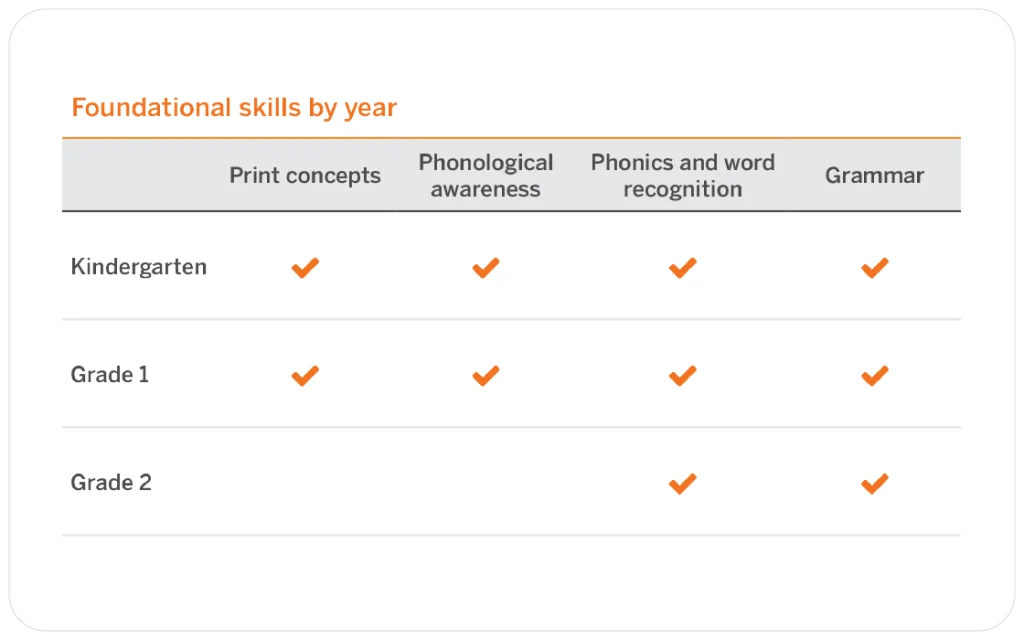

Decodable readers help students crack the code.
Amplify CKLA readers are 100 percent decodable, which means they include only words with letter-sound correspondences that have been explicitly taught. The readers are colorful fiction and nonfiction chapter books that kids love! In Grades K–1, visual supports such as underlined and bolded text scaffold students, while Big Book versions may be used for teacher modeling. Readers are also available as audio-enhanced e-books.
Amplify CKLA Skills was the first foundational skills program to earn all-green scores on EdReports.
Read the reviewWhat’s included
Amplify CKLA Skills includes engaging print and digital materials for comprehensive and effective learning.


High-quality teacher materials
Amplify CKLA Skills teachers effectively deliver instruction with print and digital resources, including:
- Teacher Guides with embedded differentiation.
- Formal and informal assessments.
- Ready-made and customizable lesson slides.
- Teacher resources and on-demand professional development.
Immersive student resources
Amplify CKLA Skills students stay engaged with a variety of print and digital resources, including:
- Original decodables and read-aloud Big Books.
- Student Activity Books with embedded assessments.
- A digital Sound Library with recordings, animated videos, and fun karaoke-style songs.


Hands-on phonics materials
Multisensory phonics and foundational skills resources help students practice key skills using fun, varied approaches that build independence.
- Chaining Folder (K)
- Letter Cards (K–1)
- Spelling Cards (2)
- Syllable Cards (K–2)
- Image Cards (K–3)
- Blending Picture Cards (K)
- Consonant and Vowel Code Flip Books (1–2)
- Exclusive digital Sound Library
Robust digital experience
Amplify CKLA Skills teacher and student resources are available through a digital experience platform that enhances instruction and saves you time. With everything you need in one place, you can effectively plan lessons, present content, and review student work.
- Ready-made yet customizable lesson presentation slide decks
- Dynamic live-review student tool
- Interactive and student-friendly experience
- LMS integration
- Recorded Read-Alouds
- Professional development website
- Real-time program support via email, live chat, and phone

Explore more programs based on the Science of Reading.
Our literacy suite programs are designed to support and complement each other. Learn more about our related programs.


Crack the code with literacy skills instruction that works.
The Amplify CKLA Skills program is grounded in Science of Reading research and helps establish strong reading foundations in your K–2 classrooms. Students practice reading and communicating every day. Their literacy skills grow alongside their confidence.
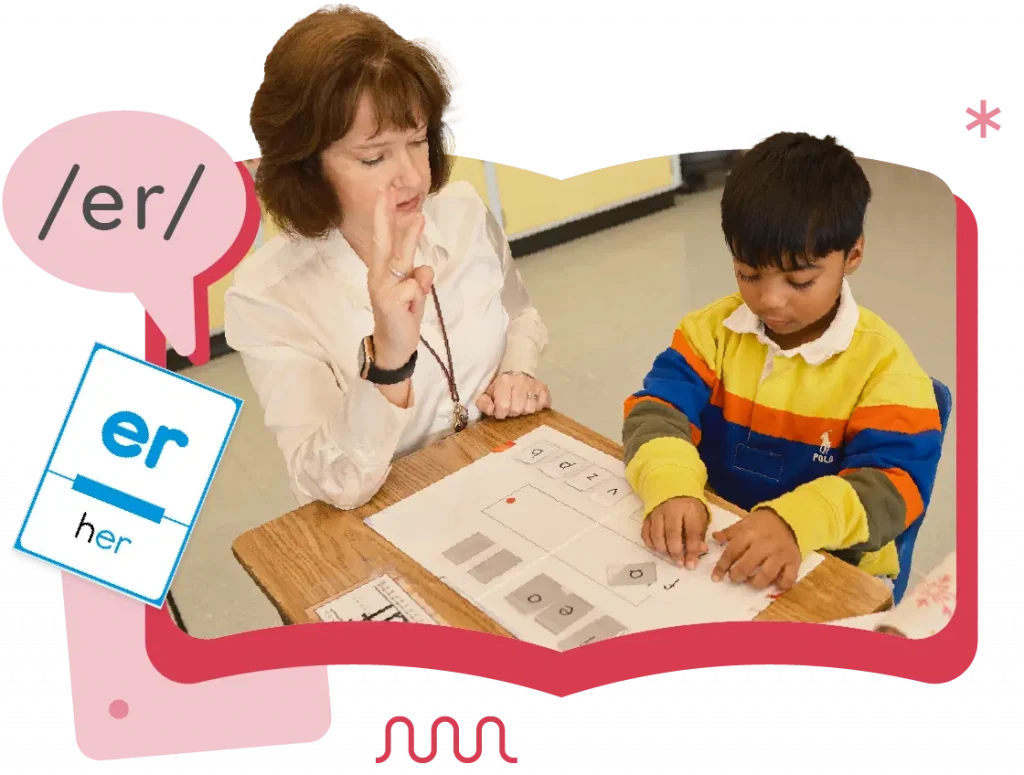
Perfect for any literacy block.
Use the powerful foundational literacy skills in Amplify CKLA Skills to supplement your core English Language Arts (ELA) program with focused lessons that fit any literacy block.
Interested in the full curriculum, including knowledge building? Explore the comprehensive Amplify CKLA program.
Our approach
Starting with sounds, students practice their phonemic awareness, handwriting skills, vocabulary, spelling, and grammar. They become aware of the connection between reading and writing, building confidence along the way.
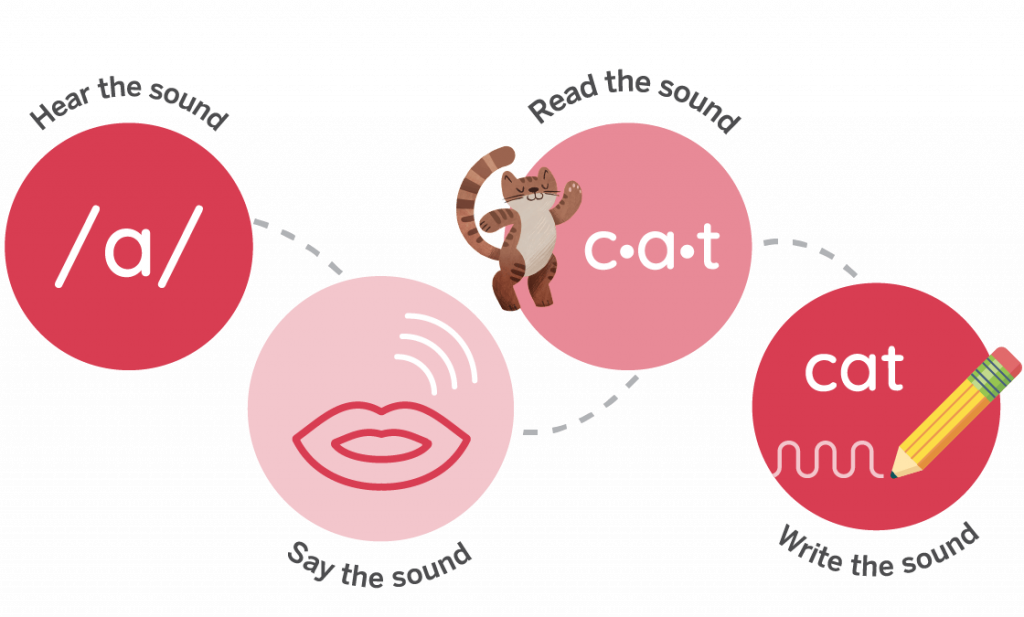
Explicit, systematic instruction that works for students and teachers
Amplify CKLA Skills’ research-based scope and sequence progresses from simple to more complex skill development, starting with phonological and phonemic awareness. Instruction guides you in explicitly teaching the 150 spellings for the 44 sounds of English, with an intentional progression and review of skills to set your students up for success.
Daily 60-minute lessons cover all skills standards.
Instruction includes print and phonological awareness, sound-letter patterns, decoding and encoding, writing mechanics, and writing structure and processes. Ready-made presentation slides help you effectively deliver each lesson.
Decodable readers help students crack the code.
Amplify CKLA readers are 100 percent decodable, which means they include only words with letter-sound correspondences that have been explicitly taught. The readers are colorful fiction and nonfiction chapter books that kids love! In Grades K–1, visual supports such as underlined and bolded text scaffold students, while Big Book versions may be used for teacher modeling. Readers are also available as audio-enhanced e-books.
What’s included
Amplify CKLA Skills includes a wide range of resources to support teaching and learning.

High-quality teacher materials
Amplify CKLA Skills teachers effectively deliver instruction with print and digital resources, including:
- Take-Home Pages to extend learning beyond the classroom.
- Teacher Guides with embedded differentiation.
- Formal and informal assessments.
- Ready-made and customizable Teacher Presentation Screens for every lesson.
- Teacher resources and on-demand professional development.
Immersive student resources
Amplify CKLA Skills students stay engaged with a variety of print and digital resources, including:
- A digital Sound Library with recordings, animated videos, and fun karaoke-style songs.
- Original decodables and read-aloud Big Books, also available as audio-enhanced e-books.
- Student Activity Books with embedded assessments.


Hands-on phonics materials
Multisensory phonics and foundational skills resources help students practice key skills using fun, varied approaches that build independence.
- Sound Library (K–2, digital)
- Chaining Folder and Small Letter Cards (K)
- Large Letter Cards (K–1)
- Sound Posters and Cards (K)
- Blending Picture Cards (K, digital only)
- Code Posters and Spelling Cards (1–2)
Robust digital experience
Engage your students and save time with a comprehensive platform.
- Assignable Practice Games
- Real-time insights into your students’ progress
- LMS integration
- Professional development website
- Support via email, live chat, and phone
- eReaders
- Sound Library
Grades 3–5 Skills supplement
Reinforce and build on K–2 instruction with the Grades 3–5 Skills supplement. This flexible resource comes included with the purchase of a core Amplify CKLA Complete Classroom Kit in Grades 3–5, and can be used to support core lessons or serve as an intervention, depending on your students’ needs. Instruction follows a familiar sequence and offers flexibility: It can be taught in two 15-minute sessions or one 30-minute session.
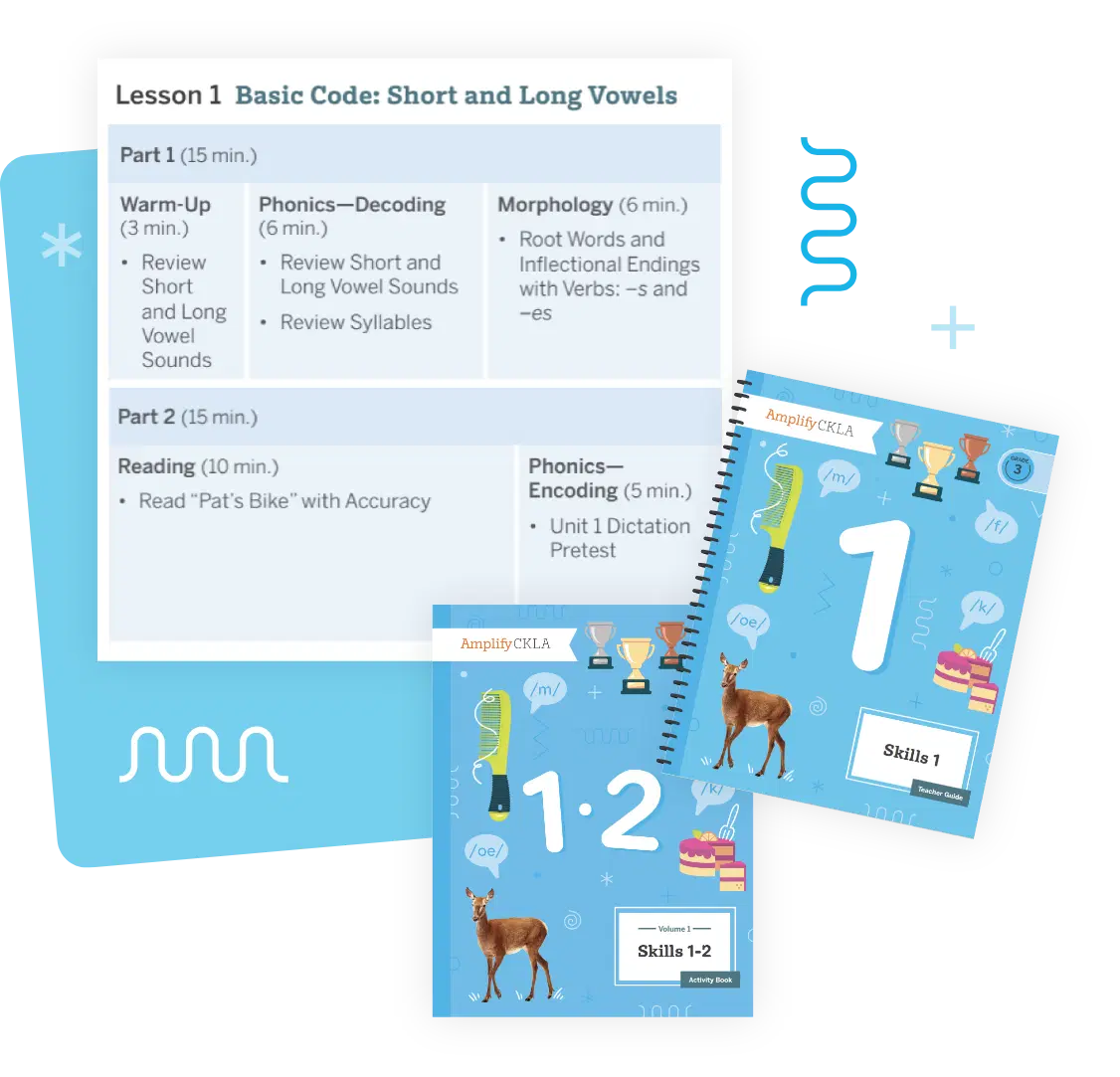
Explore more programs based on the Science of Reading.
Our literacy suite programs are designed to support and complement each other. Learn more about our related programs.

Inspiring future scientists: Amplify Science success stories
You have the next generation of scientists in your classroom—and we’re here to help! Science students across the country are using Amplify Science to think, read, write, investigate, and argue like scientists.
Why Amplify Science? Educators like you will activate curiosity by asking science students to solve real-world problems. Hear from educators across the country about the benefits of Amplify’s phenomena-based science curriculum.
You’re changing learning outcomes and helping to inspire the next generation of scientists today.
Learn More
District spotlights




The power of phenomena: Portland, Maine
Discover how students in Portland Public Schools use hands-on investigations to solve real-world problems.
A week in the life: Denver, Colorado
Learn how middle school educators in Denver Public Schools take on a week of lessons in Amplify Science.
Explore More
What educators say about Amplify Science

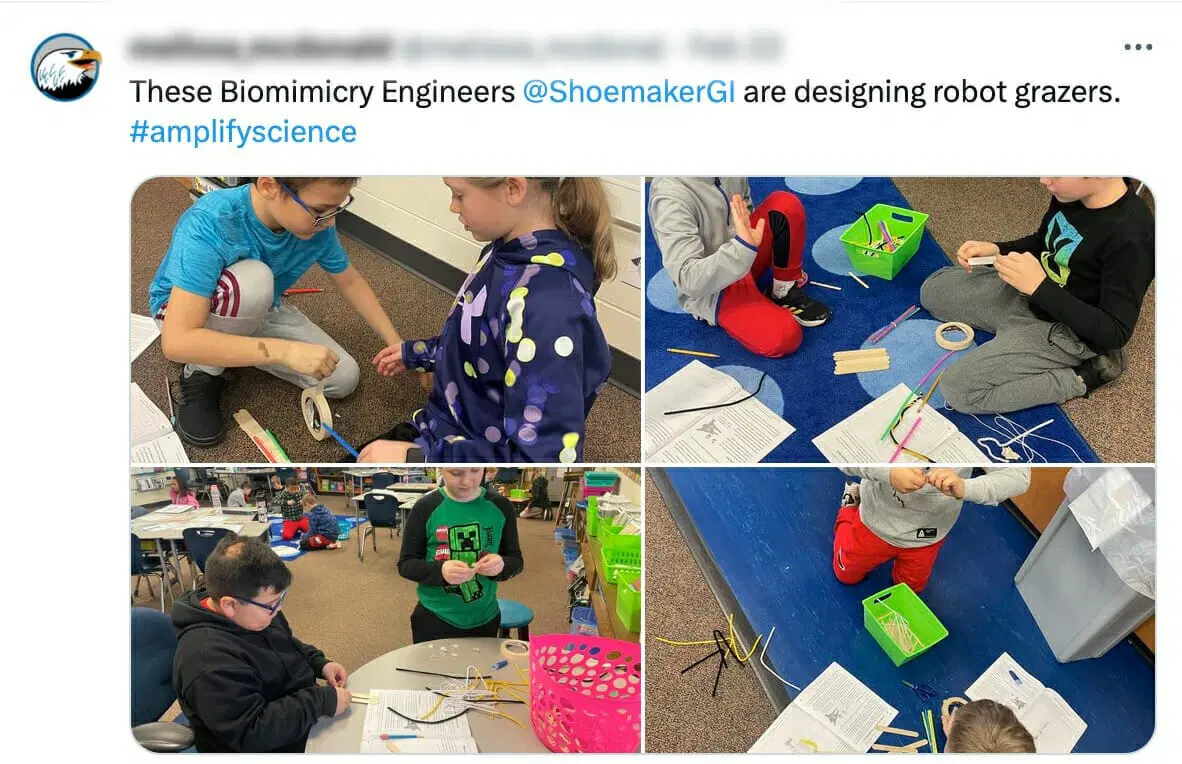


Program efficacy
Explore the research behind Amplify Science.


Unlock classroom success with Amplify webinars.
Watch one of our on-demand webinars to learn how educators like you can use Amplify Science in your classroom.
Welcome, Arkansas educators!
Amplify Science is a K–8 science curriculum that blends hands-on investigations, literacy-rich activities, and interactive digital tools to empower students to think, read, write, and argue like real scientists.
Amplify Science for grades K–8 has been rated all-green by EdReports. Read the review on EdReports.

Science of Reading Toolkit
Amplify Science is organized around units where students are introduced to compelling phenomena and real-world problems, develop and strengthen claims by collecting evidence and testing assumptions, and apply their learning in new contexts.

Program overview
Two ideas drove the development of Amplify CKLA: In order for students to actually understand what they’re learning, they need deep background knowledge and vocabulary to pull from, and decoding and encoding must be automatic and fluent.

Foundational skills instruction that makes a difference
The Core Knowledge Foundation is an independent, nonprofit, nonpartisan organization built around the Science of Reading and is designed “to advance excellence and equity in education for all children.”
- Explicit.
Learning isn’t left to chance. All 44 sounds and their 150 spellings in the English language are taught, practiced, and mastered, with ample opportunity to encounter each sound-spelling in diverse settings. - Sequential.
By moving in a sequence from easier to more complex in phonics and foundational reading skills, students master concepts before moving forward and gradually become more independent - Rewarding.
Learning to read should be fun. Decodabe chapter-books that feature dynamic plots and characters make kids want to read more. Engaging stories include children who discover fossils and a grandmother who flies hang gliders.
I would recommend Amplify Science to any district looking for a curriculum that is going to engage their students and their teachers in a compelling phenomena-based curriculum.
-Brooke Teller
STEM Director, Portland Public Schools
Try it with fidelity first to see what works best for your teaching style and student needs. Once you have a grasp of the curriculum, then you can better supplement or modify it for you and your students’ needs.
—Ashley Carter, Science Teacher, Indian River School District, Delaware
Make it fun! Your interest gets the students more involved than any fun activity you plan.
—Jadyn Kramp, 4th-Grade Teacher, Wayne County School District, Kentucky
If you have a chance to participate in curriculum development, it’s a wonderful way to dig deeper and get to know different features of each unit better.
—Kim Eich, Grade 6 Teacher, Anoka Hennepin ISD #11, Minnesota
Materials
Having a strong foundation of both foundational skills and background knowledge sets students up for a lifetime of reading and academic success. This philosophy drives the mission and the work of the Core Knowledge Foundation (CKF).
Teacher Materials
The Core Knowledge Foundation is an independent, nonprofit, nonpartisan organization built around the Science of Reading and is designed “to advance excellence and equity in education for all children.”
- Teacher Guides
- Projectable lesson components
- Quests for the Core for Grades 3–5 (immersive, problem-based learning)
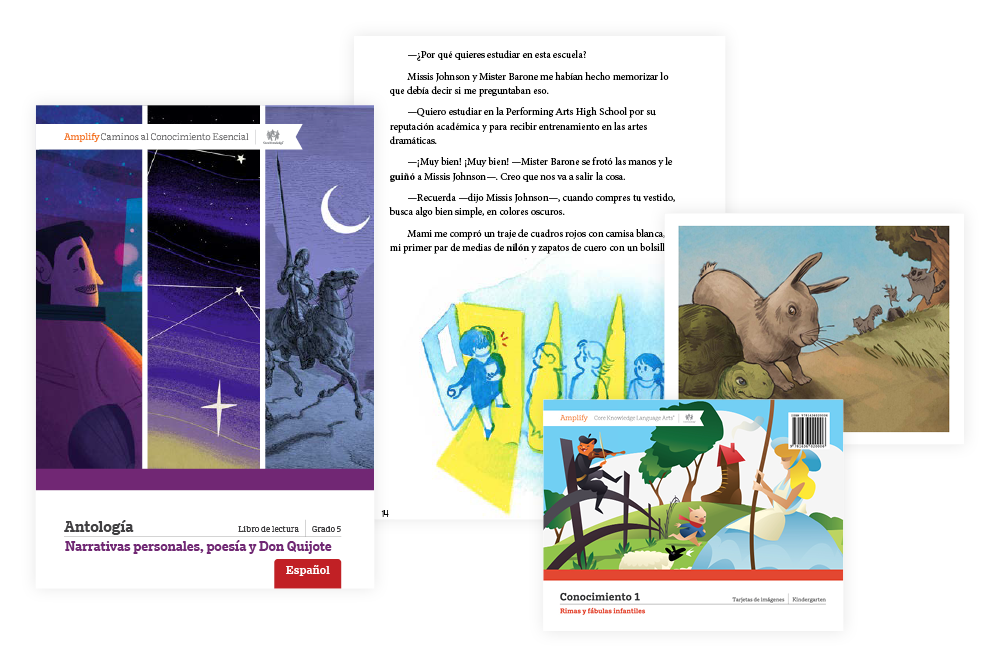
Student materials
Having a strong foundation of both foundational skills and background knowledge sets students up for a lifetime of reading and academic success.
- Student Readers
- Activity Books
- Formative Assessments
- Poet’s Journal and Writer’s Journal (write-in Readers for Grades 4–5)
Background knowledge drives results for Arkansas students
Having a strong foundation of both foundational skills and background knowledge sets students up for a lifetime of reading and academic success.
- Content-specific.
Clearly-outlined content objectives are specific and support the development of knowledge in history, science, literature, culture, and the arts. - Cumulative.
Topics and vocabulary connect within and across grades, allowing students to extend knowledge and revisit topics in increasing depth in later grades. - Coherent.
When curriculum is fragmentary and disconnected, students face repetitions as well as gaps that can hinder learning. An intentional design ensures the curriculum fits together as a whole.

The Core Knowledge Foundation & Amplify CKLA
Two ideas drove the development of Amplify CKLA: In order for students to actually understand what they’re learning, they need deep background knowledge and vocabulary to pull from, and decoding and encoding must be automatic and fluent.
What is the Core Knowledge Foundation?
Amplify CKLA is now in its second edition and maintains a foundation in the Science of Reading, while featuring new content and significant enhancements. Key updates from the 1st Edition to the 2nd Edition include:
- The development of the digital experience, a brand-new K–5 digital learning experience.
- Integrated grades 3–5 that better reflect students’ learning trajectories.
What are the distinguishing features of Amplify CKLA?
Additionally, Amplify provides professionally printed guides, readers, consumables, letter cards, flip books, posters, and hands-on phonics materials like Chaining Folders, making it easier for teachers to use the Amplify CKLA curriculum with their students.
- The foundational skills instruction in Amplify CKLA is explicit.
- The connection between oral and written language is supported.
Amplify CKLA, 2nd Edition
The Core Knowledge Foundation is an independent, nonprofit, nonpartisan organization built around the Science of Reading and is designed “to advance excellence and equity in education for all children.”
Grounded in research and proven effective
To do this, the CKF developed the Core Knowledge Sequence, which outlines the knowledge and skills that all children in the U.S. should learn, and is content-specific, cumulative, and coherent. Based on this mission and philosophy, Amplify partnered with the CKF to develop our CKLA curriculum. Amplify CKLA, now in its second edition, has continued to grow and improve to better meet the needs of the elementary classroom.
A powerful partnership
Two ideas drove the development of Amplify CKLA: In order for students to actually understand what they’re learning, they need deep background knowledge and vocabulary to pull from, and decoding and encoding must be automatic and fluent. To help students achieve this:
- The foundational skills instruction in Amplify CKLA is explicit.
- The connection between oral and written language is supported.
- Vocabulary is learned in context and through multiple exposures.
Evidence-based personalized instruction
Boost Reading is a student-led supplemental reading curriculum that gives you additional time to support other students and reinforces instruction across all instructional tiers with true skill development differentiation. It’s your digital assistant in literacy instruction—extending core instruction, addressing remediation needs, and constantly adapting activities to help every reader flourish.
When not to differentiate: A guide to small-group instruction, with Jamey Peavler



Transcripts and additional resources:
Meet Our Guest(s):

Jamey Peavler
Jamey Peavler is a co-director and full-time instructor in the Reading Science Graduate Program at Mount St. Joseph University. Before joining The Mount, Jamey served as director of training for the M.A. Rooney Foundation. In addition, she works for the National Council for Teacher Quality (NCTQ) as a higher-education textbook and teacher licensure reviewer. Jamey is a certified fellow-in-training with the Orton-Gillingham Academy and an International Dyslexia Association Structured Literacy dyslexia specialist, and currently serves on the board for the Reading League’s Indiana chapter. Her research interests include instructional design, the impact of spaced practice and interleaving to support effortful retrieval and retention of information, the role of oral language and syntactic awareness on comprehension and written expression, and foundational skills for supporting literacy in the early childhood setting.
Meet our host, Susan Lambert
Susan Lambert is the Chief Academic Officer of Elementary Humanities at Amplify, and the host of Science of Reading: The Podcast. Her career has been focused on creating high-quality learning environments using evidence-based practices. Susan is a mom of four, a grandma of four, a world traveler, and a collector of stories.
As the host of Science of Reading: The Podcast, Susan explores the increasing body of scientific research around how reading is best taught. As a former classroom teacher, administrator, and curriculum developer, Susan is dedicated to turning theory into best practices that educators can put right to use in the classroom, and to showcasing national models of reading instruction excellence.

Quotes
“We have this mindset of that small-group differentiated golden standard, but there's a certain amount of instruction, again, [that] all kids need and there isn't a lot of difference between those things.”
Featured Episodes

Embracing the complexity of learning to read (Part 1), with Reid Lyon

Transcripts and additional resources:
Meet Our Guest(s):

Reid Lyon
Dr. Reid Lyon is a neuroscientist and specialist in learning disorders. In 1980, he joined the faculty of Communication Sciences and Disorders at Northwestern, where he also directed the neuropsychology laboratory. He later joined the Stern Center for Language and Learning as the director of research, and the University of Vermont Medical School as a clinical associate professor of neurology. From 1992 to 2005, he served as a research neuropsychologist and chief of the Child Development and Behavior branch of the National Institute of Child Health and Human Development at the National Institutes of Health.
After leaving the NIH, Lyon held distinguished scientist and professorships at the University of Texas (neuroscience) and Southern Methodist University (educational leadership). Dr. Lyon is the author or co-author of over 130 peer-reviewed journal articles, books, and book chapters addressing developmental neuroscience, learning and reading disorders/dyslexia, and the translation of science into practice and policy. He also co-authored the definition of dyslexia used at the NIH and worldwide, and was a two-time recipient of the NIH Director’s Award.
Meet our host, Susan Lambert
Susan Lambert is the Chief Academic Officer of Elementary Humanities at Amplify, and the host of Science of Reading: The Podcast. Her career has been focused on creating high-quality learning environments using evidence-based practices. Susan is a mom of four, a grandma of four, a world traveler, and a collector of stories.
As the host of Science of Reading: The Podcast, Susan explores the increasing body of scientific research around how reading is best taught. As a former classroom teacher, administrator, and curriculum developer, Susan is dedicated to turning theory into best practices that educators can put right to use in the classroom, and to showcasing national models of reading instruction excellence.
Quotes
“Phonics—that is, looking at letters, letter patterns, learning how to bring sound to associate to those letters—is absolutely essential, non-negotiable. It has to be learned. But it in no way is sufficient to be able to comprehend, which is the goal of reading.”
“Reading is a complex behavior subserved by multiple systems in the brain that integrate and inform each other.”
Embracing the complexity of learning to read (Part 2), with Reid Lyon
Transcripts and additional resources:
Meet Our Guest(s):
Reid Lyon, Ph.D.
Reid Lyon is a neuroscientist and specialist in learning disorders. In 1980, he joined the faculty of Communication Sciences and Disorders at Northwestern University, where he also directed the neuropsychology laboratory. He later joined the Stern Center for Language and Learning as the director of research, and the University of Vermont Medical School as a clinical associate professor of neurology. From 1992 to 2005, he served as a research neuropsychologist and chief of the Child Development and Behavior branch of the National Institute of Child Health and Human Development at the National Institutes of Health.
After leaving the NIH, Lyon held distinguished scientist posts and professorships at the University of Texas (neuroscience) and Southern Methodist University (educational leadership). Lyon is the author or co-author of over 130 peer-reviewed journal articles, books, and book chapters addressing developmental neuroscience, learning and reading disorders/dyslexia, and the translation of science into practice and policy. He also co-authored the definition of dyslexia used at the NIH and worldwide, and was a two-time recipient of the NIH Director’s Award.
Meet our host, Susan Lambert
Susan Lambert is the Chief Academic Officer of Elementary Humanities at Amplify, and the host of Science of Reading: The Podcast. Her career has been focused on creating high-quality learning environments using evidence-based practices. Susan is a mom of four, a grandma of four, a world traveler, and a collector of stories.
As the host of Science of Reading: The Podcast, Susan explores the increasing body of scientific research around how reading is best taught. As a former classroom teacher, administrator, and curriculum developer, Susan is dedicated to turning theory into best practices that educators can put right to use in the classroom, and to showcasing national models of reading instruction excellence.
Quotes
“The Science of Reading is cumulative and we’re learning all kinds of new things.”
“A more realistic look at reading is in fact to understand the complexity, but not be intimidated by it.”
S9 E3: Know the non-negotiables in a program aligned to the Science of Reading, with Kari Kurto


Meet Our Guest(s):

Kari Kurto
Kari Kurto is the National Science of Reading Project Director at The Reading League. She directs all work related to The Reading League Compass, the Curriculum Evaluation Guidelines, and the Curriculum Navigation Reports. She also leads work to support multilingual and English learners and runs several communities of practice. Kari is a Path Forward advisory group member and has presented to schools, districts, professional organizations, and state education departments. She formerly worked as a literacy specialist at the Rhode Island Department of Education, leading statewide efforts to implement the Rhode Island Right to Read Act. Kari is an Orton Gillingham practitioner who worked at Middlebridge School in Narragansett, RI and Rawson Saunders School in Austin, TX. Before her career in education, Kari worked as a casting director in Los Angeles. She and her three wonderful children live in southern Rhode Island.
Meet our host, Susan Lambert
Susan Lambert is the Chief Academic Officer of Elementary Humanities at Amplify, and the host of Science of Reading: The Podcast. Throughout her career, she has focused on creating high-quality learning environments using evidence-based practices. Lambert is a mom of four, a grandma of four, a world traveler, and a collector of stories.
As the host of Science of Reading: The Podcast, Lambert explores the increasing body of scientific research around how reading is best taught. As a former classroom teacher, administrator, and curriculum developer, Lambert is dedicated to turning theory into best practices that educators can put right to use in the classroom, and to showcasing national models of reading instruction excellence.

Quotes
“[On dyslexia instruction] It's instruction that we know that all students should have, because that's the instruction that is most aligned to the scientific evidence. But it's instruction that they need with multiple practice opportunities and multiple repetitions.”
“Just because we have this report and we say, ‘All right, this curriculum has all the stuff,’ if you don't teach it, then you're a red flag of your own.”
“Thank you to those folks who have been listening. Thank you to the folks who are curious about learning more, those who have spent years implementing and tweaking and improving literacy outcomes for our country's next generation. I mean, that's huge.”
“It's a movement of improvement, right? We're constantly striving to improve. And don't give up. Share your stories; share your success stories.”
Science of Reading Essentials: The science of learning

Transcripts and additional resources:
Meet Our Guest(s):

Natalie Wexler
Natalie Wexler is the author of multiple books, including Beyond the Science of Reading: Connecting Literacy Instruction to the Science of Learning and The Knowledge Gap: The Hidden Cause of America’s Broken Education System—and How to Fix It; and is the co-author, together with Judith C. Hochman, Ed.D., of The Writing Revolution: A Guide to Advancing Thinking Through Writing in All Subjects and Grades. She has a free Substack newsletter called Minding the Gap, and she was the host of the Knowledge Comprehension podcast, Season 1. More information is available on her website, www.nataliewexler.com.

Nathaniel Swain, Ph.D.
Nathaniel Swain is a teacher, instructional coach, and writer. He produces a blog for teachers called Dr. Swain’s Cognitorium and is cohost of the Chalk Dust podcast with Rebecca Birch. Nathaniel works directly with schools and systems through an online learning platform called Luminary.
He founded a community of educators committed to the science of learning, called Think Forward Educators. He also has a best-selling book, Harnessing the Science of Learning: Success Stories to Help Kickstart Your School Improvement.

Hugh Catts, Ph.D.
Hugh Catts’ research interests include the early identification and prevention of reading and disabilities. He is a former board member of the International Dyslexia Association and former president of the Society for the Scientific Study of Reading. He has received the Samuel T. Orton Award, the International Dyslexia Association’s highest honor, and the Honors of the Association award from the American Speech-Language-Hearing Association, for his career contributions in these disciplines. His current research concerns the early identification of reading and language difficulties and the nature and assessment of reading comprehension problems.

Daniel Willingham, Ph.D.
Daniel Willingham is a professor of psychology at the University of Virginia, where he has taught since 1992. Until about 2000, his research focused solely on the brain basis of learning and memory. Today, all of his research concerns the application of cognitive psychology to K–12 education. He is the author of several books, including the best-selling Why Don’t Students Like School? and Outsmart Your Brain. His writing on education has appeared in 23 languages. In 2017, he was appointed by President Barack Obama to the National Board for Education Sciences.

Peter C. Brown
Peter C. Brown is a bestselling writer and novelist, retired from a career as a management consultant. He is the lead author of Make It Stick: The Science of Successful Learning. Make It Stick has been translated into 17 foreign languages and received international acclaim for changing the way we understand learning.
Jamey Peavler, Ed.D.
Jamey Peavler is a co-director of and full-time instructor in the Graduate Reading Science program at Mount St. Joseph University. Before joining Mount St. Joseph, Jamey served as director of training for the M.A. Rooney Foundation. In addition, she works for the National Council for Teacher Quality (NCTQ) as a higher-education textbook and teacher licensure reviewer. Her research interests include instructional design, the impact of spaced practice and interleaving to support effortful retrieval and retention of information, the role of oral language and syntactic awareness on comprehension and written expression, and foundational skills for supporting literacy in the early childhood setting.


David Rapp, Ph.D.
David Rapp is the Walter Dill Scott Professor of Education, Social Policy, and Psychology at Northwestern University. His research examines language and memory, focusing on the cognitive mechanisms responsible for successful learning and knowledge failures. This has included investigations into the influence of inaccurate information on comprehension, the evaluation of technologies that support formal and informal learning, and the iterative development of tools and curricula intended to support literacy. Rapps’ projects have been funded by the National Science Foundation, the U.S. Department of Education, the National Institute on Aging, and Meta.
Meet our host, Susan Lambert, Ed.D.
Susan Lambert is chief academic officer of literacy at Amplify and host of Science of Reading: The Podcast. Throughout her career, she has focused on creating high-quality learning environments using evidence-based practices. Lambert is a mom of four, a grandma of four, a world traveler, and a collector of stories.
As the host of Science of Reading: The Podcast, Lambert explores the increasing body of scientific research around how reading is best taught. A former classroom teacher, administrator, and curriculum developer, she’s dedicated to turning theory into best practices that educators can put right to use in the classroom, and to showcasing national models of reading instruction excellence.
Quotes
“To build a meaningful memory of something that you can hold on to and use, you have to think about it.”
“Memory is a cognitive process. It's the way the brain encodes, stores, and retrieves information.”
“You can't learn something new if it doesn't connect to something you already know.”
“The catch about writing is it's hugely important. It can help cement knowledge and long-term memory, deep knowledge, et cetera.”
“When we have knowledge in our long-term memory, all of these limitations suddenly disappear.”
“We can only work with a limited set of information and when there's too much happening in our working memory, we experience cognitive overload. Essentially, our system is overloaded and we shut down.”
“Essentially, memory is what enables us to retain knowledge, skills, and experiences, forming the foundation for all learning and cognition.”
“The resonance model of comprehension suggests when someone asks a question, lots of ideas get activated automatically in memory.”
“Your mind is very good at bringing up from memory the necessary facts, the facts that will help you given the context.”
“A lot of our students that are having difficulty are experiencing cognitive overload. So the first thing we need to think about is how are we gonna minimize that for them?”
Putting teacher voices at the center of math adoption, starring Matt Cash

Meet Our Guest(s):

Matt Cash
Matt Cash is the director of elementary curriculum and instruction for Lake Elsinore Unified School District, where he supports schools in designing engaging, high-quality learning experiences for all students. A former classroom teacher, staff developer, principal, and assistant director of math, he brings a deep understanding of instruction, assessment, and leadership to his work with educators. He has spoken at multiple conferences about mathematics, leadership, and curriculum, and he’s passionate about helping educators create systems that get results.
Meet our host, Ana Torres.
Ana has been an educator for 30 years, working in both the K–8 and higher education sectors. She served as an administrator and instructor at various public and private colleges and universities and as a bilingual and dual language teacher, dual language math and reading interventionist, dual language instructional coach, assistant principal, and principal in K–8 schools. Ana is currently the Senior Biliteracy and Multilingual Product Specialist at Amplify, and delivers literacy and biliteracy presentations across the nation. Ana’s passion and advocacy for biliteracy and support for all students from all walks of life has led her to educate leaders, teachers, and parents about the positive impact of bilingualism and biliteracy in our world.


Meet our Classroom Insider, Eric Cross.
Eric Cross is a middle school science teacher who hopes to someday be a lifelong educator, like the guests on Beyond My Years! In each episode, Eric connects with host Ana Torres to discuss her guests’ best insights, gleaned from their long and rewarding careers in the classroom. Then, Eric talks about bringing some of their wisdom into his current classroom and busy life.
Transcripts and additional resources:
Quotes
“When you're removing variability out of your system, quality is going up.”
“Professionals are obsessed with the idea of getting better.”
“Advocate for your kids.”
“Mathematics is something that was discovered. It's universal. It's true.”
“Give yourself grace in year one, but stay engaged and keep asking for support.”
“Instead of quietly struggling and going back to old materials, put that energy into requests and make your voice heard.”
“Sometimes the buy-in comes when we understand things better.”